Can You Wear Jade All the Time? Shower, Sleep, Swim
Updated
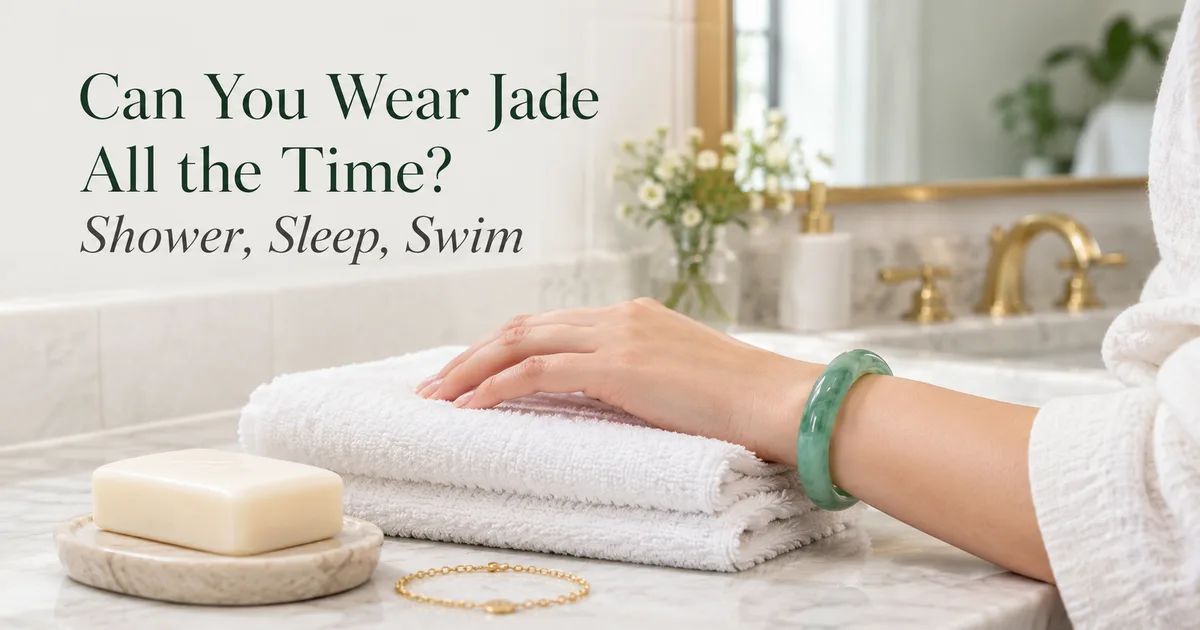
Yes: natural Type A jadeite can be worn every day, including in the shower and in bed, because water, sweat, soap and body heat do not harm it. Take it off for the gym, cooking, washing up, cleaning chemicals, hot springs and saunas: knocks, sudden heat and chemicals are what damage it. Gold does not scratch jadeite; diamonds do. Treated (Type B/C) jade is far less tolerant of heat and chemicals.
Can you wear jadeite all the time?
Yes: natural, untreated (Type A) jadeite can be worn every day, including in the shower and to bed, because water, sweat, soap and body heat do not harm it; what damages it is hard knocks, harder stones rubbing against it, sudden heat and harsh chemicals, and treated (Type B and C) jadeite is much less tolerant.
Plenty of people in China, Vietnam and Thailand put a bangle on and leave it on for years. That is not reckless. Jadeite is one of the toughest gems; it is so dense that water and skin oils do not soak in; and its color does not fade with light or sweat. See is jadeite fragile? for the hardness and toughness behind this.
But "can be worn all the time" does not mean "nothing can happen to it". In the trade, almost every broken-bangle story starts with an ordinary moment: the edge of a sink while washing up, a car door, a dumbbell, a slip in the bathroom. The useful question is less "is jade waterproof?" and more "what will my arm hit today?"
Three things decide how freely you can wear a piece:
- What it is. Natural Type A jadeite, or stone that has been resin-filled or dyed.
- What form it is in. A solid round bangle is not a thin carved pendant on a silk cord, and a loose stone is not one set in gold with soldered joints.
- What you do all day. An office worker, a cook and a gym regular need different habits.
Why does Type A versus Type B matter so much?
Everything reassuring above is about natural Type A jadeite. Type B has been bleached with acid and filled with polymer resin; Type C has been dyed. The resin and the dye are the weak points. They are softer than jadeite and react to heat, solvents and chemicals that the stone itself shrugs off. See Type A vs Type B vs Type C jadeite.
| Exposure | Type A (natural) | Type B / B+C (resin-filled, dyed) |
|---|---|---|
| Water, sweat, mild soap | No harm | Usually fine in the short term |
| Hot water, sauna, hot springs | Shower temperature is fine; sudden heat stresses existing cracks | Heat speeds up resin ageing: yellowing, loss of shine, fine crackle |
| Perfume, alcohol, nail polish remover | Leaves a film that wipes off | Solvents can attack resin and dye |
| Bleach, acid descaler, oven cleaner | Can dull the polish and wax finish; harms metal settings | Can damage resin and dye |
| Strong sunlight | Color is stable | Dye can fade; resin can yellow |
| Ultrasonic or steam cleaner | Risky if the piece has cracks or a setting | Avoid |
If you do not know which you have, wear it as if it were treated until a certificate tells you otherwise. An unusually cheap, bright, perfectly even green bangle bought without a certificate belongs in that group.
A detail few buyers hear: finished Type A pieces are usually given a thin coat of wax after polishing (the trade calls it 过蜡, "waxing") to fill microscopic pits and add shine. Hot water, soap and daily rubbing slowly take this wax off. That is harmless. The piece may look a touch less glossy for a while, and then the film from your skin gives it back a soft sheen. It is not damage, and it is not the stone changing.
Which everyday activities are safe with jadeite on?
The table assumes a Type A bangle or pendant. "Take off" means the risk is real and avoiding it is easy.
| Activity | OK? | Why | Tip |
|---|---|---|---|
| Showering | Yes, with care | Water and soap do not harm the stone; the danger is a slip or a knock on tile | Rinse soap off; take a loose bangle off first |
| Washing hands with soap | Yes | Soap leaves a dull film, especially in carvings | Rinse well; wash the piece properly every few weeks |
| Sleeping | Usually yes | The stone is not affected; a bangle can knock a bed frame or wall | Take it off if you sleep restlessly; no necklaces on sleeping children |
| Swimming pool | Better off | Chlorine does not hurt Type A but can attack gold alloys and solder; pool edges are tile and concrete | Leave set pieces at home; rinse in fresh water after |
| Sea | Better off | Salt is harmless; sand scratches; a loose bangle can slip off in cold water | Rinse after; never wear a loose bangle in waves |
| Hot springs, sauna | Take off | Heat and sudden temperature changes stress cracks; sulphur water tarnishes metal; treated resin ages faster | Leave it wrapped in your bag |
| Gym, lifting, ball sports | Take off | Bars, plates and machines are steel; one squeeze can crack a bangle | Take it off before you start |
| Cooking | Take off near heat | Oven doors, pans and stove tops are hot and hard; grease films the surface | Off for frying and baking |
| Washing dishes | Take off | The sink edge is a classic place for bangles to crack | If it stays on, pad the sink with a towel |
| Cleaning with bleach or chemicals | Take off | Chemicals dull polish and wax and damage settings and treated stone; plus knocks | Gloves stop chemicals, not knocks |
| Perfume, lotion, sunscreen, hairspray | Yes, jade last | Leaves a film; solvents matter for treated jade | Let products dry, then put jewelry on |
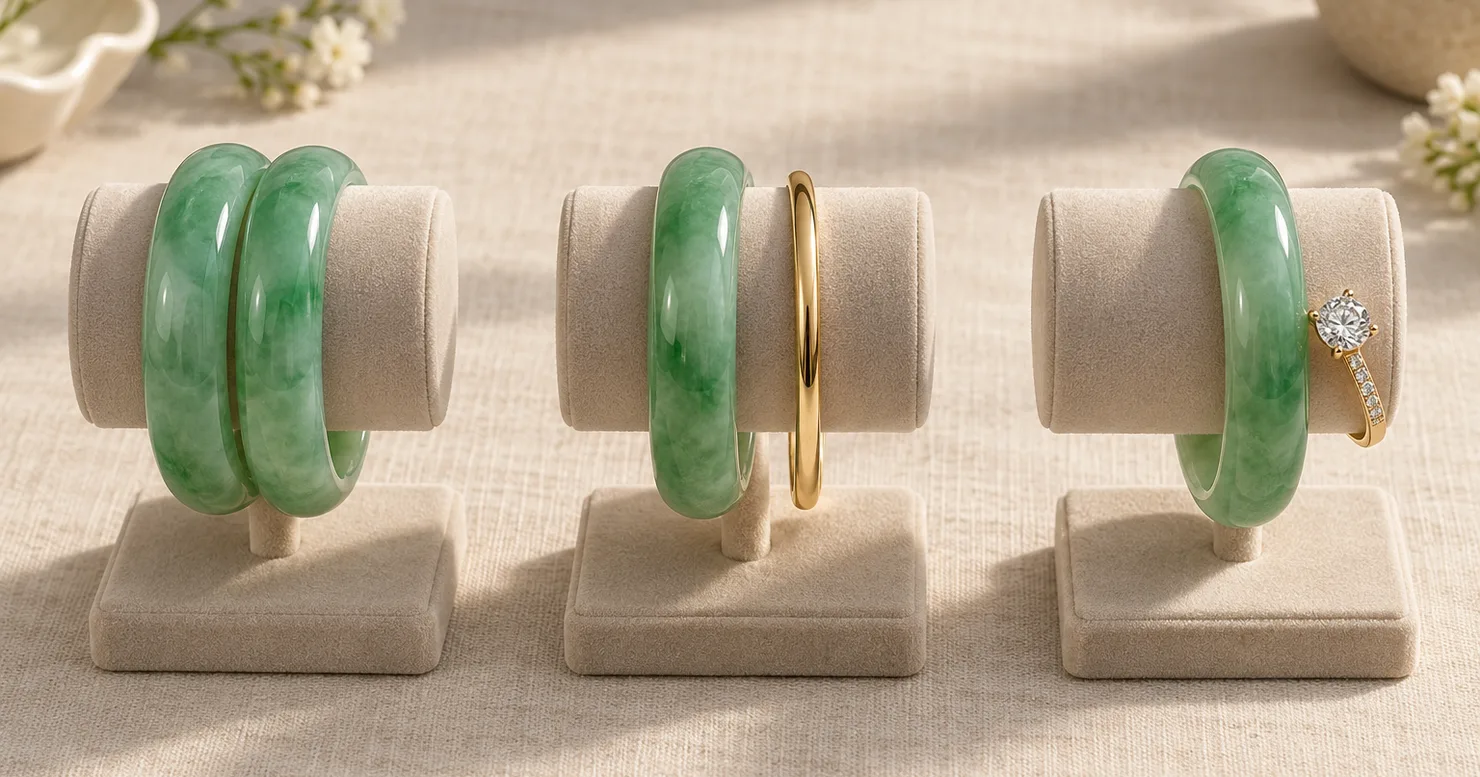
| Two jade bangles together | Not ideal | Jade against jade knocks and chips at the rims | One per wrist, or pair with thin metal |
| Next to gold | Yes | Gold is softer than jadeite and does not scratch it | Grey or gold marks are metal; they wipe off |
| Next to diamond or sapphire rings | Careful | Both are harder than jadeite and scratch it | Wear rings on the other hand |
| Airport security | Yes | X-ray scanners do not affect jadeite | Put it in a pouch if asked to remove it |
| Gardening, moving furniture, heavy bags | Take off | Knocks, grit and pressure | Keep a pouch in your bag |
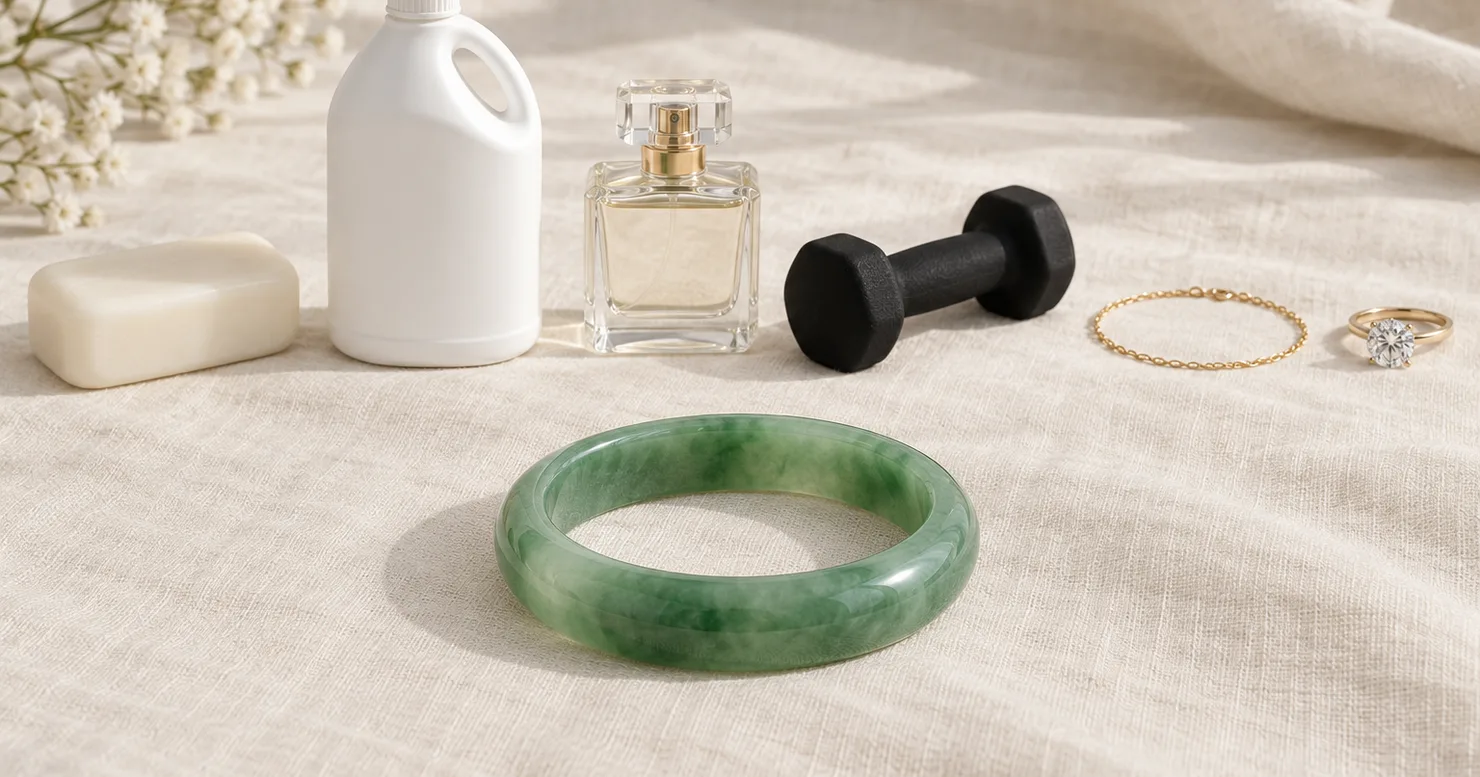
Can you shower and wash your hands with jade on?
Yes. Water does not soak into jadeite and mild soap does not affect it. People who wear a bangle for years usually keep it on in the shower. What actually happens in the bathroom is this:
- Soap film. Soap and shampoo leave a thin film that makes the surface look dull or greasy, especially in carved pendants. It is not damage. Rinse the piece when you rinse yourself, and wash it properly now and then with lukewarm water and a drop of dish soap; see how to care for jadeite.
- Slippery hands. Soap is exactly what people use to slide a bangle off. A bangle that is a little loose can slip over a soapy hand and land on tile. If yours passes over the knuckles easily, take it off before you shower.
- Hard surfaces. Tiles, the basin edge, taps and glass shelves. Most bathroom breaks are knocks, not water.
- Hot water. Normal shower temperature is fine. Pouring boiling water over jade to "sterilise" it is not.
Pendants on a silk or nylon cord are a separate case. A wet cord weakens and stretches faster, so take the pendant off or replace the cord more often. Gold chains do not mind water; silver tarnishes faster in a humid bathroom.
Can you sleep with a jade bangle on?
For most adults, yes. Sleeping does not harm the stone, and many people who never take their bangle off sleep in it every night. Take it off if:
- you sleep restlessly, against a wall, or next to a hard wooden or metal bed frame; knocks in your sleep are hard and you do not control them;
- your hand swells around a snug bangle by morning; if it already will not come off, read stuck jade bangle before you force it;
- you are pregnant, because hands often swell in the later months and a snug bangle can become impossible to remove.
Necklaces are different. A cord or chain can tangle during sleep. Babies and young children should never sleep wearing a necklace or bracelet; see jade for babies.
Can you swim, go in the sea or use a sauna with jade on?
The stone survives pool water and sea water. The problems are around it.
Pools. Chlorine at pool strength does not affect Type A jadeite. Over time it can attack gold alloys and soldered joints, which matters for set pendants and rings. Pool edges and floors are concrete and tile. Leave set pieces at home and rinse anything you wore in fresh water.
The sea. Salt water does not hurt jadeite. Sand does: it is mostly quartz, about as hard as jadeite, so it scratches the polish when it gets between the bangle and your skin. Cold water also shrinks the hand a little, and a loose bangle can slip off in a wave.
Hot springs and saunas. Take it off. Moving from cool air into very hot water, then into a cold plunge, is exactly the kind of sudden temperature change that stresses a stone along existing cracks. Mineral and sulphur water tarnishes silver and some gold alloys. And heat is the main thing that makes the resin in treated jadeite age.
Should you take jade off for the gym, cooking and housework?
Yes. These three cause a large share of broken bangles, and the cause is always the same: a hard object meeting the stone with force.
- Gym and sport. A barbell, a kettlebell handle or a machine grip can squeeze a bangle against steel. Ball sports and yoga add falls and floor contact.
- Cooking. Oven doors, pan handles and stove tops are hard and hot. Frying spatters grease that films the surface. A bangle held over a gas flame gets a sudden blast of heat.
- Washing up and cleaning. The steel or ceramic sink edge is where countless bangles crack. Bleach, oven cleaner, acid descalers and toilet cleaners can dull the polish and wax and damage metal settings and treated stone. Rubber gloves keep chemicals off but do nothing against a knock.
Keep one soft pouch in the same place every time, so taking the bangle off is a habit and not a hunt for a safe spot. Many bangles are dropped in the moment between taking them off and finding somewhere to put them.
Can you wear two jade bangles together, or with gold and diamonds?
Two jade bangles on one wrist. They are the same hardness, so they scratch each other only a little. The problem is knocking: every movement strikes two stone rings together, and over months that can chip the rims. Some people love the soft clink; dealers usually advise one per wrist. If you wear two, choose rounded profiles and check the outer rims for chips now and then. Which wrist each goes on is a separate question of habit and tradition.
With gold. Gold, silver and platinum are softer than jadeite and do not scratch it. Grey or golden lines on the jade after wearing it next to metal are metal rubbed onto the stone, and they wipe off. A thin gold bangle beside a jade one is the most common and safest pairing. A heavy gold bangle can still knock the jade; a hollow gold bangle will dent before the jade chips.
With diamonds and colored gems. Diamond (10 on the Mohs scale), sapphire and ruby (9), and lab-made stones such as moissanite and cubic zirconia are all harder than jadeite (about 6.5–7). A diamond ring on the same hand as a jade bangle will scratch the bangle wherever they touch. Wear rings on the other hand, or accept that the bangle will need repolishing one day. The same goes for watches with a sapphire crystal or a ceramic case.
Can you wear jade through airport security?
Yes. X-ray machines and walk-through metal detectors do not affect jadeite, and a plain jade bangle contains no metal. A gold-set piece or a pendant on a metal chain may set off a detector, and a body scanner may flag a bangle for a closer look. Rules differ between airports. If you are asked to remove it, put it in a pouch inside the tray, never loose. For a valuable piece, keep the certificate or a copy with you in case anyone asks what it is.
On long flights, hands often swell. A snug bangle that comes off easily at home may not come off at the other end. That is not dangerous by itself, but it is not the moment to force it.
Can sudden temperature changes crack jade?
They can, especially along cracks that are already there. Ordinary changes are fine: walking from an air-conditioned room into tropical heat, or holding an iced drink, does not crack jade. The risks are big, fast changes:
- boiling water poured over a piece, or a piece dropped into it;
- a bangle held close to a flame or put down on a hot stove;
- a hot spring or sauna followed by a cold plunge;
- a jeweler's torch near the stone while a setting is soldered.
Stress gathers at a crack that already exists. That is why a bangle with a visible crack should stay away from heat altogether.
Is it true you should never take jade off?
Many families say so. Older Chinese, Vietnamese and Thai-Chinese wearers often say a bangle, once it is on, should stay on, and that jade gets better the longer it is worn.
| Language | Saying | What people mean |
|---|---|---|
| Chinese | 人养玉,玉养人, "people nourish jade, jade nourishes people" | Worn jade stays "alive" and keeps its owner company |
| Vietnamese | người nuôi ngọc, ngọc nuôi người; ngọc "lên nước" | Worn jade develops a richer luster |
| Thai | คนเลี้ยงหยก หยกเลี้ยงคน; "raising" jade (เลี้ยงหยก) | Jade worn every day grows more beautiful |
These are traditions, and they are part of the pleasure of owning jade. The honest explanation of what owners see is simpler. A worn piece looks glossier because skin oils leave a thin film that smooths the surface, years of rubbing act like a very slow polish, and a piece worn every day is always clean. None of this changes the inside of the stone: Type A jadeite does not become greener, finer or more translucent with wear. See does jade change color?.
So from the stone's point of view there is no reason not to take it off. Taking it off for the gym, the sink or a hot spring costs the jade nothing; keeping it on through those moments is how most bangles break. Some owners never take a bangle off simply because it is tight and hard to remove. That is a size problem, not a tradition.
Be wary when a seller turns the saying into a sales pitch: "wear it and it will turn greener", "this one has been nourished, that's why it glows". Judge the stone as it is today, in daylight and under a flashlight.
A simple routine for jade you wear every day
- Know what you have. The certificate should say natural jadeite with no treatment. Without one, treat the piece as fragile.
- Learn your take-off list: gym and sport, cooking with heat, washing up, cleaning chemicals, hot springs and saunas, gardening, moving furniture.
- Put jewelry on last, after perfume, lotion and hairspray have dried.
- Rinse after the sea, the pool or a soapy shower, and dry with a soft cloth.
- Wash it properly every few weeks: lukewarm water, a drop of mild soap, a soft brush for carvings.
- Check it with a flashlight once a month. Shine the light into the band from the side and follow it all the way round. Light carries on across a natural stone line but stops at a crack. A new line, or a chip on the outer rim, means it is time to be more careful or to have it looked at.
- Check cords and settings. A frayed cord or a loose prong drops more pendants than any knock.
On JadeiteHub, every piece is listed with real photos from the seller, some with video, and every sold piece is checked against its certificate before it ships, so you know you are wearing natural jadeite before it goes on your wrist. If it does not match the description, you get a full refund.
FAQ
Can I shower with my jade bangle on?
Yes, if it is natural Type A jadeite. Water and soap do not harm it. Rinse off soap film, and take the bangle off if it is loose enough to slip over a soapy hand onto tile.
Is it OK to sleep with a jade bangle?
For most adults, yes. The stone is not affected. Take it off if you sleep restlessly next to a hard bed frame or wall, or if your hand swells around it. Children should not sleep wearing jewelry.
Does chlorine or sea water damage jade?
Not Type A jadeite itself. Chlorine can attack gold settings and solder over time, sand scratches the polish, and a loose bangle can slip off in water. Rinse in fresh water after swimming.
Will a gold bracelet or a diamond ring scratch my jade bangle?
Gold will not: it is softer than jadeite, and grey or gold marks are metal that wipes off. Diamonds, sapphires, rubies, moissanite and cubic zirconia are harder and do scratch jadeite, so wear rings on the other hand.
Does wearing jade every day make it greener?
No. Daily wear gives a soft surface sheen from skin oils and gentle polishing, but the color, texture and translucency inside Type A jadeite stay the same.