Is Jade Fragile? Jadeite Hardness vs Toughness Explained
Updated
No, jadeite is not fragile. Its hardness is about 6.5–7 on the Mohs scale and it is very tough, because its crystals interlock in every direction. But a sharp knock on tile, stone or metal can still crack or break a bangle. Dust and harder gems scratch it; hard impacts, existing cracks, sudden heat, ultrasonic cleaners and Type B treatment are what break it.
What is jadeite's hardness, and does jade break easily?
Jadeite's hardness is about 6.5–7 on the Mohs scale, close to quartz and harder than glass, and it is one of the toughest gems because its crystals interlock in every direction; it does not break easily, but a sharp knock on a hard surface can still crack or break a bangle.
The reason is structure. A jadeite bangle is not one crystal but a rock made of countless small jadeite crystals, grainy or fibrous, packed and interlocked like the fibres of felt. Each single crystal can split along flat planes (this is what makes the tiny flashes dealers call 翠性, "fly-wing" flashes). But because the crystals point in every direction, a crack that starts in one of them has to change direction at every grain boundary. That uses up energy, so cracks stop instead of running through.
That is why jade was used for tools long before it was jewellery, and why a well-made bangle can be worn every day for decades. It is also why "fragile" is the wrong word. The honest answer is: jadeite is tough, not unbreakable.
Hardness, toughness and stability: what is the difference?
Gemmologists judge how a stone wears with three separate ideas. People mix them up, and that causes most of the myths.
- Hardness is resistance to scratching. It is measured on the Mohs scale, where each mineral scratches the ones below it. The scale is a ranking, not a ruler: diamond (10) is far more than one step harder than sapphire (9).
- Toughness is resistance to breaking and chipping. It depends on structure, not hardness. A hard stone can be brittle.
- Stability is resistance to heat, light, chemicals and humidity.
| Material | Mohs hardness | Toughness | What it means in daily wear |
|---|---|---|---|
| Jadeite | 6.5–7 | Excellent | Resists scratches from most things; survives small knocks; can crack from a hard impact |
| Nephrite | 6–6.5 | Exceptional, the toughest common gem | Scratches a little more easily than jadeite but is even harder to break |
| Quartz (incl. agate, quartzite) | 7 | Good | As hard as jadeite, so it scratches jadeite's polish; chips more easily |
| Glass | about 5–6 | Poor | Scratched by dust and jadeite; chips and breaks in shell-shaped flakes |
| Sapphire and ruby | 9 | Excellent | Scratch jadeite easily if they rub against it |
| Diamond | 10 | Good | Scratches everything, but a hard blow along its cleavage can split it |
The toughness words are the descriptive grades used in gem references, not lab numbers. Two lessons follow. A diamond ring next to a jade bangle will scratch the bangle, even though the diamond itself can chip. And nephrite, which is softer than jadeite, is tougher, because its fibres are even finer and more tangled. See jadeite vs nephrite.
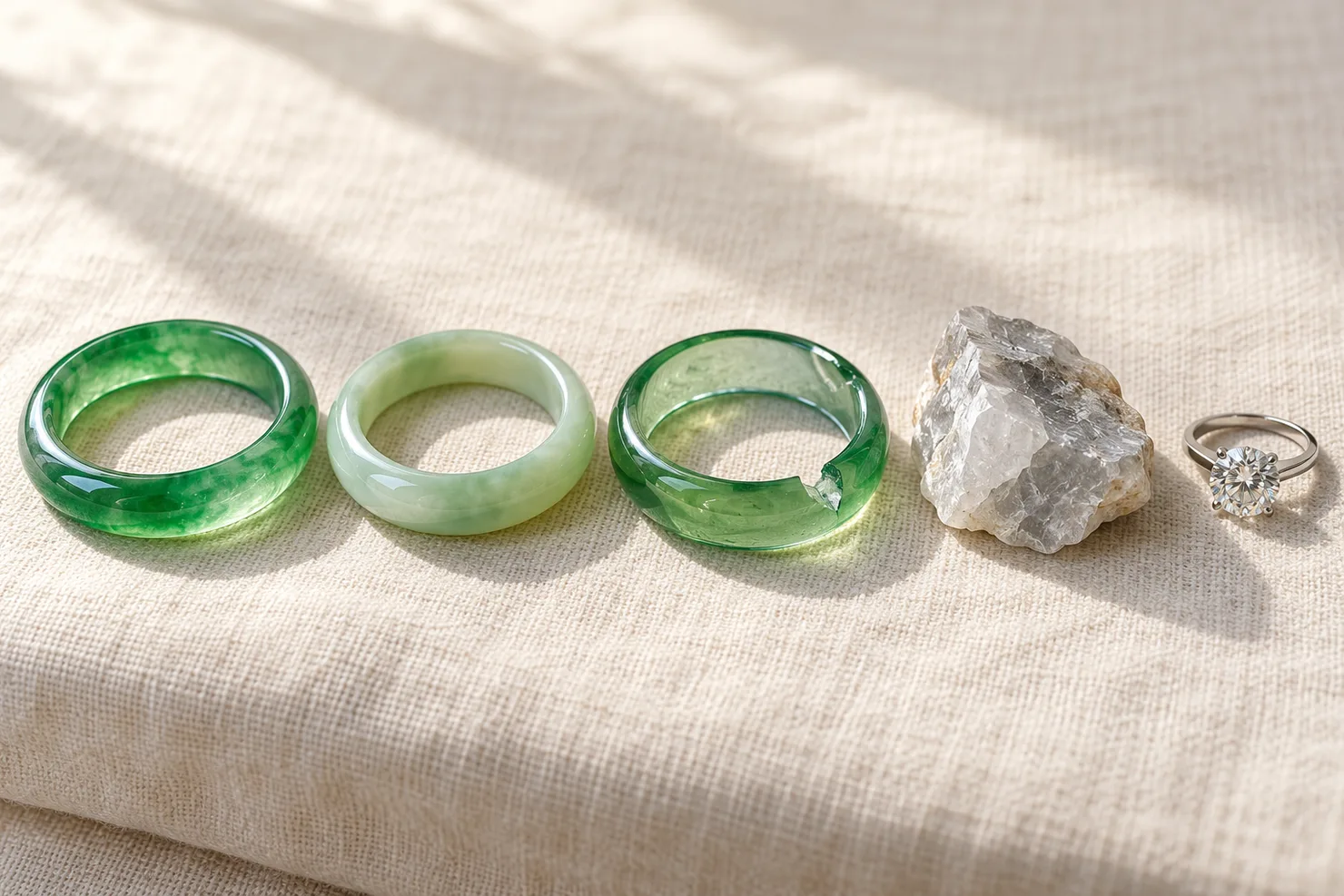
As for stability, natural jadeite is very stable: light, water, sweat and normal wear do not harm it, and its color does not fade. Its weak points are sudden heat and, for treated stones, chemicals.
What scratches jadeite?
Anything harder than about 7, or as hard as it, can scratch jadeite. In daily life that is mostly dust.
| Contact | Harder than jadeite? | What happens |
|---|---|---|
| Household dust and sand | Contains quartz (about 7) | Fine scratches; over years the polish slowly dulls |
| Granite, quartz-stone counters, concrete | Contain quartz | Scratches on contact; chips if the piece is knocked against them |
| Diamond, sapphire, ruby, moissanite, cubic zirconia rings | Yes | Clear scratches when a ring rubs against a bangle or pendant |
| Ceramic watch cases and bezels | Often yes | Scratches where a bangle and a watch touch |
| Gold, silver, platinum, stainless steel | No, softer | The metal itself does not scratch jadeite; grey lines are usually metal rubbed onto the jade, which wipe off; grit trapped between them can still scratch |
| Another jadeite bangle | Same hardness | Little scratching, but bangles worn together knock and can chip each other |
The outer edge of a bangle shows fine scratches first. It is the high point of the curve, so it is what touches desks, laptop edges, table tops and car doors every time you rest your arm. The inner side, against the skin, usually stays bright. A bangle worn daily for years may look slightly frosted along the outer rim under a lamp.
Wiping a dusty bangle with a dry cloth is like rubbing it with very fine sandpaper. Rinse or use a damp soft cloth instead.
Scratches can be removed. A jade polisher can repolish (抛光) the surface and bring back the shine. It removes a very thin layer, so it is fine now and then, not every month. Tell the polisher if the piece is set in metal, and whether it has a certificate stating any treatment.
What actually breaks jadeite?
Toughness has limits. These are the things that break jadeite in real life, roughly in order of how often they happen.
| Cause | Why it is dangerous | How to avoid it |
|---|---|---|
| A sharp knock on tile, stone or metal | All the force lands on one small point: doorframes, sink edges, stone counters, car doors, railings | Take bangles off for housework and sport; be careful near hard edges |
| Dropping it on a hard floor | Tile and stone floors are the classic breaker; carpet and wood often forgive | Put on and take off over a bed or a towel |
| An existing crack (裂) | The crack is already open; a small knock can make it run through | Check for cracks before buying; see cracks and cotton in jadeite |
| Thin sections | Thin or narrow bangle bands, openwork carvings, thin leaf tips and edges have little material to absorb a blow | Choose a solid band for daily wear; save delicate carvings for occasions |
| Sudden temperature change | Uneven expansion stresses the stone, most of all along cracks: boiling water, a hot spring after cold air, a stove | Avoid boiling water, saunas and hot springs; never "sterilise" jade in hot water |
| A jeweller's torch | Soldering a setting or a gold cap near the stone can crack it, and burns the resin in treated jade | Ask the jeweller to remove the jade first or keep it away from the flame; see gold-set jadeite |
| Ultrasonic and steam cleaners | Vibration and heat can widen existing fractures and loosen settings | Clean with lukewarm water and mild soap only |
| Forcing a bangle that is too small | Hands are wet and squeezed, the bangle slips and hits the basin | Choose the right size; see how to choose a jadeite bangle size |
Why is Type B jadeite weaker?
Type B jadeite has been soaked in acid to bleach out stains, then filled with resin. The acid dissolves material between the crystals, which is exactly what makes jadeite tough. The resin fills the gaps and hides them, but it is softer than jadeite and ages: over the years it can yellow, and the surface can develop fine crazing, a net of tiny cracks. Treated stones are also more sensitive to heat and household chemicals. So a Type B bangle is not only worth less; it is structurally weaker. See how to spot treated jadeite and Type A vs Type B vs Type C jadeite.
What do dealers know about which jade holds up?
People who handle jadeite every day look at a few things before they worry about breakage.
Stone lines (石纹) versus cracks (裂). A stone line is an old break that healed while the rock formed: new mineral grew into it and sealed it. A crack is open. That is why a bangle with a faint stone line is usually worn for decades without trouble, while a bangle with a crack is treated as damaged. Under a flashlight, light carries on across a stone line but stops at a crack. Dealers still handle a strong stone line that runs right across a thin band with care, and the trade does not fully agree how much such a line matters.
Texture, from fine to coarse. Grain size changes how a piece wears.
| Texture | Grain | How it tends to wear | How it polishes |
|---|---|---|---|
| Glassy and icy (玻璃种, 冰种) | Very fine, tightly packed | Tough and dense; keeps its polish well | Very high, glassy shine; the glow dealers call 起胶, "gel-like" |
| Glutinous (糯种) | Fine, soft-looking | Wears well | Smooth, soft shine |
| Bean (豆种) | Coarse, grains visible | Generally fine for wear, but loose, coarse material has more and weaker grain boundaries and chips more easily | Grains polish unevenly, so the surface can show a faint "orange-peel" ripple (橘皮) |
Dealers call tight, well-formed material 种老 ("old texture") and loose material 种嫩 ("young texture"). Loose, coarse material is also the kind most often bleached and filled, which is one more reason to check for treatment.
Tapping and listening. Many dealers hang a bangle on a finger or a string and tap it very lightly with a small piece of jade, then listen. A tight, sound Type A bangle tends to give a clear, ringing note; a cracked, loose or resin-filled bangle tends to sound dull and short. It is a quick screen, not a test. The note also depends on the bangle's size, thickness, shape and how it is held, a coarse but sound bangle can sound dull, and glass rings too. And tapping with a coin, a key or another bangle can chip the edge. Leave it to the dealer, and do not treat the sound as proof.
Does a bangle that survives a drop prove it is real?
No. Whether a bangle breaks depends on the floor, the height, the angle and the exact point that hits first, not only on the material. Real jadeite bangles break on tile, and glass or plastic bangles sometimes bounce off wood. A bangle that survived one fall may also have a new internal crack you cannot yet see.
Several "home tests" go further and actively damage jade. Do not do them.
| Myth test | What people believe | What really happens |
|---|---|---|
| Drop it on the floor | Real jade does not break | Proves nothing and may break or crack a real bangle |
| Scratch glass with it | Real jade scratches glass | Quartz fakes and many other stones scratch glass too; you can chip your piece |
| Hit it with a hammer or a coin | Real jade cannot be damaged | Any stone can crack; you only find out by destroying it |
| Hold it over a lighter flame | Real jade does not get hot or blacken | Soot proves nothing, sudden heat can crack it, and the resin in treated jade burns |
| Knock two bangles together | The clearer ring is the real one | Both can chip; sound depends on shape and size |
Only a gem lab certificate tells you what the material is and whether it was treated.
How do I stop my jadeite scratching or breaking?
- Take it off for the gym, sport, gardening, housework, moving furniture and carrying heavy shopping bags.
- Pad the sink. Put a towel in the basin, or put bangles on and take them off over a bed. Soap or lotion helps the bangle slide over the hand.
- Store each piece separately in a soft pouch or lined box. Do not toss jadeite into a tray with diamond and sapphire rings.
- Clean gently. Lukewarm water, a drop of mild soap and a soft cloth. No ultrasonic, steam or boiling water. See how to care for jadeite.
- Wear the right size. Too loose, and the bangle swings and hits every edge; too tight, and putting it on is the risky moment.
- Tell any jeweller that the piece is jadeite before they apply heat, steam or polishing.
- Photograph your piece when you get it, including a flashlight photo of the band. After a knock, you can compare.
What should I do after a knock?
- Stop wearing it until you have checked it. Wash and dry it so that dust does not hide a line.
- Find the impact point. Look along the outer edge for a small chip or a whitish bruise.
- Shine a small white flashlight from inside the band and move it slowly past the impact point. A new crack usually starts there. Tilt the bangle: a crack may flash as a bright, mirror-like plane, and the glow beyond it looks darker.
- Run a fingernail gently across the spot, inside and outside. A catch is a warning sign.
- Look again a day later in good daylight. A very fine crack can be hard to see at first.
- If you are unsure, take it to a jeweller or a gem lab before wearing it again.
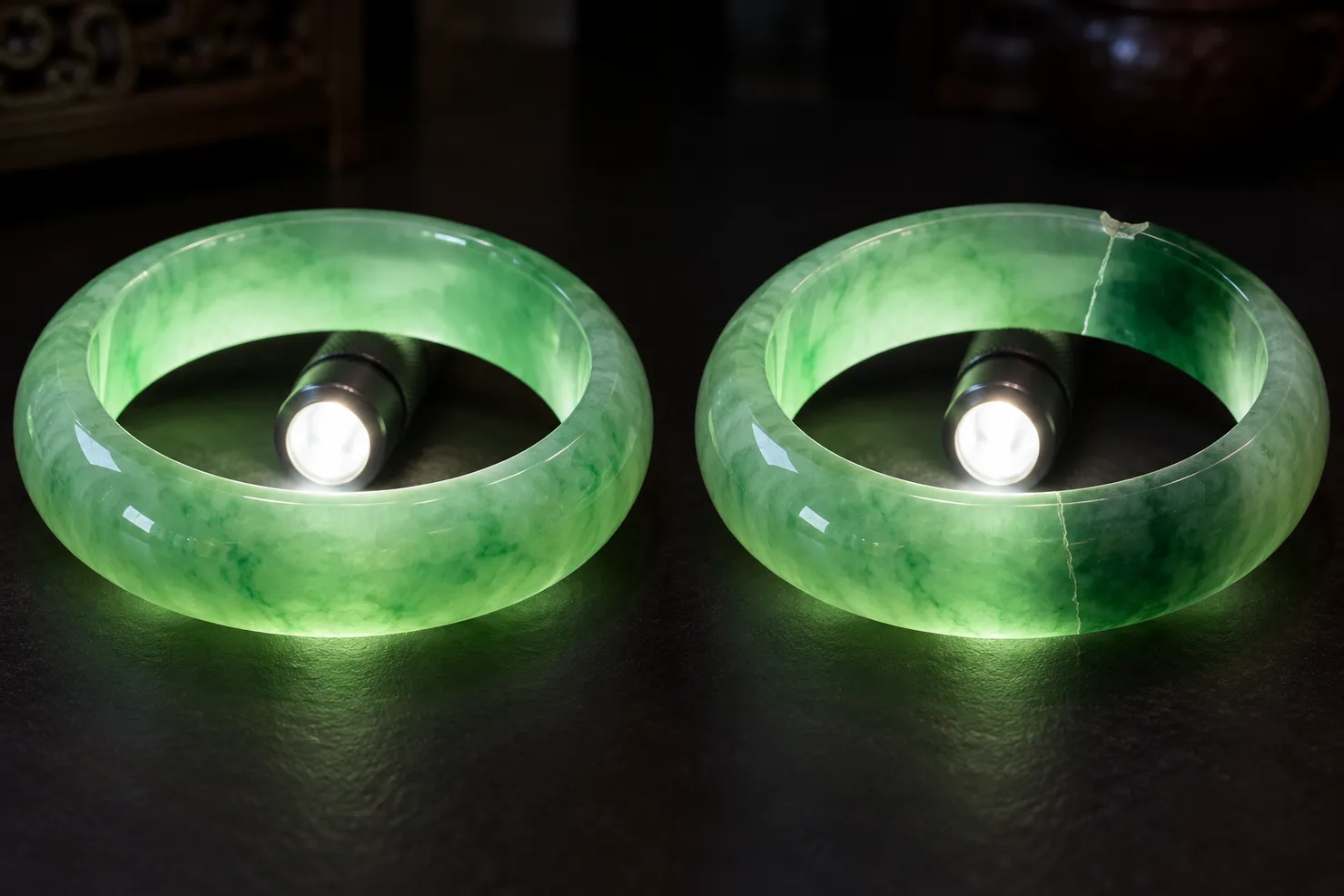
If you find a crack, see cracked or broken jade bangle: what to do for repair choices such as a gold band, recutting or keeping the pieces.
Can jadeite be insured or repaired?
- Insurance. Some home insurance policies cover jewellery, and specialist jewellery insurance exists. Check whether accidental breakage is covered, not only theft. Keep the certificate, the receipt and clear photos.
- Repolishing removes scratches and can smooth small chips on an edge.
- Cracks cannot be undone. A cracked bangle can be bound with gold or silver, or recut into rings or pendants. Filling a crack with resin hides it but does not make the stone strong again, and it is a treatment that must be disclosed if the piece is sold.
On JadeiteHub, every piece has real photos from the seller, some with video, so you can look at the band and the outer edge before you buy. Every sold piece is checked against its certificate before it ships, it travels with insured shipping, and if it does not match the description you get a full refund.
FAQ
Is jade harder than glass?
Yes. Jadeite is about 6.5–7 on the Mohs scale and glass about 5–6, so jadeite scratches glass. But quartz-based fakes scratch glass too, so this is not a way to tell real jade.
Will a jade bangle break if I drop it?
It may or may not. On carpet or wood it often survives; on tile or stone it can crack or break. Even if it looks fine, check it with a flashlight for a new crack at the point that hit the floor.
Can jade get scratched?
Yes. Dust contains quartz, which is about as hard as jadeite, and diamonds, sapphires and ceramic watches are harder. Bangles get fine scratches on the outer edge first. A jade polisher can repolish them.
Is nephrite tougher than jadeite?
Yes. Nephrite is slightly softer (6–6.5) but is the toughest common gem, because its fibres are finer and more tangled. Jadeite is harder and also very tough.
Is Type B jadeite more fragile?
Yes. Acid bleaching dissolves material between the crystals and the resin filling ages, so treated jadeite is weaker, more sensitive to heat and can develop fine surface crazing over time.