Jade Crack or Natural Line? Cotton and Flaws Explained
Updated
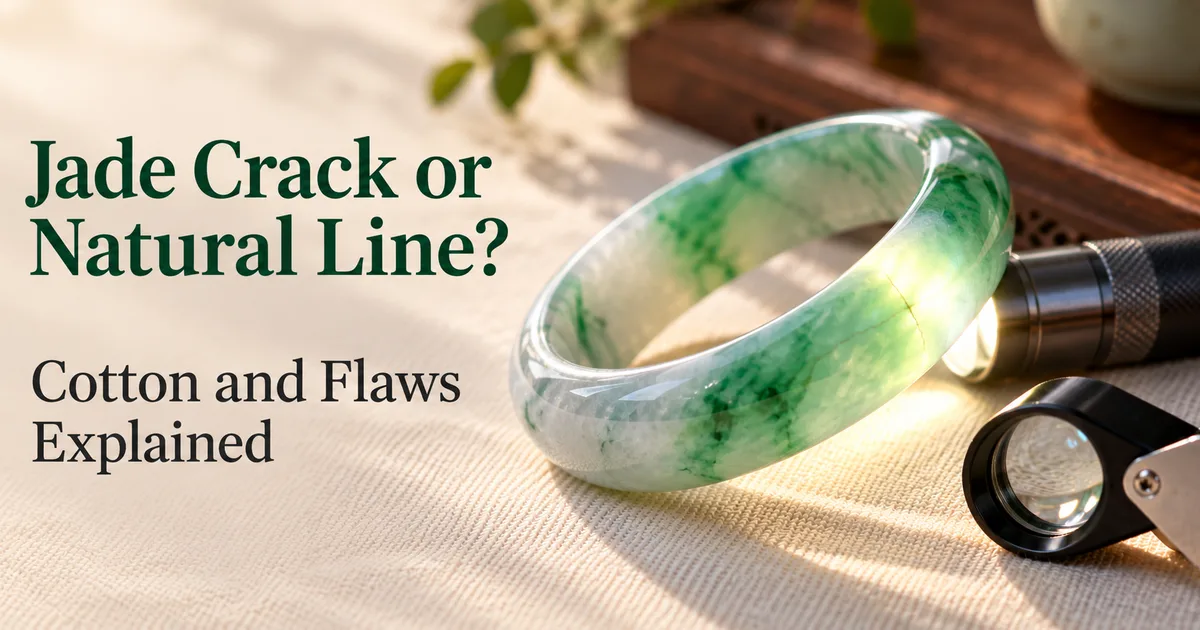
A crack is an open break in jadeite; a natural stone line is a healed one. Under a flashlight, light stops at a crack and a shiny plane flashes when you tilt the piece; it carries on across a stone line. Cotton (white cloudy flecks) and small black spots are natural, and matter mainly by size and place. Cracks are the worst flaw, above all in bangles, and most certificates do not list them.
What is the difference between a crack and a natural line in jadeite?
A crack (裂, "lie") is an open break in the stone; a natural line (石纹, "stone line") is an old break or growth line that healed while the stone formed, so it is closed and does not weaken the piece in the same way. Almost every natural jadeite has some lines, cotton or small spots. Cracks are much rarer in good pieces, and they matter much more.
Jadeite forms deep underground under heat and pressure, and the rock is squeezed and broken more than once. Breaks that happened early were often filled again by new mineral and sealed: these are the stone lines. Breaks that happened late, in the mine, during cutting or from a knock, stay open: these are cracks. That is why the trade treats them so differently, even though both look like "a line inside the jade".
Dealers have a whole vocabulary for these features. The main terms:
| Trade term | Plain meaning | What you see | How dealers treat it |
|---|---|---|---|
| 裂 (crack) | An open break | A line that stops light; often a bright, mirror-like plane at some angle | The most serious flaw, above all in bangles |
| 绺 (old term for a fissure) | Used for small cracks, sometimes for healed ones | Short lines, often near the surface | Ask which one the seller means |
| 石纹 (stone line) | A healed line inside the stone | A faint whitish or darker line; light passes through it | Normal in natural jadeite; value depends on how visible it is |
| 水线 (water line) | A growth line that is clearer than the stone around it | A thin, glassy streak, often in parallel bands | Common in icy material; not a crack |
| 棉 (cotton) | White cloudy flecks or patches | Snow-like dots, wisps or clouds | Natural; value depends on amount and place |
| 石花 (stone flower) | Small, dense white clusters | Tiny white knots, sometimes flower-like | Many dealers treat it as a coarse kind of cotton |
| 黑点 (black spot) | Small dark mineral grains | Black or dark green dots | Natural; value depends on size and place |
| 癣 (dark patch) | Larger dark grey, black or dark green patches or streaks | Blotches or bands, sometimes next to green | Judged piece by piece |
The trade does not use all of these words in exactly the same way. 石花 in particular means slightly different things to different dealers, so when a seller uses a term, ask them to point to it in a photo.
How do I tell a crack from a stone line?
Dealers look at three things: what the light does, what the surface does, and what the line looks like from different angles.
| Check | Crack (裂) | Stone line (石纹) |
|---|---|---|
| Flashlight through the stone | Light stops at the line; one side looks darker (dealers call this 断光, "broken light") | Light carries on across the line |
| Tilting the piece | At some angle a bright, flat, mirror-like plane flashes inside | No flash at any angle; the line stays the same faint line |
| Fingernail across the surface | Catches if the crack reaches the surface | Does not catch |
| Reflection on the polished surface | A surface crack breaks the reflected line of a lamp | The reflection runs smoothly over it |
| Direction | Often cuts straight across the grain or the color | Often follows a direction in the stone, or the edge of the color |
| Color | Sometimes stained brown or yellow inside if it is old and open | Often slightly whiter or darker than the stone around it |
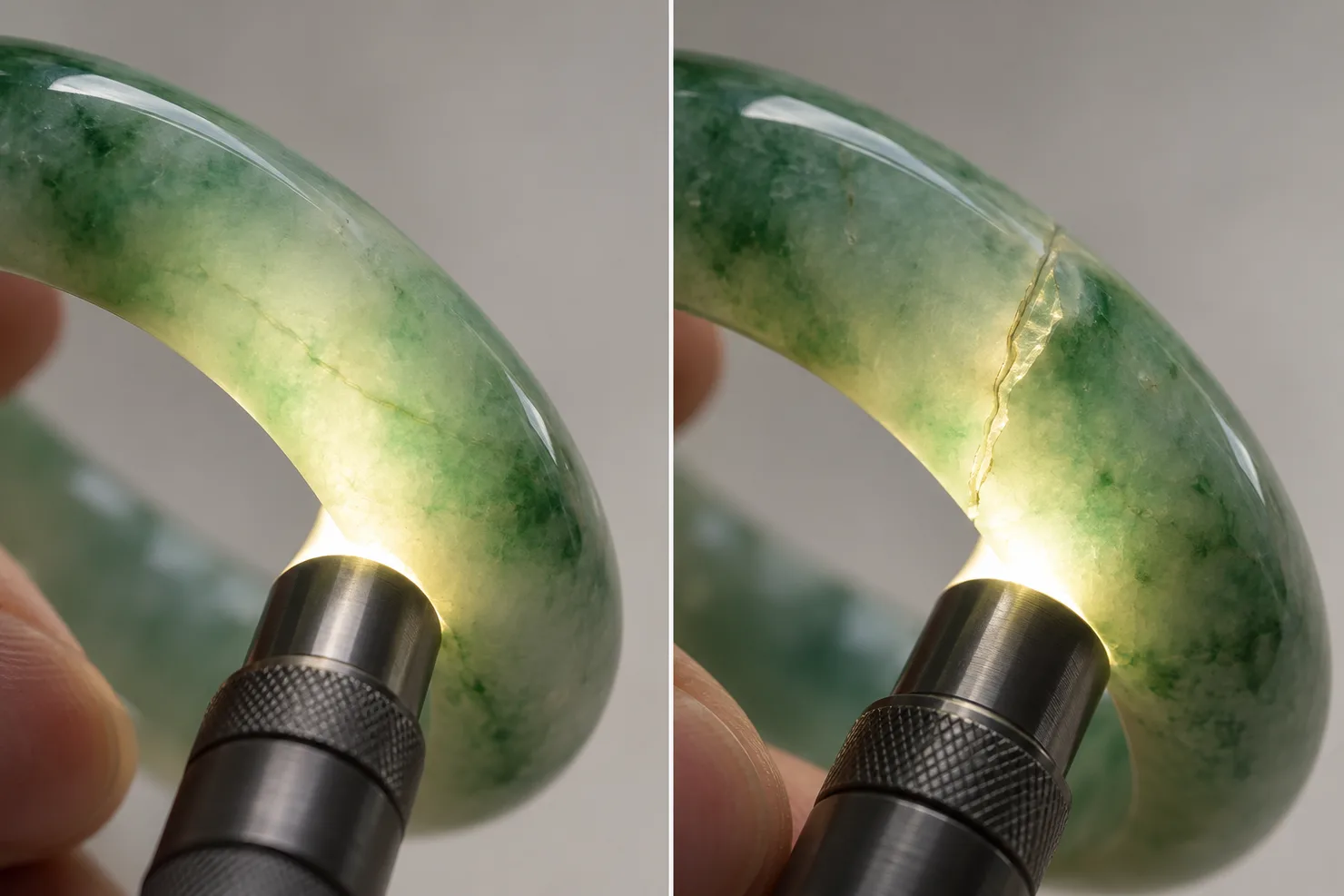
The single most useful sign is the "broken light". Hold a small white flashlight against the stone and move it slowly along the line. If the glow on the far side of the line is suddenly dimmer, or the light seems to end at the line like a wall, it is a crack. If the glow fades smoothly as it moves away from the light, it is a stone line.
A note on bangles: a strong stone line that runs right across a thin band is still a weaker spot than clean jade. Dealers disagree about how much it matters. Most will wear a bangle with a faint stone line without worry, but are careful with a deep, very visible one.
What is the difference between an internal crack and a surface crack?
- Surface crack (外裂): reaches the surface. A fingernail usually catches on it, and it breaks the reflection of a lamp on the polish. Dirt, skin oil and old dye can collect in it, so an old surface crack may look brownish.
- Internal crack (内裂): stays inside. You cannot feel it with a fingernail. You only see it under light, usually as a bright plane when you tilt the piece, or as a place where the light stops.
Do not assume an internal crack is safe because you cannot feel it. It is still an open break, and a knock or a sudden change in temperature can make it grow to the surface. For bangles, an internal crack that runs across the band is treated almost as seriously as a surface crack.
A crack that has been filled with resin or glue to hide it is a treatment, and must be disclosed. Filling hides the light break and the flash, but does not make the stone strong again. See how to spot treated jadeite.
What is cotton in jadeite?
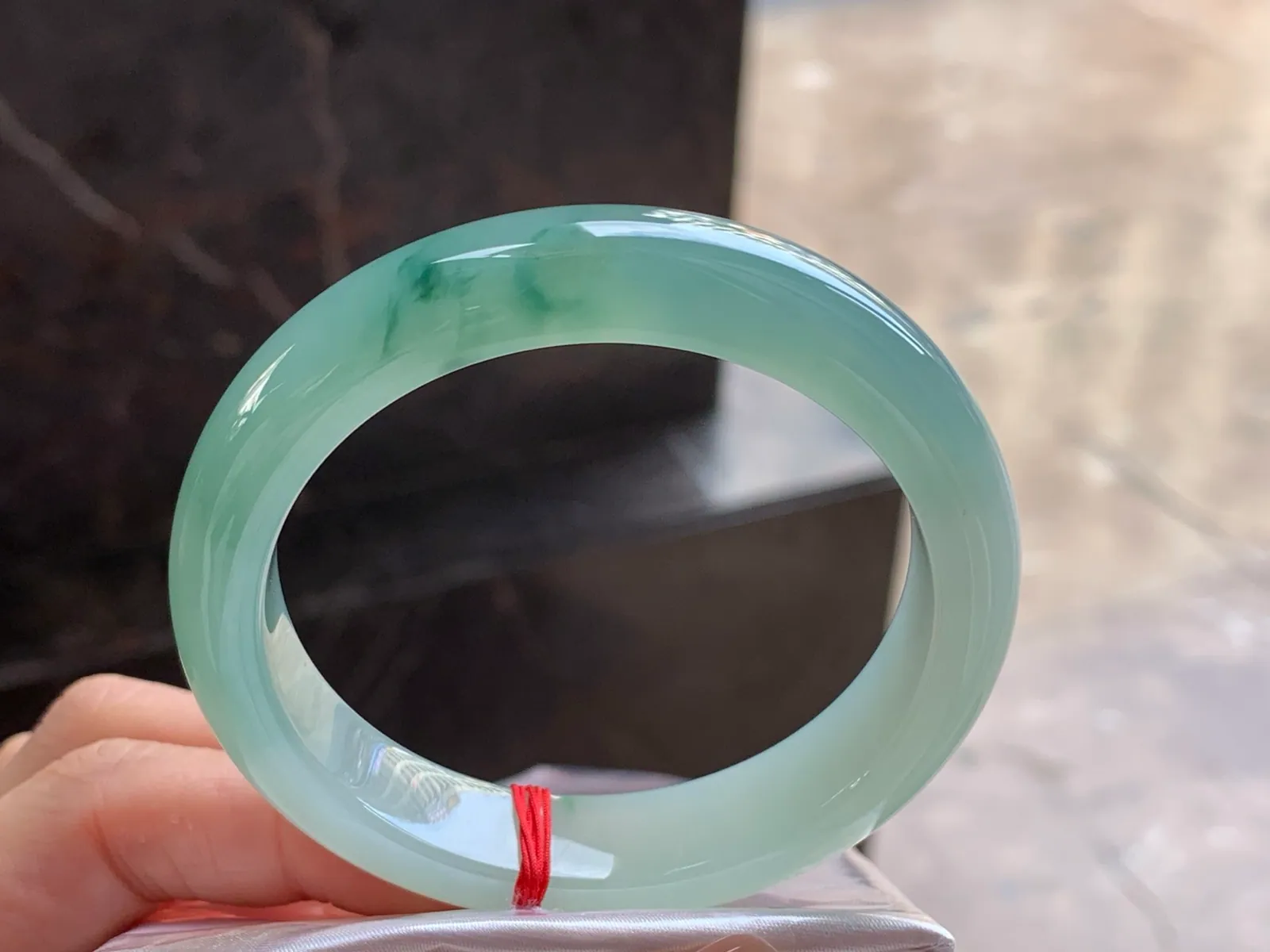
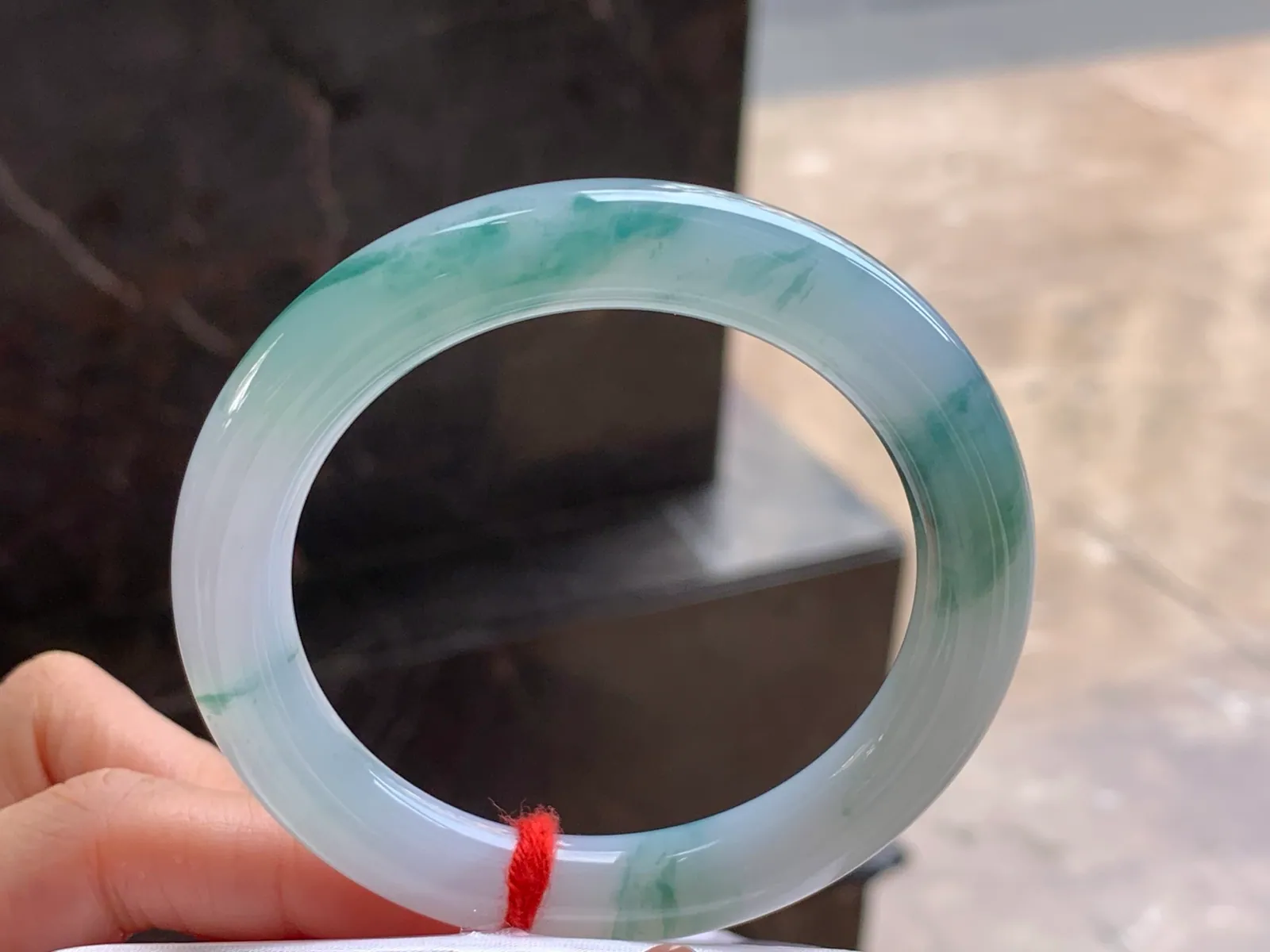
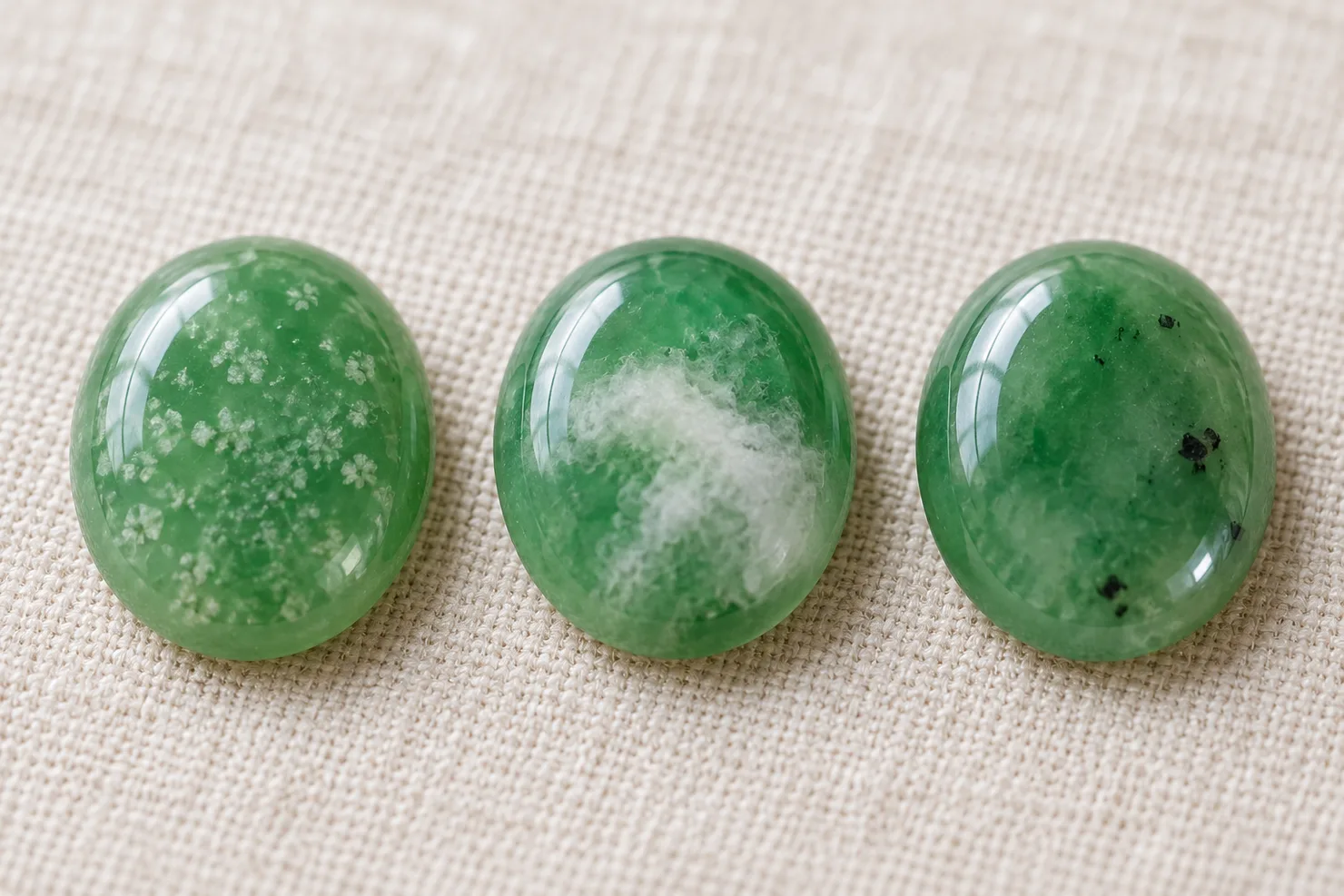
Cotton (棉) is the white, cloudy material inside jadeite: tiny groups of crystals that scatter light instead of letting it through. It is part of the stone, not damage, and nearly all natural jadeite has some. The trade describes it by shape:
| Type | What it looks like | Effect on the stone |
|---|---|---|
| Snowflake cotton (雪花棉) | Fine, scattered white flecks | In icy, clear material it can look like falling snow and some buyers like it |
| Cotton wisps (棉絮) | Thin threads or veils | Softens translucency a little |
| Cotton cloud (团棉) | A dense, rounded white patch | Very visible; breaks up the clear areas |
| Stone brain (石脑) | Chalky, opaque white lumps | The heaviest kind; looks like a separate stone inside |
| Stone flower (石花) | Small, hard-looking white knots | Visible under a flashlight; usually counted as a flaw |
Cotton is not always bad. In clear, icy jadeite, fine snowflake cotton is often seen as part of the look, and carvers sometimes use a patch of cotton as clouds, waves or snow in a design. What lowers value is cotton that is dense, chalky, or sits in the middle of the face of a piece. For translucency itself, see zhong, shui and se explained.
What are black spots and dark patches (癣)?
Black spots (黑点) are small grains of dark minerals inside the jadeite. 癣 is the trade word for larger dark patches or streaks, grey, black or very dark green. Some dealers have a saying that "green follows the black" (绿随黑走), because dark patches sometimes sit next to green. Treat that as trade lore, not a rule.
Neither can be removed without cutting stone away, so the only question is where they sit and how big they are.
How much does each flaw lower the value?
| Flaw | Bangle | Cabochon, ring, earrings | Carved pendant |
|---|---|---|---|
| Crack through or across the band | Most serious: a safety issue, the bangle can break | Serious | Serious, unless carved away |
| Internal crack | Serious | Serious if on the face | Depends on place |
| Stone line, faint | Small effect | Visible on a clear stone; moderate | Small; often hidden in the carving |
| Stone line, strong | Moderate to serious | Moderate to serious | Moderate |
| Fine snowflake cotton | Small; can be part of the look | Small | Small |
| Dense cotton cloud or stone brain | Moderate, more if on the outer face | Serious if in the centre | Moderate; carvers often use it |
| Small black spots | Small if on the inside or a hidden side | Serious if in the centre of the dome | Small to moderate |
The rule of thumb is location. The same spot costs much more in the centre of a cabochon, the middle of a 平安扣 (safety-buckle disc) or the outer face of a bangle than on the back or the inside of the band.
Plain pieces (bangles, cabochons, safety-buckle discs, plain beads) need clean material, because there is nowhere to hide a flaw. Carvings are different. The trade has a saying, 无绺不作花, "no fissure, no carving": rough with flaws is often carved, and the design is laid out to cut away or cover the cracks. That is fine when it is honest, but it is also why you should look closely into the deep grooves of a carving. For how flaws fit into price overall, see what determines jadeite price.
How do I check a piece myself, step by step?
You need a small white flashlight (a jade torch or a phone light), a clean dry cloth and a dim room.
- Clean and dry the piece. Water and oil fill surface cracks and make them almost invisible. Never judge a wet stone.
- Look at reflected light first. Hold the piece under one lamp and tilt it so the lamp's reflection runs across the surface. A surface crack breaks or bends the reflected line.
- Then use transmitted light. Press the flashlight against the stone. For a bangle, shine it from the inside of the band and turn the bangle slowly through a full circle, so that every part of the band passes over the light.
- Follow every line you see. Move the light along it. Does the light stop at the line (crack) or carry on across it (stone line)?
- Tilt the piece in front of the light at several angles. A bright, flat flash inside is a crack plane.
- Run a fingernail gently across each line, on both sides of a bangle.
- Map the cotton and spots. Note where they are: centre of the face, side, back, inside of the band.
- Ask in writing. "Are there any cracks, internal or surface? Where are the stone lines?" Ask for a video with the flashlight run all the way round.
What about the tap test? Some people tap a bangle with another bangle or a coin and listen: a clear ring for whole jade, a dull sound for a crack. It is not reliable. The sound depends on shape, thickness, how the bangle is held and what it is tapped with, and good bangles with heavy cotton can sound dull too. Tapping jade on jade can also chip or crack the piece. Do not rely on it, and do not do it to a piece you do not own.
How do sellers hide flaws?
Most sellers are honest, but these tricks are common enough that you should know them:
- Strong light from one side, or only from the front, so the light never passes across a crack.
- Wet or oiled surfaces in photos and videos, which fill and hide surface cracks.
- Angle choice: the crack or spot is kept on the side away from the camera, or under a finger.
- Close-up crops and filters that show only the best part.
- Gold over the flaw: a gold setting, a gold-capped section or a wrap placed exactly over a crack or a dark spot. A setting can be a design choice, but ask what is underneath. See gold-set jadeite.
- Words: "it's just a stone line", "lines don't count as cracks" (纹不算裂), "all natural jade has lines", "no lines, no cracks" (无纹无裂) said of a piece nobody has shown under light.
Part of this is fair: stone lines really are not cracks, and natural jade really does have lines. An honest seller tells you where both are, and shows them under a flashlight.
Does the certificate list cracks?
Usually not. A jadeite identification certificate tells you what the material is and whether it is treated. It normally does not describe cracks, stone lines, cotton or spots, and its photo is often taken in light that hides them. So a clean certificate means natural, untreated jadeite, not "no cracks".
Read the wording anyway. If a remark mentions filling or treatment, that matters. And check that the certificate belongs to the piece: see how to verify a jadeite certificate. If your own bangle already has a crack, see what to do with a cracked or broken jade bangle.
Buying on JadeiteHub
On JadeiteHub, sellers show real photos of the piece, some with video, and you can ask them to show any lines under a flashlight before you buy, so the description covers them. Every sold piece is checked against its certificate before it ships, and if it does not match the description, you get a full refund.
FAQ
How can I tell if a jade line is a crack or a natural line?
Shine a small flashlight through the stone and move it along the line. If the light stops at the line or a shiny plane flashes when you tilt the piece, it is a crack. If the light carries on across it and your fingernail does not catch, it is most likely a natural stone line.
What is cotton in jade?
Cotton (棉) is white, cloudy material inside jadeite: tiny crystal groups that scatter light. It is natural and very common. Fine, scattered cotton matters little; dense clouds or chalky lumps in the centre of a piece lower its value.
Should I buy a jade bangle with a stone line?
A faint stone line is normal in natural jadeite and many people wear such bangles for years. Check it under a flashlight to make sure it is not a crack, and be more careful with a deep line that runs right across a thin band.
Are black spots in jade bad?
They are natural mineral grains, not a sign of fake jade. They lower value most when they sit in the centre of the face of a piece, and much less on the back or the inside of a bangle.
Does a jadeite certificate show cracks?
Usually not. An identification certificate states the material and any treatment. It normally does not describe cracks, lines or cotton, so check the piece itself under a flashlight or ask the seller to show you on video.