Jade Donut Pendant Meaning: How to Choose a Safety Buckle
Updated
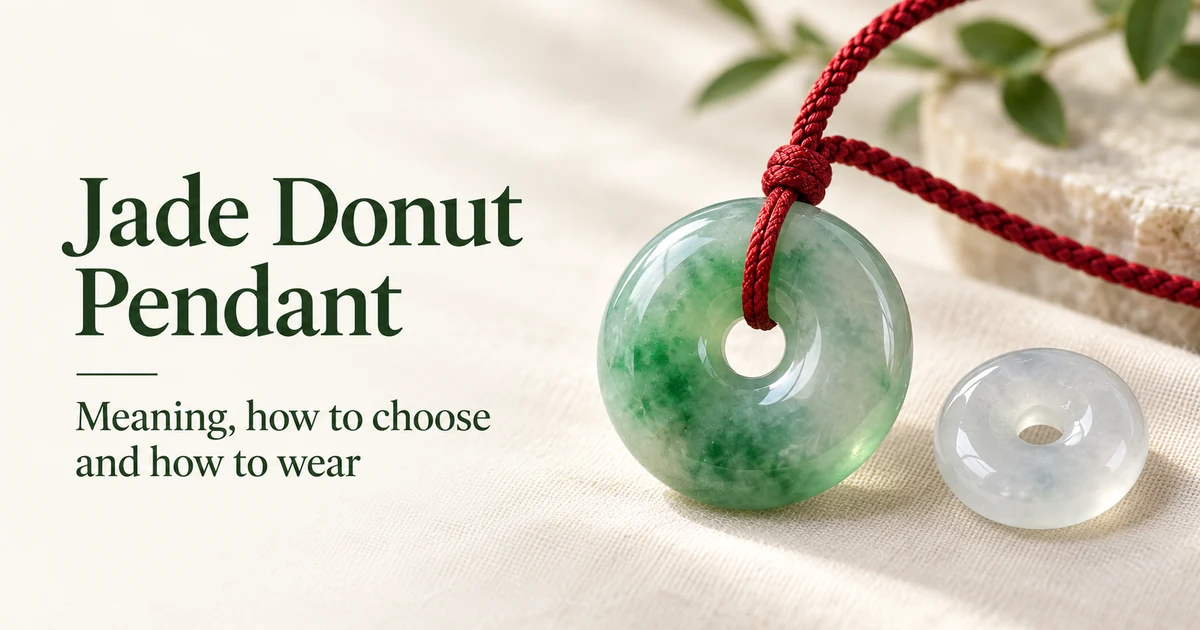
A jade donut, or safety buckle (平安扣), is a round jade disc with a hole, traditionally said to stand for peace, safety and completeness. It is a small modern pendant, not the ancient bi disc. Because it has no carving, it shows every crack, cotton patch and color flaw, so check it against a flashlight, look for a full rounded profile, an even ring and a centred hole, and judge translucency before color. As a size reference (outer diameter of the jade itself, not including any setting), a small, delicate pendant is about 18–25 mm and a larger, bolder one about 25–35 mm. Wear it on a cord with a lark's head knot or with a gold or silver setting.
What is a jade donut pendant?
A jade donut pendant is a flat, round disc of jade with a hole in the middle, worn on a cord or chain. In Chinese it is called 平安扣 (ping an kou), usually translated as "safety buckle" or "peace buckle". English sellers also call it a donut, a pi disc or a circle pendant. It is also known as 怀古 (wai gu), a name also used in the Hong Kong jewelry and auction markets. Vietnamese buyers call it cẩm thạch đồng điếu or khấu bình an, and Thai buyers call it หยกโดนัท (jade donut) or ห่วงผิงอัน.
It is one of the simplest shapes in jadeite: no carving, just a ring with a rounded profile. With nothing to hide flaws, the material is all you are paying for.
What does a jade donut (safety buckle) mean?
Traditionally, the safety buckle stands for peace, safety and wholeness. The name says it directly: 平安 (ping an) means "safe and sound", and 扣 means a buckle or clasp. The round outer edge is read as completeness and a life that comes full circle; some people also read the outer circle as heaven and the inner hole as a heart that stays open. These are traditional readings, not promises: a pendant does not keep anyone safe.
Because of that wish, it is a classic gift:
| Occasion | Why the donut is chosen |
|---|---|
| A baby's first month or first birthday | A wish that the child grows up safe; often kept as a keepsake |
| A child leaving for school or work abroad | "Ping an" (stay safe) on the journey |
| Couples and weddings | The circle as a complete, lasting union; sometimes bought as a matching pair |
| Elderly parents | A wish for health and peace in old age (said as a wish, not a health claim) |
| Men who want something plain | No figure, no motif, easy to wear every day |
For other motifs and how their meanings come from wordplay, see jadeite pendant meanings.
Is a safety buckle the same as an ancient bi disc?
No. The bi (璧) is an ancient Chinese ritual disc, usually large and made of nephrite, found in early burials and used in ceremony. The safety buckle is a small modern pendant form inspired by round discs like it. Sellers sometimes call any round jade a "pi disc" to sound old, but a jadeite donut is not an antique bi: jadeite only became widely used in China in the Qing dynasty, long after the bi tradition began.
In shape, a bi is usually flat and wide, while a safety buckle is small, thick for its size and fully rounded, like a donut.
Is the donut cut from the center of a bangle?
Sometimes. When a bangle is cut from a slab, a round core is left in the middle, and in the trade that core (镯心, "bangle heart") is often used for small round pieces, including safety buckles. Many donuts, though, are cut on their own from rough or offcuts, sometimes in sets sized for children and adults. Neither is better: what matters is the material in the piece you hold.
A "bangle core" story does not prove the donut matches a bangle's quality, since color and texture change a lot within one boulder. Very large or very thick donuts are usually cut on their own.
How do you choose a good jade donut pendant?
Check it backlit, check the shape, then judge the material. A plain donut shows every crack, every patch of cotton and every uneven color, so you can judge it more honestly than a carved piece.
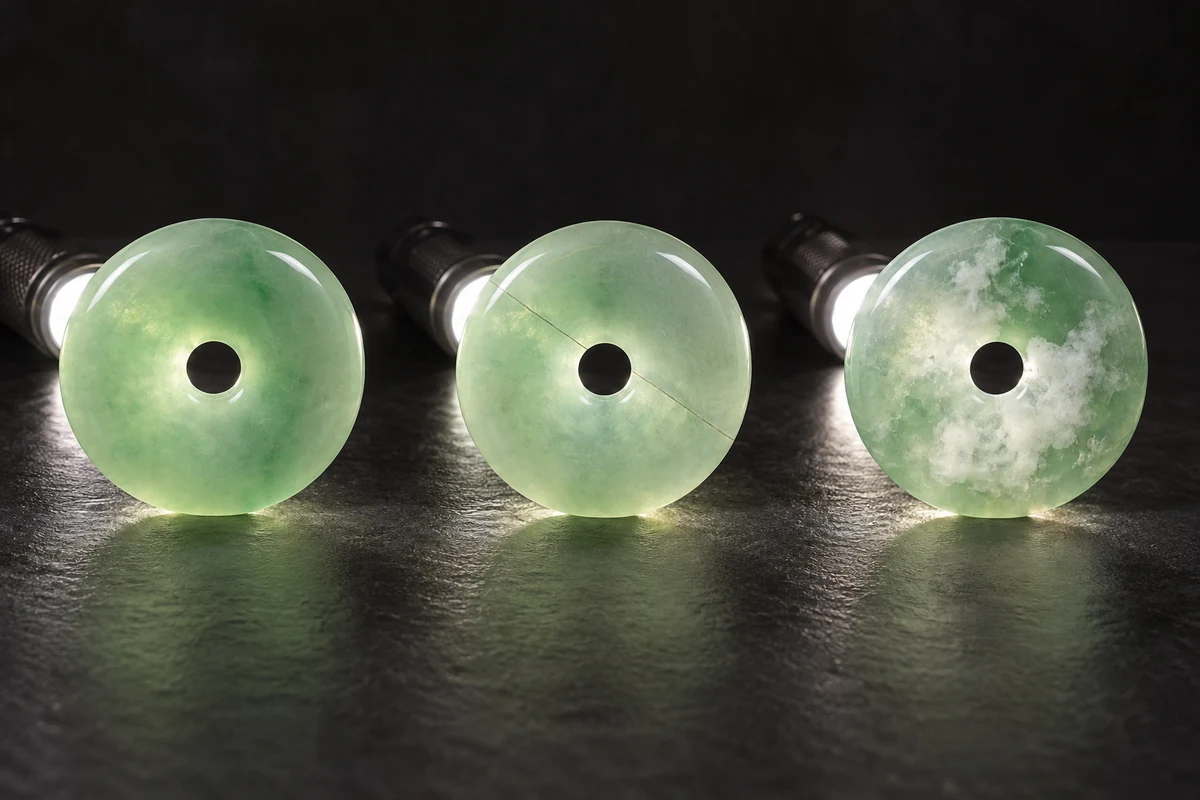
- Look for cracks with a flashlight. Shine a small white flashlight through the ring from behind, then turn it slowly. A crack shows as a sharp line that blocks or reflects light; it often runs straight across the width of the ring. Natural grain lines (石纹) are healed and do not catch a fingernail; a crack across a narrow ring is a real weakness. See cotton and cracks in jadeite.
- Check cotton and spots. White cloudy patches (棉) and dark specks are normal in natural jadeite, but on a plain piece they sit in full view. Small, soft cotton near the inner edge matters less than a large white patch on the face.
- Judge fullness (饱满). Lay the donut flat and look at it from the side. A good one is thick and evenly rounded, with no flat top and no sharp edge where the faces meet. Dealers say a "full" donut (饱满, fat and round) looks richer and glows better in light. A thin, flat donut uses less material and costs less, which is why it is made.
- Check the ring width and hole. The ring should be the same width all the way round, with the hole centred. An off-centre hole or a ring that is thinner on one side usually means the cutter worked around a crack or saved material.
- Check both faces. Turn it over. Both faces should be equally polished and equally domed; sometimes the back is flatter or left with cotton or a rough patch, while the front is the "show" side. The hole should be smoothly polished inside, with no chips at the rim.
- Judge translucency and texture. Translucency (水头, water) and fineness of texture (种, zhong) decide most of the value. Light should pass softly through the ring and glow at the edges. See texture, translucency and color.
- Judge the color last. Color can be even, patchy, a single "float" of green, or none at all. Clear colorless (icy) donuts are popular in their own right; a pale stone with a high translucency often looks better than a dull green one.
Ask the seller for photos or video against light, from the side and of both faces.
What size jade donut should I choose?
Choose by how it will be worn, the design and your own taste. Donuts are sold by outer diameter in millimetres.
Size buying reference. The figures below are the outer diameter of the jade itself, not including any metal setting. They are reference ranges for some styles only; the actual choice depends on the design, the weight and personal preference.
| Style or use | Reference outer diameter | Notes |
|---|---|---|
| Small stud earrings | about 8–12 mm | Small stud styles only; donuts on drop earrings can be much larger. Check the post setting |
| Small donuts braided on cord bracelets | about 10–16 mm | Small enough not to catch on things |
| Child (older, supervised wear) | about 12–18 mm | A reference only: the child's age, the weight and how it is worn all matter. Often kept as a keepsake until the child is older; see the safety note below |
| Small, delicate pendant | about 18–25 mm | Light and discreet for everyday wear |
| Larger, bolder pendant | about 25–35 mm | Larger and thicker; often chosen by men, also worn on dark cord |
| Statement or display piece | above 35 mm | Less common; heavy for daily wear |
Thickness should look in proportion: a large thin donut looks like a washer. Holding a coin of similar size at your collarbone in a mirror helps.
How do you wear a jade donut on a cord?
The usual way is a cord looped through the hole with a lark's head knot. Fold the cord in half, push the folded loop through the hole, then pull both cord ends through that loop and tighten. The cord grips the ring itself, so the donut sits flat and does not slide around. Many people add a diamond knot (金刚结) above it on both sides to stop it moving, and close the two ends with a sliding knot to adjust the length.
Pick a cord that fills the hole without being forced. A thin cord in a large hole lets the donut swing and wear at the rim. For cord materials, knots and length, see how to hang a jade pendant.
Red cord is traditional, especially for gifts; black or dark cord is common for men.
How else can a jade donut be worn?
Settings let you wear a donut on a chain and protect the edge. Common styles:
- Bail through the hole. A small gold or silver bail with a pin or tube passing through the hole. Simple and lets the stone show; check the pin is closed and smooth.
- Center caps (金镶 caps). A metal piece fills the hole with a cap on each face, often carved with a motif, and the bail rises from it. Very popular in China for gold-set donuts; it covers the hole and adds a little weight and color.
- Rim or bezel. A metal band around part or all of the outer edge. It protects the edge from knocks but hides some of the stone.
- Bracelets and charms. A small donut on a braided cord bracelet, often with a sliding knot, or strung between beads.
- Earrings. Small matched donuts on hooks or studs; matching color and translucency in a pair is the hard part. See jadeite earrings.
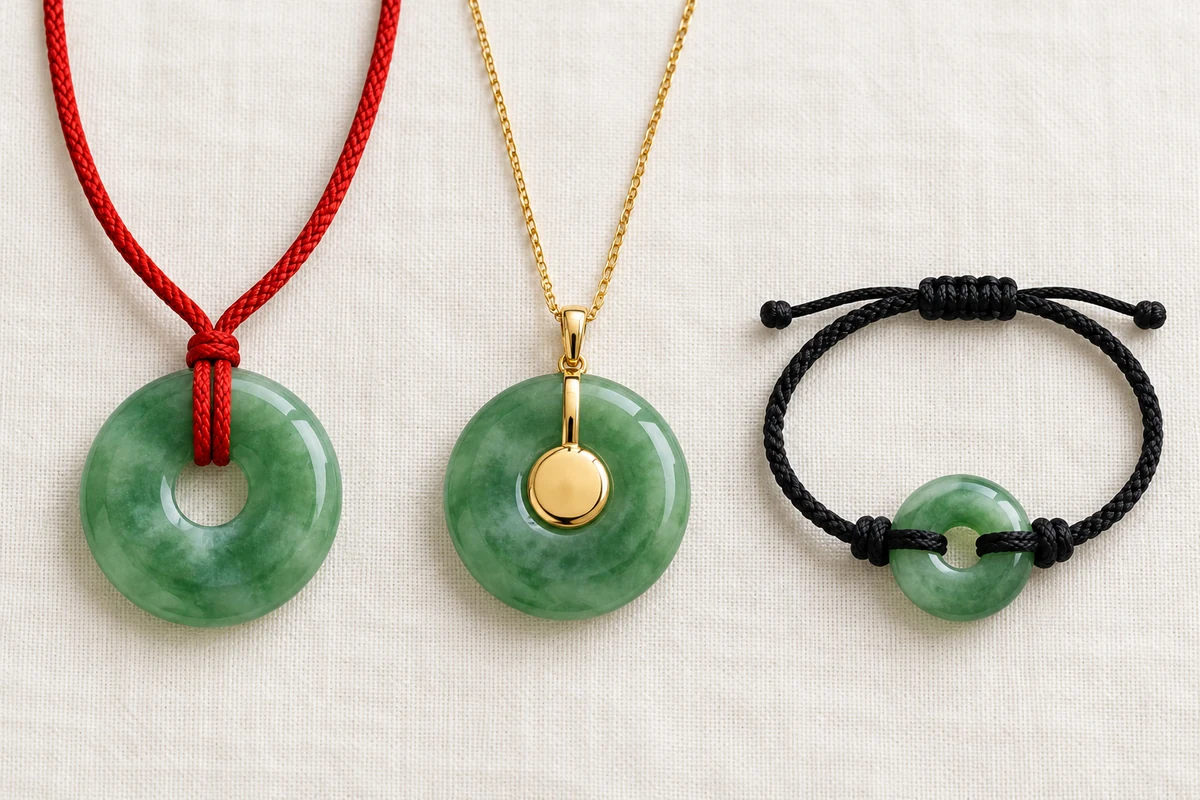
Gold-set jadeite is mostly made in China in 18K (75%) gold. Every silver setting sold on JadeiteHub is 925 sterling silver. For gold-set donuts, the price includes the gold weight and labor, so ask for the stone and the metal to be described separately.
Can men and babies wear a jade donut?
Yes, both. For men, the donut is one of the most popular choices because it is plain and has no figure to explain. Men often pick a larger, thicker donut (for example the 25–35 mm tier in the size reference above) on a dark cord or a sturdy chain, and darker or more saturated greens, black jadeite or clear icy stones.
For babies, a small donut is a traditional gift, but a cord around a baby's neck is a strangling and choking risk. Many families keep it as a keepsake until the child is old enough, and a necklace should never be left on a sleeping baby. See jade for babies for sizes and safe ways to give it.
What are the "taboos" for a jade donut?
There are no rules. What people call taboos (禁忌) are sayings, and they differ between families and regions. The ones you will hear most:
| Saying | What lies behind it |
|---|---|
| "Do not lend it to others" | A personal piece is felt to be "yours"; practically, a cord tied for one neck may not fit another |
| "It is better received as a gift than bought for yourself" | The wish carries more meaning from someone else; buying your own is perfectly normal |
| "If it breaks, it took a blow for you" (碎了是挡灾) | A comforting saying; the practical point is to stop wearing a cracked piece |
| "Wear it on red cord in your birth year" | A custom for the zodiac year; not a requirement |
| "Do not wear a cracked donut" | Sensible: a crack across a narrow ring can open further |
| "Take it off to sleep and for sport" | Practical: avoids knocks and a pulled cord |
None of these change the stone. If a seller uses a "taboo" to push a sale, treat it as sales talk.
What decides the price of a jade donut?
Mainly the material, then the shape and size. In rough order of importance:
- Texture and translucency (种水). Fine-grained, translucent material can cost many times more than coarse, opaque material of the same size.
- Color. Even, saturated green is the most valued; lavender, yellow and black follow their own markets. A small float of color counts for less than color spread through the ring.
- Cleanliness. No cracks, little cotton, no dark spots. Plain shapes are priced hard on this.
- Size and thickness. Larger and fuller donuts need a larger clean piece of rough, which is rarer.
- Proportions and finish. Even ring, centred hole, both faces polished.
- Setting. Gold weight, workmanship and design.
We do not quote typical prices because the range is enormous and depends on all of these together. The same factors apply to every jadeite piece; a donut simply hides none of them.
Are there treated or fake jade donuts?
Yes, many. Because the donut is cheap to cut and popular, it is one of the most common shapes for treated jadeite and look-alikes.
- Type B and C jadeite. Bleached and resin-filled (B) or dyed (C) jadeite. A bright, even green donut at a low price is the classic warning sign. Only a lab can confirm treatment; a certificate should name the mineral and say whether it is natural (Type A). See how to verify a jadeite certificate.
- Look-alike stones. Serpentine ("new jade", Xiuyan jade), dyed quartzite, aventurine, chalcedony and glass (look for round bubbles) are all cut into donuts. Nephrite donuts are real jade but not jadeite, and they are priced differently.
Home checks give clues, not proof. For a piece that matters, ask for a certificate from a recognized gem lab.
How do I care for a jade donut?
Wash it in lukewarm water with mild soap when needed and dry it. Replace the cord when it frays at the hole. Take it off for sport and sleep, and store it apart from harder stones. A donut is tough, but its narrow ring can crack if it hits tile.
On JadeiteHub we list only jadeite with a lab certificate. Every sold piece is checked against its certificate at our inspection center before it ships, and if it does not match its description you get a full refund.
FAQ
What does a jade donut pendant mean?
Traditionally it stands for peace and safety (平安, ping an) and, through its round shape, completeness. It is a popular gift for babies, travelers, couples and parents. These are traditional meanings, not promises.
Is a jade donut the same as a pi disc?
No. The bi or pi disc is an ancient ritual disc, usually large and made of nephrite. The jade donut or safety buckle is a small modern pendant inspired by round discs. A jadeite donut is not an antique bi.
What size jade donut should I choose?
As a reference, measured as the outer diameter of the jade without any setting: about 18–25 mm for a small, delicate pendant and about 25–35 mm for a larger, bolder one (often chosen by men). Small stud earrings use about 8–12 mm and cord bracelets about 10–16 mm. For children, about 12–18 mm is only a reference; age, weight and how it is worn matter. The actual choice depends on design, weight and personal preference.
How do you tie a jade donut on a cord?
Use a lark's head knot: fold the cord in half, push the loop through the hole, pull both ends through the loop and tighten. A diamond knot above and a sliding knot at the back keep it in place and adjustable.
Is a jade donut cut from a bangle?
Sometimes. The round core left after cutting a bangle is often used for small donuts, but many donuts are cut on their own. Judge the stone you hold, not the story.
How can I tell if a jade donut is real?
Home checks such as weight, a flashlight and a loupe give clues, but treated jadeite and look-alikes are common in this shape. A bright even green at a low price is a warning sign. A certificate from a gem lab is the proof.
Can a baby wear a jade donut?
It is a traditional baby gift, but a pendant on a cord is a choking and strangling risk for babies. Keep it as a keepsake or use it only under supervision until the child is older.