How to Hang a Jade Pendant: Cord, Chain or Bail?
Updated
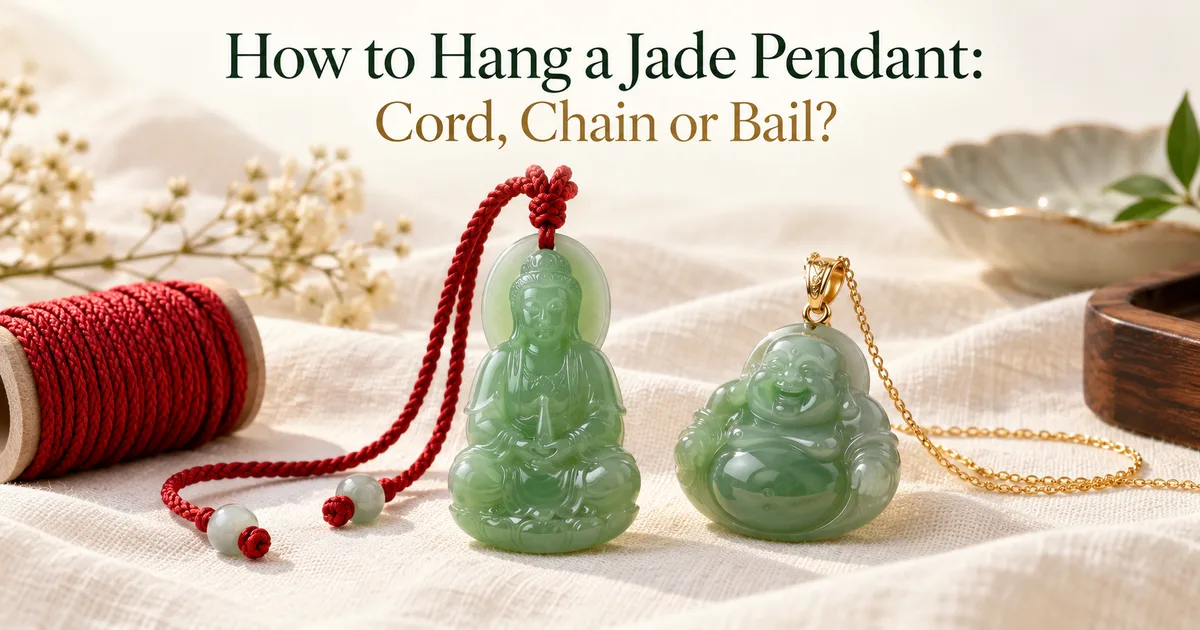
The safest way to hang a jadeite pendant is a soft braided cord through a drilled hole, or a gold or silver chain through a metal bail. Never run a bare chain through the stone: jadeite is harder than gold and silver, so it wears the chain thin, and the chain gives no cushion when the pendant is knocked. Choose a cord that fills the hole, a sliding knot for length, and replace the cord when it frays.
What is the best way to hang a jadeite pendant?
The best way to hang a jadeite pendant is the one that matches how the pendant is made: a soft braided cord straight through a drilled hole, or a chain through a metal bail, never a bare metal chain rubbing inside the stone. Everything else (colour of the cord, gold or silver, length) is taste and custom.
Almost every carved jadeite pendant reaches you in one of three states. Dealers check which one before they talk about cords at all:
- Drilled hole only (打孔). A small hole is drilled through the top of the carving, usually from both sides so the two drills meet in the middle. This is how most Guanyin, Buddha, leaf and safety-buckle (平安扣) pendants leave the carving workshop. It is meant for cord.
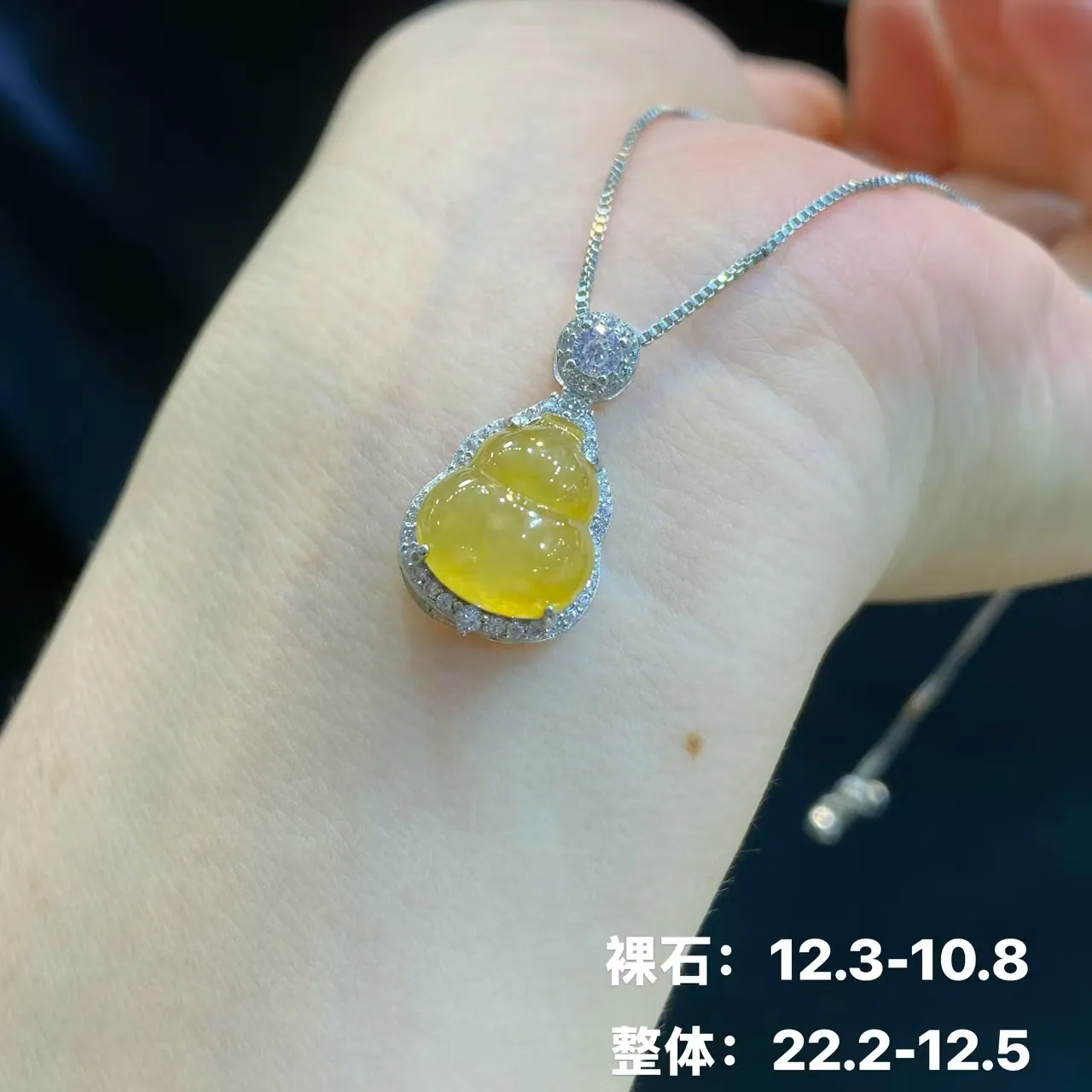
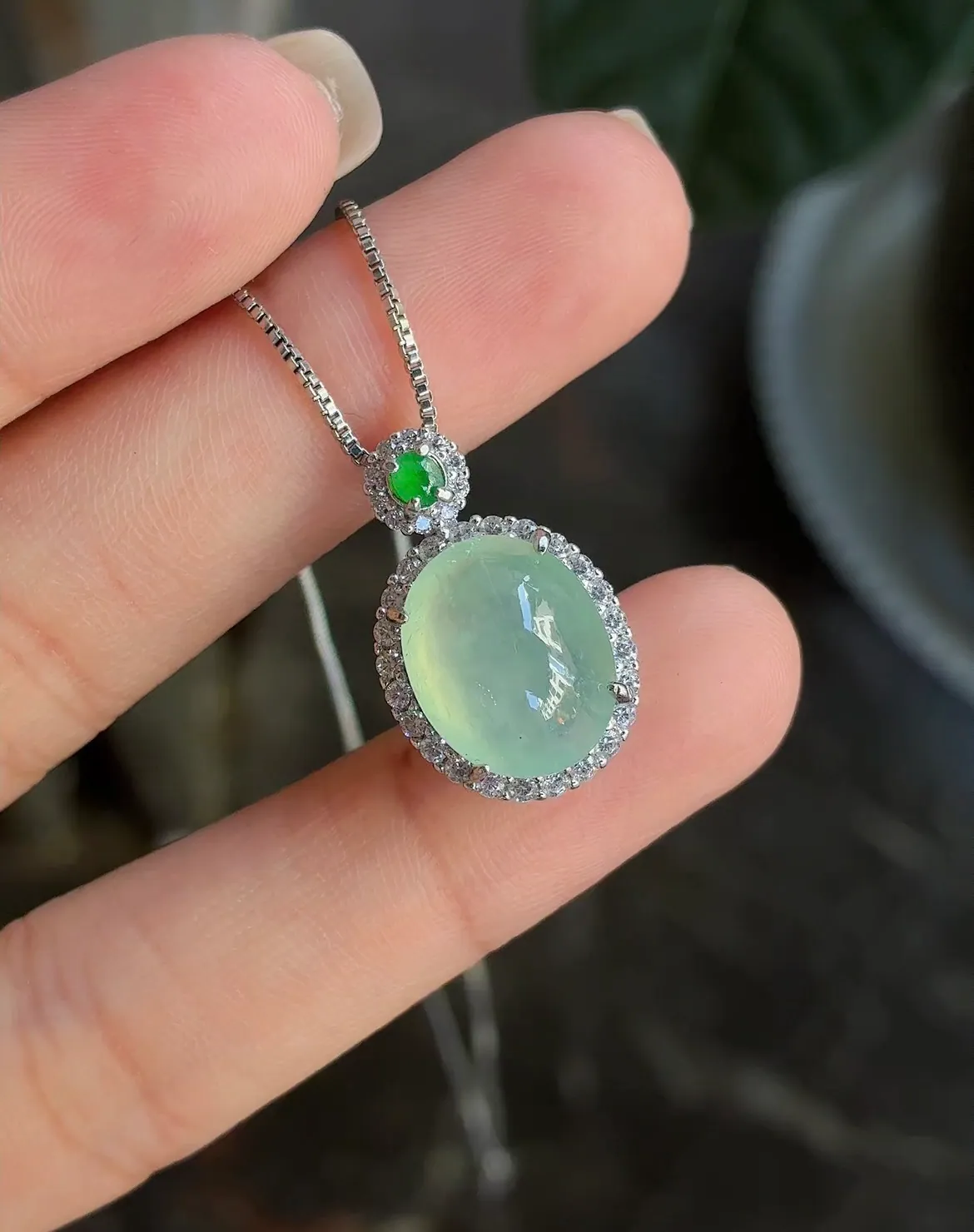
- Hole plus a bail (挂扣). A small metal loop is fitted through or onto the hole so a chain can pass. The most common shape in the Chinese trade is the melon-seed bail (瓜子扣), a small teardrop of gold or silver held by a pin through the drill hole. Thai sellers call a bail or jump ring ห่วง; Vietnamese sellers say khoen or móc.
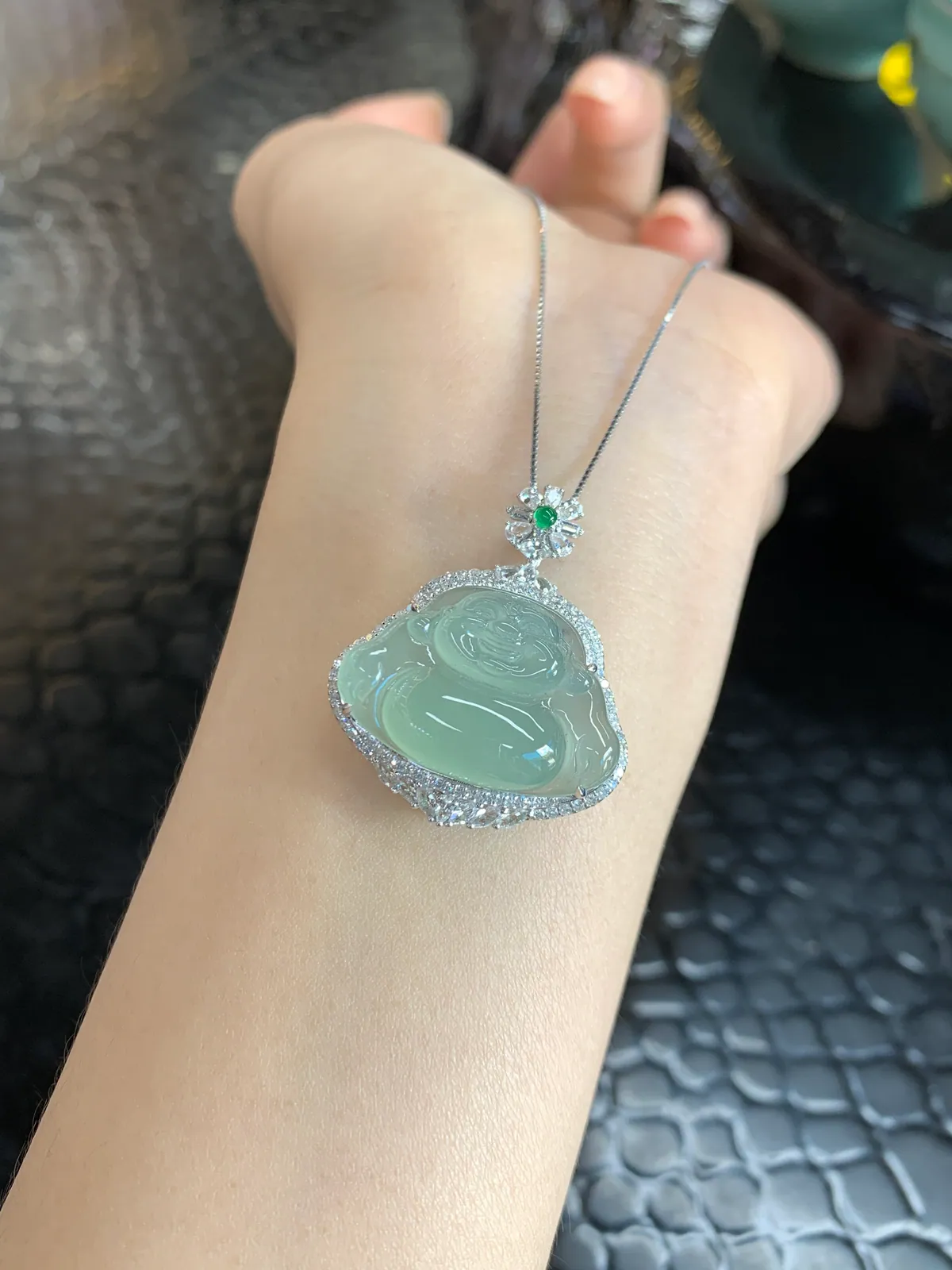
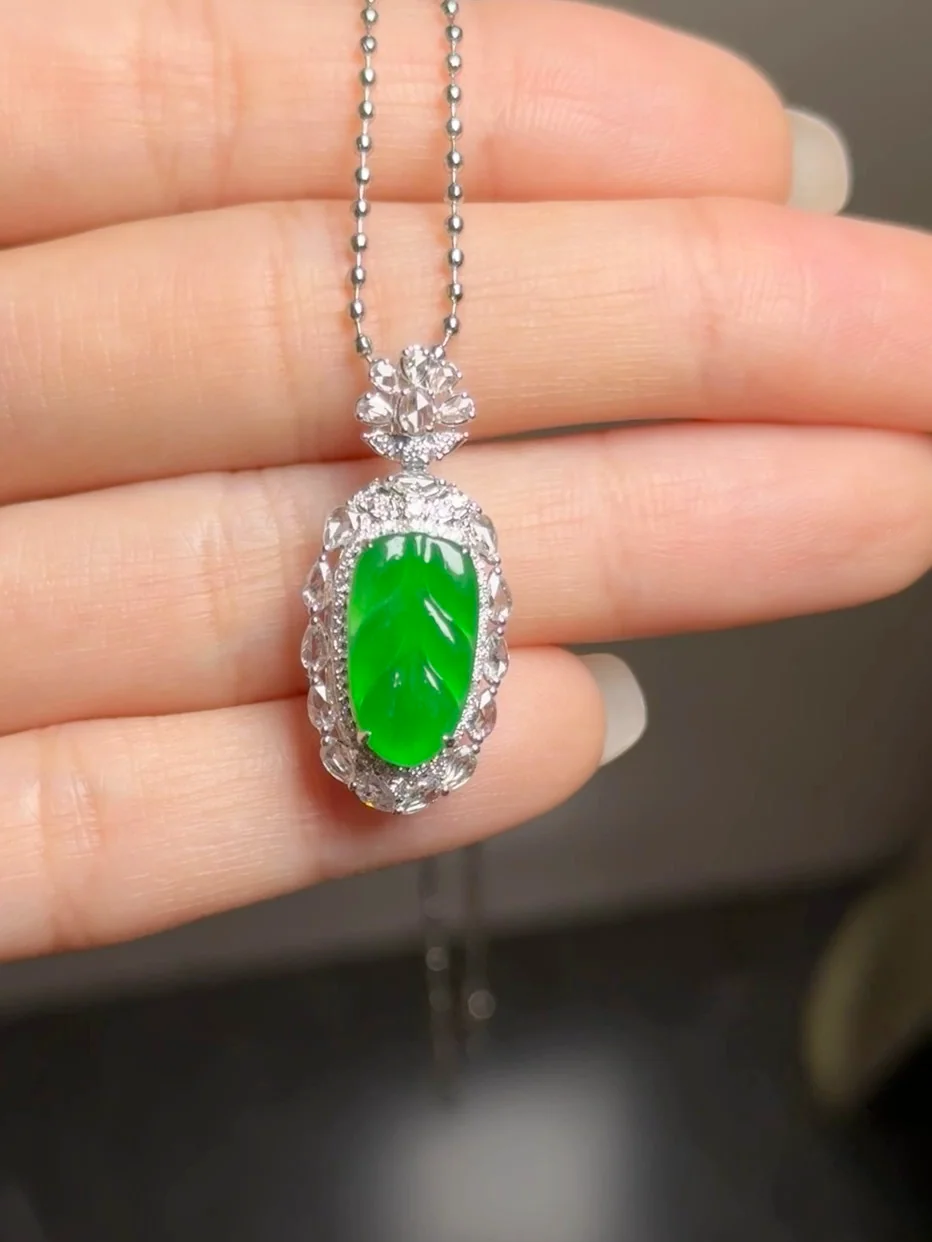
- Metal cap or frame, no hole needed. A gold cap (包头) grips the top of the carving, or a full gold or waterproof frame (Thai เลี่ยมกรอบ, กรอบพระ) holds the whole piece, with a loop on top. See gold-set jadeite for how these settings are made and what they can hide.
| How the pendant is made | Hang it on | Avoid |
|---|---|---|
| Drilled hole, no metal | Braided nylon cord, waxed cord, silk cord | A metal chain threaded straight through the hole |
| Hole with a melon-seed bail | Gold or silver chain, or a cord | A chain thicker than the bail opening, which forces and bends the bail |
| Gold cap or frame with a loop | Gold or silver chain | A very thin chain on a heavy framed piece |
| Large or heavy plaque (牌子) | Thick cord or a strong chain with a solid bail | Thin single-strand thread |
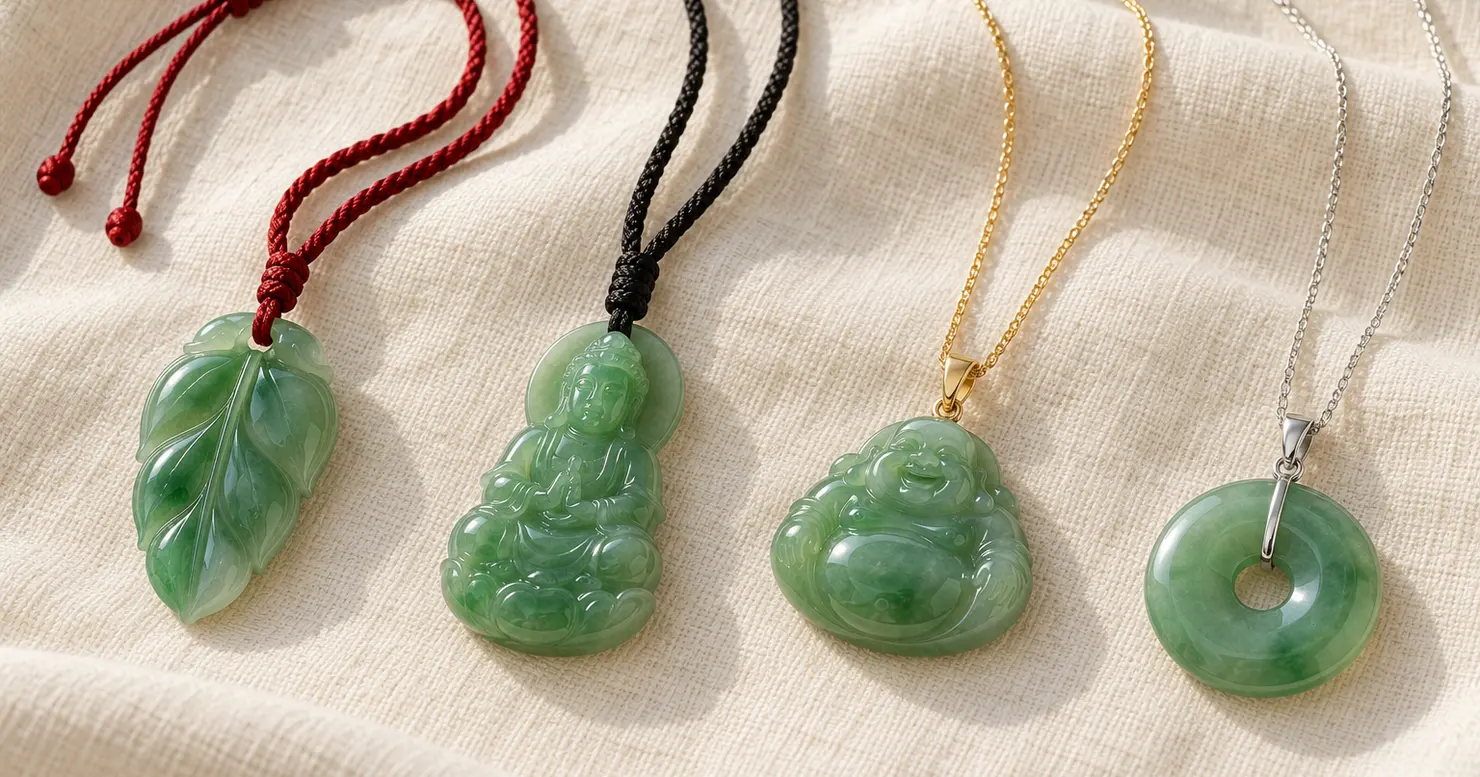
Cord or chain: which suits which pendant?
The trade does not agree on one answer here. Older Chinese buyers and many men prefer cord for its soft, traditional look; buyers in Thailand and Vietnam lean towards gold chains. Both are fine when the hardware matches.
| Option | Look | Strength and wear | Best for | Watch out for |
|---|---|---|---|---|
| Red braided cord (红绳) | Traditional, warm; red is the colour of good fortune in Chinese custom | Soft on the stone; frays and fades with time | Leaf, safety buckle, gourd, small and mid-sized pieces | Colour can run when new and wet; fades in sun and sweat |
| Black or dark cord | Understated, common for men | Same as red; dirt shows less | Guanyin, Buddha, plain tablets, men's pieces | Looks worn once it goes grey and fuzzy |
| Waxed cord (蜡绳) | Thin, slightly shiny, sporty | Resists water better than plain cord; the wax wears off | Small pendants, daily wear in hot weather | Too thin for heavy pieces |
| Gold chain, with a bail | Formal, finished | Strong; the clasp and the link at the bail are the weak points | Framed or capped pieces, heavier pendants, Thai and Vietnamese style | Thin fashion chains snap; check the hallmark |
| Silver chain, with a bail | Light, modern, affordable | Strong enough for small pieces; tarnishes | White, icy and lavender jadeite, everyday pieces | Silver polish and dip must not touch the jade |
Two common buying mistakes. First, choosing a chain for a pendant that has no bail, then pushing the chain straight through the drill hole. Second, buying a heavy pendant and hanging it on the thin cord it came with, which was meant for display, not years of wear.
What are jade cords made of, and what do 72 and 71 mean?
Most pendant cords in the Chinese trade are braided from jade thread (玉线), a strong nylon jewellery thread sold in numbered sizes. The number is a maker's size code, not millimetres. Sellers' listings put No. 72 at about 0.8 mm and No. 71 at about 0.4 mm; makers differ slightly, so ask for the width in millimetres when it matters.
| Material | What it is | Typical use |
|---|---|---|
| Jade thread No. 72 (72号玉线) | Thin nylon thread, about 0.8 mm | Braided several strands together into a pendant cord; tying knots |
| Jade thread No. 71 (71号玉线) | Finer thread, about 0.4 mm | Fine knots, binding, small or light pieces |
| Finished braided cord | Several strands braided into a round or flat rope | The usual ready-made pendant cord, often with a sliding knot |
| Waxed cord (蜡绳; Thai เชือกเทียน; Vietnamese dây sáp) | Cotton or polyester coated in wax | Simple adjustable cords |
| Parachute-style nylon cord (Thai เชือกร่ม; Vietnamese dây dù) | Smooth nylon cord, often 1 to 2 mm, black or white | The standard amulet cord in Thailand and a common men's cord in Vietnam |
| Silk cord (丝绳; Vietnamese dây tơ) | Soft and glossy | Light pieces; weakens faster when wet |
The rule of thumb: the cord should fill the drill hole without being forced. A cord much thinner than the hole lets the pendant swing and saws itself on the hole edge; a cord forced through a tight hole frays from day one. Measure the hole, or ask the seller to.
Which knots hold a pendant safely?
Two knots do most of the work on a jade pendant cord.
- Sliding knot (平结 closure, also called a push-pull knot). A short run of flat knots tied around both cord ends. It slides to make the loop larger to pass over the head, then smaller to set the length. A good one grips firmly: hang the pendant and it should not creep open by itself.
- Diamond knot (金刚结; Vietnamese nút kim cương). A firm, round knot tied just above the pendant, often on both sides. It locks the pendant in place so it does not slide along the cord and wear one spot of the hole. In Chinese custom it is also seen as a protective knot; that is a tradition, not a property of the cord.
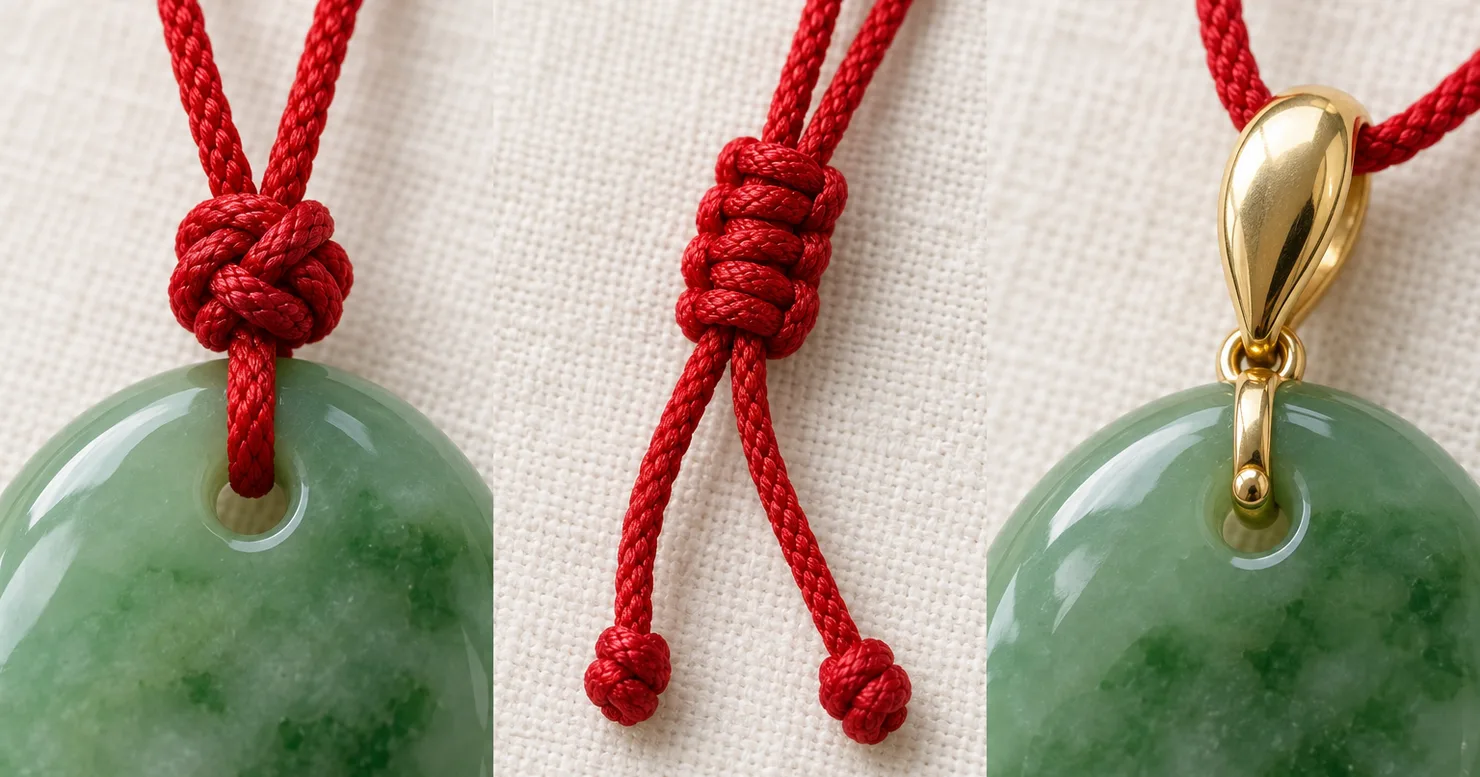
When you check a ready-made cord, look at three places: the knot above the hole (tight and even), the sliding knot (grips without slipping), and the cut ends (neatly melted or tucked, not loose fibres). Ask the seller which of these were tied by hand.
How long should the cord or chain be?
Length decides where the pendant sits, and for religious figures that matters to many wearers. In Chinese, Thai and Vietnamese custom alike, a Buddha or Guanyin is commonly worn around chest height, near the heart, and never so long that it hangs towards the waist. See jade Buddha pendants for the customs around these figures, and jadeite pendant meanings for what the common designs stand for.
| Necklace length (standard jewellery sizes) | Where it sits on most adults | Suits |
|---|---|---|
| About 40 to 45 cm | At or just below the collarbone | Small safety buckles, beads, small leaves; open necklines |
| About 45 to 50 cm | A little below the collarbone | Most small to mid-sized pendants; crew necks |
| About 50 to 60 cm | Upper chest | Guanyin and Buddha pieces, plaques; men's pendants; shirts with an open collar |
| About 60 cm and more | Mid chest, under clothing | Wearing the pendant hidden under a shirt |
Measure an existing necklace you like, laid flat, rather than guessing. A sliding cord avoids the problem: you set the length after it arrives. Heavier pendants pull a cord into a sharper V and sit a little lower than a chain of the same length.
Why does the hole wear out cords, and can a chain damage the hole?
Jadeite is a hard stone, about 6.5 to 7 on the Mohs scale. Nylon, silk, gold and silver are all far softer. That one fact explains most of what goes wrong.
- The stone cuts the cord. Every time the pendant swings, the edge of the drill hole rubs the cord. A hole with a sharp, unpolished edge wears a cord through much faster than one with a smoothed, rounded edge (倒角). If cords keep breaking at the same spot, look at the hole with a loupe.
- The stone wears the chain, too. A gold or silver chain threaded straight through a drill hole rubs against something harder than itself. The link that sits in the hole thins, and that is where such chains break, often without warning. This is why a bail exists: the chain rubs on metal, not on stone.
- A chain gives no cushion. Metal through a hole has no give, so when the pendant is knocked, the force goes into the thin wall of jade around the hole. That edge is where pendants chip. Thin-walled or hollowed carvings, resin-filled (Type B) pieces and softer look-alike stones are the most at risk. See is jadeite fragile? for what actually breaks jadeite.
So the trade's practical rule is short: cord through stone, chain through metal.
When should you replace the cord?
A common rule among dealers is to check a daily-worn cord about once a month and replace it when any of these signs appear, rather than on a fixed date. In hot, humid climates and for people who wear the pendant in the shower, it goes sooner.
| Sign | What it means | What to do |
|---|---|---|
| Fuzz or thin spot just above the hole | The hole edge is cutting the cord | Replace now; check the hole edge |
| Colour faded, cord stiff or shiny with grime | Sweat, soap and sun have aged the fibres | Replace soon |
| The sliding knot creeps open | The knot has loosened or the cord has stretched | Retie or replace |
| The pendant slides along the cord | The knot above the hole has loosened | Retie the diamond knot |
| Cord stays damp for hours | Common with thick cords worn in water | Take it off for swimming and showers |
Change the cord over a soft towel on a table, never over a hard floor or an open sink. Read how to care for jadeite for cleaning the pendant itself.
How do I check that a bail is secure?
A bail fails more often than the jade. Before you hang a pendant on a chain, check it in this order:
- Read the stamp. A gold bail is usually stamped 750, 18K or Au750; silver is stamped 925. Most gold bails and caps on Chinese-made jadeite are 18K. No stamp means you do not know what the metal is.
- Look at how it is held. A pin that passes right through the drill hole is the strongest. A bail held only by glue in a shallow hole can pull out, especially after heat or an ultrasonic cleaner.
- Tug and twist gently. Hold the jade, pull the bail lightly and turn it a little. It should not move, click or show a gap.
- Check the glue line. Yellowed or cracked glue around a cap or bail means it is ageing.
- Check the loop. The chain should pass freely. A loop worn thin on top, or pinched to force a thick chain through, should be replaced by a jeweller.
- Check the clasp of the chain too. Most lost pendants are lost through an open clasp or a snapped thin chain, not a broken bail.
How do Thai and Vietnamese wearers hang jade pendants?
Thailand. Many Thais hang a jade Buddha the way they hang an amulet: framed (เลี่ยมกรอบ, กรอบพระ, often gold or waterproof) on a gold chain (สร้อยคอทอง, สร้อยพระ). Thai gold shops mainly sell 96.5% gold, which is softer than 18K, so chains are often chosen heavy and the frame's loop (ห่วงพระ) should be solid. Some people wear several images on one chain with the main one in the centre. For cord, Thai shops sell ready-made amulet cords of parachute cord (เชือกร่ม) with adjustable length and a lobster clasp (ก้ามปู).
Vietnam. A gold chain with a jade pendant (dây chuyền vàng đeo mặt ngọc) is a classic gift, especially in 18K (vàng tây) or 24K (vàng ta). 24K gold is soft, so a thin 24K chain on a heavy pendant stretches and breaks; choose a sturdy chain or a lower, harder karat. Many men wear a Buddha pendant (dây đeo mặt Phật) on a black parachute cord (dây dù), and red cord is popular for a person's own zodiac year (năm tuổi), by tradition.
How do I hang a new pendant, step by step?
- Look at the top: hole only, hole with bail, or cap or frame.
- Measure the hole width and the pendant's weight, or ask the seller.
- Hole only: choose a braided cord that fills the hole, with a knot above the pendant and a sliding knot.
- Bail or frame: choose a chain that passes the loop freely and is strong enough for the weight; check the stamp and clasp.
- Set the length so the pendant sits where you want it, at chest height for a Buddha or Guanyin.
- Check the cord monthly and the bail and clasp whenever you clean the piece.
On JadeiteHub, every listing shows real photos from the seller, some with video, and every sold piece is checked against its certificate before it ships with insured shipping. Ask the seller how the pendant is hung and what the hole or bail looks like before you buy. If the piece does not match the description, you get a full refund.
FAQ
Can I put a gold chain straight through the hole of a jade pendant?
It is better not to. Jadeite is harder than gold, so the link inside the hole wears thin and breaks, and the rigid chain can chip the edge of the hole when the pendant is knocked. Ask a jeweller to fit a bail, or use a cord.
Is a red or a black cord better for a jade pendant?
Both work the same. Red is the traditional colour of good fortune in Chinese custom and suits small, bright pieces; black or dark cord looks understated and is common for men and for Buddha and Guanyin pendants.
How often should I change a jade pendant cord?
Replace it when it shows fuzz or a thin spot above the hole, fades, stiffens or the knot slips. Many dealers suggest checking a daily-worn cord about once a month; in hot climates it wears out sooner.
What is a melon-seed bail?
A small teardrop-shaped metal loop, called 瓜子扣 in Chinese, fitted to the top of a pendant by a pin through the drill hole. It lets a chain pass without rubbing the stone. Check the metal stamp and that it does not move when gently pulled.
How long should the chain be for a Buddha or Guanyin pendant?
Most people wear it at chest height, often on a chain or cord of about 50 to 60 cm, so the figure sits near the heart and well above the waist. Measure a necklace you already like, or use an adjustable sliding cord.