Jade Buddha Pendants: Meaning, Thai Customs and Fakes
Updated
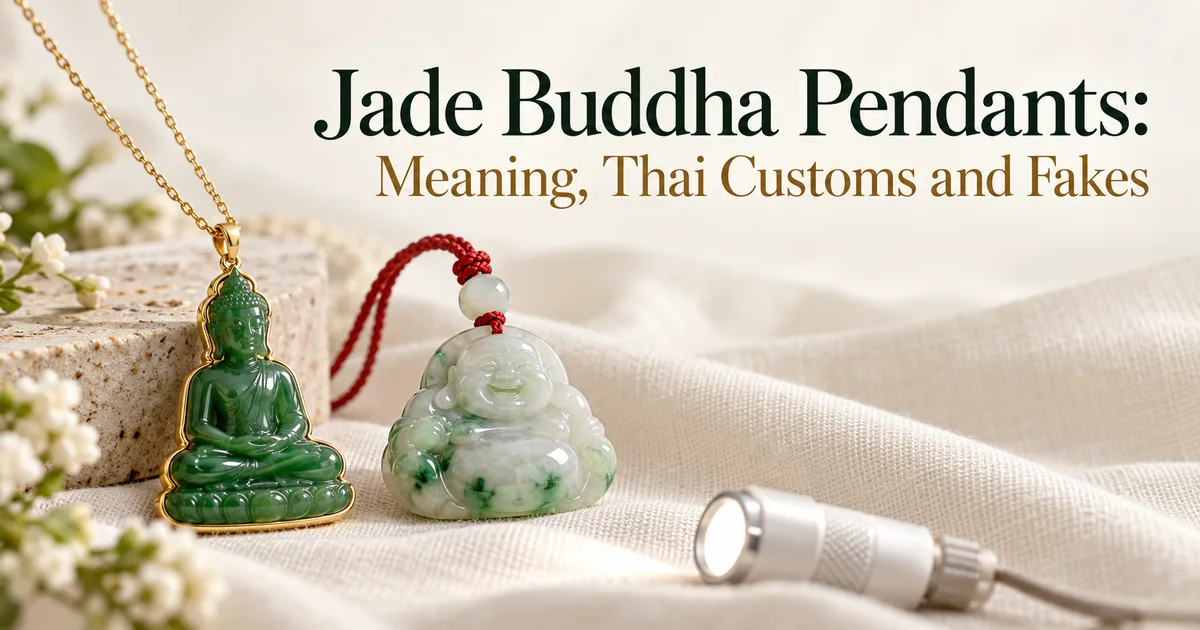
A jade Buddha pendant is a jadeite carving of a Buddha or bodhisattva worn on a cord or chain, most often the laughing Buddha (Maitreya), Guanyin or a Thai-style seated Buddha. Its value comes from the jade and the carving, not from whether it was blessed. Check the face, shine a flashlight along every carved fold for hidden cracks, get a lab certificate before framing it in gold, and be wary of any "already blessed" price premium.
What is a jade Buddha pendant?
A jade Buddha pendant is a jadeite carving of a Buddha or a bodhisattva, worn on a cord or chain around the neck. The figures you will meet most are the laughing Buddha, Guanyin and Thai-style seated Buddha images.
For many people it is two things at once: a piece of jewelry and a religious image. That changes how it is bought. Buyers care about the face, about how and where it is worn, and about whether it has been blessed. Sellers know this, and some use it. In Chinese, people even avoid the word "buy": they say they "invite" (请) a Buddha. Many Thais say เช่า ("rent") or บูชา ("worship") instead of ซื้อ, and Vietnamese say thỉnh.
This guide covers the figures, the customs around wearing them, what consecration does and does not change, and how a dealer judges the jade and the carving of a Buddha piece.
| Language | What people call it |
|---|---|
| Chinese | 翡翠佛公 or 弥勒佛 (laughing Buddha), 翡翠观音 (Guanyin), 佛像吊坠 |
| Thai | จี้พระหยก, พระหยกพม่า, จี้เจ้าแม่กวนอิมหยก |
| Vietnamese | mặt Phật cẩm thạch, mặt Phật Di Lặc, mặt Quan Âm phỉ thúy |
| English | jade Buddha pendant, jade Guanyin pendant, jade amulet |
Which Buddha figures are carved in jadeite?
Three groups make up most of the market.
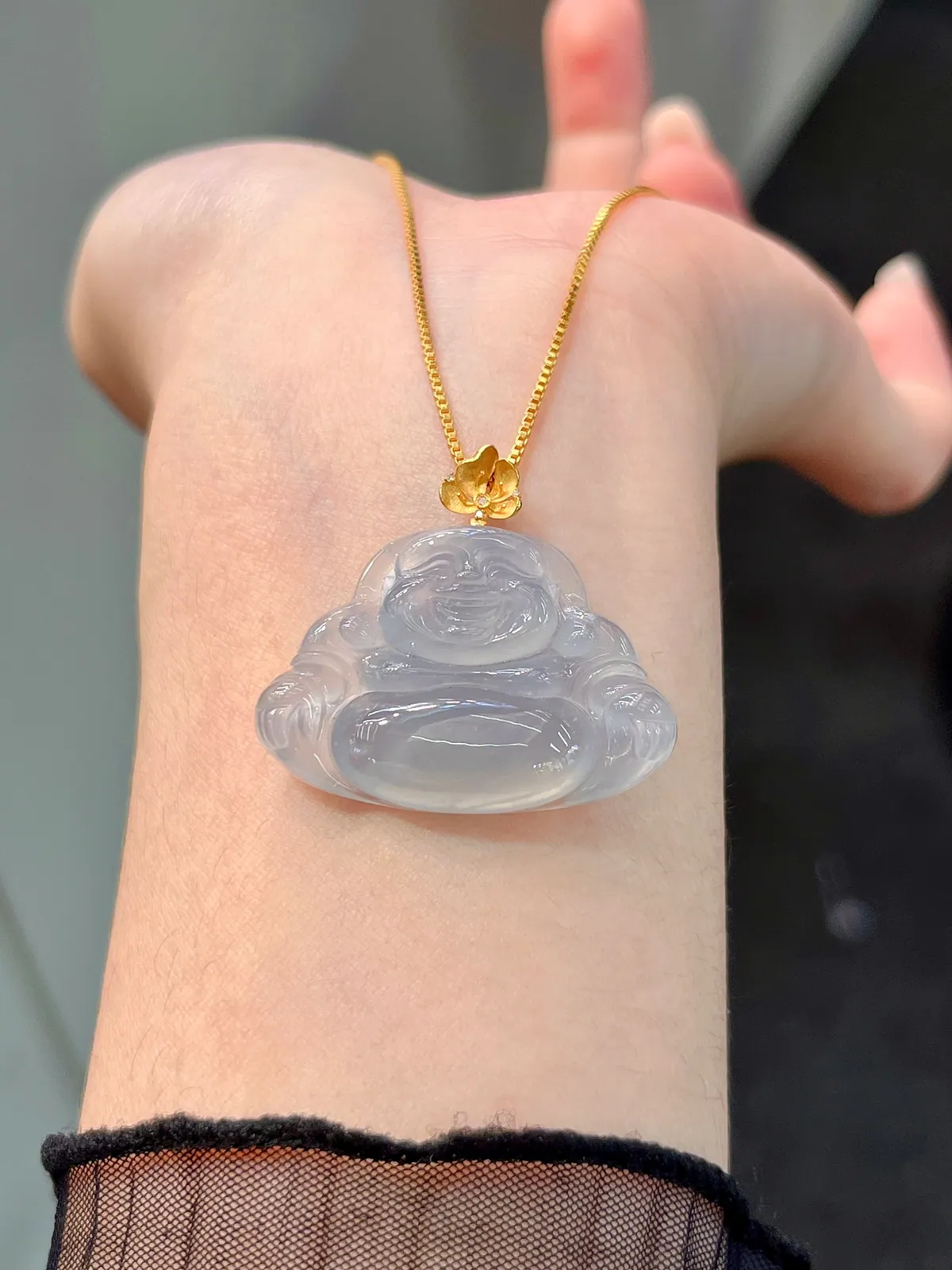
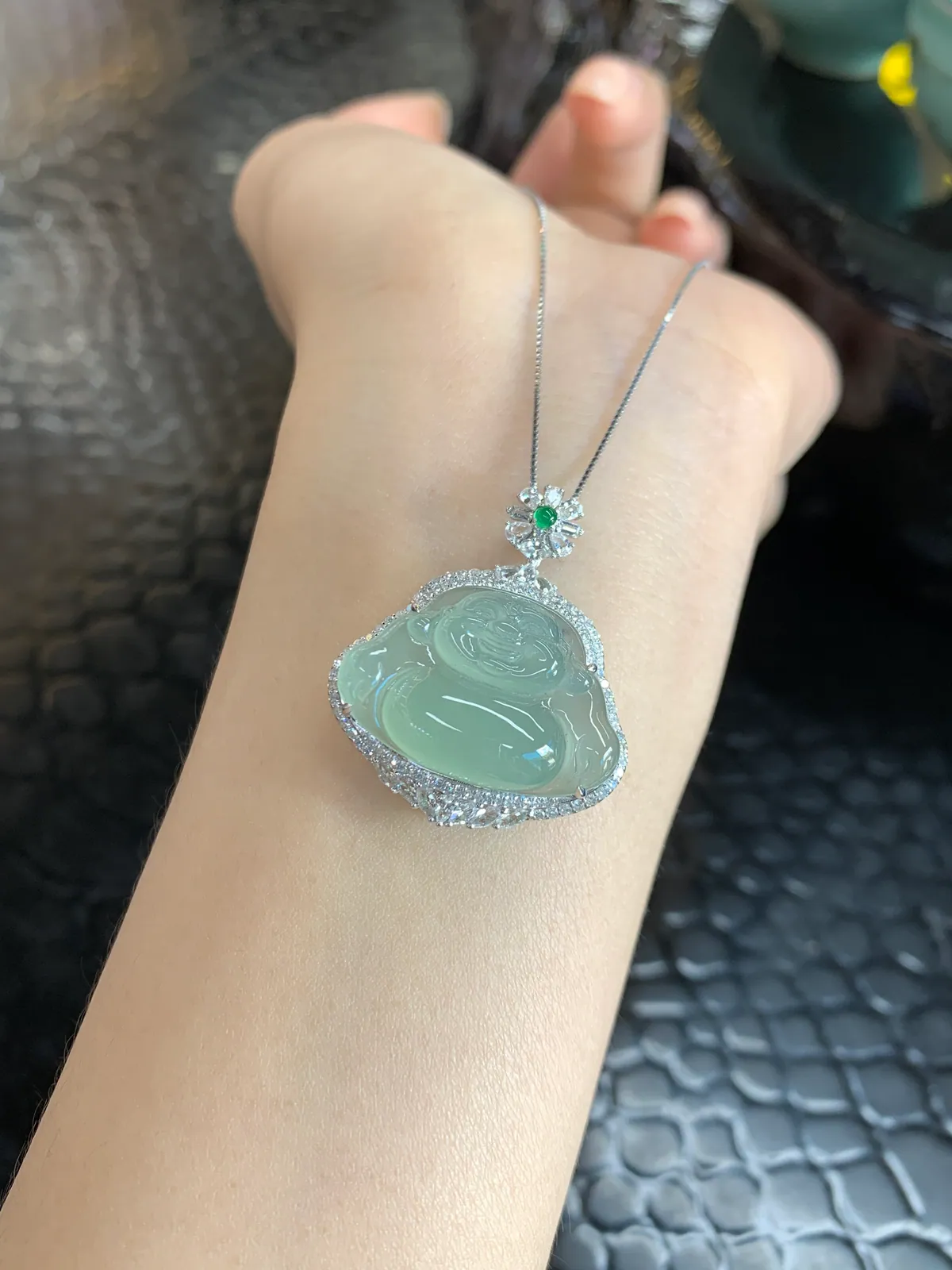
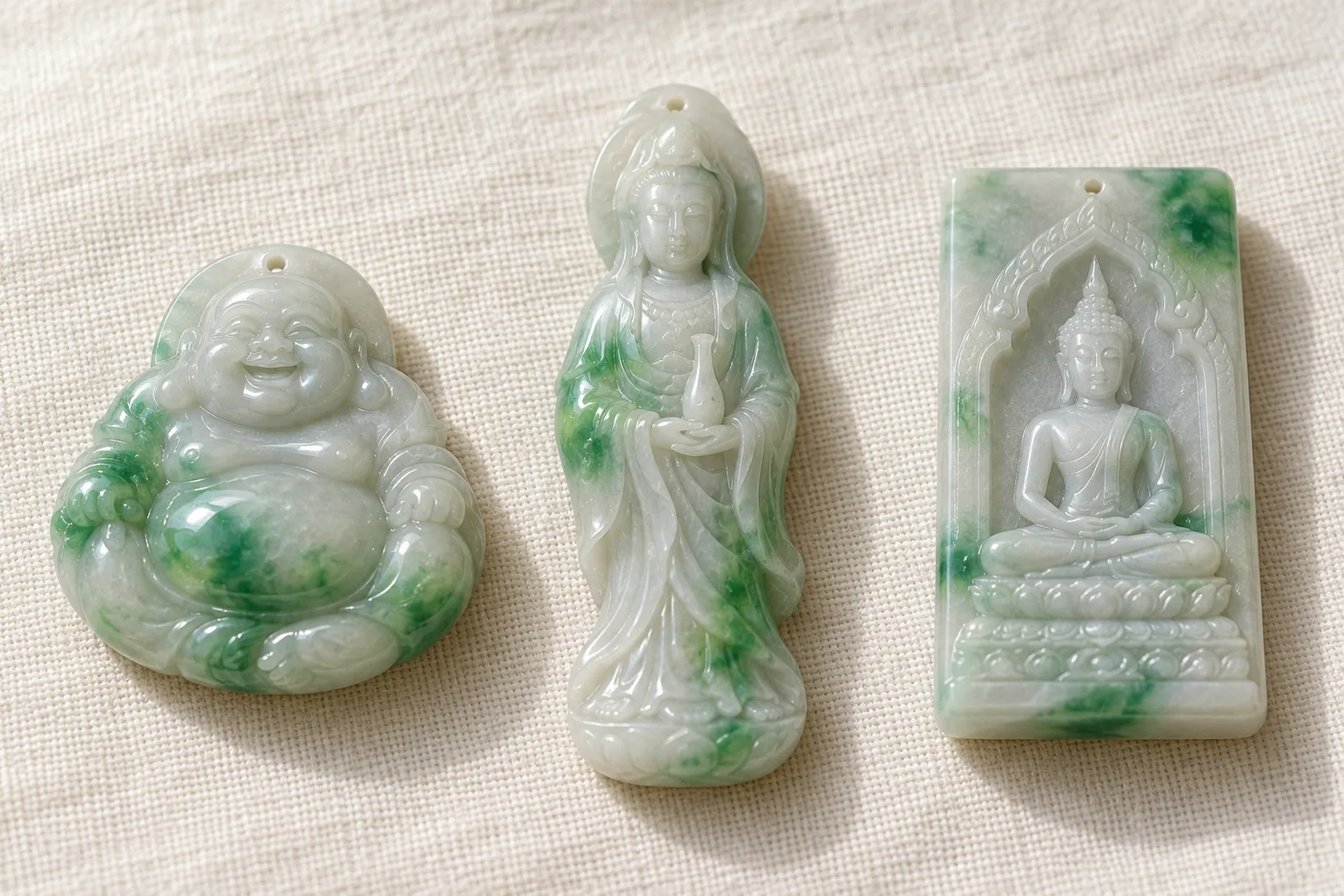
The laughing Buddha (佛公). A round-bellied, smiling figure, usually seated, sometimes with a cloth bag or prayer beads. In Chinese tradition he is Maitreya (弥勒佛), the Buddha of the future, shown in the form of Budai (布袋), a cheerful monk from Chinese legend. He is the most carved Buddhist figure in jadeite. The rounded shape suits the stone, and the large, smooth belly shows off colour and translucency.
A gentle note on names. In Thailand this figure is often called พระสังกัจจายน์ (Phra Sangkajai). Strictly, those are two different figures. Phra Sangkajai is Mahakaccayana, a disciple of the Buddha, who in Thai images is also round and seated but is shown as a calm monk rather than a laughing figure with a bag. The Chinese laughing Buddha is Maitreya, whom Thais call พระศรีอาริย์ (Phra Si An). Because both are round-bellied, the two are mixed up all the time, in shops as well as at home. If the identity matters to you, ask the seller which figure the carving is meant to be.
Guanyin (观音). The bodhisattva of compassion, with a calm face, a hood or crown, often holding a small vase of pure water or a willow branch, and standing or seated on a lotus. Guanyin is especially loved in Thai-Chinese families, where she is เจ้าแม่กวนอิม. In jadeite she is usually carved as a slim upright figure, or inside an oval or arched plaque.
Thai-style Buddha images. A Buddha seated in meditation or in the earth-touching posture, with a Thai-style face, a flame-shaped top on the head and the robe over one shoulder. Some are carved in the shape of a Thai amulet: a rectangular plaque with an arch and a tiered base, in the style people know from Phra Somdet (พระสมเด็จ) amulets. A jadeite piece in this shape is a carving in the form of a well-known amulet type. It is not a temple-made amulet, and it should not be sold as one.
Two smaller groups are worth knowing. Chinese buyers sometimes choose a "birth-year Buddha" (本命佛): eight Buddhas and bodhisattvas matched to the twelve zodiac years, such as the Thousand-armed Guanyin for the year of the Rat and Amitabha for the Dog and the Pig. Some Thai buyers prefer a Buddha in the posture for their day of birth (พระประจำวันเกิด), such as the meditation posture for Thursday. With both, the posture or attributes define the figure, so check them with the seller.
| Figure | Chinese | Thai | Vietnamese | How to recognise it | What people associate it with |
|---|---|---|---|---|---|
| Laughing Buddha (Maitreya, Budai) | 佛公 / 弥勒佛 | พระศรีอาริย์, often called พระสังกัจจายน์ | Phật Di Lặc | Round belly, broad smile, often a cloth bag or beads | Happiness, contentment, tolerance; the saying "a big belly holds what is hard to hold" (大肚能容) |
| Guanyin | 观音 | เจ้าแม่กวนอิม | Quan Âm | Calm face, hood or crown, vase or willow branch, lotus | Compassion, peace, protection |
| Thai-style seated Buddha | 泰式佛像 | พระพุทธรูปแบบไทย, ปางสมาธิ or ปางมารวิชัย | tượng Phật kiểu Thái | Meditation or earth-touching posture, robe over one shoulder | Faith, calm, a reminder of the teaching |
| Amulet-shaped plaque | 泰国佛牌造型 | ทรงสี่เหลี่ยมแบบพระสมเด็จ | mặt Phật kiểu bùa Thái | Rectangular frame, arch, tiered base | The same as the Buddha image it shows |
| Birth-year Buddha | 本命佛 | พระประจำปีเกิดแบบจีน | Phật bản mệnh | Eight figures, each linked to one or two zodiac years | Protection for the wearer's birth year |
Is it really "men wear Guanyin, women wear Buddha"?
The Chinese saying is 男戴观音女戴佛. The usual explanations: Guanyin's calm softens a man's temper and keeps him safe on the road; the laughing Buddha's tolerance brings a woman contentment; and 佛 (fo) sounds a little like 福 (fu, good fortune). Vietnamese buyers know it too, as "nam Quan Âm, nữ Di Lặc". The meanings of each design are covered in jadeite pendant meanings.
In practice, many people ignore it. Plenty of Chinese men wear a laughing Buddha, and many women wear Guanyin. In Thailand the saying is not a rule people follow at all: men and women alike wear Buddha images, and choose by faith, family habit or simply what they like. For the wider beliefs around jade in Thailand, China and Vietnam, see jadeite meaning and beliefs.
| Chinese custom | Thai custom | Vietnamese custom | |
|---|---|---|---|
| Who wears what | 男戴观音女戴佛, often ignored today | Everyone wears Buddha images, regardless of gender | "Nam Quan Âm, nữ Di Lặc" is known, and often ignored |
| How many | Usually one pendant | One main image, and some people wear several on one chain | Usually one pendant |
| Blessing | 开光 at a temple, for those who want it | ปลุกเสก, or taking a new piece to a monk to bless it, is common | Khai quang at a pagoda, for those who want it |
| How it is acquired | 请 ("invite") rather than 买 | เช่า or บูชา rather than ซื้อ | Thỉnh rather than mua |
These are sayings and customs, not effects. A pendant does not work differently because of who wears it.
How do many Thais wear a Buddha image?
Customs vary between families and temples, so treat these as what many people do, not as rules.
- Above the waist. A Buddha image is worn on a neck chain or cord (ห้อยคอ), not in a trouser pocket, on a belt or on an ankle chain. Many people feel an image should not hang below the waist.
- One main image in the centre. People who wear several on one chain usually put the Buddha image in the middle, with other pieces on either side.
- A moment of respect. Many raise their hands in a wai, and some say a short chant (คาถา), before putting the image on.
- Taking it off. Many Thais take a Buddha image off before sex, and some also before going somewhere they consider unsuitable for it. When it is off, it goes in a high, clean place, such as a shelf or the family altar, not on the floor or on a bed, and nobody steps over it.
- Guanyin and beef. Some Thai-Chinese who wear or worship Guanyin do not eat beef. Others do not follow this. It is a personal practice.
There are practical reasons that fit the same customs. Taking a pendant off before sport, heavy work or sleep also protects it from knocks, which is when most pendants chip.
What is consecration (ปลุกเสก, 开光), and does it change the jade?
In Thailand, ปลุกเสก is a ceremony in which monks chant over Buddha images and amulets to bless them. Many Thais also take a newly bought jade pendant to a temple and ask a monk to bless it, mark it (เจิม) or sprinkle it with holy water before wearing it for the first time. In Chinese practice the equivalent is 开光, "opening the light": a temple ceremony that marks a carving as a religious image. Vietnamese call it khai quang.
Whether to have a piece blessed is a personal and religious choice, and this guide takes no view on it. What it does not do is change the stone. A Type B or dyed piece stays treated after any ceremony. A crack stays a crack. The colour, translucency and texture are the same before and after. The certificate and the jade itself tell you what you are buying.
That is why "already blessed" is one of the most common ways to sell poor material at a high price. Typical lines, and what to do with them:
| What the seller says | What it tells you about the jade | What to do |
|---|---|---|
| "ปลุกเสกแล้ว / 已开光, so it costs more" | Nothing | Price the jade and the carving; compare with similar unblessed pieces |
| "Blessed by a famous monk / master" | Nothing, and usually impossible to check | Do not pay for a claim you cannot verify |
| "Blessed pieces must not be tested, taken out of the frame or lit with a torch" | It stops you inspecting it | Walk away. An honest seller lets you look |
| "Real Burmese jade, blessed" with no certificate | Nothing about treatment | Ask for a lab certificate that says jadeite, natural (Type A) |
| "This one has a special energy" | Nothing | Judge the stone the way you would any jadeite |
If a blessing matters to you, the cleanest way is to buy certified jade for what the stone is worth and then take it to a temple of your choice.
How do you judge the carving on a Buddha pendant?
On any figure, the face matters most. The trade calls carving a face 开脸, "opening the face", and a dealer looks there first.
| Part | Good work | Poor work |
|---|---|---|
| Face (开脸) | Eyes, brows and mouth symmetrical; expression calm (Guanyin, Thai-style Buddha) or truly joyful (laughing Buddha), with the smile reaching the eyes | Uneven eyes, a crooked mouth, a flat or blurred face, an expression that looks sly, sad or stiff |
| Clean face | The face sits in clean, even jade | A black spot, a cotton patch or a crack across the face; dealers say the face must be clean (脸要干净), and a flaw there costs far more than the same flaw on the base |
| Proportion | Head, body and base in balance; on a Thai-style Buddha, the seated figure forms a steady triangle | Head too big, body squeezed to fit the stone, a lopsided plaque |
| Hands and ears | Fingers separated, objects held clearly; long earlobes carved cleanly | Mitten-like hands, objects that blur into the body |
| Robe folds and recesses | Crisp folds, polished right into the hollows | Shiny high points, dull or gritty recesses, tool marks |
| Back and thickness | A flat, finished back with enough thickness | A deeply hollowed back that makes the front look brighter than it is |
| Bail and drill hole | Centred, smooth, strong enough for the weight | Off-centre, chipped, or too thin to be safe |
Buddha pendants are among the most machine-made jadeite pieces. A tray of identical Buddhas, every fold the same, is machine work. That is fine at the right price; it is not fine when sold as "pure hand carved". The signs of hand and machine carving are set out in jade carving quality.
Where do cracks hide on a Buddha pendant?
The trade saying is 无绺不雕, "no flaw, no carving": clean stone is often left plain, and stone with cracks is carved so the flaws fall into grooves. On a Buddha piece, the lines of the design give cracks plenty of places to hide.
- Laughing Buddha: the fold under the belly, under the chin, along the bag and the robe.
- Guanyin: the long robe folds, the neck (often the thinnest part), the edge of the hood and the lotus base.
- Thai-style Buddha and amulet plaques: the lines of the tiered base and the arch, and the edge of the plaque, which a frame will later cover.
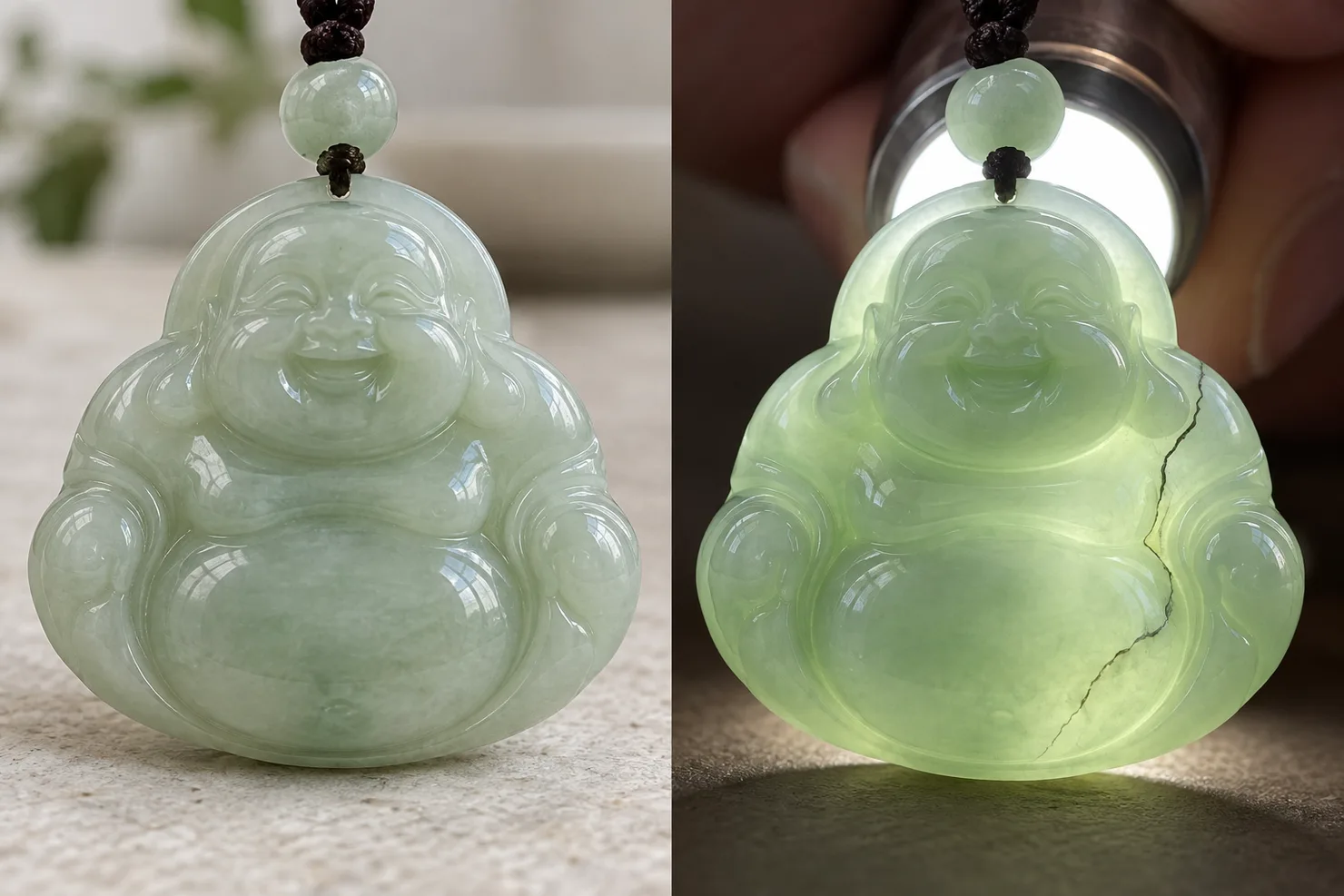
How to check, in this order:
- Daylight first. Look at front, back and side by a window. Note the thickness and whether the back is hollowed.
- Reflected light. Tilt the piece under one lamp. A crack that reaches the surface often breaks the reflection as a fine line.
- Transmitted light. In a dim room, press a small white flashlight against the back and move it slowly along every fold. A crack stops the light and shows as a sharp line with a bright side and a dark side. A healed vein (石纹) lets light pass and shows as a soft line of colour.
- Follow the line past the groove. A line that continues beyond the end of a fold, or appears on the back too, is a crack, not a carved line.
- Do not judge colour only from behind. A thin piece lit from behind looks greener and more translucent than it will look on the chest.
How to tell a crack from a vein, and which flaws matter most, is covered in jadeite cotton and cracks.
Is it treated jadeite, or not jadeite at all?
Cheap Buddha pendants are one of the most common places to find treated jadeite and look-alikes, because mass-made machine carvings in low-cost material are easy to produce in quantity.
| Material | How it may be sold | Signs to look for | What settles it |
|---|---|---|---|
| Type B jadeite (acid-bleached, resin-filled), หยกเกรด B | "Natural jade", "grade A" | Very clean, bright look for the price; a soft, plastic-like lustre; under a loupe, a fine net of etched lines on the surface | A lab certificate |
| Type C (dyed) jadeite | "Imperial green", "old jade" | Bright, even green; colour gathered in veins and cracks | A lab certificate |
| Glass | "Jade", "Burmese jade" | Round bubbles, swirls, moulded seams; many identical pieces | Loupe, then a certificate |
| Nephrite, often called หยกไต้หวัน in Thailand | "Jade" | Real jade but a different mineral: oilier lustre, often even spinach green with black dots, lighter in the hand | A certificate that names nephrite |
| Quartzite, serpentine and others | "Malaysia jade", "new jade" | Dye nets, softness, waxy lustre | A certificate |
Nephrite is genuine jade, and a nephrite Buddha is a fine thing to own if it is sold as nephrite; the problem is only when it is sold as Burmese jadeite. See jadeite vs look-alikes, how to spot treated jadeite and how to verify a jadeite certificate.
Should you frame a jade Buddha in gold (เลี่ยมกรอบ)?
In Thailand, framing a Buddha image in a gold or waterproof casing (เลี่ยมกรอบ, เลี่ยมทอง, เลี่ยมกันน้ำ) is normal, and many Thai buyers do the same with jade Buddhas. A frame protects the edges from knocks, adds a strong bail for a chain, and gives a finished look.
The catch is that a frame covers exactly the part where chips and cracks often start: the edge. A closed back hides the back, a sealed waterproof case means you can no longer touch the stone, and a bright backing behind a thin piece can make it look greener than it is.
| Frame | Good for | Watch out for |
|---|---|---|
| Open-back gold bezel | Protecting the edge; both faces still visible | The edge itself is hidden |
| Closed-back frame | Thin or fragile pieces | The whole back is hidden; a coloured or foil backing can change the colour |
| Waterproof casing (เลี่ยมกันน้ำ) | Daily wear, water, knocks | You cannot touch the stone; a scratched cover blurs it; moisture can get trapped if the seal fails |
| Gold cap and bail only | Keeping most of the jade visible | Whatever lies under the cap |
So: get the certificate and inspect the piece before it is framed, and keep the daylight and flashlight photos. Make sure the certificate photo still matches the framed piece. Ask the framer, in writing, the gold purity and the gold weight. Most gold-set jadeite is made in China, usually in 18K (75% gold, stamped Au750 or G18K); a framing shop in Thailand may use a different purity, so ask. More on settings and what they can hide in gold-set jadeite.
What size and thickness, and cord or chain?
- Size. Ask for the length, width and thickness in millimetres, and a photo next to a coin or ruler. Photos make pendants look larger than they are. Larger figures usually suit a longer chain; small ones are easier for daily wear.
- Thickness. Enough to carry the colour and survive daily wear. A very thin, hollowed piece looks bright from behind but pale in daylight, and breaks more easily. A very thick piece can look dark and feel heavy.
- Weight and bail. A heavy pendant needs a solid bail, or a gold cap and bail, and a chain strong enough for it.
| Cord (เชือก) | Gold chain (สร้อยทอง) | |
|---|---|---|
| Feel | Soft and light | Heavier, more formal |
| Strength | Frays and stretches with time | Strong, but needs a metal bail or frame |
| Watch out | Check it often and replace it when it frays; a wet cord stays damp | Metal rubbing inside a drill hole can wear or chip the hole; check the clasp |
| Typical choice | Red cord for Chinese-style pieces, simple daily wear | Framed Thai-style pieces, several images on one chain |
Care. Take the pendant off for sport, heavy work and sleep. Wash it in lukewarm water with a drop of mild soap, using a soft brush in the folds, and dry it well, especially under a frame. Do not use ultrasonic or steam cleaners on carved or framed pieces, keep it away from chemicals, and store it on its own in a soft pouch.
What should you check before you buy?
- Decide on the figure and confirm with the seller which one it is.
- Ask for daylight photos of the front, back and side, and a short video.
- Look at the face closely. Symmetry, expression, and no spot or crack on it.
- Ask for a flashlight video along every fold, front and back.
- Ask for a lab certificate that says jadeite, natural (Type A), and check that its photo, weight and size match the piece.
- Price the jade and the carving, not the blessing.
- Frame it only after you have inspected it.
- Put the important answers in writing: hand or machine carved, any cracks, treated or not.
Typical mistakes are trusting "already blessed" or "from a temple" in place of a certificate, judging the jade only from backlit photos, and framing a piece before anyone has looked at its edges.
Buying a jade Buddha pendant on JadeiteHub
On JadeiteHub, sellers post real photos of the actual piece, some with video, and you can ask a seller to show the face, the folds and the back under a flashlight before you buy, so the listing describes them. Every sold piece is checked against its certificate before it ships, travels with insured shipping, and is fully refunded if it does not match the description. If a blessing matters to you, you can take the piece to a temple of your choice once it arrives.
FAQ
Can a man wear a laughing Buddha, or a woman wear Guanyin?
Yes. "Men wear Guanyin, women wear Buddha" (男戴观音女戴佛) is a Chinese saying, not a rule, and many people ignore it. In Thailand, men and women alike wear Buddha images and choose by faith or taste.
Is Phra Sangkajai the same as the laughing Buddha?
Strictly, no. The Chinese laughing Buddha is Maitreya, called พระศรีอาริย์ in Thai. Phra Sangkajai (พระสังกัจจายน์) is Mahakaccayana, a disciple of the Buddha. Both are round-bellied, so they are often mixed up; ask the seller which figure a carving is meant to be.
Is a blessed (consecrated) jade Buddha worth more?
Not as jade. Consecration (ปลุกเสก, 开光) is a religious matter and does not change the stone, its treatment or its cracks. Price a piece by its jade and carving, and be wary of sellers who use "already blessed" to justify a high price without a certificate.
Should I frame my jade Buddha in gold?
Many Thai buyers do, to protect the edges and add a strong bail. Inspect the piece and get the certificate first, because a frame hides the edge, where chips and cracks often start. Ask the framer for the gold purity and weight in writing.
How can I tell if a cheap jade Buddha is real jadeite?
Look for warning signs: identical machine-made pieces, a plastic-like lustre, bright even green, bubbles, or colour gathered in cracks. These only raise questions. A lab certificate naming jadeite, natural (Type A) is the answer.