Jade Carving Quality: Hand vs Machine and What It Hides
Updated
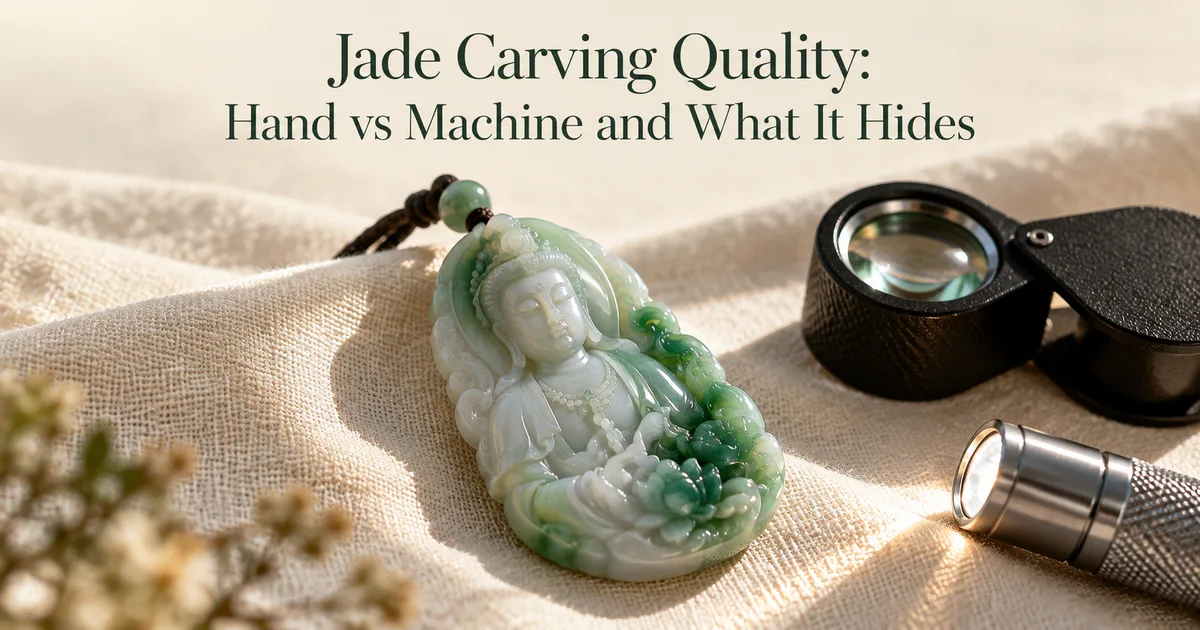
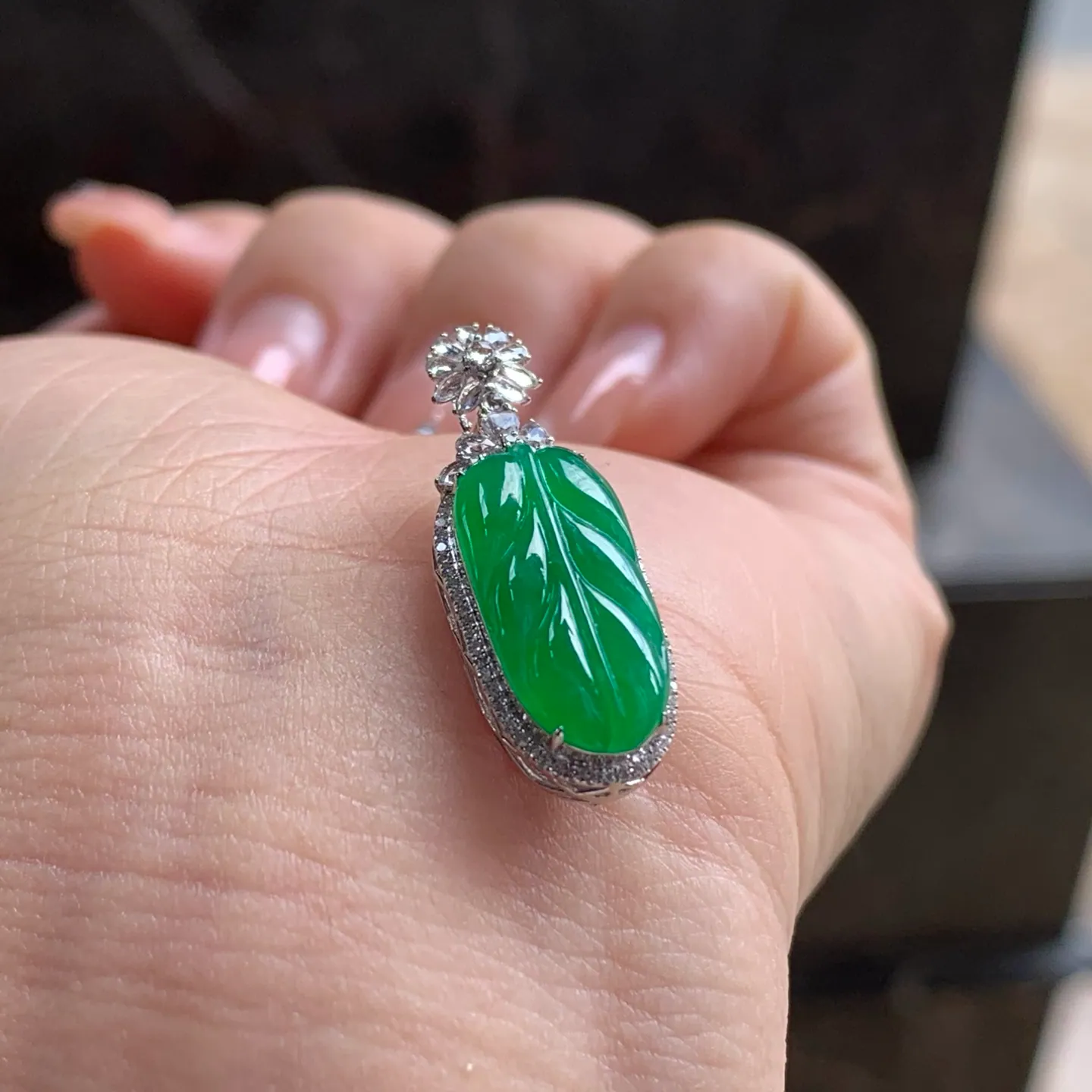
Workmanship (做工) is everything done to the stone after it is cut: the design, the carving, the polish, the proportions and the finishing. Good work fits the design to the stone, cuts crisp layered relief and polishes right into the recesses. Machine carving is normal on lower-priced pieces if the price matches. Heavy carving often covers cracks or cotton, so a plain piece of the same material is usually worth more: check every carved area with a flashlight.
What is workmanship (做工) in jadeite?
Workmanship, called 做工 or simply 工 ("work") in the trade, is the quality of everything done to the stone after it is cut: the design, the carving, the polish, the proportions and the finishing of the bail and drill hole. It is the second thing a dealer looks at, after the material itself.
Chinese carvers have a common saying, 三分料,七分工: "three parts material, seven parts work". It comes from the wider jade-carving tradition, where an ordinary stone becomes a treasure through the carver's hands. Many jadeite dealers turn it around and say the material counts for more, because no carving can make poor jadeite valuable. Both views hold some truth. The material sets how much a piece can be worth. The work decides how much of that you actually get to see: good work shows the colour and translucency at their best, and poor work wastes good stone.
This guide is about the quality of the work: how to tell good carving from poor carving, how to spot machine work, and what carving can hide. What each motif means is covered in jadeite pendant meanings.
What does workmanship include?
Dealers look at five things, roughly in this order.
| Part of the work | Chinese term | Good work | Poor work |
|---|---|---|---|
| Design and layout | 设计 / 构图 | The design fits the shape of the stone, puts the best colour on the front, and places flaws where they are cut away or blend into the motif | Colour pushed to the side or back; motif squeezed or cut off at the edge; a crack running across a face |
| Carving | 雕工 | Several levels of depth, crisp lines, clean undercuts, faces and hands in proportion with a lively expression | Shallow, flat relief; blurred lines; stiff or lopsided faces; tool marks left in the grooves |
| Polish | 抛光 | Even, bright shine on the high points and inside the recesses; the flat background between motifs (地子) smooth and level | Shiny on top, dull and gritty in the hollows; ripples or fine scratches; a thick waxy glow over a poor polish |
| Proportion and thickness | 比例 / 厚薄 | Balanced outline, symmetry where the design calls for it, enough thickness for the colour and for daily wear | Heads too big for bodies; a lopsided disc; a back hollowed out so thin that the piece is fragile |
| Bail and drill hole | 挂头 / 打孔 | Hole centred and straight, smooth inside, edges slightly rounded so the cord does not fray; a solid bail | Off-centre hole, chipped edges, a rough channel that cuts the cord; a bail too thin to be safe |
On figures, the face matters most. The trade calls carving a face 开脸, "opening the face". On a Guanyin or a Buddha, buyers look first at the eyes, the mouth and the line of the brows: are they symmetrical, calm and alive? A slightly crooked face spoils the whole piece, whatever the material. Hands and fingers come next, because they are small, hard to carve and easy to rush.
How do you tell hand carving from machine carving?
Almost all jadeite carving today uses power tools. A hand carver works with a flexible-shaft drill and diamond burs, so "hand carved" means a person guides every cut, not that no machine was used. The real difference is between pieces shaped cut by cut by a carver and pieces shaped automatically.
| Method | Chinese term | How it is done | Typical signs |
|---|---|---|---|
| Hand carving | 手工雕 | A carver shapes the piece with burs, one cut at a time | Every piece slightly different; crisp edges and undercuts; layered depth; lively expression |
| CNC machine carving | 机雕 (数控) | A computer-guided bur follows a 3D file | Identical pieces; even depth; fine parallel tool-path lines in the hollows; symmetrical but stiff faces |
| Ultrasonic stamping | 超声波 | A shaped steel die vibrates against the stone with abrasive paste and presses the whole design in at once | Very shallow, uniform relief; soft rounded edges; no undercuts; dull, slightly frosted recesses; many identical copies |
| Semi-hand | 半手工 | A machine roughs out the design, then a carver refines the face, the details and the polish | Mixed signs; good examples come close to hand work |
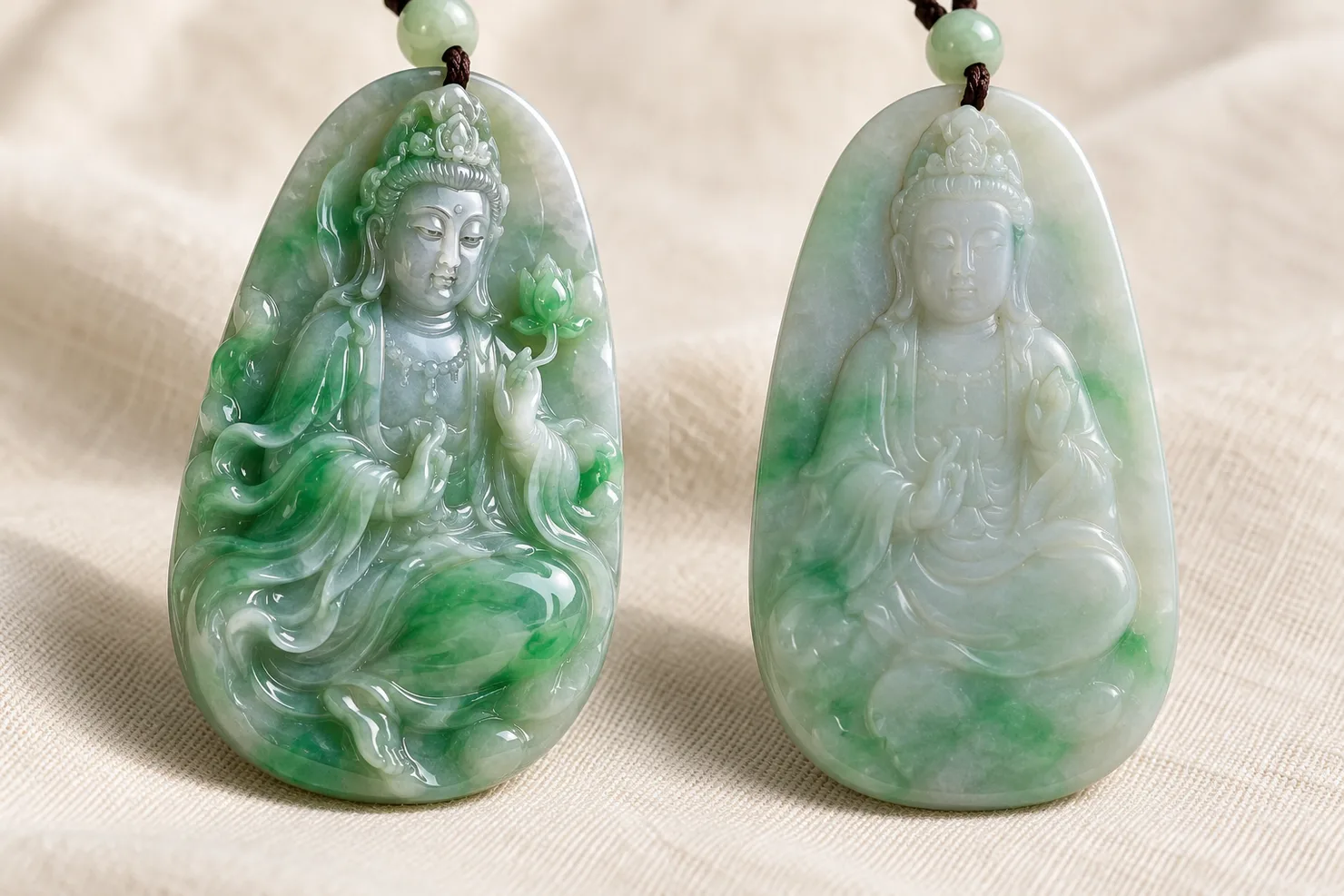
Signs of machine work:
- Identical pieces. A seller with a tray of the same Buddha, every one the same down to the folds of the robe, is selling machine work. Hand carving always varies a little.
- Shallow, uniform depth. Every part of the design sits at about the same height, as if pressed into the stone.
- Soft, rounded edges and no undercuts. A die or a vertical bur cannot cut underneath a leaf or behind a hand, so nothing stands free of the background.
- Stiff faces. The face is technically neat but has no expression; the eyes are simple grooves.
- Unpolished recesses. The high points shine, but the hollows are matte, grey or gritty, because nobody spent time polishing inside them.
Signs of hand work: small differences between left and right, lines that taper and turn, leaves that lift away from the background with a shadow underneath, several clear levels of depth, and a face that looks like it is thinking or smiling.
Machine carving is not "bad". It is what makes many jadeite pendants affordable, and on modest material it is the sensible choice: weeks of a skilled carver's time would cost more than the stone. What matters is that the price matches the work. Be wary when a piece with every machine sign is sold as "pure hand carved" (纯手工) and priced like it.
An honest note: the line is blurring. Modern CNC machines with fine burs, followed by hand finishing of the face and polish, can produce pieces that even dealers hesitate over in photos. If the carving is a major reason for the price, ask the seller in writing how the piece was made.
What does it mean when a design "uses the stone"?
The trade term is 因材施艺, "adapting the art to the material". Before choosing a motif, a good carver studies the stone: where the colour sits, where cotton and cracks run, how thick it is. The design comes from the stone, not the other way round. That is why two pendants of the same subject can look completely different, and why the best designs feel as if they could not have been carved any other way.
- 俏色 (also written 巧色), "clever colour". Using the different colours in one stone on purpose, each for a different part of the design. On a 春带彩 stone (lavender and green together), the lavender becomes a flower and the green becomes the leaves. A patch of red or yellow becomes a bat, a gourd, a fish or an autumn leaf.
- 留皮, "keeping the skin". Leaving part of the brownish or reddish weathered skin of the boulder as a feature, such as a monkey's fur, a branch or a bird's wing.
- Turning flaws into features. A patch of cotton becomes clouds, waves or snow; a dark patch becomes a crab shell or rocks.
Carvers often say that one well-placed touch of colour is worth more than several, and the test is simple: does the colour stop exactly where the motif stops? A red patch that forms the whole bat and nothing else is fine 俏色. Colour that spills over the edge of the motif, or a design that ignores where the colour is, shows the carver did not plan around the stone. Treated or dyed colour can also be shaped into a motif, so the usual checks for treated jadeite still apply.
What can carving hide?
This is the most important part for buyers. The trade saying is 无绺不作花, often shortened to 无绺不雕: "no flaw, no carving". Clean material is usually left plain, because cutting it away loses value. Material with cracks, cotton, black spots or patchy colour is carved, and the design is laid out to cut the flaws away or hide them in grooves.
That is not dishonest in itself. It is how the trade makes good use of stone that would otherwise be wasted, and many carved pieces are lovely. But it means two things for buyers:
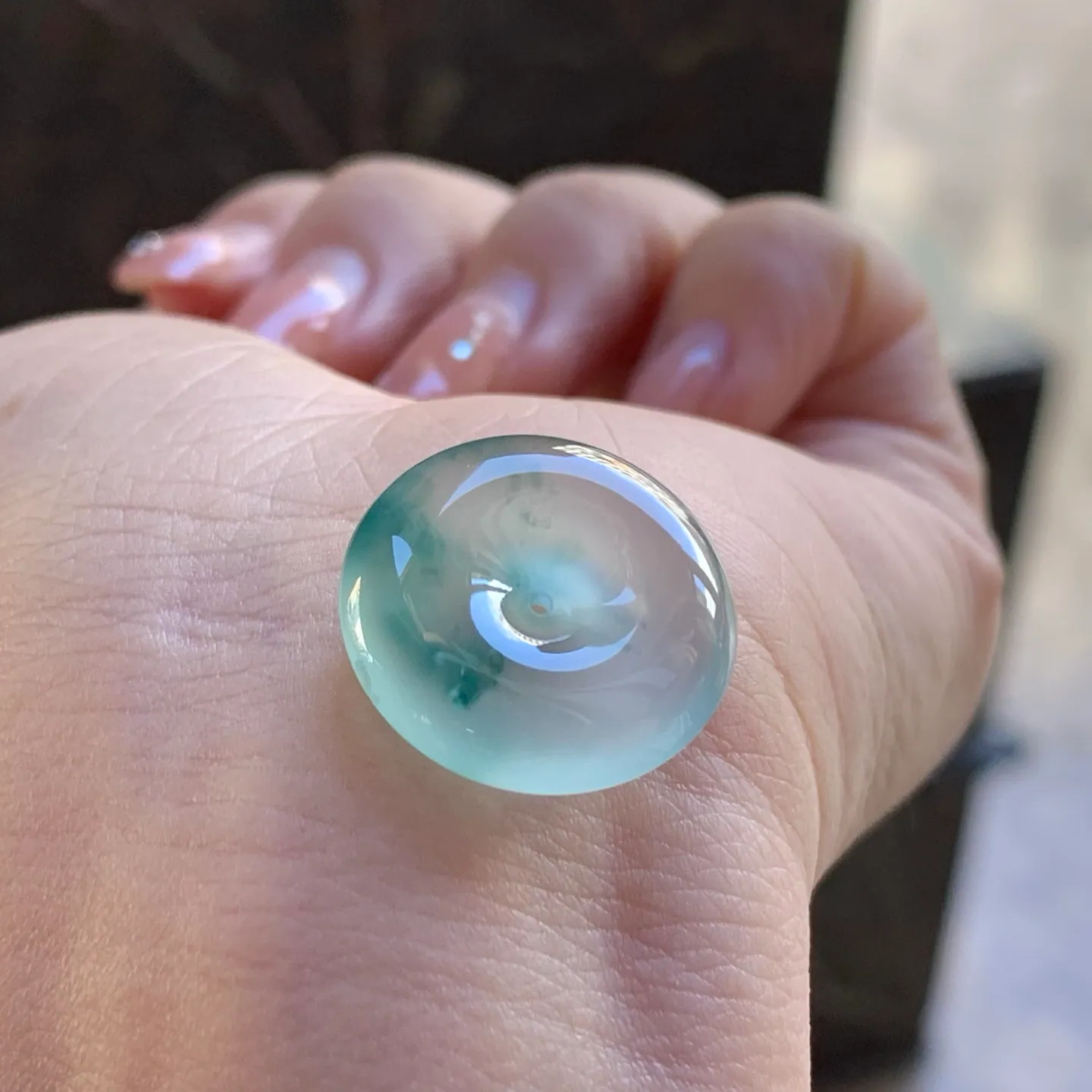
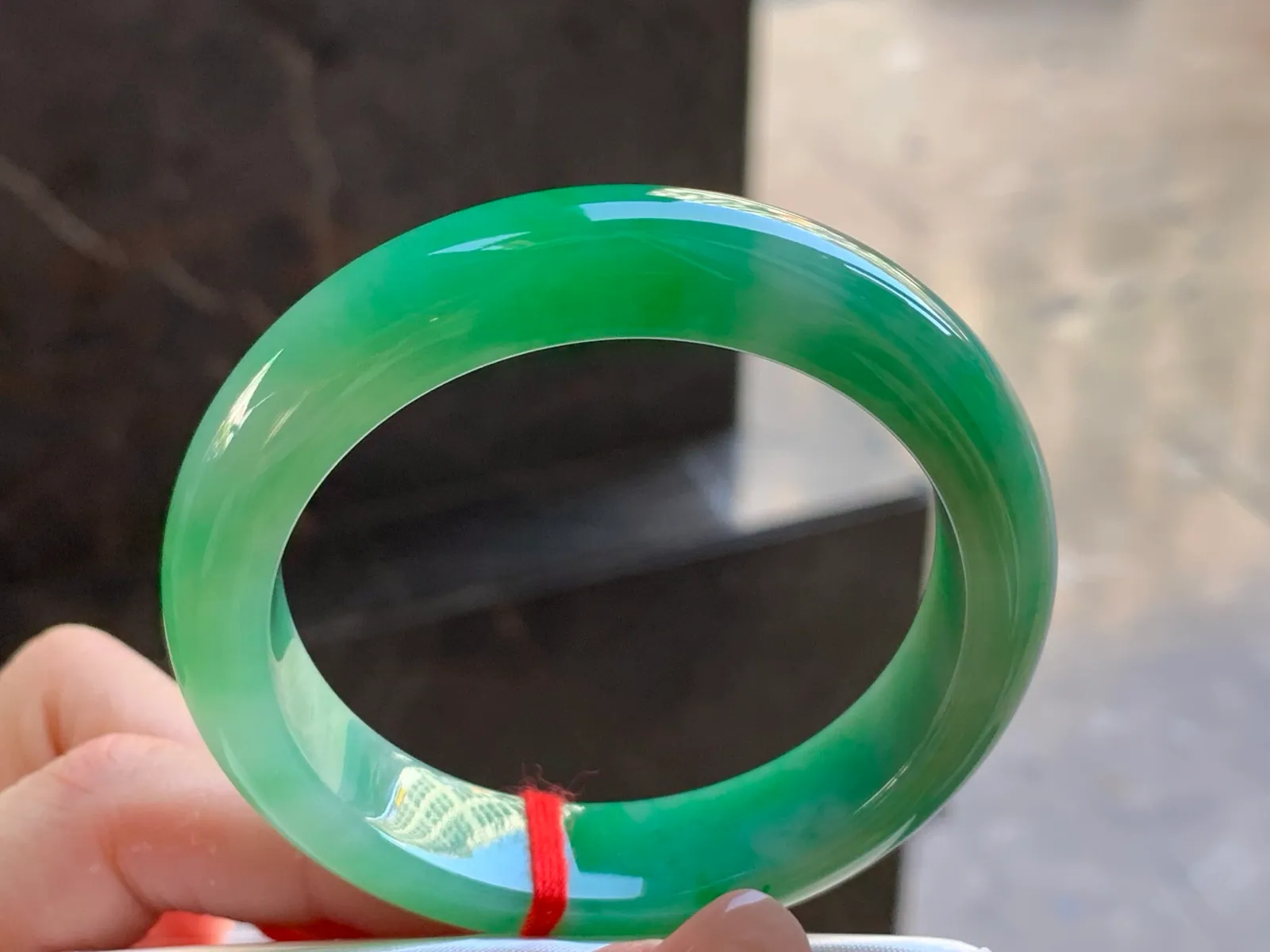
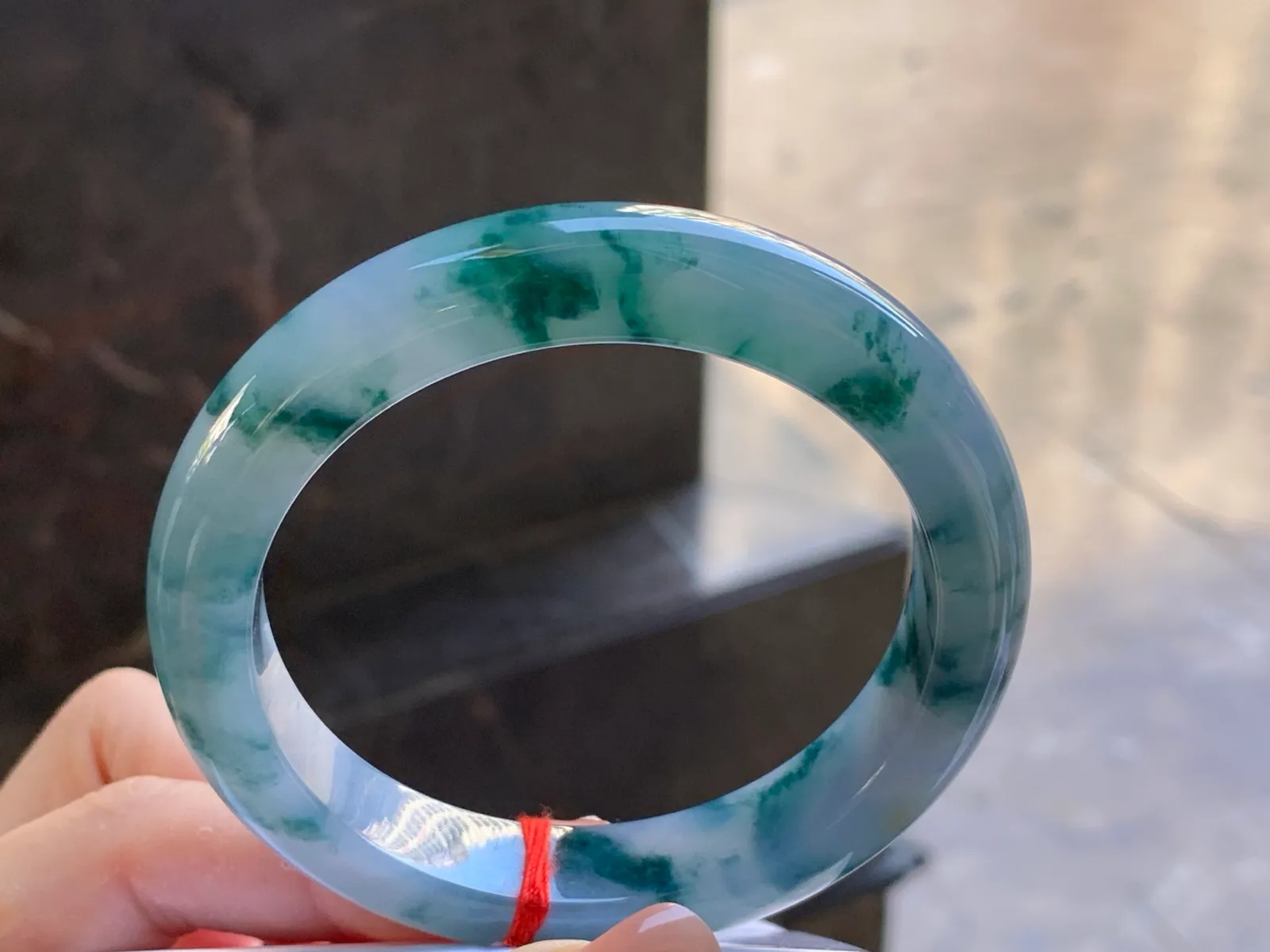
- A plain piece of the same material is usually valued higher than a heavily carved one. A plain surface (素面), such as a round bangle, a safety buckle, a plain tablet or a cabochon, shows that the stone is clean, because there is nowhere to hide anything. See what determines jadeite price.
- The more elaborate the carving, the more carefully you check what is underneath, with a flashlight, through every carved area.
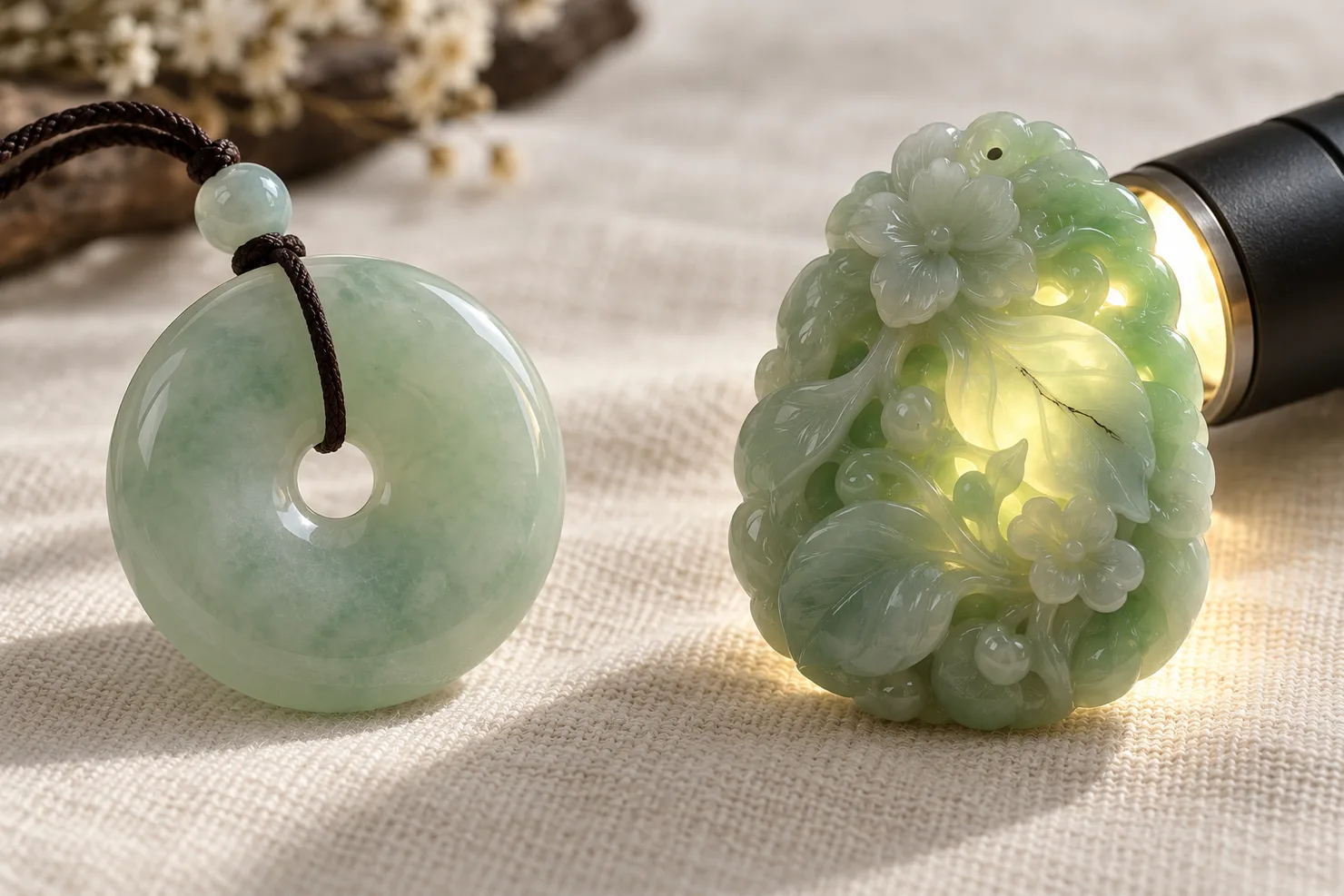
| Carving feature | What it may hide | How to check |
|---|---|---|
| Deep grooves: leaf veins, bamboo joints, waves, robe folds | A crack that runs along the groove, or a crack that was only partly cut away | Shine a flashlight from behind and follow each groove. If the light stops at a line, it is a crack. Look for a line that carries on past the end of the groove |
| Busy all-over carving, flowers, openwork (镂空) | Scattered cotton, black spots, coarse or uneven texture | Compare the light passing through carved and smooth areas; ask for a clear photo of the back |
| Openwork with thin bridges | Cracks removed by cutting right through; what is left can be fragile | Check each thin bridge for cracks; handle and wear it carefully |
| A hollowed-out back (挖底) | A thin piece looks brighter and more translucent when lit from behind, so the colour seems stronger than it is | Side view for thickness; ask for a photo of the back in daylight, not only backlit |
| A colour patch carved as a motif | Fine when natural; also a way to use patchy colour | Check the certificate says natural (Type A); look at the edges of the colour with a loupe |
| Gold caps or settings over part of a carving | Cracks, chips or dark spots under the metal | Ask what is under the gold; see gold-set jadeite |
| A thick, glossy wax coat | A poor polish, surface pits, fine surface-reaching cracks | Look at the reflection in the grooves; see the polish section below |
How to tell a crack from a harmless healed vein, and which flaws matter most, is covered in jadeite cotton and cracks.
There is one real exception. A fine carving by a well-known master on good material is a different thing: the best carvers choose clean, high-grade stone, and their work is a large part of the value. But "master work" (大师工) is also a common sales line. If it is part of the price, ask who carved it and how that is documented.
What should the polish look like?
Polish (抛光) is the last step, and the one most often rushed. Hold the piece under a single lamp and tilt it so the reflection slides over the surface.
- Good polish gives a bright, even reflection that flows smoothly over curves and carries on down into the grooves and recesses. The flat background between motifs is level and glossy.
- Poor polish shows a bright surface on the high points but dull, grey or gritty hollows; a rippled "orange peel" reflection; or fine scratches that a 10× loupe picks up straight away.
- Matte or frosted finishes on purpose (亚光, 磨砂) are a design choice: a frosted background makes a glossy figure stand out, or a soft matte surface gives a calm, modern look. Deliberate matte is fine and even, with a clean border where it meets the polished parts. Unfinished work is patchy, with scratch lines and grit.
Wax is normal; heavy wax is not. Almost all finished jadeite is given a light wax coat after polishing (过蜡). This is standard practice, not a treatment, and it slowly wears off with wear. The problem is a thick coat used to cover a poor polish: the piece has a greasy, soft glow, wax builds up whitish or yellowish in the grooves, and after a few weeks of wear the shine fades to reveal a duller surface. Wax is not the same as the resin used in Type B jadeite, which is forced deep into the stone; see how to spot treated jadeite. Do not re-wax or oil a piece at home; see how to care for jadeite.
How should you check a carved piece before buying?
Use a small white flashlight, a 10× loupe and, if you can, daylight from a window.
- Front and back. Look at both sides in daylight. Is the back flat and finished, or hollowed out? Many listings show only the front.
- Side view. Check the thickness. Is it even? Is the bail thick enough to hold the piece safely?
- Flashlight through every carved area. Put the light against the back and move it slowly along each groove. A line that stops the light is a crack.
- Reflection over the surface. Tilt under one lamp to see whether the polish reaches into the recesses.
- Loupe on the faces, hands and recesses. Crisp, deliberate cuts or blurred edges? Fine parallel tool-path lines? Grit or scratches in the hollows?
- Compare several pieces of the same design. If they are identical, they are machine work, and should be priced that way.
- Drill hole and bail. Smooth, centred, no chips around the edge.
- Ask in writing: "Hand, machine or semi-hand carved? Are there any cracks under the carving? Can you film a flashlight moving through the carved areas?"
Typical mistakes are judging only from front photos, being won over by an impressive amount of carving, and paying a hand-carved price for machine work. Typical seller wording to question: "pure hand carved" with no detail, "master work" with no name, "the carving is so fine" in answer to a question about cracks, and "it's just a natural line" for a line that has never been shown under a flashlight.
Buying carved jadeite on JadeiteHub
On JadeiteHub, sellers post real photos of the actual piece, some with video, and you can ask a seller to show the carved areas and the back under a flashlight before you buy, so the listing describes them. Every sold piece is checked against its certificate before it ships, and if it does not match the description, you get a full refund.
FAQ
Is hand carved jade always better than machine carved?
Not always. Hand carving usually has more depth and life, and it is what you want on good material. On modest material, machine carving is normal and keeps the price down. The real question is whether the price matches the work and the stone.
Why is a plain jadeite piece often more expensive than a carved one?
A plain bangle, safety buckle or cabochon has nowhere to hide flaws, so it needs clean material. Stone with cracks, cotton or patchy colour is usually carved instead, and the design cuts away or covers the flaws. With similar-looking material, the plain piece is usually the cleaner stone.
What does qiaose (俏色) mean?
俏色, also written 巧色, means "clever colour": using the different colours in one stone for different parts of the design, such as lavender for a flower and green for its leaves, or a red patch carved as a bat. It is done well when the colour stops exactly where the motif stops.
How can I tell machine carving in photos?
Look for identical pieces in the same shop, shallow relief at one even depth, soft rounded edges with no undercuts, stiff faces and dull, unpolished recesses. A zoomed-in photo of the face and the hollows tells you most. Good semi-hand work can be hard to judge from photos, so ask the seller.
Does wax on jadeite mean it is treated?
No. A light wax finish after polishing is standard on natural (Type A) jadeite and is not a treatment. A very thick, greasy coat can hide a poor polish or fine cracks, though, and wax is different from the resin filling used in Type B jadeite.