Jade Ruyi: Meaning of the Scepter and Pendant
Updated
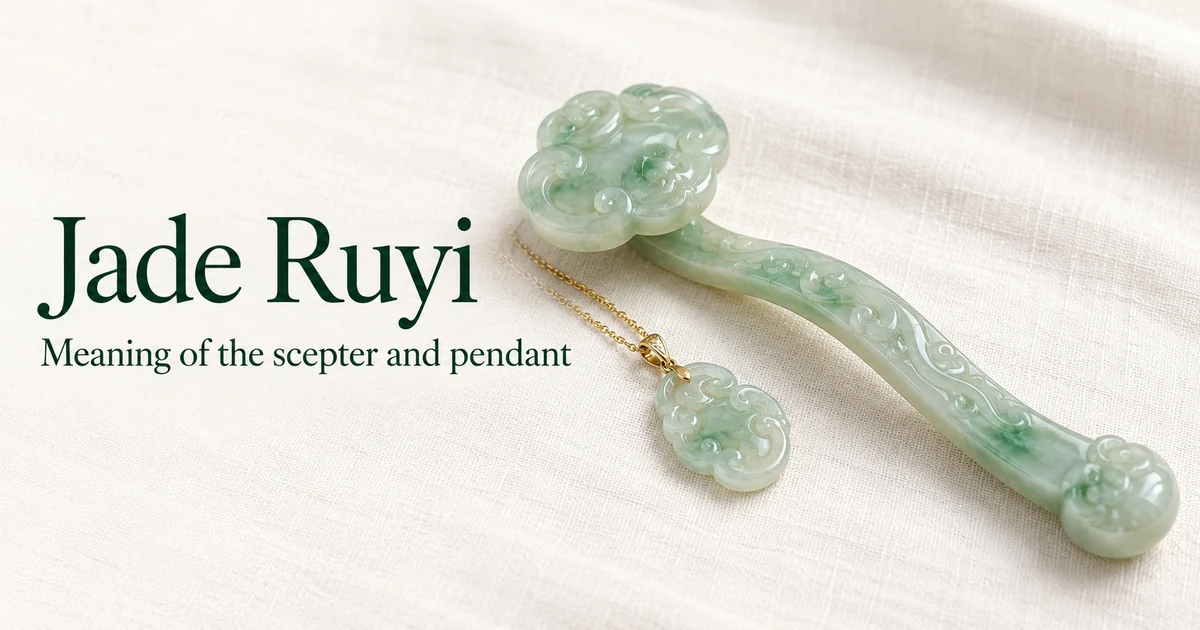
A ruyi (如意, "as you wish") is a curved, S-shaped scepter with a head shaped like a cloud or a lingzhi mushroom. It began as a practical object, became an auspicious gift and was given in large numbers at the Qing court, for example on birthdays. It is not a weapon or a magic wand. Today a ruyi scepter is a display piece and gift for a home, an office, a business opening or a wedding; large ones are usually nephrite or other stones, rarely jadeite. In jewelry the motif appears as the cloud-shaped head alone, as a ruyi lock (如意锁) for babies, or as carved cloud scrolls. Judge a ruyi pendant by its material first, then its lines, symmetry and thin edges.
What is a jade ruyi?
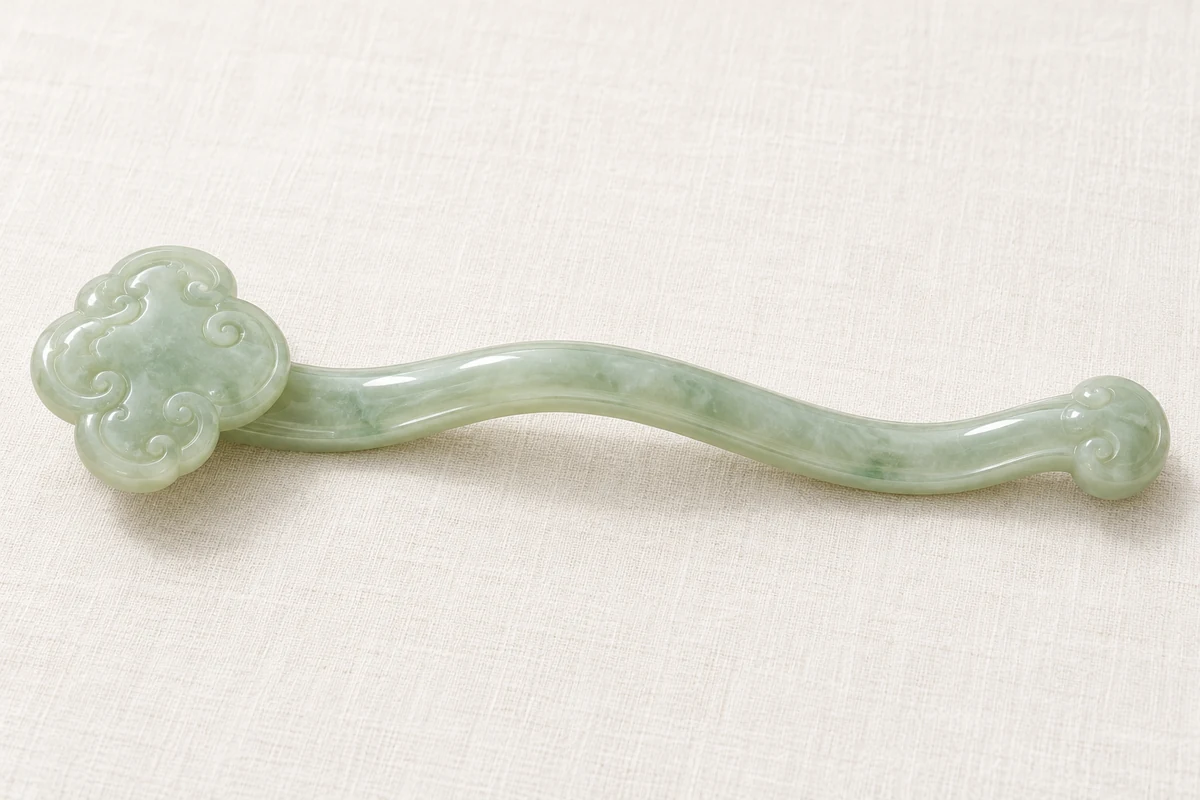
A ruyi (如意, ru yi) is a curved, S-shaped scepter with a head shaped like a cloud or a lingzhi mushroom, and its name means "as you wish". A jade ruyi is one carved from jade, or a jade pendant that borrows the shape of its head. Hold one and the whole object reads as a wish: may everything go the way you want.
A classic ruyi has three parts:
| Part | Chinese | What it looks like |
|---|---|---|
| Head | 如意头, 云头 | A broad, rounded head, curled like a cloud or a lingzhi mushroom (灵芝), the fungus traditionally linked with long life |
| Shaft | 柄 | A long, gently curved handle, often carved or set with plaques |
| Tail | 尾 | A small, rounded end, sometimes carved with a smaller cloud and a hole for a silk tassel |
Ruyi were made in almost every precious material: nephrite and jadeite, gold and silver, carved wood, lacquer, coral, bamboo and cloisonné enamel. A well-known form is the "three-inlay" ruyi (三镶如意), a wooden shaft set with three jade plaques at the head, the middle and the tail. For how this object fits into the wider story of jade in China, see jade in Chinese culture.
Where does the ruyi come from?
Its exact origin is debated, and historians give more than one answer. The explanation you will hear most often is that the ruyi grew out of a back-scratcher: a stick with a small hand at the end that reaches the itch you cannot, so it does exactly "as you wish". Another line runs through Buddhism, where a ruyi was held by monks and scholars during lectures and debates, and in Chinese Buddhist art the bodhisattva Manjushri is sometimes shown holding one.
Over time the practical use faded and the meaning took over. By the Ming and especially the Qing dynasty, the ruyi was an auspicious object pure and simple. At the Qing court it was one of the most common gifts: ruyi were presented on birthdays and festivals, and given as rewards and as marks of favor. That is why so many survive. Many museums, such as the Palace Museum in Beijing, hold large numbers of ruyi in jade, wood, gold and enamel.
The cloud-shaped head also became a design of its own. The ruyi cloud (如意云纹) runs along furniture, roof tiles, textiles, porcelain and silverware, and it is the source of most ruyi jewelry today.
Is a ruyi a weapon or a magic wand?
No. A ruyi was never a weapon and it is not a magic wand. It is too short and too brittle to fight with, especially in jade, and it was held, displayed and given, not swung.
The confusion has two common sources. Games, films and fantasy novels sometimes give a ruyi magic powers. And the Monkey King's staff in Journey to the West is called 如意金箍棒, the "as-you-wish gold-banded staff", but that staff is a long fighting pole, not a ruyi scepter; it just shares the word. When a seller tells you a ruyi "drives away bad luck" or "brings promotions", treat it as a traditional wish, not a property of the object.
What does a ruyi mean?
The ruyi means "may things go as you wish": smooth plans, a good career, harmony at home. It is one of the most general good wishes in Chinese, which is why it suits almost any occasion. Its meaning grows when it is carved or set with other symbols, because Chinese art often spells a wish with objects whose names sound like words:
| Combination | Chinese | How it reads |
|---|---|---|
| Ruyi alone | 如意 | "As you wish" |
| Two persimmons and a ruyi | 事事如意 | Persimmon (柿, shi) sounds like "matters" (事, shi): "may every matter go as you wish" |
| A vase and a ruyi | 平安如意 | Vase (瓶, ping) sounds like peace (平, ping): "peace, and all as you wish" |
| Ruyi with lingzhi | 灵芝如意 | The head already looks like lingzhi; a wish for long life |
| Ruyi in wedding wishes | 吉祥如意, 称心如意 | Good fortune and everything to your heart's content |
These are sayings and picture puzzles, not promises, and families and sellers phrase them in slightly different ways. For other motifs, see jadeite pendant meanings.
What is a jade ruyi used for today?
Today a ruyi scepter is a display piece and a gift. You will see it in four places most often:
- At home. On a stand or in a box in the living room or study, often near the entrance or on a shelf where guests see it.
- At the office. On a desk or in a meeting room, as a wish for smooth business.
- At a business opening. A ruyi, sometimes in a pair, is a classic opening-day gift for a shop or company.
- At weddings and birthdays. As a wish for a smooth life together, or for elders on a milestone birthday, echoing the Qing custom.
Feng shui sellers often add rules about where to place a ruyi and which way the head should point. Those rules vary from one seller to the next and are beliefs, not facts about the stone. Put it where you will enjoy looking at it.
Why are large ruyi scepters rarely jadeite?
Because a large, clean block of jadeite is very expensive. A full-size display ruyi is often about as long as a forearm and needs one solid piece of stone, and jadeite rough of that size without cracks, in a good color, is far more valuable cut into bangles and pendants. That is why most large stone ruyi you will see are carved from other stones:
- Nephrite (软玉, the "jade" of most classical Chinese carving), from China and other sources. Many traditional ruyi are nephrite.
- Other ornamental stones, such as serpentine (sold as Xiuyan jade, 岫玉) and various quartz-based stones, which are cheaper still.
- Lower-grade jadeite, with a coarse, opaque base and patchy color. Jadeite display ruyi do exist, but a large one in fine, translucent jadeite is a rare and costly piece.
None of these is "fake" if it is named honestly. The problem starts when a nephrite or serpentine ruyi is sold as 翡翠 (jadeite). If the material matters to you, ask for a lab certificate that names it. The differences between the two jades are explained in jadeite vs nephrite.
JadeiteHub does not sell display scepters; we list jadeite jewelry, including ruyi pendants.
What kinds of ruyi pendants are there?
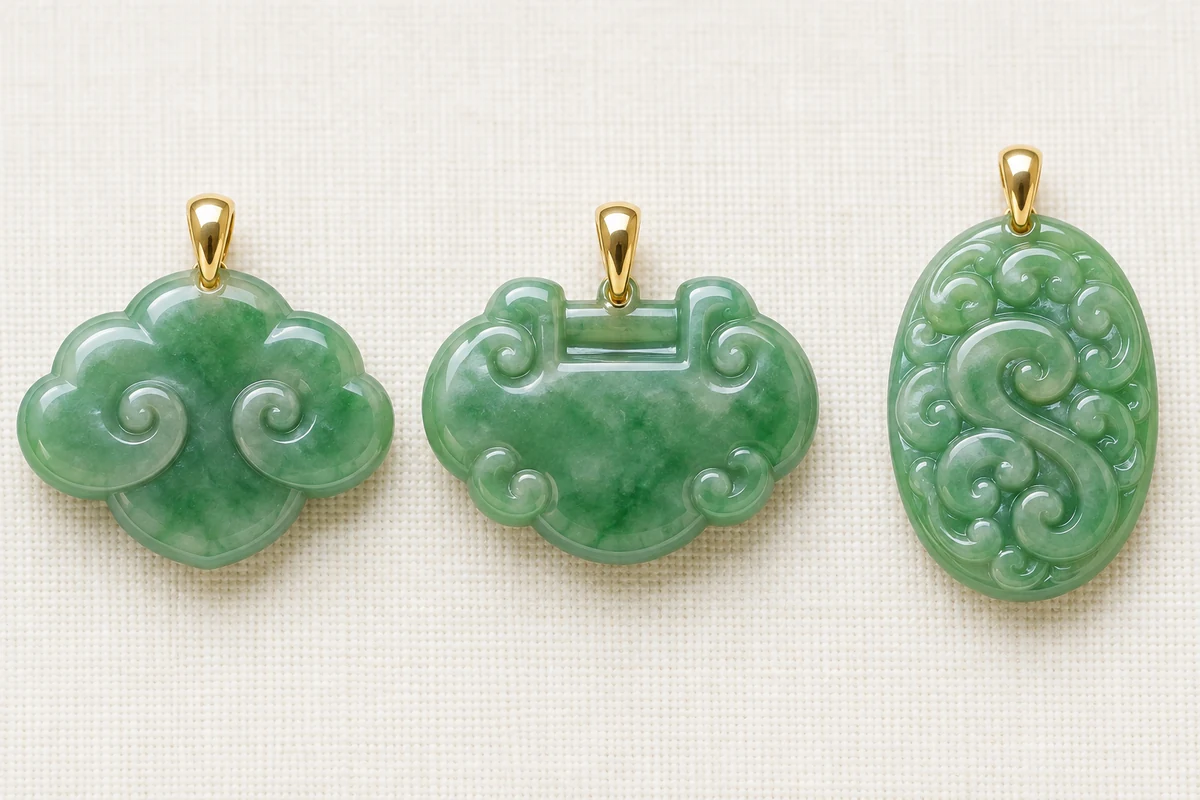
Three styles cover almost every ruyi pendant you will find in shops and livestreams.
| Style | Chinese | Look | Usually chosen for |
|---|---|---|---|
| Ruyi-head pendant | 如意吊坠, 如意头 | The cloud-shaped head alone, often symmetrical, sometimes with a small lingzhi or bat | Anyone; a neutral everyday gift |
| Ruyi lock | 如意锁 | A lock-shaped pendant whose outline follows the ruyi curves | Babies and children |
| Ruyi cloud pattern | 如意云纹 | Flowing cloud scrolls carved over a pendant, plaque or bead | People who like an abstract, lighter design |
The ruyi lock comes from the longevity lock (长命锁), a lock-shaped pendant given to children as a wish that they will be "locked" safely to a long life. Locks are more often made of silver or gold; a jade ruyi lock is usually kept as a keepsake rather than worn by a small child. For safe ways to give jade to a baby, see jade for baby.
The ruyi pattern is the lightest and most modern of the three. Because it is a flowing, abstract design, it works on thin, translucent material and suits both men and women.
Jadeite or nephrite: which is better for a ruyi?
Neither is better; they are different stones, priced in different ways. In jewelry, ruyi pendants are made in both.
| Jadeite ruyi | Nephrite ruyi | |
|---|---|---|
| Mineral | Jadeite (翡翠), mostly from Myanmar | Nephrite (软玉, often sold as Hetian jade) |
| Typical look | Glassy luster; can be icy and translucent; green, lavender, white and other colors | Oily, waxy luster; white, green, grey or black; usually more opaque |
| Common uses | Pendants and small carvings; large scepters are rare and costly | Pendants, plaques and many display scepters |
| What drives price | Color, translucency, texture, cracks | Whiteness and fineness for white nephrite, size, carving |
The name on the certificate matters more than the color. A pale green ruyi pendant can be either stone.
How do you choose a jade ruyi pendant?
Check the material first, then the carving, then the setting.
- Follow the lines. Good ruyi curls are smooth and continuous, with even depth and soft, rounded edges. Wobbly scrolls, jagged grooves and flat, lifeless curves are signs of rushed work.
- Check the symmetry. A ruyi head is usually symmetrical: the two side curls should mirror each other and sit level. A lopsided head is the easiest fault to spot.
- Look at thin edges. The curls and pierced openings are where a ruyi chips. Check them under a light from the side; a thin, sharp edge is fragile.
- Judge texture and translucency. A fine, icy texture lets light glow through the scrolls; a coarse, cloudy base makes carving look muddy. See jade texture and translucency.
- Judge the color in daylight. Is the green even or patchy? Warm shop light flatters green, so look by a window too.
- Check the setting. The bail should be closed, firmly fixed and stamped (18K gold is stamped Au750 or G18K). Look at the back for rough metal.
- Ask for the certificate. Buy natural Type A jadeite with a lab certificate that matches the piece.
Machine or hand carving? Low- and mid-grade ruyi pendants are commonly cut with CNC carving machines and then finished by hand. That is normal practice in the Guangdong workshops, not a defect. Machine-cut pieces tend to look identical, with even, flat curves; hand-carved scrolls usually have softer, more varied lines. Either way, the material decides most of the price. For more, see jadeite carving craftsmanship.
How much does a jade ruyi pendant cost?
Price depends on color, translucency, texture and size, in roughly that order, then on the gold and the carving. One certified natural Type A jadeite ruyi pendant is listed on JadeiteHub; its price is as of 21 October 2026 and may change.
| Listing | Material | Setting | Size | Price |
|---|---|---|---|---|
| JH-000011 | Icy, light green with floating green, carved with ruyi cloud scrolls | 18K yellow gold bail | 30 × 16.7 × 3.2 mm | US$759 |
At 3.2 mm thick this pendant is slim, so light passes through the scrolls and the light green looks fresh. A ruyi in stronger, more even green, or a larger piece with the same clarity, would cost considerably more; a dry, opaque one would cost less. You can compare it with other carved pieces under jade pendants.
Is a jade ruyi a good gift?
Yes. Few motifs fit as many occasions: a ruyi pendant suits a new job, a graduation, a birthday or a wedding, for men and women of any age, and a ruyi lock suits a newborn. Choose a pendant if the person will wear it, and a display scepter if the gift is for a home or a business. For more ideas by occasion, see the jadeite gift guide.
On JadeiteHub we list only jadeite with a lab certificate. Every sold piece is checked against its certificate at our inspection center before it ships, and if it does not match its description you get a full refund.
FAQ
What does a jade ruyi mean?
Ruyi (如意) means "as you wish". A jade ruyi is a traditional wish for things to go smoothly. Combined with persimmons it reads 事事如意, "may every matter go as you wish"; with a vase, 平安如意, peace and all as you wish. These are traditional wishes, not promises.
What is a ruyi scepter used for?
Today it is a display piece and gift: at home, on an office desk, at a business opening, a wedding or an elder's birthday. In the past it was a ceremonial and auspicious object, and at the Qing court it was a common gift, for example on birthdays.
Is a ruyi a weapon?
No. A ruyi was never a weapon and is not a magic wand. The Monkey King's staff in Journey to the West shares the word ruyi in its name, but it is a fighting pole, not a ruyi scepter.
Are jade ruyi scepters made of jadeite?
Large ones rarely are, because a big, clean block of jadeite is very expensive. Most large stone ruyi are nephrite or other stones such as serpentine, or lower-grade jadeite. Ask for a certificate that names the material.
What is a ruyi lock pendant?
A lock-shaped pendant (如意锁) whose outline follows the ruyi curves. It comes from the longevity lock given to children. Jade ones are usually kept as a keepsake rather than worn by a small child.
Is a CNC-carved ruyi pendant bad?
No. Low- and mid-grade ruyi pendants are commonly cut with CNC machines and then finished by hand; it is normal practice. Hand-carved scrolls usually look softer and more varied, but the material still decides most of the price.