What Is Jade Gambling? Rough Jadeite Risks and Scams
Updated
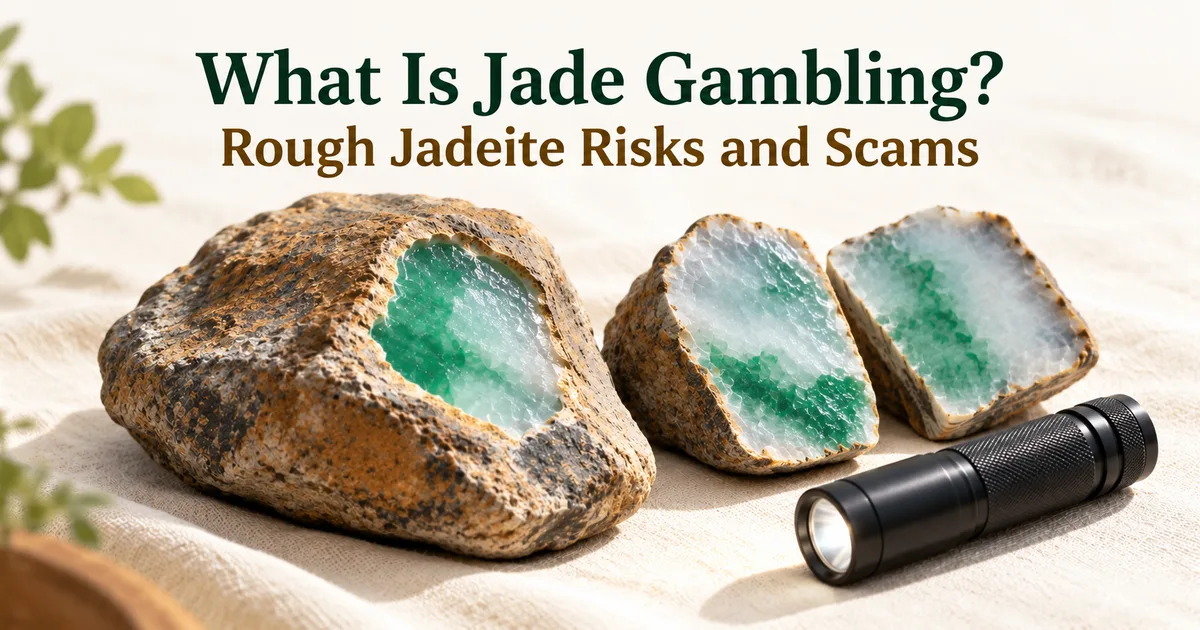
Jade gambling (赌石) is buying uncut jadeite rough whose inside cannot be seen, betting it holds better jade than its price. Even experts misjudge rough: a window shows one spot, a flashlight makes green look bigger, and colour may not go deep. Fake skins, glued slices, treated windows and staged livestream cuts are very common. Finished pieces, which you can see whole and certify, are far safer to buy.
What is jade gambling?
Jade gambling (赌石, "gambling stone") is buying uncut jadeite rough whose inside cannot be seen, betting that it holds more valuable jade than the price you pay.
Most jadeite comes out of the ground as boulders wrapped in a weathered skin. The skin hides the colour, translucency and cracks inside, and those decide almost all of the value. Sellers show buyers a little of the inside by polishing a window or cutting a face, and buyers price the whole stone from that small view. Our guide to where jadeite comes from explains the skin, windows and mining areas in short. This article goes deeper: how the trade reads rough, why the window misleads, and the scams that grow around it.
One thing to say clearly at the start: jade gambling is high risk even for professionals, and it is a field with a very high share of scams. This article is here to help you understand it and protect yourself, not to encourage you to buy rough.
What kinds of rough jadeite are there?
Dealers sort rough jadeite by how much of the inside is visible. The less you can see, the bigger the bet.
| Type (Chinese trade term) | What it is | What you can see | Risk |
|---|---|---|---|
| Fully covered rough (全赌, 蒙头料) | A whole boulder with intact skin, no window, no cut | Only the skin | Highest: a pure bet on the skin |
| Window rough (开窗料) | A small spot polished through the skin | One small patch of the inside | Very high: the window shows one spot, not the stone |
| Rubbed or cut-open rough (擦口, 切口料) | A strip of skin rubbed off, or one cut through the stone | A wider strip, or one cut face | High: one face, but not the depth |
| Half-open rough (半明料) | Cut in several places, partly open | Several faces | Lower, but cracks and colour can still change between faces |
| Open slabs (明料) | Sawn into slabs, the inside fully visible | Colour, translucency and cracks across each slab | Lowest of the rough types; still needs judgement on yield |
Risk falls as more becomes visible, and the price usually rises to match. Even an open slab only tells you what is on its two faces, but it is far closer to buying what you see. Fully covered rough is where the most money is lost and where most of the drama on social media comes from.
What do dealers look for on the skin?
Before any window, experienced traders read the skin (皮壳). These are the main signs they talk about:
- Skin (皮壳): its colour, thickness and grain. Dealers rub it to feel whether the sand grains are fine and tight or coarse and loose.
- Pine flowers (松花): green or dark green traces, spots or patches on the skin.
- Python bands (蟒带): bands on the skin with a different texture from the skin around them.
- Dark patches (癣): black or dark grey patches. Some traders say they "eat" the green, others that good colour sits next to them. The trade genuinely disagrees.
- Pit stories (场口): each mining area is said to have its own typical skin and inside.
| Sign on the skin | What the dealer hopes it means | Why it can be wrong |
|---|---|---|
| Fine, tight skin | Fine, dense texture inside | Skin and inside can differ completely |
| Pine flowers (松花) | Green underneath | The green may be thin, scattered or only at the surface |
| Python bands (蟒带) | Colour follows the band | The band can be texture only, with no colour |
| Dark patches (癣) | Colour nearby, or colour eaten | Can mean either; can also go deep and spoil the stone |
| Famous pit (场口) | A pit known for good material | Cannot be verified from the stone; pits produce good and bad |
The honest summary is that skin reading is pattern-matching, not measurement. Nothing on the outside proves what is inside. The trade has sayings for this. 神仙难断寸玉: "even an immortal cannot judge an inch of jade." 一刀穷一刀富: "one cut makes you poor, one cut makes you rich." And a common line among dealers is that in jade gambling, more people lose than win. That line is not a statistic; it is what people who handle rough every day tell each other.
Why can a window mislead you?
The window is the most persuasive part of rough jadeite, and the most misleading. Here is what to watch for.
The flashlight makes green look bigger and brighter. Sellers press a strong flashlight right against the window. Light spreads through the stone, the green glows, and a patch the size of a fingernail can look as if it fills the stone. The trade's own warning is 灯下不观色: "do not judge colour under a lamp". Look at the window in daylight, without a torch, before you form any opinion of the colour.
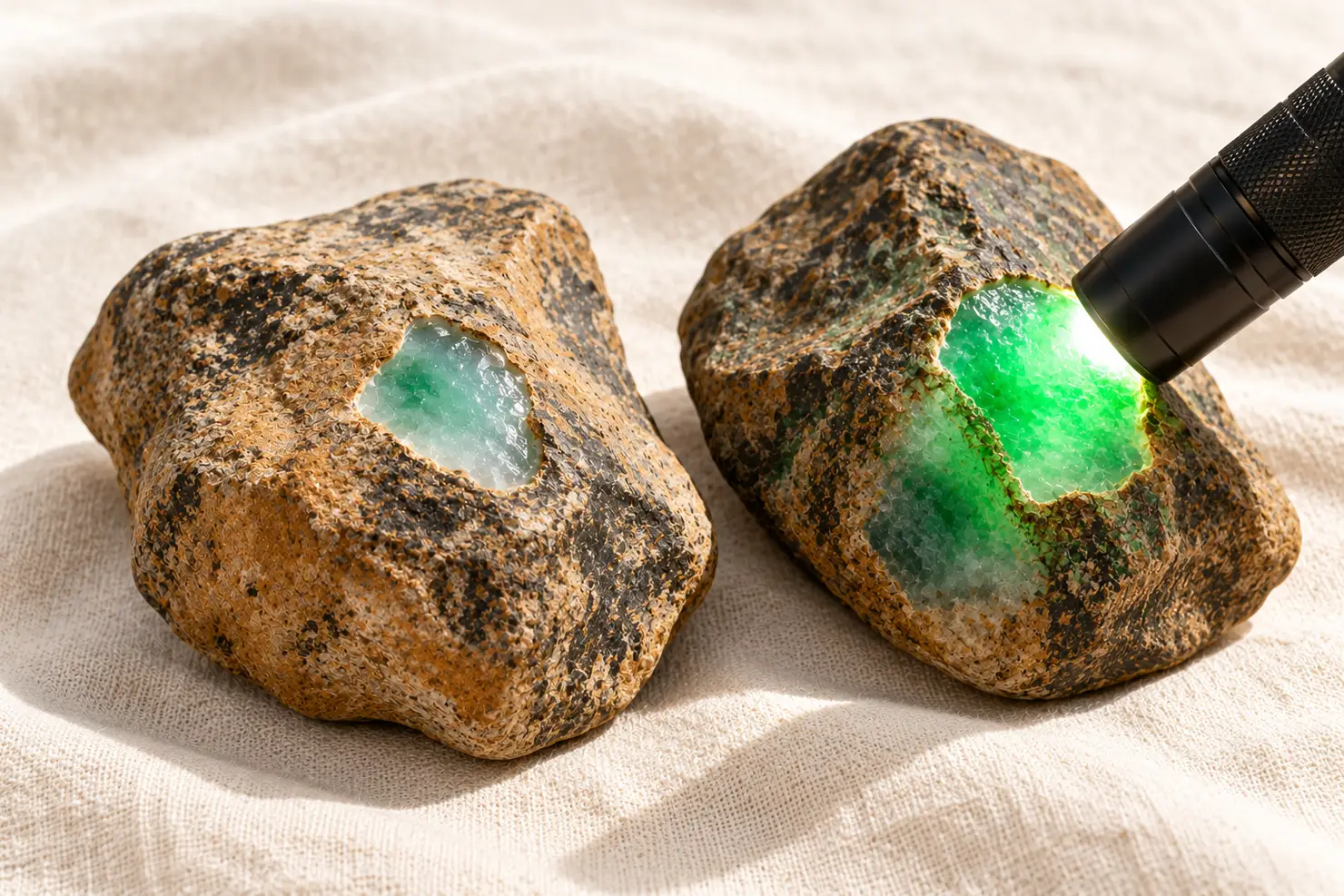
Some other things a window can hide:
| What you see | What it may really mean |
|---|---|
| Bright green glowing under a flashlight | Pale or patchy green in daylight; the light spreads and enlarges it |
| Green in the window | Green that sits only near the skin and does not go deep (色不进去, 皮上有色肉里没色) |
| A clean, crack-free window | Cracks and cotton a few centimetres further in |
| A small window with fine, translucent texture | The rest of the stone coarser or drier; one spot does not predict the whole |
| Good colour and texture | Not enough clean material for a bangle once cracks are cut around |
| A wet or oily-looking window | Water or oil that makes the surface look more translucent than it is |
Two of these deserve a few more words.
Colour that does not go in. Green in jadeite often forms in thin bands, veins or patches. If the window happens to sit on a band near the surface, the stone looks green, but once it is cut, the colour may be a skin-deep layer over pale material. Dealers have a name for it because it happens often enough to hurt.
Cracks decide what can be made. A bangle needs a large, clean, crack-free ring of material. A stone with good colour but a network of cracks may yield only small cabochons and pendants, which can be worth much less than the rough price implied. See our guide to cracks, lines and cotton in jadeite for how cracks look under light.
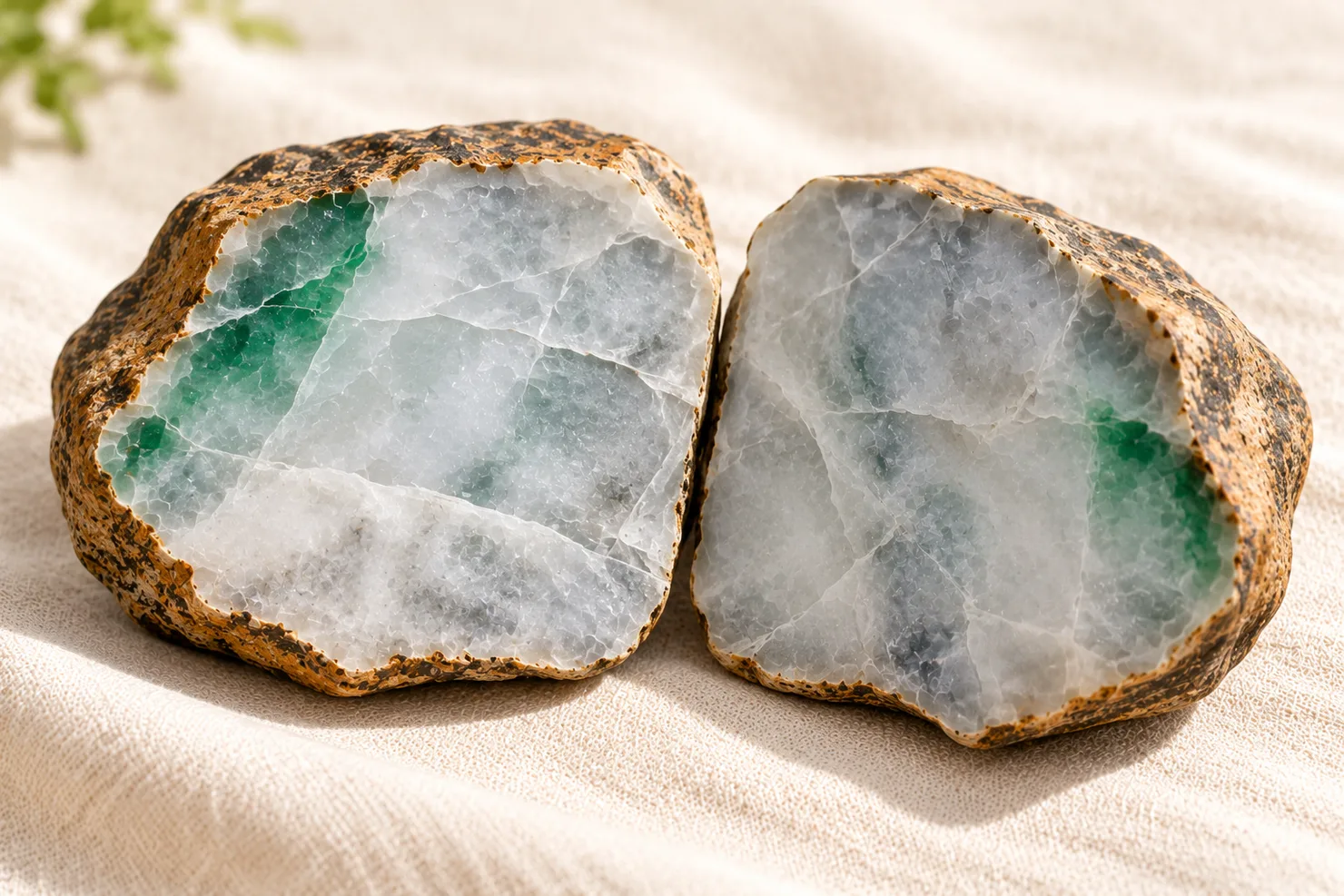
How dealers look at a window. If you ever look at rough, do it in this order: first daylight, no torch, for the real colour; then a flashlight held at the side of the window, not pressed onto it, to see how far light goes in and where it stops at cracks; then the edges of the window under a loupe, for glue lines, colour sitting in cracks or a change of material. A seller who only wants to show the window under their own lamp is telling you something.
What are the most common jade gambling scams?
Because nobody can see inside the stone, rough is an easy place to cheat. These tricks are very common:
| Scam | How it works | What to watch for |
|---|---|---|
| Fake skin (假皮, 做皮) | Low-grade jadeite, another stone, or even resin is given an artificial skin of glued sand and powder; or real skin is glued onto a different stone | Skin that looks too even, flakes or softens, smells of glue, or ends at a seam |
| Glued slice on the window (贴片, 贴皮) | A thin slice of good green, or green glass, is glued over the window | A fine line around the window edge; colour that stops sharply at the edge |
| Treated window | The window area is dyed or filled with resin: Type B or C treatment at the one spot you can see | Colour in a net along cracks; a plastic-like shine; see how to spot treated jadeite |
| Prepared cut faces | A stone is cut in advance, the poor part swapped or hidden, and the faces polished or oiled to look better | Faces that look too good for the skin; cut faces that are wet or oily |
| Unverifiable origin stories | Claims of a famous pit (场口), "old pit" (老坑) material, or "bought at the public auction (公盘)" | No way to check any of it on the stone itself |
| Livestream cutting shows | Staged cuts, shills, remote cutting and buyback promises (see below) | Excitement, countdowns and a chat full of winners |
| Tourist and border traps | A friendly stranger, "my friend's mine", unusually cheap "Burmese rough" | Anyone you met that day who has a stone to sell |
| Pressure | "Another buyer is coming", "cut it now or lose it", "price only for today" | Any push to decide before you can think or check |
Livestream jade cutting. Jade cutting live streams are popular and some are simply entertainment. But this is also where many buyers are caught, and the patterns are well known in the trade:
- Staged results. A stone that was cut and glued back together before the stream can be "opened" live to a gasp. The audience cannot inspect it.
- Shills (托) in the chat. Accounts that "win" big, thank the host and urge others to buy are often part of the show.
- "We cut it for you and ship the green." You buy a stone on screen, the host cuts it and promises to ship your slices or to have them made into bangles for a fee. You cannot check that what arrives came from the stone you paid for.
- Buyback promises. "If it opens green, we will buy it back at a high price." Such promises are hard to enforce, especially across borders.
Myanmar and rough. Myanmar restricts the export of jade rough; it is sold through official channels. Rough offered to you informally, "straight from the mine" or "just across the border", may have left the country outside those channels, and carrying it home can cause you problems with customs. This is general background, not legal advice.
Can a certificate help with rough jadeite?
Only a little. A gem lab can test whether the material at the tested spot, usually the window, is jadeite, and whether that spot has been treated. That catches some scams: a glass slice, a dyed window, a stone that is not jadeite at all.
What it cannot do is tell you what is inside. A certificate says nothing about how deep the colour goes, how many cracks there are, or what the stone will yield. And a certificate issued for one rough stone is easily swapped onto a similar-looking one, because rough has no fixed shape or measurements that a buyer can check against. See how to verify a jadeite certificate for what a report does and does not cover.
Why are finished pieces a safer way to buy jadeite?
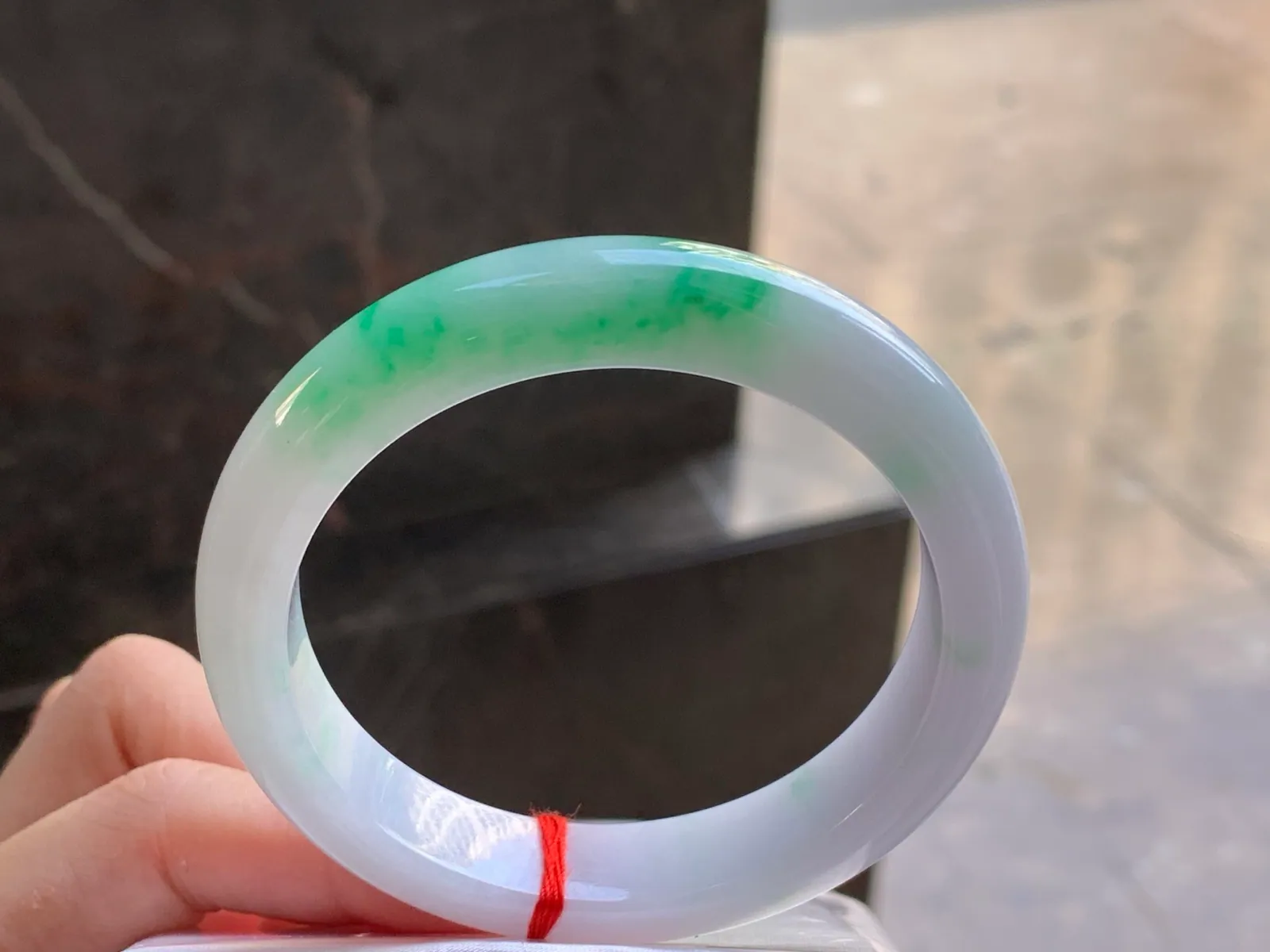
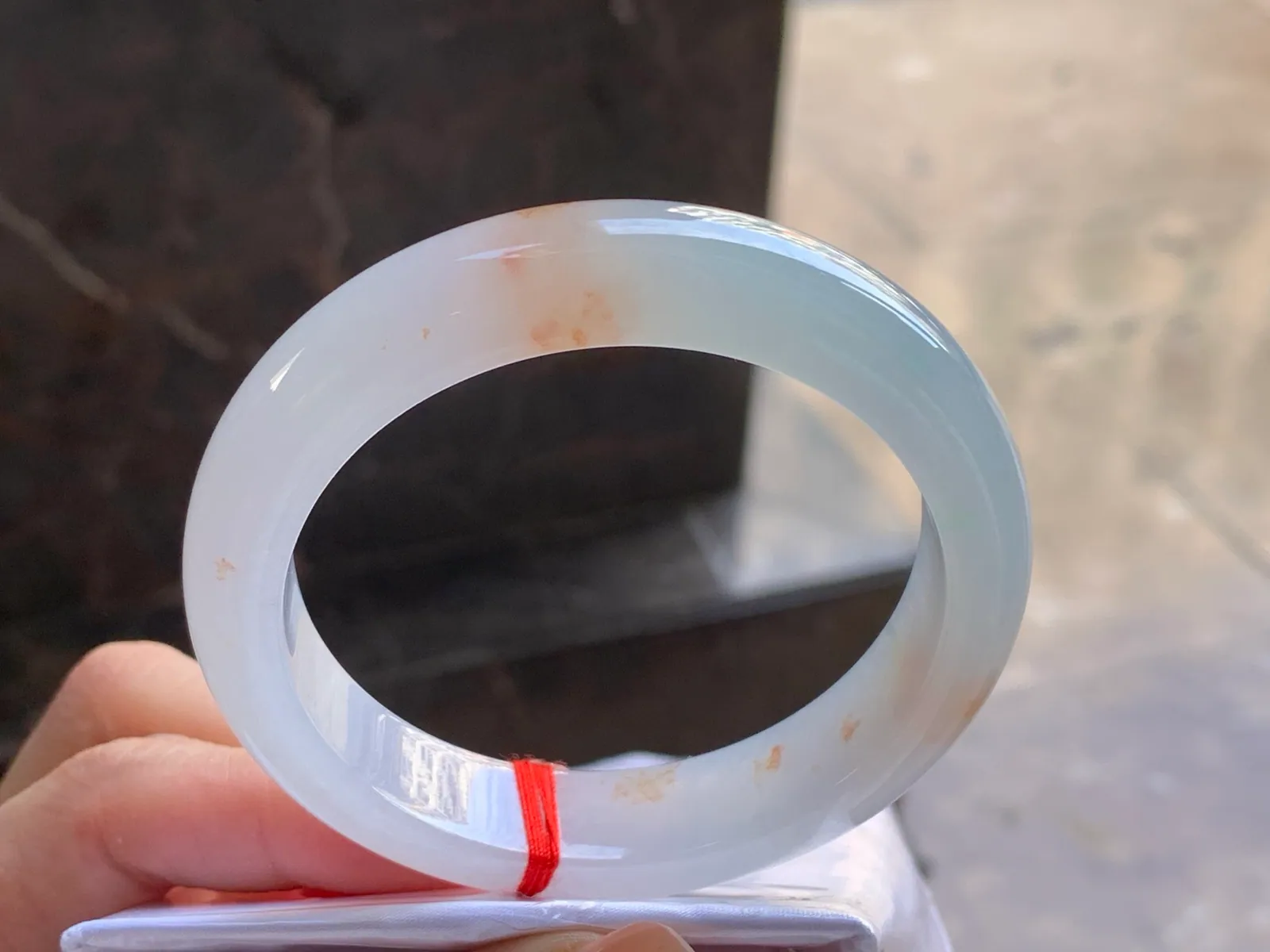
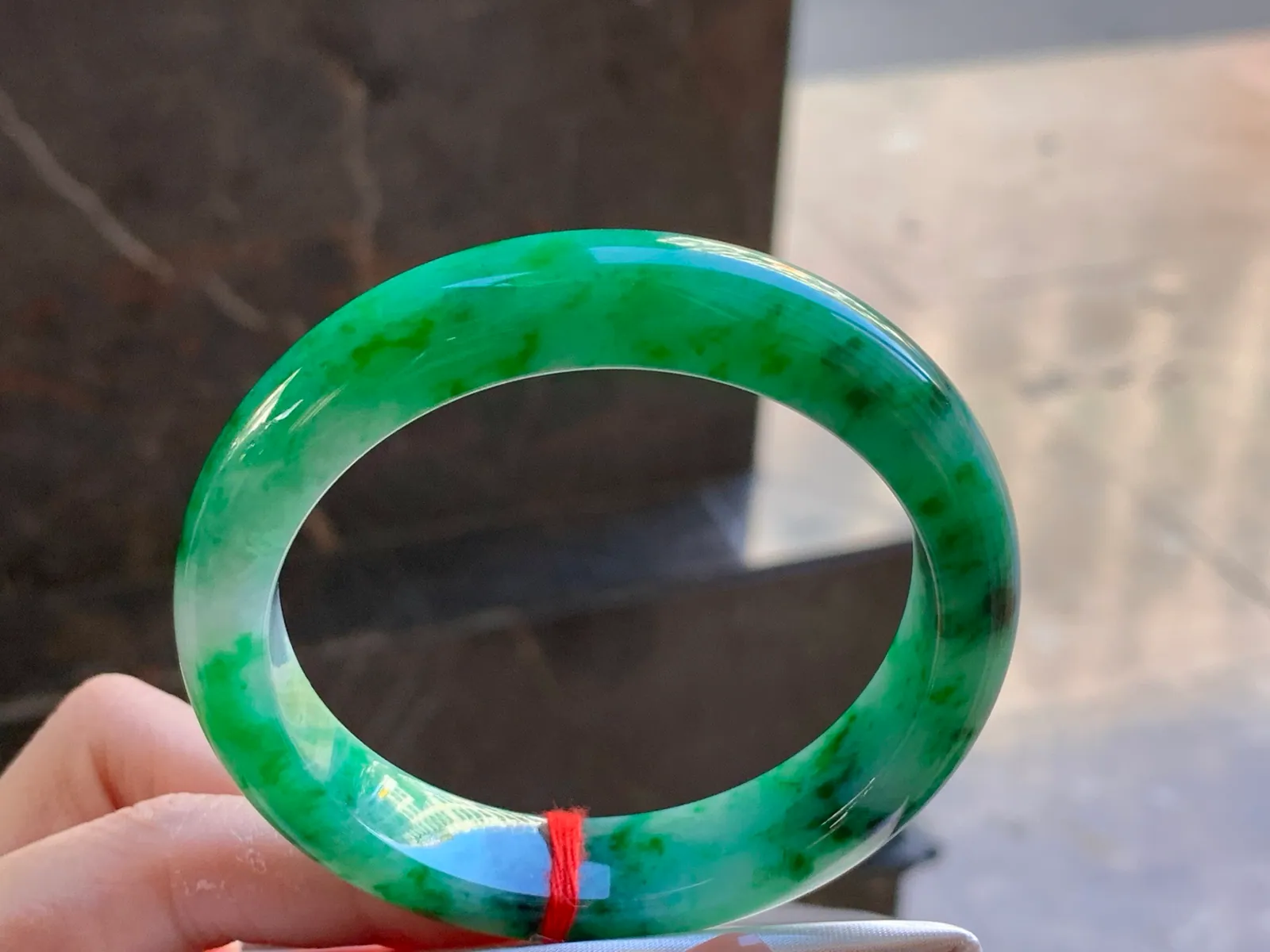
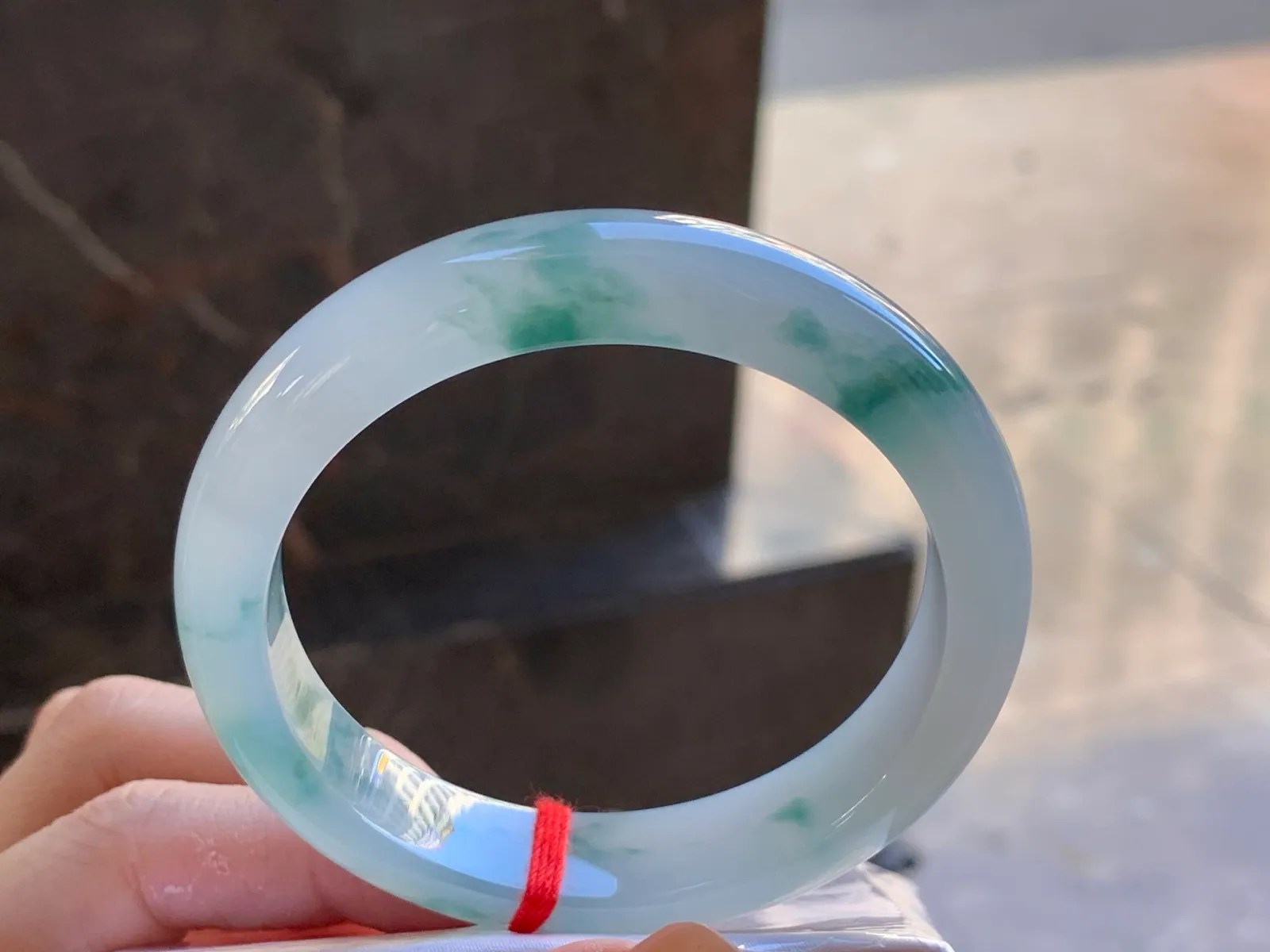
With a finished bangle, pendant or ring, everything that sets the value is in front of you. You can see its texture and translucency (种水), its colour in daylight, and its cracks and cotton under a flashlight. A lab can test the whole piece, and the certificate photo and measurements can be matched to it. The price is set on what is actually there, not on hope.
| Rough (赌石) | Finished piece | |
|---|---|---|
| Colour | One window, often seen under a lamp | The whole piece, in any light |
| Cracks and cotton | Hidden inside | Visible under a flashlight |
| Treatment | Only the tested spot | The whole piece can be tested |
| Certificate | Easy to swap, says nothing about the inside | Photo and measurements match one piece |
| What you pay for | A chance | What you see |
To understand how those visible qualities turn into price, see what determines jadeite price. For buying across borders, see how to buy jadeite from China safely.
What if I still want to try or watch jade gambling?
Watching a cutting video is harmless. If you want to go further, keep these rules:
- Use only money you can afford to lose completely. Treat it as the price of an experience, not an investment. Nothing here is investment advice.
- Never buy rough online or through a livestream. You cannot inspect the stone, see the cut or prove what you receive.
- Never buy rough from strangers, from someone you have just met or from a "friend of a friend with a mine".
- If you buy in person, watch it cut yourself, on the spot, and take the pieces with you.
- Look in daylight first, and remember 灯下不观色.
- Walk away from pressure. A real deal will still be there tomorrow.
Buying on JadeiteHub
JadeiteHub does not sell rough or gambling stones. We only sell finished jadeite pieces. Sellers post real photos of each piece, some with video, every sold piece is checked against its certificate before it ships, and if it does not match the description you get a full refund.
FAQ
Can you really get rich from jade gambling?
A few stones do open far better than their price, which is why the trade says 一刀穷一刀富, "one cut poor, one cut rich". But dealers also say that more people lose than win, and that even experts misjudge rough. Treat any story of a big win as the exception, not a plan.
Are livestream jade cutting shows real?
Some are honest entertainment, but staged cuts, shills in the chat and "we cut it and ship you the green" schemes are very common. You cannot inspect the stone or prove that what arrives came from it, so do not buy rough through a livestream.
Can a flashlight tell what's inside rough jadeite?
No. A flashlight pressed on a window makes the green look bigger and brighter than it is, which is why the trade says 灯下不观色. Held at the side, it can show some cracks near the surface, but it cannot show how deep the colour goes.
Is rough jadeite cheaper than finished jadeite?
Per piece it can look cheaper, but you are paying for a chance, not for jade you can see. After cutting, cracks and shallow colour can leave little usable material, so rough can end up costing more than a finished piece of the quality you hoped for.
Can I bring rough jadeite back from Myanmar?
Myanmar restricts the export of jade rough; it is sold through official channels. Rough bought informally may have left the country outside those channels, and you may also face your own country's customs rules. Check before you buy anything.