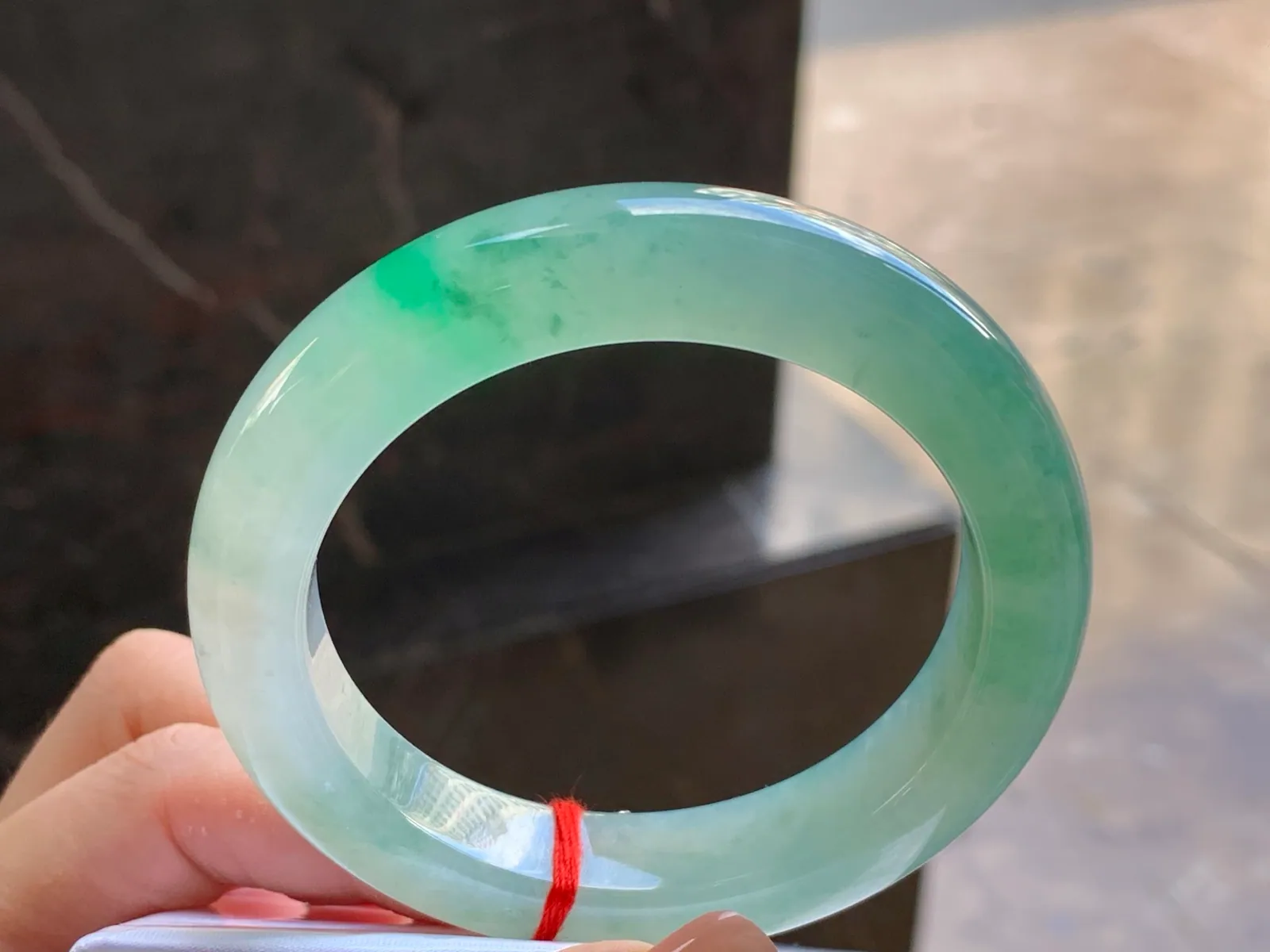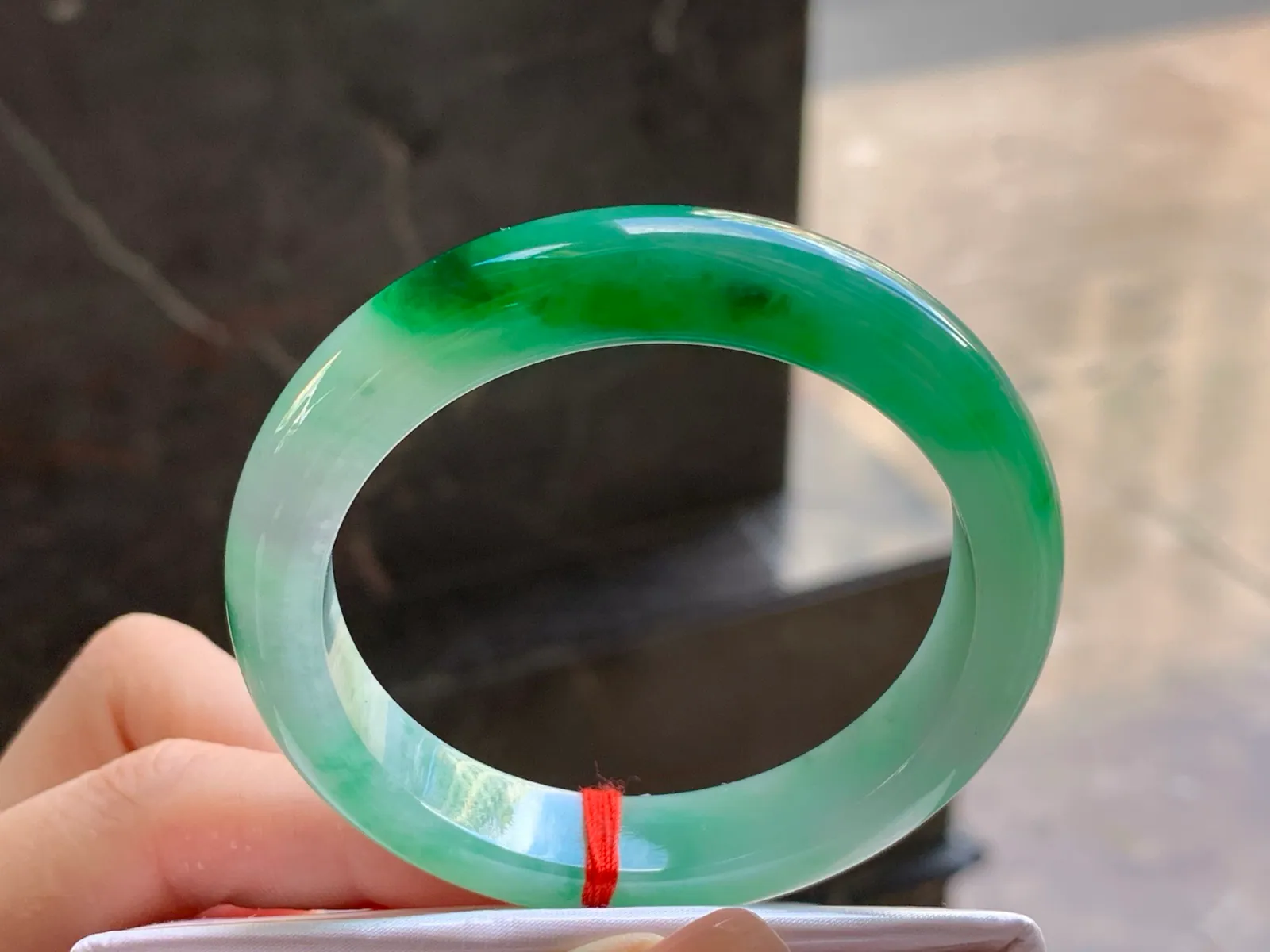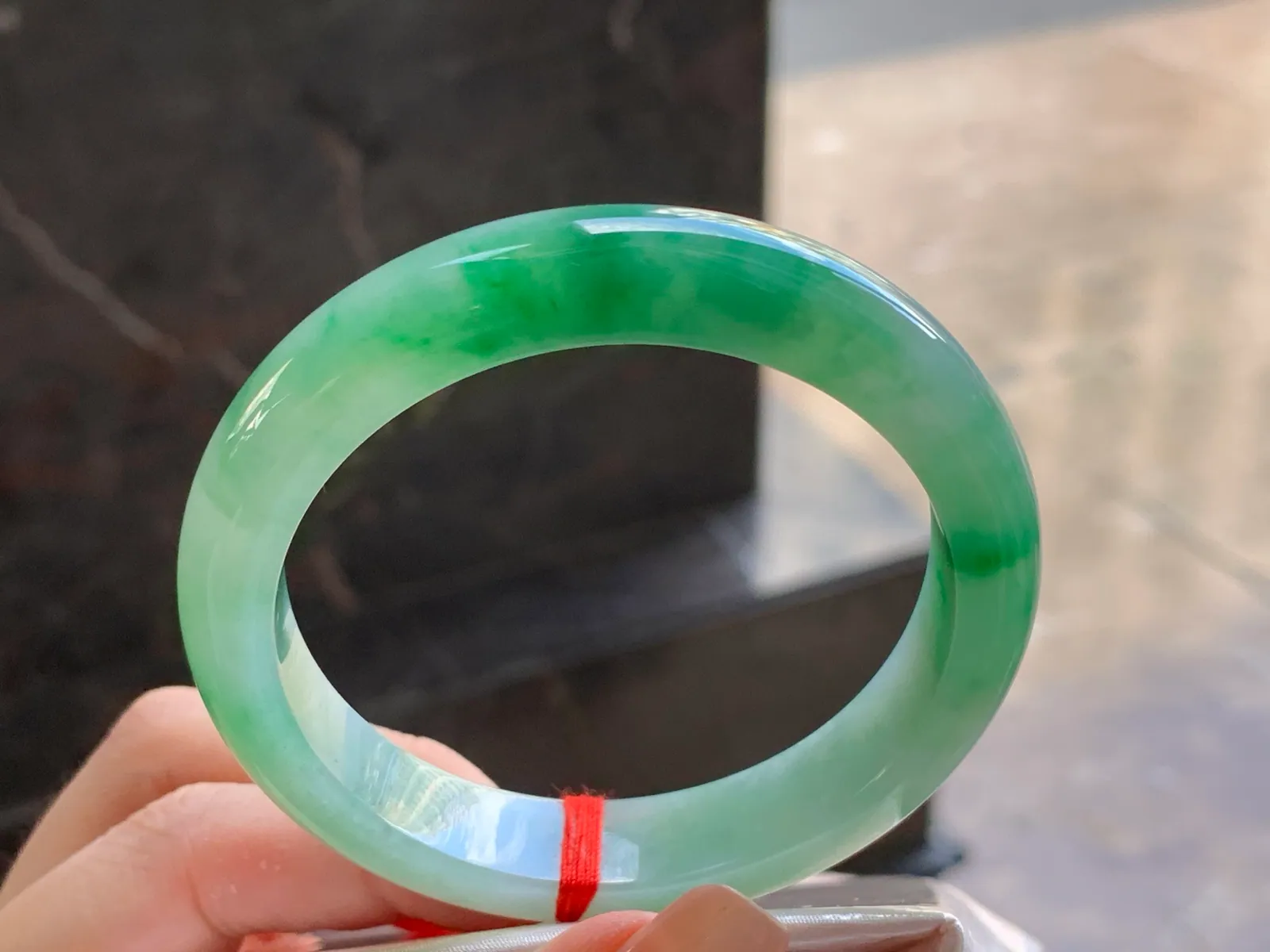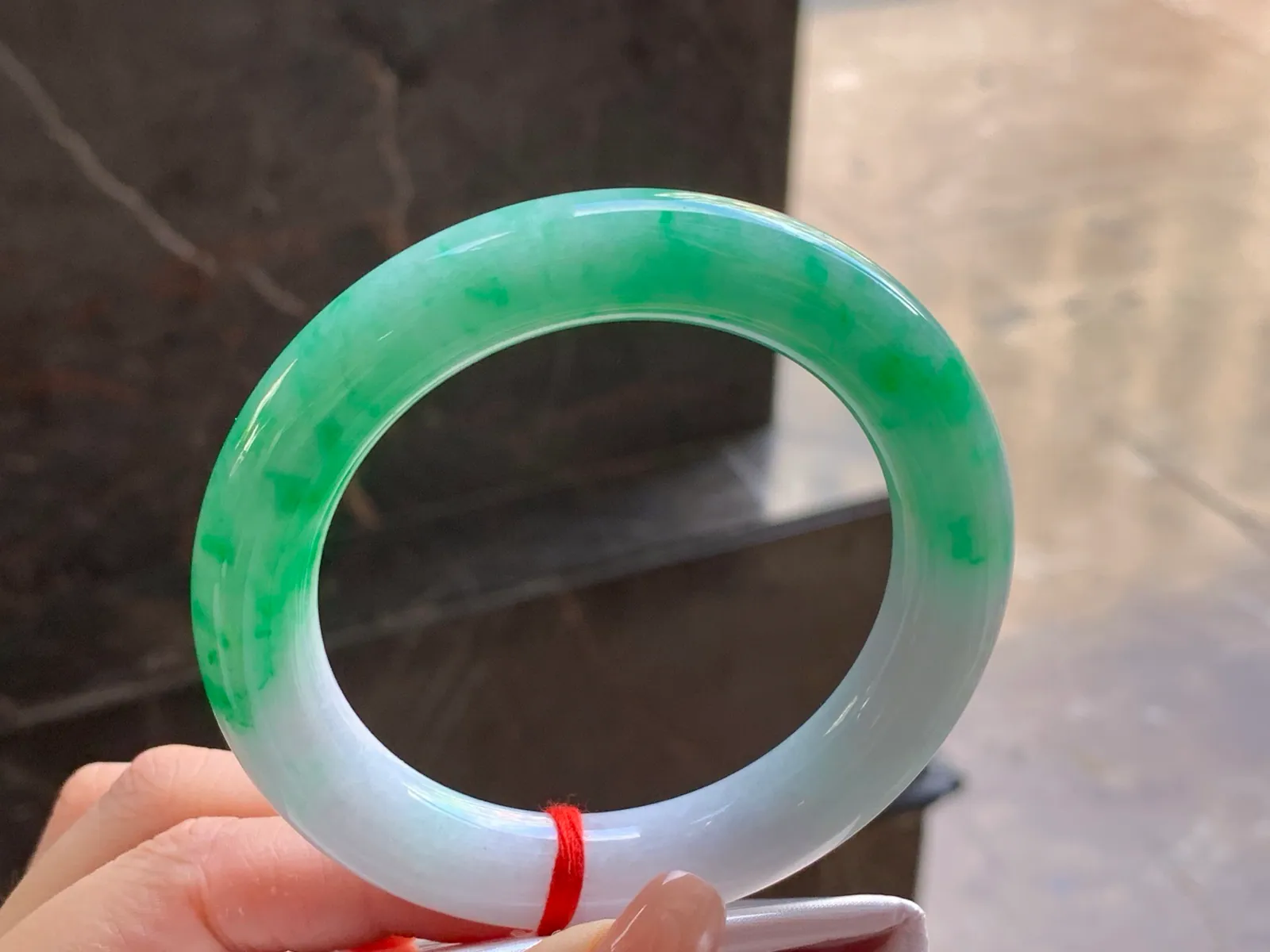
What Is Icy Jadeite? Ice Jade and Floating Flowers
Updated
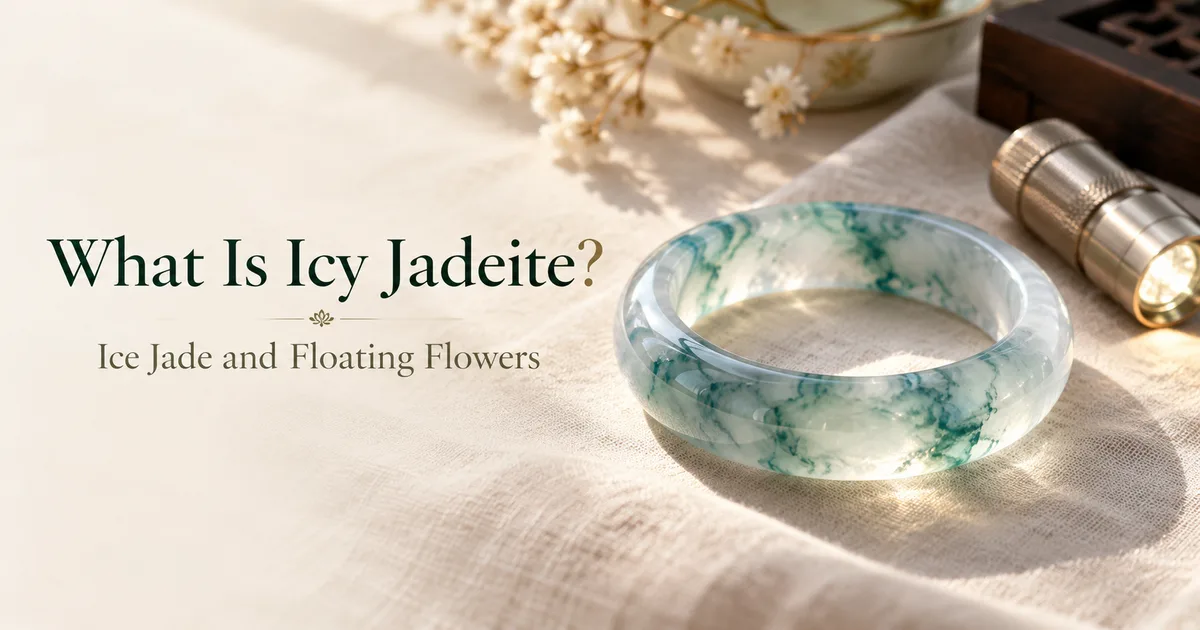
Icy jadeite (冰种) is jadeite with a fine texture and high translucency that looks like clear ice, a step below glassy (玻璃种) and above glutinous (糯种). Floating flowers (飘花) are green or blue-green wisps inside a pale, translucent body, often icy. Judge it in daylight, reflected light and with a flashlight, not under a backlight alone, and confirm natural Type A jadeite with a certificate: bleached Type B and albite can both look icy.
What is icy jadeite (冰种)?
Icy jadeite (冰种, "ice type") is jadeite with a fine, tight texture and high translucency that looks like clear ice: light passes deep into the stone, but it is not quite as water-clear as glassy jadeite.
In the Chinese trade, quality is described with three words: 种 (texture, the size and packing of the crystals), 水 (translucency, how far light goes in) and 色 (color). "Icy" is a grade of the first two together. For the full system, see zhong, shui and se explained.
Three points are worth knowing from the start:
- Icy describes the material, not the color. An icy piece can be colorless, light green, bluish, lavender or have floating flowers.
- It is trade language, not a lab grade. A gem lab certificate names the material (jadeite) and any treatment. It does not normally say "icy" or "glassy". The grade comes from the seller.
- Most "ice jade" in English listings means this. In Vietnamese it is băng chủng (chủng băng); in Thai, หยกพม่าเนื้อน้ำแข็ง.
How is icy different from glassy, high-icy and glutinous?
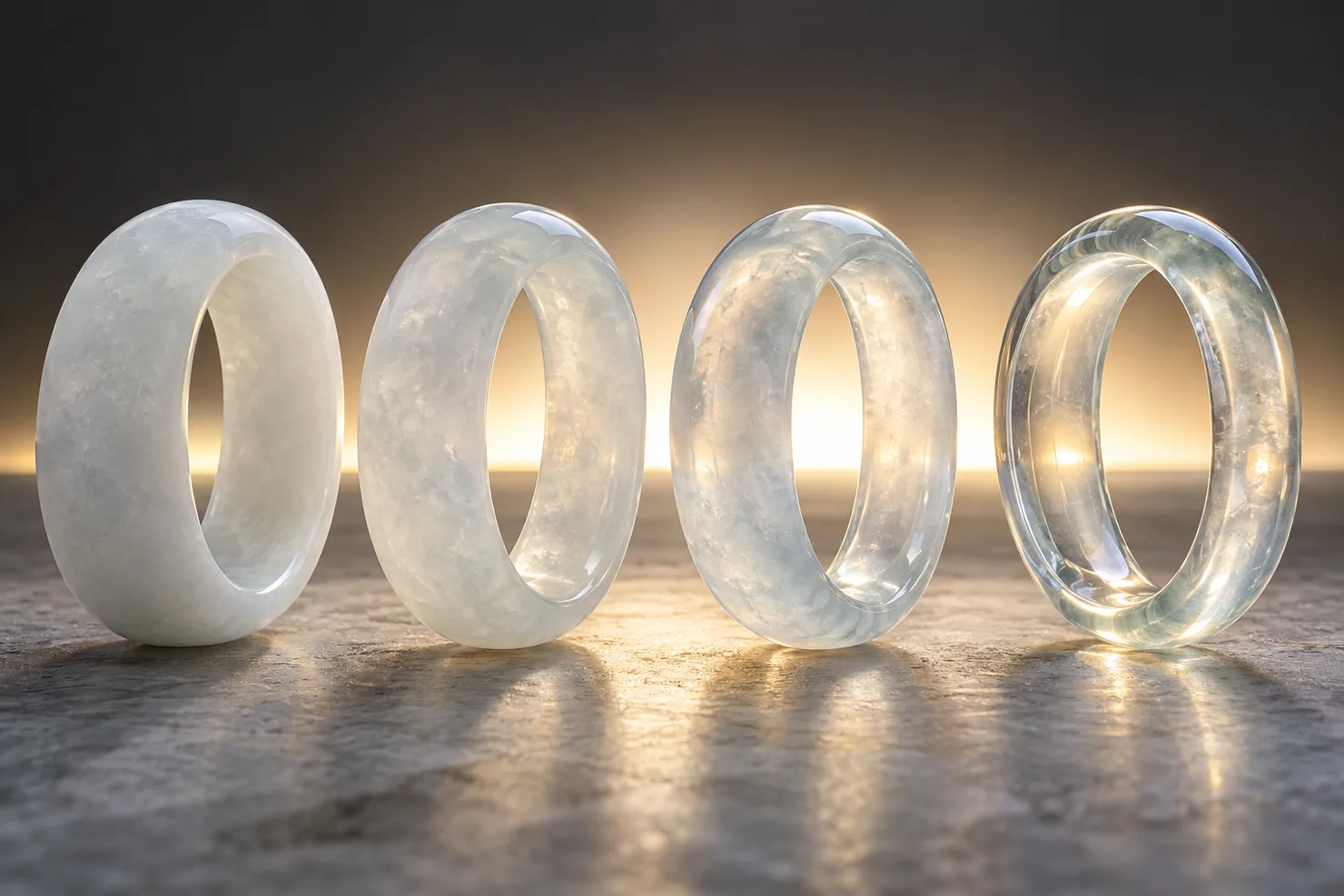
Dealers place texture on a ladder. The steps blur into each other, but the order is well established.
| Grade | Chinese | In daylight | With a flashlight behind it | Printed text under a thin piece |
|---|---|---|---|---|
| Glutinous | 糯种 | Soft, milky, like cooked sticky rice | Light spreads only a short way; a small glowing patch | Not readable; only dark shapes |
| Glutinous-icy | 糯冰种 | Translucent but softly hazy | Light goes in further, edges still soft | Blurred shapes |
| Icy | 冰种 | Clear like ice, slightly misty | A broad, even glow; fine cotton may show | Visible but blurred |
| High-icy | 高冰 | Very clear, near glassy | Light passes almost straight through | Nearly readable |
| Glassy | 玻璃种 | Water-clear, sharp, strong sheen | Clean, almost no visible grain | Readable |
A few points the table cannot show:
- Glutinous-icy (糯冰种) is the in-between grade. It sits between glutinous and icy: translucent, with a soft haze. You may sometimes see it written 冰糯; that means the same in-between grade, but the trade usually says 糯冰种. In Vietnamese it is nếp băng.
- High-icy (高冰) is the step that causes most arguments. One dealer's high-icy is another's glassy. The difference between a top icy piece and a lower glassy piece can be small.
- Glassy is more than clear. Glassy material has no visible grain, a crisp, hard luster and usually a strong floating sheen. A piece can be quite transparent and still be called icy if the grain is visible or the look is slightly soft.
- Thickness and color change the look. A thin pendant always looks clearer than a thick bangle of the same material, and strong color makes material look less transparent.
What do "glow" (起光) and "gel" (起胶) mean, and can treated jadeite fake them?
On fine, tightly packed jadeite that has been well polished into a curve, light scatters just under the surface. You see a soft, bluish-white sheen that seems to float on the stone and slides across it when you turn the piece. Dealers call a thick, jelly-like luster 起胶 ("gel coming up") and a stronger floating sheen 起光 or 起荧 ("glow coming up"). It shows best on bangles and cabochons, and most strongly on glassy and high-icy material. It is a texture effect. It has nothing to do with fluorescence under a UV lamp.
The honest caveat: treatment can imitate the look. Type B jadeite is soaked in acid to remove gray and brown stains and then filled with resin. The result is often a clean, white, translucent body that looks icy at first glance. A white "icy" bangle at a surprisingly low price is the classic profile of bleached and filled jadeite.
| What you see | More typical of natural icy jadeite | Warning signs of Type B |
|---|---|---|
| Luster | Bright, glassy, crisp | Softer, waxy or slightly plastic |
| Sheen when turned | Floats and moves with the curve | Flat, or looks like a coating |
| Surface under a loupe, reflected light | Fine "orange peel" texture | Network of etched lines (酸蚀网纹) |
| Body | Clear, with small natural specks or cotton | Unusually clean and white, translucency "too good" for the grain |
These are clues that experienced dealers still misread. Only a lab can confirm natural, untreated jadeite. See how to spot treated (Type B) jadeite.
What are floating flowers (飘花)?
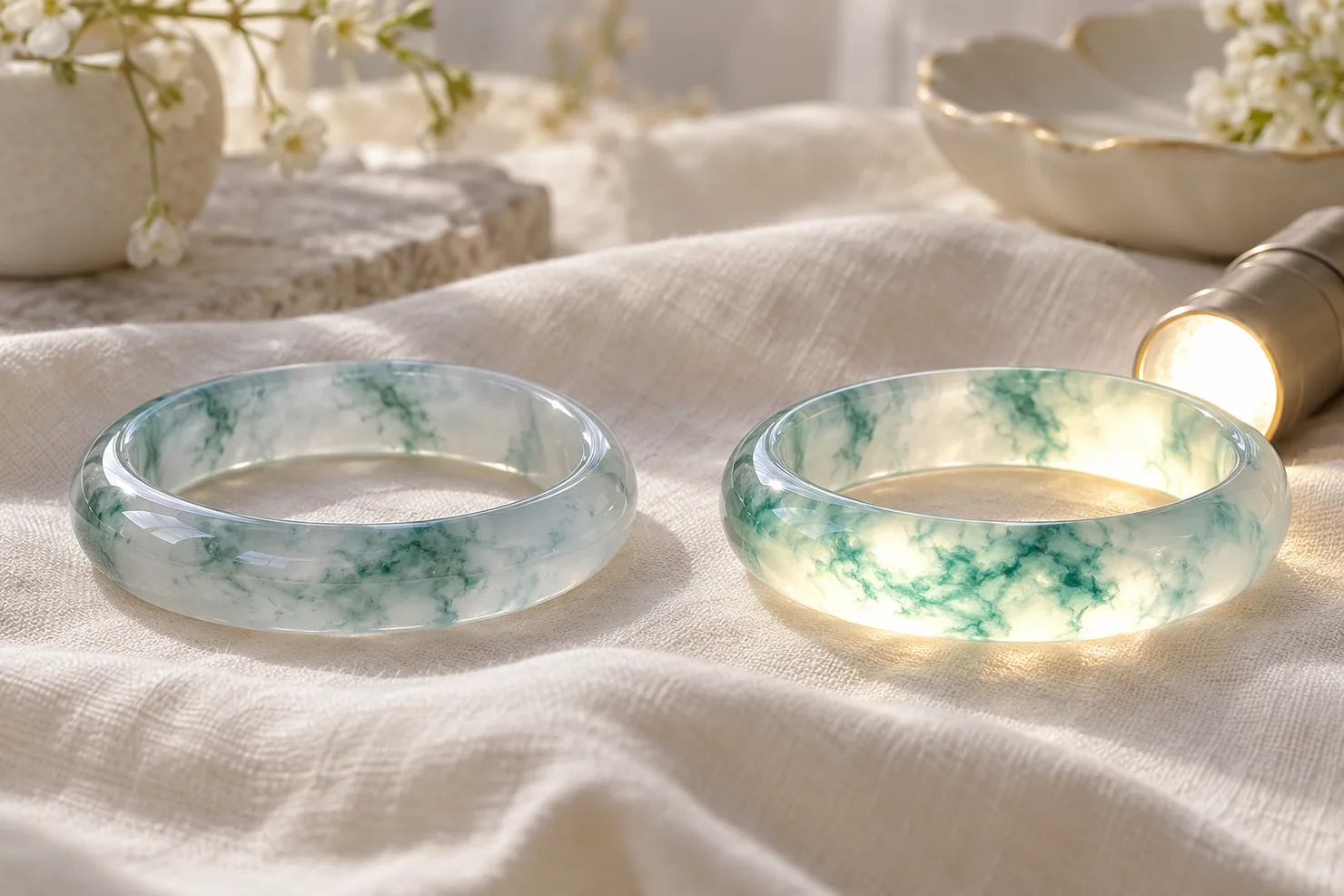
Floating flowers (飘花) are wisps, threads or patches of color, usually blue-green, green or dark green, that seem to float inside a pale, translucent body, most often icy material.
The Vietnamese term is hoa bay (also phiêu hoa); a vòng cẩm thạch hoa bay is a floating-flower bangle. Thai sellers say ลายดอกลอย or describe it as green wisps floating in the stone. Common combinations in listings:
- 冰种飘蓝花: icy with blue or blue-green flowers. The most common kind.
- 冰种飘绿花: icy with green flowers. Usually valued above blue flowers when the green is lively.
- 飘阳绿: bright, vivid green flowers. Less common and sought after.
Floating flowers are judged by a few factors, roughly in this order:
| Factor | More valued | Less valued |
|---|---|---|
| Base | Clean icy or better, no gray tone | Glutinous, cloudy or grayish base |
| Flower color | Lively green or fresh blue-green | Very dark, blackish-green or gray flowers |
| Shape | Flowing, natural lines, like brushwork or water weed | Hard blobs, scattered dots, dirty-looking patches |
| Amount and placement | Enough to form a pattern, placed well on the visible side | Crowded, or all bunched on one spot or the inside |
| Clarity around the flowers | Flowers sharp inside a clear body | Flowers sitting among cotton or cracks |
Taste matters more here than with plain icy material. Some buyers want a few fine wisps; others want strong, bold flowers. Two dealers can value the same piece differently.
What are qingshui (晴水) and blue water (蓝水)?
Two other names often appear next to "icy":
- 晴水 (qingshui, "clear-sky water") is a light, even green spread through the whole piece in icy or clear material, with no flowers. The best looks like pale green water. It is judged on how even, clean and fresh the green is.
- 蓝水 ("blue water") is icy or clearer material with a cool bluish tint. It has become popular in recent years. The key question is whether the blue is clean or grayish. Some bluish icy material on the market comes from Guatemala rather than Myanmar; see where jadeite comes from. A standard certificate identifies jadeite but usually does not state the origin.
The line between 蓝水 and a dull gray body is where sellers stretch words most. Look in neutral daylight, not under a blue-white LED.
How do you judge icy texture yourself?
Dealers look in a fixed order, under three kinds of light. Do the same with the piece in hand, or ask the seller for each view on video.
| Step | Light | What to do | What it shows |
|---|---|---|---|
| 1 | Neutral daylight, by a window, out of direct sun | Hold the piece over white paper | Overall tone: clean white or bluish is good; gray, brownish or dull (发灰, 发闷) is weaker |
| 2 | Reflected light from a lamp | Tilt the piece so the light slides over the surface | Luster, the floating sheen, polish, and surface marks such as an etched net |
| 3 | Transmitted light: flashlight pressed against the back or inside | Move the light slowly around the whole piece | How deep and wide the glow spreads, cotton, cracks, stone lines, grain and flowers |
| 4 | Daylight again | Lay a thin part over printed text | A rough check of clarity (see the ladder table above) |
Common mistakes:
- Judging by the flashlight alone. A strong flashlight makes almost any jadeite look icy. Translucency has to be judged in normal light too.
- Trusting live-stream lighting. Backlit trays, white LEDs and filters raise the look by a grade or more.
- Looking at a wet or oiled piece. Water and oil fill tiny surface gaps and make the stone look clearer than it is dry.
- Judging only the thin edge. The edge of a bangle or the rim of a pendant is always clearer than the body.
- Confusing white with icy. A white, milky bangle can be bright and clean but still glutinous.
What lowers the value of icy jadeite?
| Flaw | Chinese | How to see it | Effect |
|---|---|---|---|
| Cotton | 棉 | White, cloudy specks or patches under the flashlight | Fine, scattered cotton is normal in icy material; large clumps lower the grade |
| Cracks | 裂 | A line that blocks or breaks the light and often shows on the surface under reflected light | The biggest value killer, and a risk for bangles |
| Stone lines | 石纹 | Healed lines that let light through and do not show on the surface | Much less serious than cracks, but still noted |
| Gray or dull tone | 发灰 / 发闷 | Body looks grayish or lifeless in daylight | Lowers value even when translucency is good |
| Dark specks and patches | 黑点 / 癣 | Black or dark-green spots in the body | Depends on size and position |
Telling a crack from a stone line is a skill in itself; see what to do with a cracked jade bangle for how cracks are judged.
How is icy jadeite mislabeled?
"Icy" is one of the most stretched words in jadeite listings.
| What you are told | What it may be | Clues |
|---|---|---|
| "Icy" | Glutinous or glutinous-icy jadeite | Looks icy only with the flashlight on or on the thin edge |
| "Icy white", cheap | Type B: bleached and resin-filled | Waxy luster, unusually clean white body; a certificate will state treatment |
| "Icy floating flowers" | Albite jade (水沫子) | Translucent white with blue-green flowers like jadeite, but lighter in the hand, with a softer luster and white snowflake-like specks; a certificate names it albite, not jadeite |
| "Ice jade" | Glass | Round bubbles, swirl lines, perfectly even look |
| "Ice jade" | Quartzite or chalcedony | Lighter in the hand; chalcedony has no visible grain at all |
Albite jade deserves a special mention, because it looks so much like icy floating-flower jadeite that it fools many buyers. It is a different mineral and is worth far less. For more on look-alikes, see fake jade look-alikes.
What does icy jadeite symbolize?
Clear jade carries its meaning through sayings and tradition:
- China: the idiom 冰清玉洁, "pure as ice, clean as jade", describes integrity and a clean character. Icy jadeite is often chosen for this sense of purity and calm.
- Vietnam: white and colorless belong to the Metal element (mệnh Kim) in ngũ hành, and folk advice says they suit Metal and Water people. Green flowers add the Wood color.
- Thailand: colorless jade has no birth-day color of its own. Wednesday-born buyers often choose green flowers, and Friday-born buyers bluish pieces, matching their day colors.
These are folk traditions and personal meaning, not properties of the stone. See jade meaning and beliefs.
How do I buy icy jadeite safely?
- Ask for video in three lights: daylight over white paper, reflected lamp light, and a flashlight moved around the whole piece.
- Ask whether the piece is wet or oiled in the photos, and ask for at least one dry shot.
- Ask for close-ups of any cotton, lines or cracks, and the dimensions, including thickness.
- Get a lab certificate stating jadeite and natural (Type A), and check it online. Expect it not to say "icy". If it says albite, quartzite or glass, it is not jadeite. See how to verify a jadeite certificate.
- Treat the grade as the seller's opinion. Compare the video with the ladder above rather than the word in the title.
On JadeiteHub, listings use the seller's own photos, and some include video. Every sold piece is checked against its certificate before it ships, and if it does not match the description you get a full refund.
FAQ
What is ice jade?
In jadeite listings, ice jade usually means icy jadeite (冰种): natural jadeite with a fine texture and high translucency, like clear ice. It describes the material, not the color, and it is a trade grade, not a lab grade.
What is the difference between icy and glassy jadeite?
Glassy (玻璃种) is clearer, has no visible grain and a crisp, strong sheen. Icy (冰种) is clear but slightly misty and may show fine cotton or grain. High-icy (高冰) sits between them, and dealers often disagree at that boundary.
What does glutinous-icy (糯冰种) mean?
It is the grade between glutinous (糯种) and icy (冰种): translucent, with a soft haze. You may sometimes see it written 冰糯, which means the same grade; the trade usually says 糯冰种.
Do floating flowers make jadeite more or less valuable?
It depends on the flowers. Lively green or fresh blue-green flowers with flowing shapes in a clean icy body add appeal. Dark, blackish or messy flowers, or flowers in a cloudy body, add little.
Can an icy-looking bangle be fake?
Yes. Bleached and resin-filled Type B jadeite, albite jade (水沫子), glass and quartzite can all look icy. A lab certificate stating natural, untreated jadeite is the proof.