Jade Dragon Pendant Meaning: Styles, Carving and Price
Updated
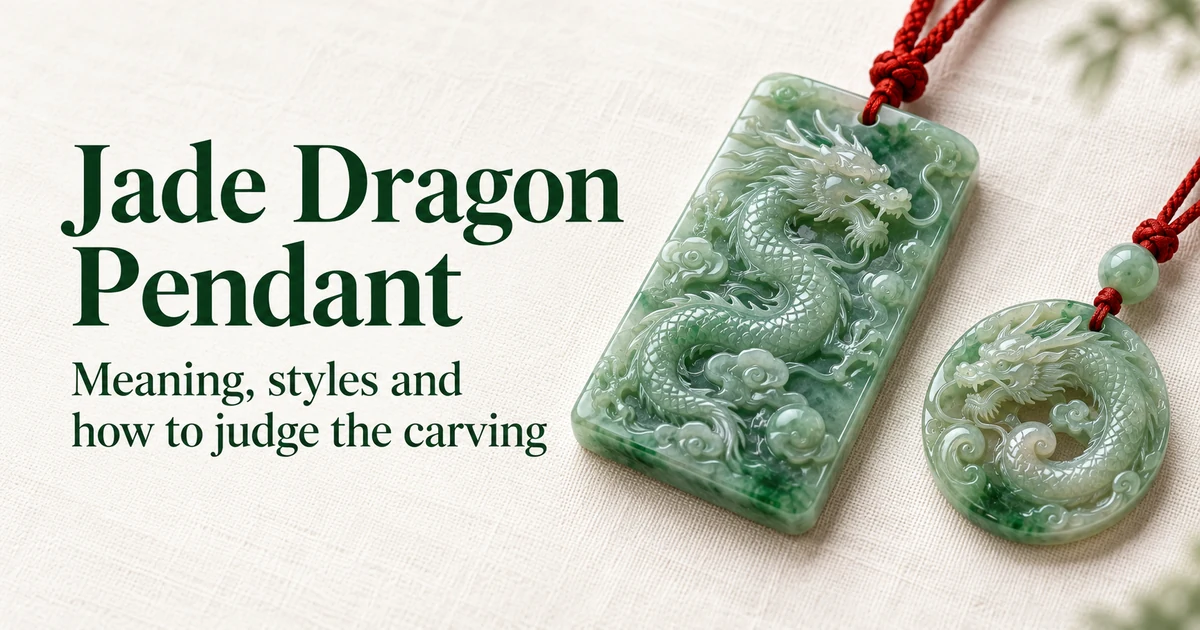
A jade dragon pendant is a jadeite carving of the Chinese dragon (龙), traditionally a symbol of power, success, strong yang energy and, for centuries, the emperor. It is worn as a wish and a cultural sign; the carving has no physical effect on the wearer. Common styles are the dragon plaque (龙牌), the coiled dragon (盘龙), the dragon head, the dragon-and-phoenix pair for couples, the dragon turtle and the carp leaping into a dragon. People born in a Dragon year and men choose it most, but anyone can wear one. Judge the eyes, whiskers, scales, claws and the flow of the body, backlight it for cracks, and remember that the material sets most of the price. Buy with a certificate that says natural (Type A) jadeite.
What does a jade dragon pendant mean?
In Chinese tradition the dragon stands for power, success, authority and strong yang (male, active) energy, and a jade dragon pendant is worn as a wish for those things. It is a cultural symbol, not a charm with a mechanism: the stone does not change your career or your health because a dragon is carved on it.
The Chinese dragon (龙, lóng) is not the fire-breathing monster of European stories. It is a benevolent creature of water and sky, said to bring rain and good harvests. Traditional texts describe it as a mix of nine animals: the antlers of a deer, the scales of a carp, the claws of an eagle, the neck of a snake and so on. Over the imperial centuries it became the emblem of the emperor, who was called the "true dragon, son of heaven" (真龙天子). That link is why the dragon still reads as the most senior, most powerful of the auspicious animals.
Everyday sayings show what people wish for when they wear one:
| Saying | Literal meaning | How it is used |
|---|---|---|
| 望子成龙 | Hoping one's son becomes a dragon | Parents' wish for a child to succeed; a common reason to give a dragon to a son |
| 龙马精神 | The spirit of a dragon-horse | Energy and vigour, a New Year greeting, often for older people |
| 鲤鱼跃龙门 | The carp leaps the Dragon Gate | Passing exams, a promotion, a big step up |
| 龙凤呈祥 | Dragon and phoenix bring good fortune | A happy marriage; used for weddings |
| 画龙点睛 | Painting the dragon, dotting the eyes | The final touch that brings a work to life (and the first thing to check on a carving) |
Does a jade dragon pendant have any effect (功效)?
No physical effect, but a real cultural meaning. Chinese searchers often ask about a dragon plaque's 功效, "effect" or "function". Sellers answer with promises of career luck, protection from bad people or "boosting your yang energy". Those are traditional beliefs at best and sales talk at worst. Jadeite is a tough, beautiful stone, and that is all it physically is.
What a dragon pendant honestly does: it marks an identity (your birth year, your family's hopes for you), it carries a wish you care about, and it is a durable piece of jewelry that can be passed down. If a seller ties the price to the "power" of the carving rather than to the stone and the workmanship, walk away.
Which jade dragon styles are most common?
Workshops carve a handful of standard dragon designs. Knowing their names helps when you search, compare or talk to a dealer.
| Style | Chinese trade name | What it looks like | Traditionally associated with |
|---|---|---|---|
| Dragon plaque | 龙牌 | A flat rectangular plaque with a dragon in low relief, often among clouds or waves, with a carved top (牌头) | Authority, steady success; the classic men's piece |
| Coiled dragon | 盘龙 | The dragon curled into a circle or oval, sometimes around a pearl | Power held in reserve; a compact, sturdy shape |
| Dragon head | 龙头 | Just the head, carved in the round | A bold, modern look; popular with younger men |
| Dragon with pearl | 龙戏珠 | A dragon chasing a flaming pearl | Wisdom and treasure |
| Dragon and phoenix | 龙凤牌, 龙凤佩 | A dragon piece and a phoenix piece as a pair, or both on one plaque | Marriage and harmony; given at engagements and weddings |
| Dragon turtle | 龙龟 | A turtle body with a dragon head, often carrying coins | Long life plus wealth; widely used in feng shui |
| Carp into dragon | 鲤鱼跃龙门, 鱼化龙 | A carp leaping, its head or tail already turning into a dragon | Success through effort; exams and careers |
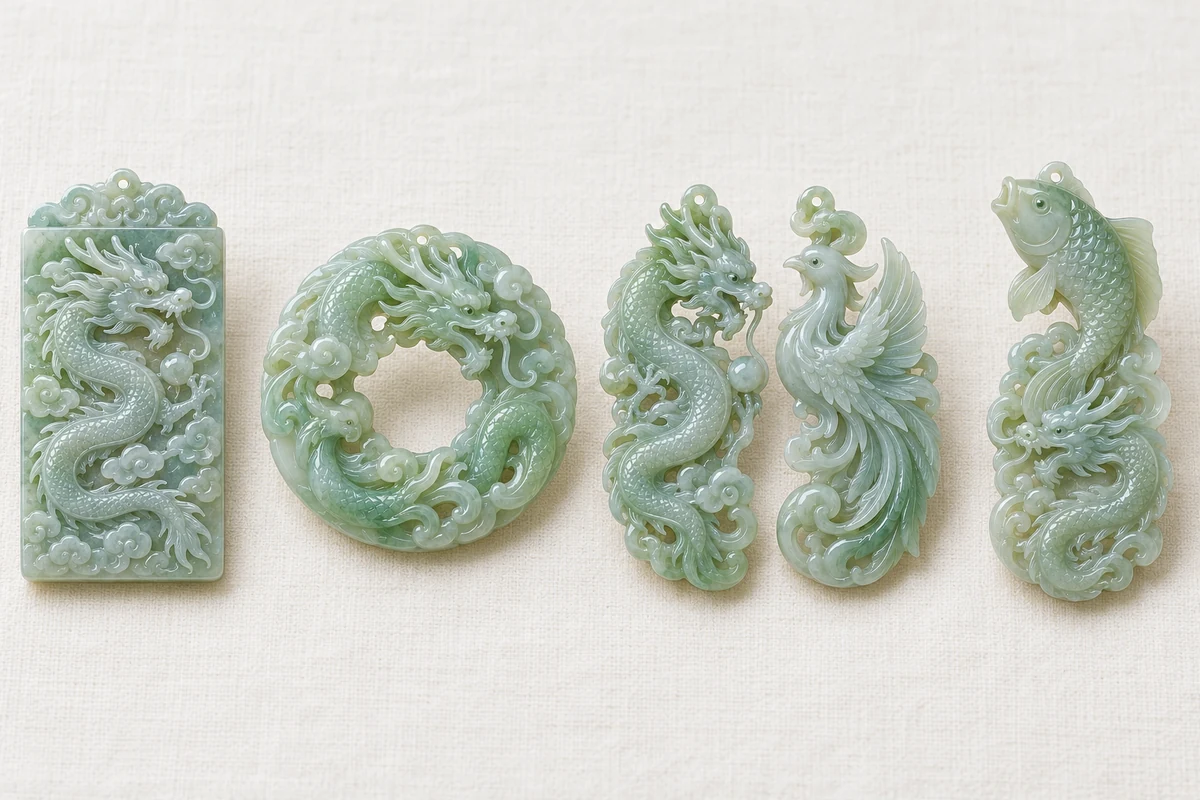
The dragon and phoenix is the one style meant for two people: traditionally the man wears the dragon and the woman the phoenix. It is a common engagement or wedding gift; see jade wedding jewelry for how it fits the rest of a wedding set. The carp turning into a dragon is especially loved in Vietnam, where it is called cá chép hóa rồng, and the dragon turtle is a familiar sight in Thai shops as เต่ามังกร.
Who should wear a jade dragon pendant?
Anyone who likes it can wear a dragon; there is no rule against it. In practice three groups choose it most:
- People born in a Dragon year. The Dragon is the fifth of the twelve zodiac animals. Recent Dragon years are 1964, 1976, 1988, 2000, 2012 and 2024 (each starting at Lunar New Year, not 1 January), and the next is 2036. Many people wear their own animal, especially in their own zodiac year (本命年).
- Men. The dragon is the classic men's motif, and a plain, solid dragon plaque is one of the most common gifts for a father, husband or son. More on choosing pieces for men in jadeite for men.
- Families with a new baby or a student. A small dragon or a carp-and-dragon for a child born in a Dragon year, or for a student before big exams, carries the 望子成龙 wish.
Women wear dragons too, especially women born in a Dragon year or who simply like a strong design. Some prefer a smaller coiled dragon, a dragon set with gold, or the phoenix half of a pair. The older saying that women should wear the phoenix and men the dragon is custom, not a rule.
Some zodiac charts say the Dragon "clashes" with the Dog (辰戌相冲), and some Thai and Vietnamese lists for 2027 group the Dragon among the signs to be careful with; see jade and the 2027 zodiac. These are beliefs, and many people ignore them. If a dragon matters to you, wear the dragon.
How do you judge the carving on a jade dragon?
Look at the eyes first, then the whiskers, scales, claws and the line of the body. Dealers sum up a good dragon in one word, 神 (spirit): it should look alive and moving, not like a lizard stuck to a plaque. The saying 画龙点睛 is literal here. A carver who cannot finish the eyes cannot carve a dragon.
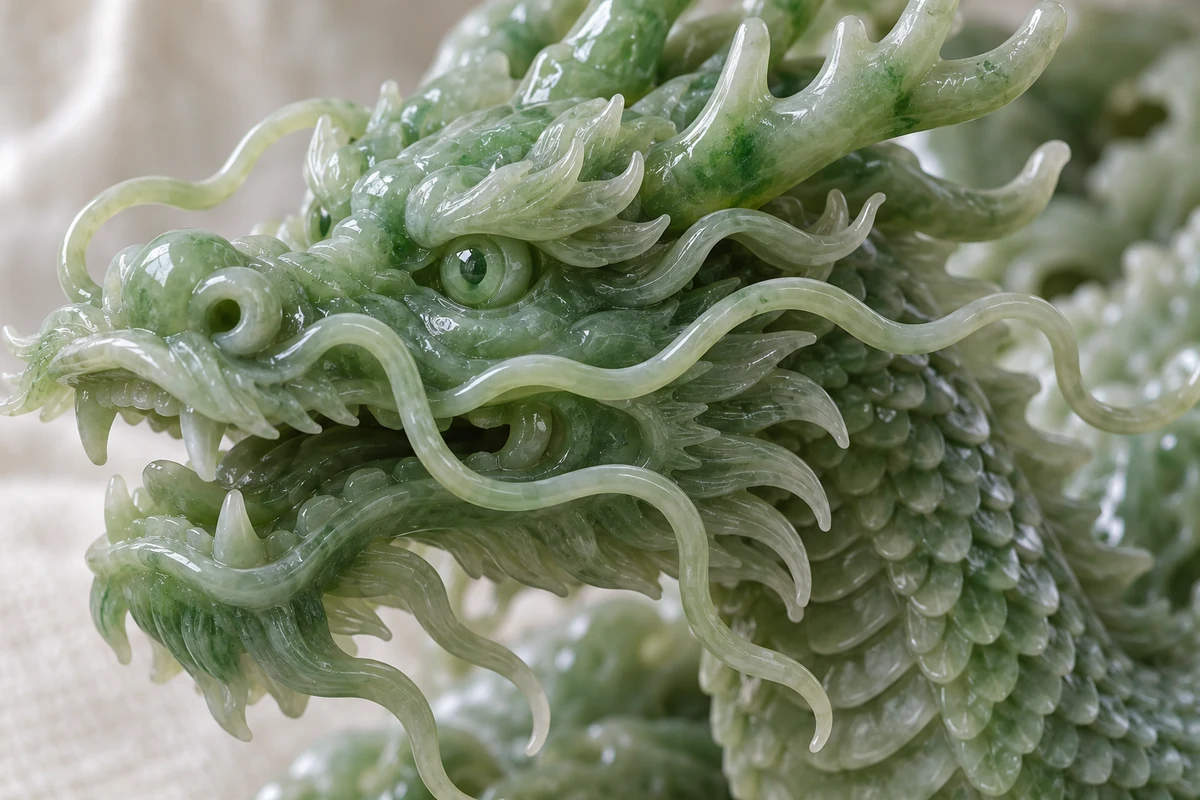
| Part | Good work | Poor work |
|---|---|---|
| Eyes | Bright, clearly cut, the same size on both sides, looking in one direction | Blurred, flat or uneven; a dark spot or crack in the eye |
| Whiskers and mane (龙须, 龙鬃) | Fine, long, flowing, freed from the background where possible | Thick stubs, or lines scratched onto the surface |
| Antlers and head | Crisp antlers, a clear jaw and nose, a mouth with teeth | A rounded blob where the head should be |
| Scales | Cut one by one, overlapping, getting smaller toward the tail | A stamped grid of identical squares, or no scales at all |
| Claws | Sharp, gripping, with clear joints | Mitten feet; claws that look like stumps |
| Body | An S-curve with movement, twisting through clouds or waves | Stiff, straight, the same thickness from head to tail |
| Finish | Polished into the hollows, between scales and under whiskers | Shiny high points, dull or gritty recesses |
How many claws? In imperial China, especially in the Ming and Qing dynasties, the five-clawed dragon was generally reserved for the emperor and imperial use, while four-clawed dragons (called 蟒, mang) appeared on officials' robes. Three-clawed dragons are common in older and in Japanese art. Today the claw count carries no restriction and very little meaning for price. A well-carved four-claw dragon beats a clumsy five-claw one every time; just do not pay extra because a seller calls a piece "imperial five-claw".
Colour placement matters too. When a carver puts a patch of green on the dragon's body and leaves the clouds white, or uses a brown or yellow skin colour for the pearl, the trade calls it 俏色 (clever use of colour) and it adds value. When green cuts across the face at random, the design ignored the stone. More on this in jade carving quality.
Is a jade dragon hand carved or machine carved?
Most low- and mid-grade carved jadeite dragons are cut on CNC carving machines and then finished by hand. That is normal across the trade, including the workshops in Sihui, Guangdong, that make much of the market's mid- and low-grade carving. A machine-cut, hand-finished dragon at a fair price is a perfectly good buy. It only becomes a problem when it is sold as "pure hand carved" at a hand-carved price.
Signs that point to machine work:
- Mass identical dragons. A tray or a livestream full of dragons with exactly the same pose, scale pattern and clouds.
- Even depth everywhere. Every groove has the same depth and the same rounded bottom.
- Scales as a pattern, not as individual scales that change size along the body.
- Little undercutting. Whiskers and claws are carved onto the surface rather than freed from it.
- Colour that ignores the design. The program does not see the green.
Hand-finished and fully hand-carved pieces show the opposite: small differences between pieces, depth that varies, freed whiskers, and a design that follows the colour of the stone. Ask the seller "hand carved, machine carved, or machine carved and hand finished (机雕手修)?" and get the answer in writing.
Can heavy carving on a dragon hide cracks?
Yes, and that is why dealers check carved dragons carefully. The trade saying 无绺不雕, "no flaw, no carving", means that clean stone is often left plain or carved lightly, while stone with cracks or cotton gets carved more, so the lines of clouds, scales and whiskers can follow and hide the flaws. Not every richly carved dragon hides a crack, but a busy dragon on a cheap piece deserves a closer look.
Where to look:
- The base of the whiskers and antlers, which are thin and chip easily.
- The claw tips and the edge of a coiled dragon.
- Long cloud or wave lines that run across the whole plaque.
- Around the drill hole, which carries the weight of the pendant.
Use a small white flashlight in a dim room and move it slowly over the back. A crack stops the light and shows a sharp edge with a bright side and a dark side; if a line runs past the end of a carved groove or shows on the back as well, it is a crack, not part of the design. See jadeite cotton and cracks.
What drives the price of a jade dragon pendant?
The material first, then the carving, then size and paperwork. Two dragons with the same design can differ in price many times over because of the stone.
| Factor | What dealers look at | Why it matters |
|---|---|---|
| Texture and translucency (种水) | How fine and glassy the stone is: icy, glassy or coarse | The biggest single driver; fine, translucent stone costs far more |
| Colour (色) | How green, how even, and where the colour sits | Strong, even green costs the most; well-placed green adds value |
| Cleanliness | Cracks, cotton, black spots, especially on the head | A crack through the dragon's head or body cuts the value sharply |
| Carving | Hand or machine, detail, 俏色, the dragon's "spirit" | Matters more on mid-grade stone; on top stone the carving is kept simple |
| Size and thickness | Width, length and thickness in mm, weight | A plaque needs a large, clean slab, and that is scarce |
| Certificate | A lab report naming natural (Type A) jadeite | Without it, the price rests on trust alone |
| Setting | 18K gold or 925 silver, how much metal | Adds metal and labour cost on top of the jade |
Notice the order. A flat dragon plaque in fine, even material is often more expensive than an elaborate dragon in coarse stone, because clean material that size is rare. For how dealers grade stone, see what determines jadeite price.
Should a jade dragon be set in gold or silver?
Either works; choose by budget, the weight of the piece and how you want it to look.
- 18K gold. A gold bail, a gold top cap on a plaque, or gold accents such as a gold pearl or flames on the dragon. Gold-set jadeite is mostly made in China in 18K (75%) gold. Gold is strong enough for heavy men's plaques and does not tarnish.
- 925 silver. A silver bail or frame for a lighter budget or a white-metal look. Every silver setting JadeiteHub sells is 925 sterling silver. Silver tarnishes and is softer than gold, so check the bail on a heavy dragon.
- Cord. A red or black cord is the traditional choice for a plaque and keeps the look simple. Replace it when it frays.
A full metal frame protects the edge of a plaque but also hides it, so inspect the edge before it is set. Our guide to silver vs 18K gold settings compares them in detail.
What should you check before buying a jade dragon pendant?
- Choose the style: plaque, coiled dragon, dragon head, dragon-phoenix pair, dragon turtle or carp into dragon.
- Look at the eyes and whiskers first, then the scales, claws and the curve of the body.
- Ask: hand carved, machine carved, or machine carved and hand finished? Get it in writing.
- Ask for a flashlight video along the whiskers, claws, clouds and drill hole, front and back.
- Ask for the size and thickness in millimetres and a photo next to a coin or ruler; men's plaques can be heavy.
- Ask for a lab certificate that names natural (Type A) jadeite, and check that the photo, size and weight match the piece.
- Ignore power talk. Price the stone and the work, not the promises.
On JadeiteHub we only list jadeite that comes with a lab certificate. Every sold piece is checked against its certificate at our inspection center before it ships, and if it is not as described you get a full refund.
FAQ
What does a jade dragon pendant mean?
In Chinese tradition the dragon stands for power, success, authority and strong yang energy, and it was long the emblem of the emperor. A jade dragon pendant is worn as a wish for those things. It is a cultural meaning, not a physical effect.
Does a jade dragon plaque have any real effect?
No. Claims that a dragon plaque brings career luck, protection or energy are traditional beliefs or sales talk. The value is in the stone, the carving and what the symbol means to you.
Can women wear a jade dragon pendant?
Yes. The dragon is most popular with men and with people born in a Dragon year, but there is no rule against women wearing one. Some women prefer a smaller coiled dragon or the phoenix half of a dragon-and-phoenix pair.
Which years are Dragon years?
Recent Dragon years are 1964, 1976, 1988, 2000, 2012 and 2024, and the next is 2036. Each zodiac year starts at Lunar New Year, so people born in January or early February may belong to the previous sign.
Is a five-claw dragon better than a four-claw dragon?
Not today. In the Ming and Qing dynasties the five-clawed dragon was generally reserved for imperial use, but the claw count now has no restriction and little effect on price. Judge the material and the quality of the carving instead.
How can I tell if a jade dragon is machine carved?
Many identical copies, grooves of the same depth, scales that form a regular pattern, whiskers carved onto the surface rather than freed, and colour that ignores the design all point to CNC work. Most low- and mid-grade dragons are machine cut and hand finished, which is fine at a fair price.
What is a dragon and phoenix pendant for?
It is a matching pair, or a single plaque, showing a dragon and a phoenix, traditionally a symbol of a happy marriage. Couples wear one each, usually the man the dragon and the woman the phoenix, and it is a common engagement or wedding gift.