Jade in Sterling Silver vs 18K Gold: Which Setting?
Updated
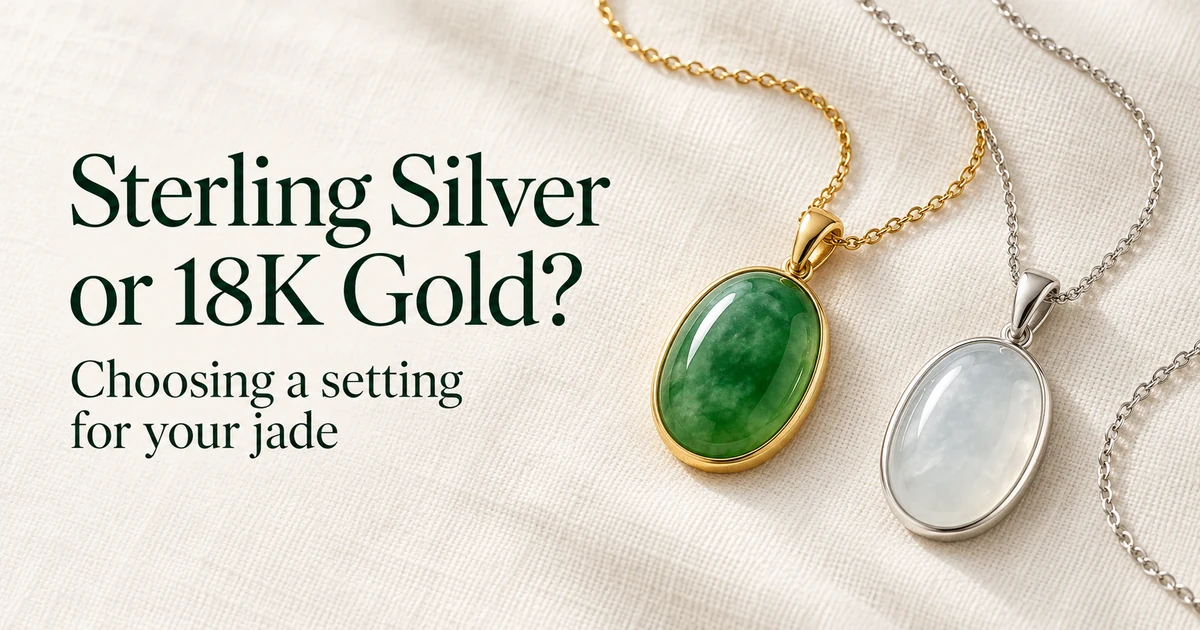
Neither metal changes the jade. 18K gold (75% gold) holds a stone more securely, does not tarnish and keeps a metal value, so it suits rings and valuable jadeite. 925 sterling silver is softer and darkens over time but costs far less, so it suits pendants, earrings and modest pieces. A silver setting does not mean the jade is poor, and an 18K setting does not prove the jade is natural; only a certificate does. Check the hallmark: 925, S925 or Ag925 is sterling silver; 750, 18K or Au750 is 18K gold; GP, HGE or GF means plated or filled. JadeiteHub's silver settings are all 925 sterling silver; our gold-set pieces are mostly made in China in 18K gold.
Is jadeite better in sterling silver or 18K gold?
Neither metal makes the jade better or worse. The jade's quality comes from its texture, translucency, color and whether it has been treated. The metal decides four other things: how securely the stone is held, how the piece wears over the years, how the jade's color reads next to it, and what the piece is worth apart from the stone.
As a rule of thumb, 18K gold suits rings, valuable stones and pieces you plan to keep for decades. 925 sterling silver suits pendants, earrings and modestly priced pieces, where you want the money to go into the jade rather than the metal.
At JadeiteHub, every silver setting we sell is 925 sterling silver, and our gold-set pieces are mostly made in China in 18K (75%) gold. That mirrors how most of the jadeite trade works, and the rest of this guide explains why.
How do 925 silver, 18K gold and other metals compare?
The table below covers the metals you will meet on jadeite jewelry, plus the steel and titanium used for chains and clasps.
| Metal | Purity | Color | Prongs and durability | Tarnish and plating | Skin notes | Metal value on resale |
|---|---|---|---|---|---|---|
| 925 sterling silver | 92.5% silver, the rest mostly copper | Bright white with a grey tone | Soft; prongs and thin rims wear and bend sooner | Darkens over time; often rhodium-plated to slow this, and the plating wears off | Allergy to silver itself is uncommon; reactions usually come from other metals in a cheap alloy or plating | Low |
| 18K yellow gold | 75% gold | Warm yellow | Strong enough for prongs; the usual choice | Does not tarnish in normal wear | Generally well tolerated | Keeps its gold value |
| 18K white gold | 75% gold, alloyed with white metals such as palladium or nickel | Slightly grey or yellowish; rhodium plating makes it bright white | Strong; nickel white gold is harder | Rhodium plating wears at contact points and can be redone | Nickel white gold can trigger a nickel allergy; ask for nickel-free | Keeps its gold value |
| 18K rose gold | 75% gold with more copper | Pink | Strong | Does not tarnish in normal wear | Generally well tolerated | Keeps its gold value |
| 22K to 24K gold (pure gold, 足金) | About 91.6% to 99.9% | Deep yellow | Soft; bends, dents and scratches; poor for prongs | Does not tarnish | Generally well tolerated | Highest per gram |
| Gold-plated silver, "gold vermeil" | Silver with a thin gold layer on top | Yellow until the plating wears | Same as silver | Plating wears at edges; the silver underneath tarnishes | Same as silver | Little; the plating adds almost nothing |
| Platinum | Usually 90% to 95% (Pt900, Pt950) | Naturally white, no plating needed | Dense and hard-wearing; prongs wear slowly | Does not tarnish | Generally well tolerated | Has metal value |
| Stainless steel, titanium | Alloys | Grey-white | Strong | Do not tarnish | Titanium is usually nickel-free; steel varies by grade | Little; used for chains, clasps and cord ends, rarely to set jade |
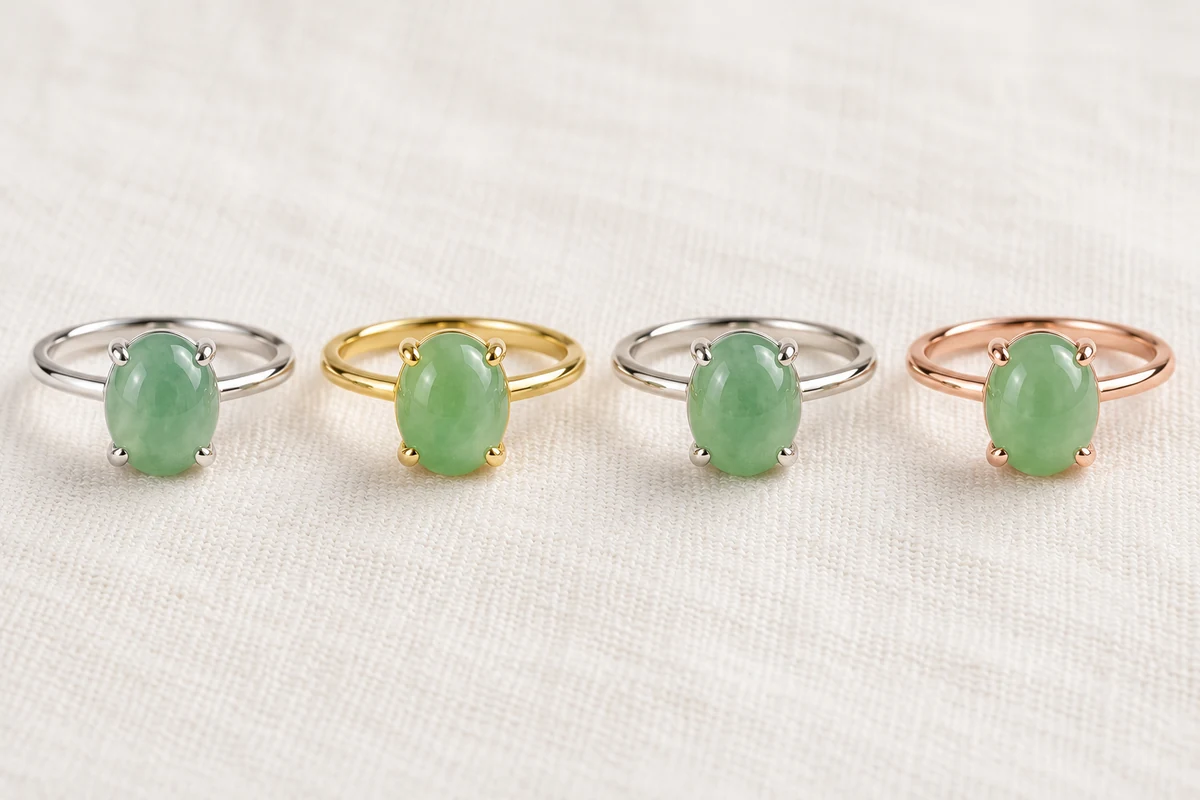
A few points the table cannot show:
- Weight. Gold and platinum are far denser than silver: pure silver is about 10.5 g/cm³, pure gold about 19.3 and platinum about 21.4. The same design is noticeably heavier in 18K than in silver. Gold jewelry is priced by the weight of the metal plus labor, so a chunky design in gold costs far more than the same look in silver. That is why gold settings for jadeite are often lighter, more open designs.
- "Gold vermeil." In the United States the term is defined for sterling silver coated with gold of at least 10K and at least 2.5 microns thick. Elsewhere the word is used loosely. Either way, it is silver with a gold skin, not gold.
- White gold and silver look alike when new. Both are often rhodium-plated, so they can be hard to tell apart in a photo. The hallmark tells you which you have; after a year of wear, silver usually starts to darken in the recesses, white gold does not.
- Resale. When a gold piece is sold on, the gold has a value of its own by weight. Silver's metal value is small, so a silver-set piece resells almost entirely on the jade.
Why is fine jadeite usually set in 18K gold and modest pieces in 925 silver?
Mostly for reasons of security and proportion, not because silver says anything bad about the jade.
- Security. A valuable stone sits in prongs or a rim that must hold for years. 18K prongs keep their shape and can be re-tipped by a jeweler. Silver is softer; its prongs wear thin and bend more easily, and a lost stone is the most expensive way a setting can fail.
- Proportion. Dealers in China say "a good horse deserves a good saddle" (好马配好鞍). A modest cabochon in heavy 18K gold can end up costing more in metal than in jade. A top-quality stone in silver looks like a mismatch to trade buyers and lowers what they will pay.
- Long life. Fine pieces are kept and passed down. Gold does not tarnish, and it can be repaired and polished many times.
- Metal value. The gold keeps a value of its own if the piece is ever sold.
Now the important part: the metal is not a verdict on the jade.
- A natural, untreated (Type A) stone in sterling silver is still Type A. The certificate describes the jade, not the mount.
- A heavy 18K setting with a ring of small diamonds can hold treated (Type B) jade, or a stone with a crack under the rim. Gold and side stones are sometimes used to lift the look and the price of an average stone. Judge the jade on its own, with its certificate.
- Many designers choose silver for larger, modern designs that would be very costly in gold.
Two lines you will hear from sellers, and why both are wrong: "It's set in 18K, so the jade must be real." The metal proves nothing about the stone. "Silver-set jade is always B goods." Also wrong; plenty of Type A jade is set in silver.
Which metal color suits which jade color?
This is taste, not a rule. Metal reflects through translucent jade, so the mount color slightly tints how the stone looks. Common habits in the trade:
| Jade | Often set in | Why |
|---|---|---|
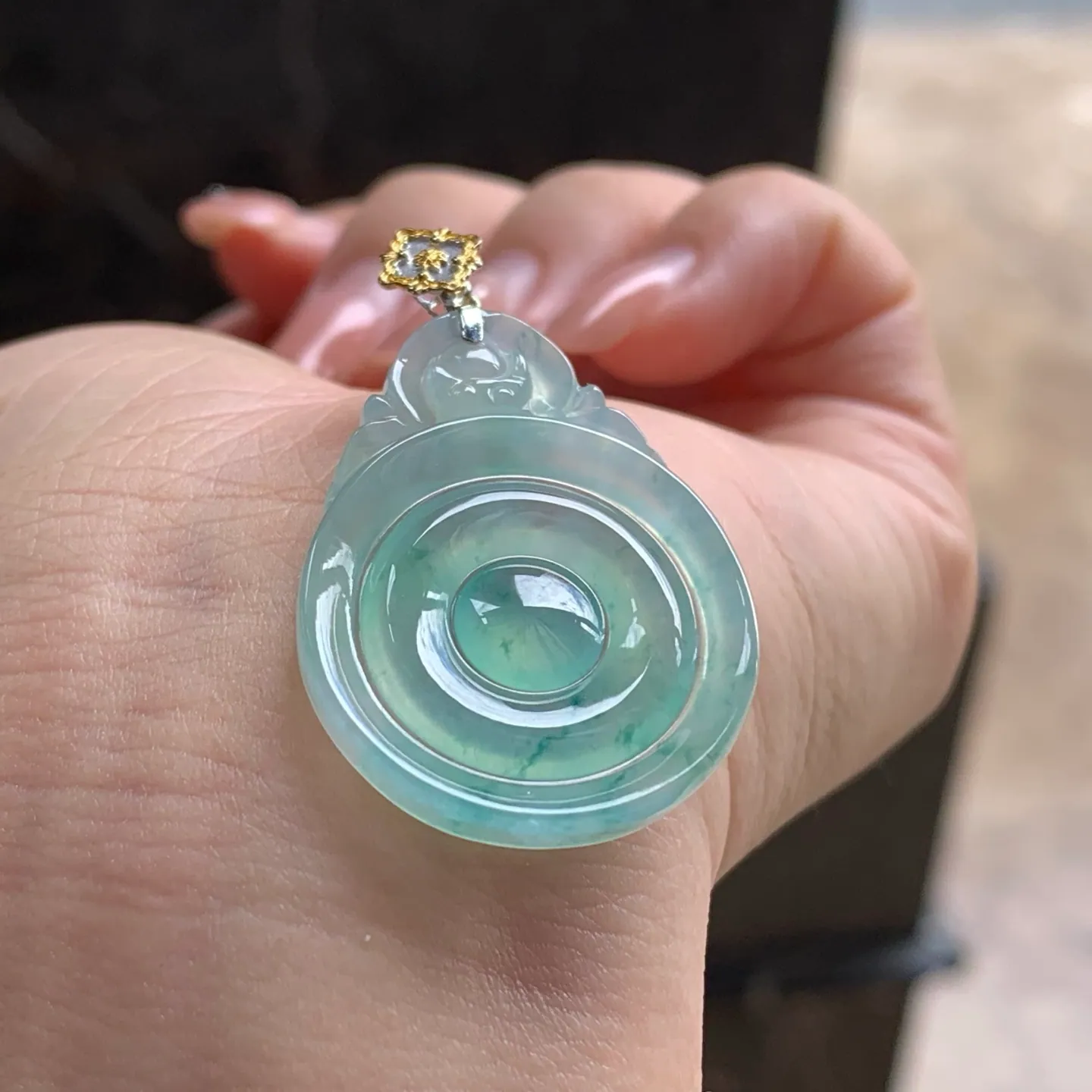
| Icy, colorless or near-colorless | White gold, platinum or silver | White metal keeps the stone looking cool and clear; yellow gold can add a warm tint |
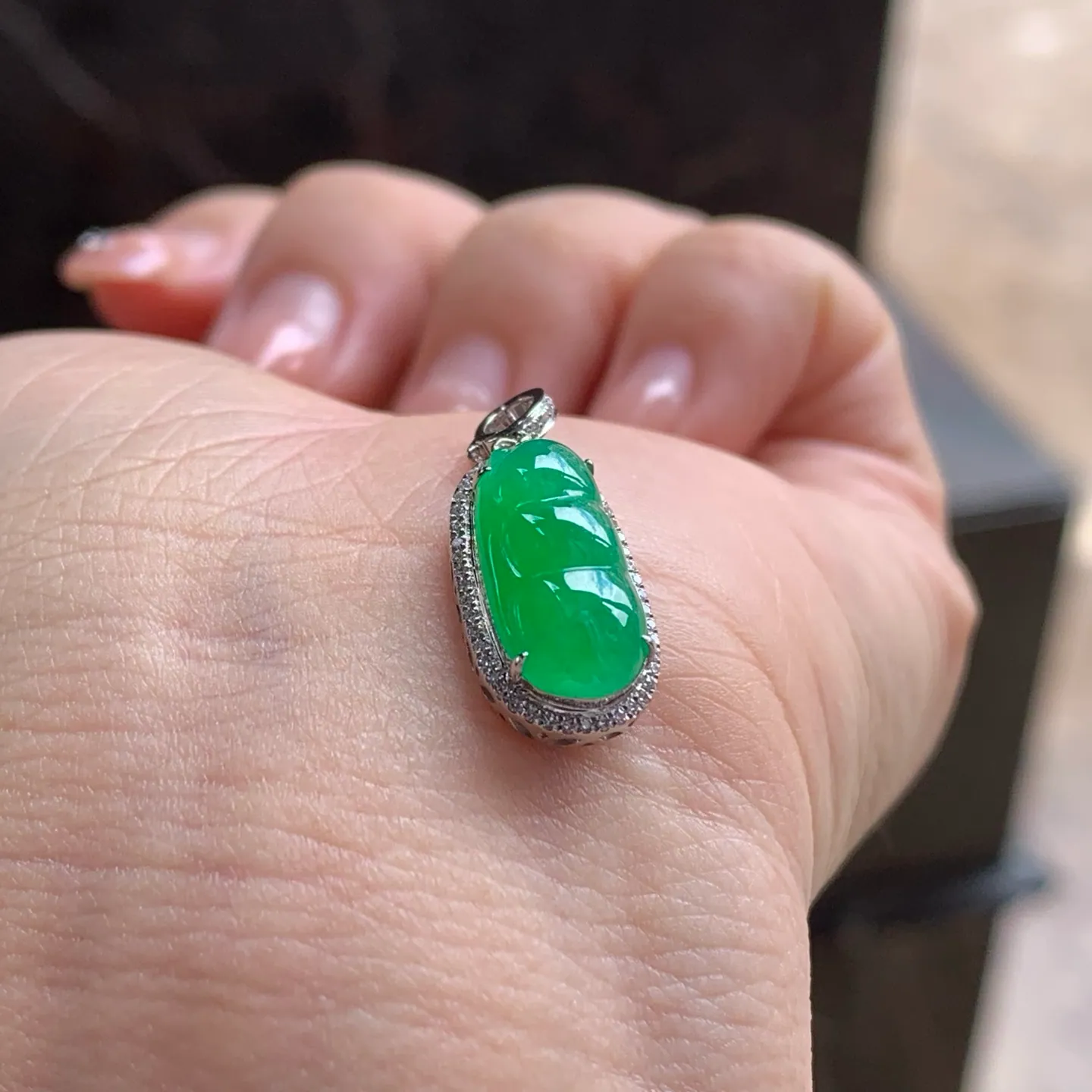
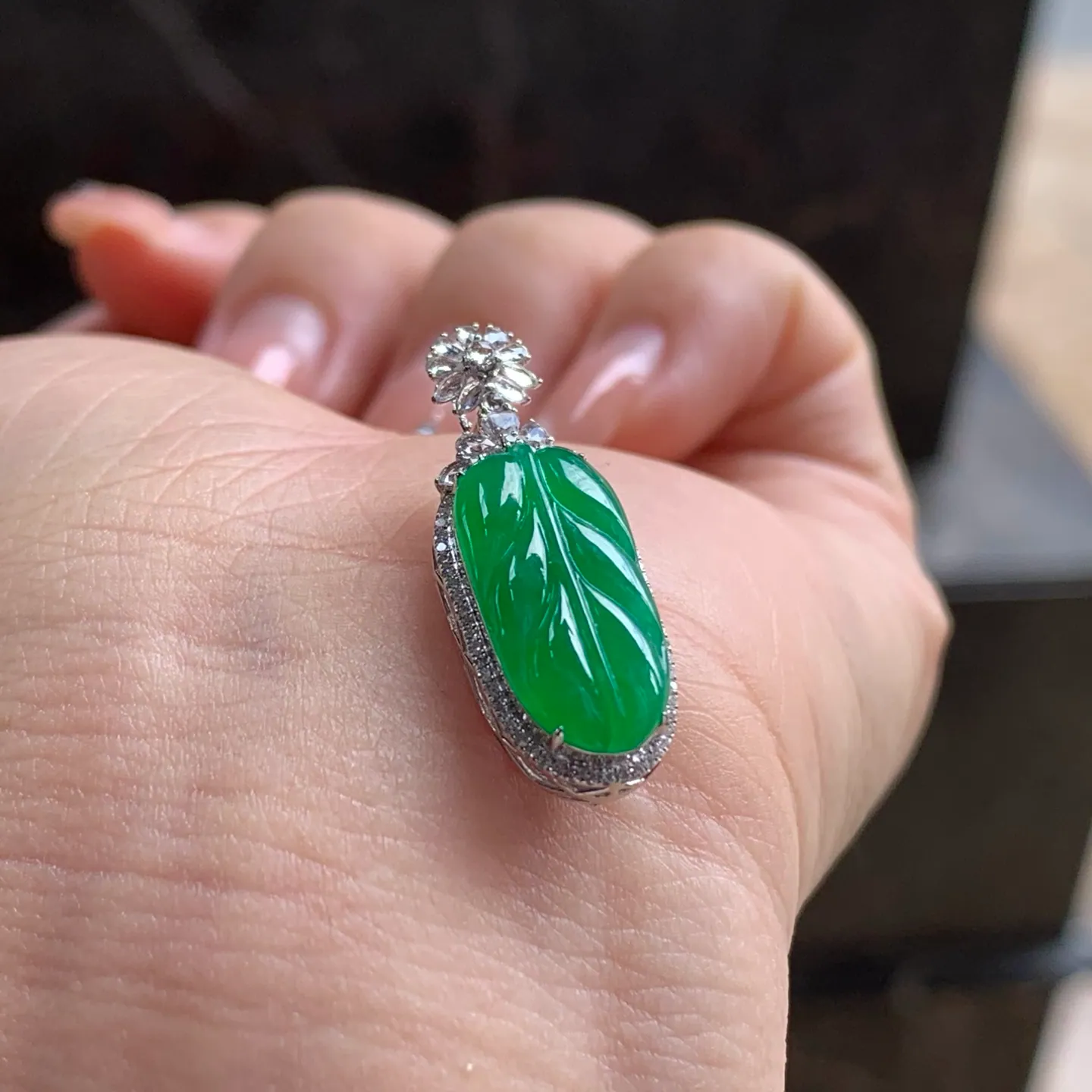
| Green | Yellow gold, also white gold | Yellow gold is the classic pairing in China and Southeast Asia and makes green look warmer; white metal makes it look cooler and more modern |
| Lavender | White gold, silver or rose gold | Keeps the purple from turning greyish next to yellow |
| Red or yellow jadeite | Yellow or rose gold | Warm metal matches warm color |
| Black jadeite | Either | Silver and white gold for a modern look, yellow gold for a traditional one |
When you judge color in a photo, remember that the metal and any backing behind the stone are part of what you see.
What can a setting hide, whatever the metal?
The same things in silver as in gold. A rim (bezel) covers the edge of the stone, where chips and cracks start. A closed back covers the whole underside, and a foil or colored backing behind a thin stone can make it look greener and brighter than it is. A cap on top of a carved pendant can cover a drill hole or a crack. Prongs can sit over a chip.
None of this means a closed setting is a problem; thin stones need support, and many rims are simply a design. But ask the seller why the setting is closed, ask for photos of the back, and compare the stone with the photo on the certificate. More detail on each style is in gold-set and gold-wrapped jadeite and, for rings, open versus closed backs in the jadeite ring guide.
Which metal works best for rings, pendants, earrings and bangles?
Choose by how much the piece gets knocked.
| Piece | What it faces | Silver is fine when | Choose 18K gold or platinum when |
|---|---|---|---|
| Ring | Door handles, desks, bags; the prongs and the underside take the hits | The stone is modest and you check the prongs often | The stone is valuable, or you wear it every day |
| Pendant | Little impact; the bail rubs against the chain | Almost always | The stone is valuable, or you want a gold chain to match |
| Earrings | Light, little impact | Almost always | Your ears react to the posts, or the stones are valuable |
| Bangle | Usually solid jade; metal appears only as wraps or hinges | Decorative wraps on everyday bangles | A wrap holds a crack together, or the bangle is hinged |
A few practical notes:
- Rings. Check prongs every few months; a snagging prong is the early warning. If a ring needs resizing, the jeweler should take the stone out before using heat, because heat can harm jadeite and burns any resin filling. A saddle ring is all jade and cannot be resized.
- Pendants. The wear point is the bail. A silver bail on a steel chain wears faster than on a soft cord, and a gold bail is best paired with a gold chain or a cord. See jade pendant cord and chain.
- Earrings. If your ears are sensitive, look at what the posts and hooks are made of, not only the setting. Some silver earrings have plated posts. See jadeite earrings.
- Men's pieces. Men's rings are often larger and get knocked harder, so a heavier mount matters more. Silver is popular for large pendants and bold rings because the same design in gold is heavy and costly. See jadeite for men.
How do you read hallmarks on silver and gold jade jewelry?
Look for a small stamp inside the ring band, on the bail, on the clasp or on the earring post.
| Mark | Meaning |
|---|---|
| 925, S925, Ag925, STERLING, STER | Sterling silver, 92.5% silver |
| 999, S999 | Fine silver, 99.9%; very soft |
| 750, 18K, Au750 | 18K gold, 75% gold |
| 585, 14K, Au585 | 14K gold, 58.5% gold |
| 足金, 千足金, 999, 9999 | Pure gold, as marked in China and Hong Kong (about 99% or higher) |
| Pt900, Pt950 | Platinum, 90% or 95% |
| GP, GEP, HGE, RGP, or "18K GP" | Gold-plated, not solid gold, even if "18K" appears |
| GF, or "1/20 14K GF" | Gold-filled: a thicker gold layer bonded to a base metal, still not solid gold |
Three things to keep in mind. A yellow piece stamped only S925 is gold-plated silver. A stamp can be faked, so the seller's written description of the metal matters as much as the mark. And a jeweler can test the metal without damage using an X-ray fluorescence (XRF) analyzer.
How do you clean tarnished silver without harming the jade?
Clean the metal gently and keep chemicals off the stone.
- Wash first. Lukewarm water, a drop of mild soap and a soft brush remove most dullness. Rinse and dry well; water trapped behind a closed back can leave marks.
- Polish the metal with a silver cloth, not the jade. Work around the stone. Polishing cloths carry mild chemicals that you do not want rubbed into the jade.
- No silver dip. Dip solutions are acidic. They can dull the jade's polish and strip its wax finish, and they can attack the resin in treated jade. The same goes for toothpaste and baking-soda pastes, which are abrasive.
- No ultrasonic or steam cleaner for treated or cracked jade, or for pieces with closed backs. Vibration and heat can open existing cracks. Even for Type A jade, let a jeweler check the piece first.
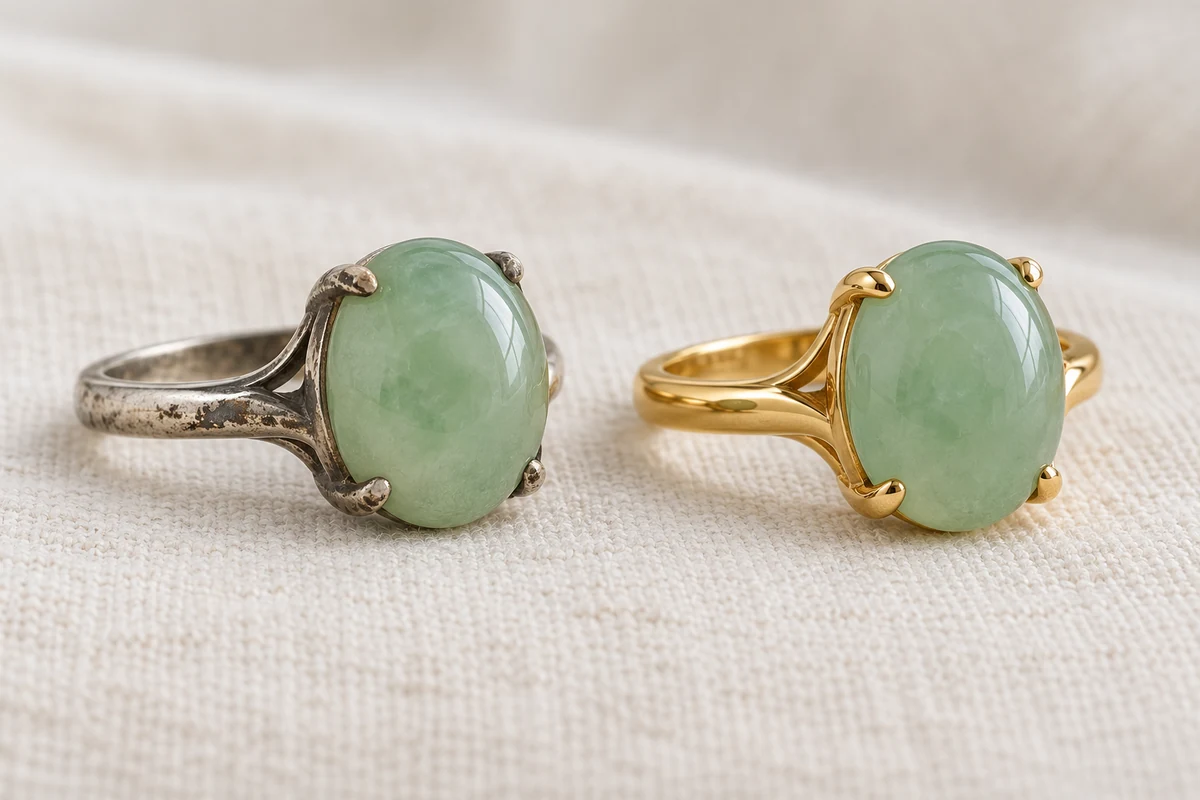
- Slow down tarnish. Store silver pieces in a small sealed bag, away from rubber bands and humid bathrooms, and wipe them after wearing.
- Re-plating. If a rhodium-plated silver or white gold setting has worn, a jeweler can re-plate it. Ask how they protect the jade, or whether the stone has to come out first.
For the jade itself, see how to care for jadeite.
What do Thai and Vietnamese sellers mean by "เลี่ยมเงิน", "เลี่ยมทอง", "bọc bạc" and "bọc vàng"?
In Thailand, เลี่ยม means to frame or set. หยกเลี่ยมทอง is jade framed in gold, หยกเลี่ยมเงิน is jade framed in silver. Jade Buddha pendants (พระหยก) can be put into a frame (กรอบ) like a Thai amulet, sometimes with a sealed, waterproof case (กันน้ำ). Frames come in gold, silver, gold-plated "micron" and stainless steel. Thai jewelry gold is traditionally 96.5% gold, so ask what a gold frame is made of rather than assuming 18K. A sealed frame covers the edges and back of the jade, so look at the jade before it is framed. See jade Buddha pendants.
In Vietnam, bọc vàng and bọc bạc mean wrapped or set in gold or silver: a vòng cẩm thạch bọc bạc is a jade bangle with silver wraps, a nhẫn cẩm thạch bọc vàng a gold ring with a jade top. Gold is sold as vàng 18K (750), vàng tây (karat gold alloys) or vàng 24K (9999, often called vàng ta). Silver is sold as bạc 925 or as higher-purity bạc ta, which is softer. A silver wrap on a bangle is softer than a gold one and darkens with time, but it is an honest way to dress up or protect an everyday bangle.
What does JadeiteHub use?
Every silver setting we sell is 925 sterling silver. Our gold-set pieces are mostly made in China in 18K (75%) gold. Every listed piece has a lab certificate for the jade, every sold piece is checked against its certificate at our inspection center before it ships, and if a piece does not match its description, you get a full refund.
FAQ
Is sterling silver good for jade jewelry?
Yes, for pendants, earrings and modestly priced rings. 925 sterling silver is softer than 18K gold and tarnishes, so for valuable stones and everyday rings, 18K gold or platinum holds the stone more securely. Silver does not lower the quality of the jade itself.
Does jade look better in gold or silver?
It is a matter of taste. Yellow gold is the classic pairing for green jade and makes it look warmer; white gold, platinum and silver keep icy, colorless and lavender jade looking cool and clear.
Is jade set in 925 silver real jade?
It can be. The metal says nothing about the stone: Type A jadeite is often set in silver, and treated jade can be set in 18K gold. Only a lab certificate tells you what the jade is.
What does S925 mean on a jade ring?
S925 means sterling silver, 92.5% silver. Ag925, 925 and STERLING mean the same. A yellow ring marked only S925 is gold-plated silver, not gold.
Will silver tarnish damage my jade?
Tarnish forms on the metal and does not harm jadeite. The risk is in cleaning: silver dips and abrasive pastes can dull the jade's polish and damage treated jade. Wash gently and polish only the metal.
Is 18K or 24K gold better for a jade ring?
18K for a ring. Pure 24K gold is soft, so prongs bend and the stone can loosen. 24K is used for thick wraps and caps where strength matters less.