What Is a Jade Bead Bracelet? How to Choose a Real One
Updated
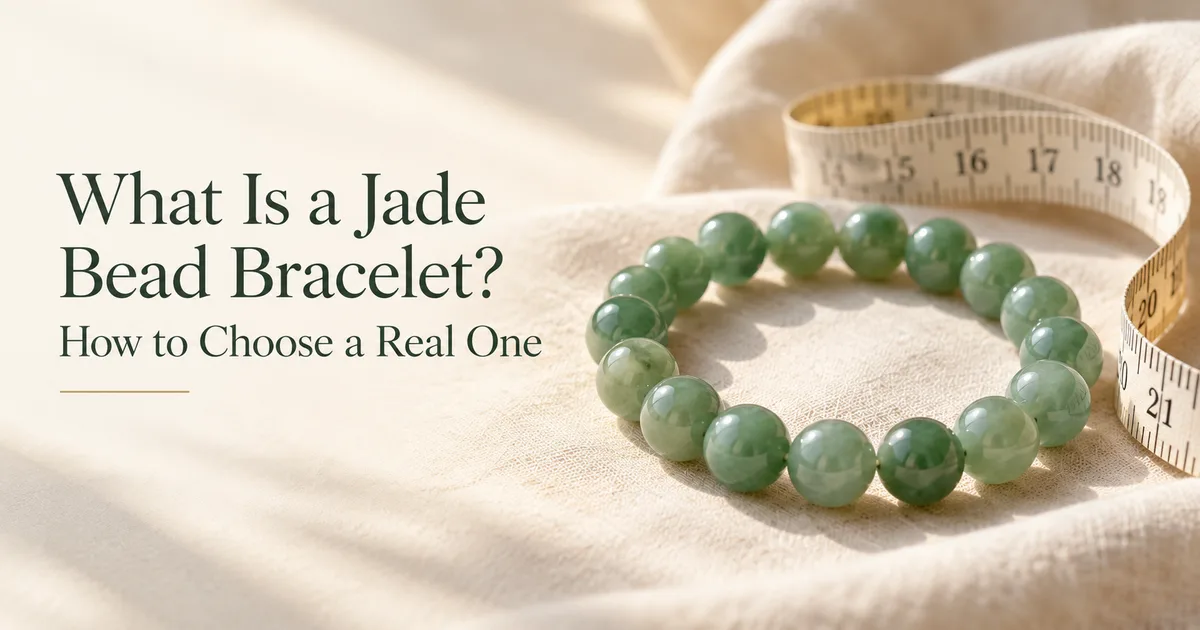
A jade bead bracelet (手串) is a strand of round jadeite beads, usually on an elastic cord; longer strands are worn as necklaces or 108-bead malas. Its value depends less on the number of beads than on how well they match in color, texture and size. Dyed and treated beads are common, so ask for a certificate that covers the whole strand. Measure your wrist, add a little room, and restring the elastic from time to time.
What is a jade bead bracelet?
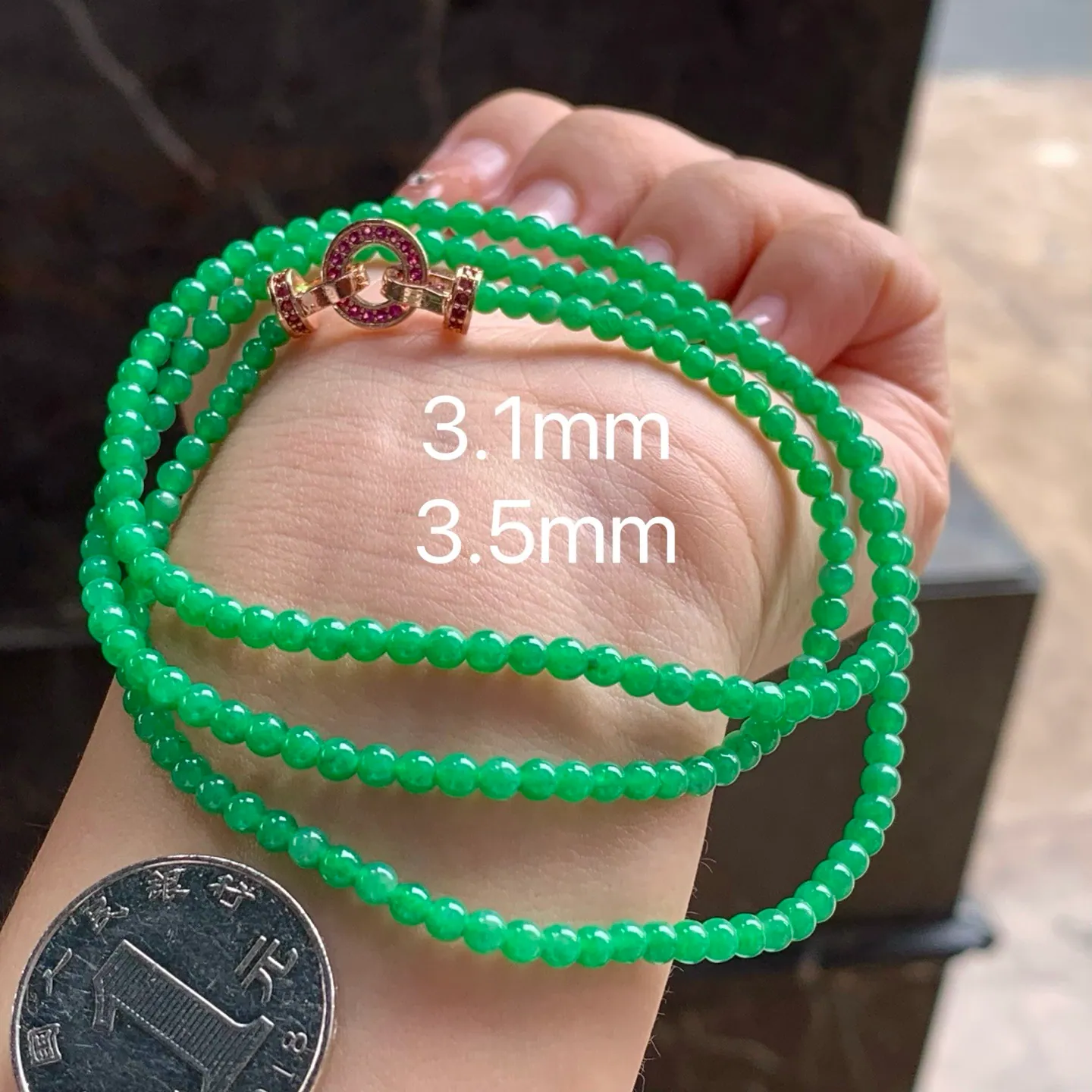
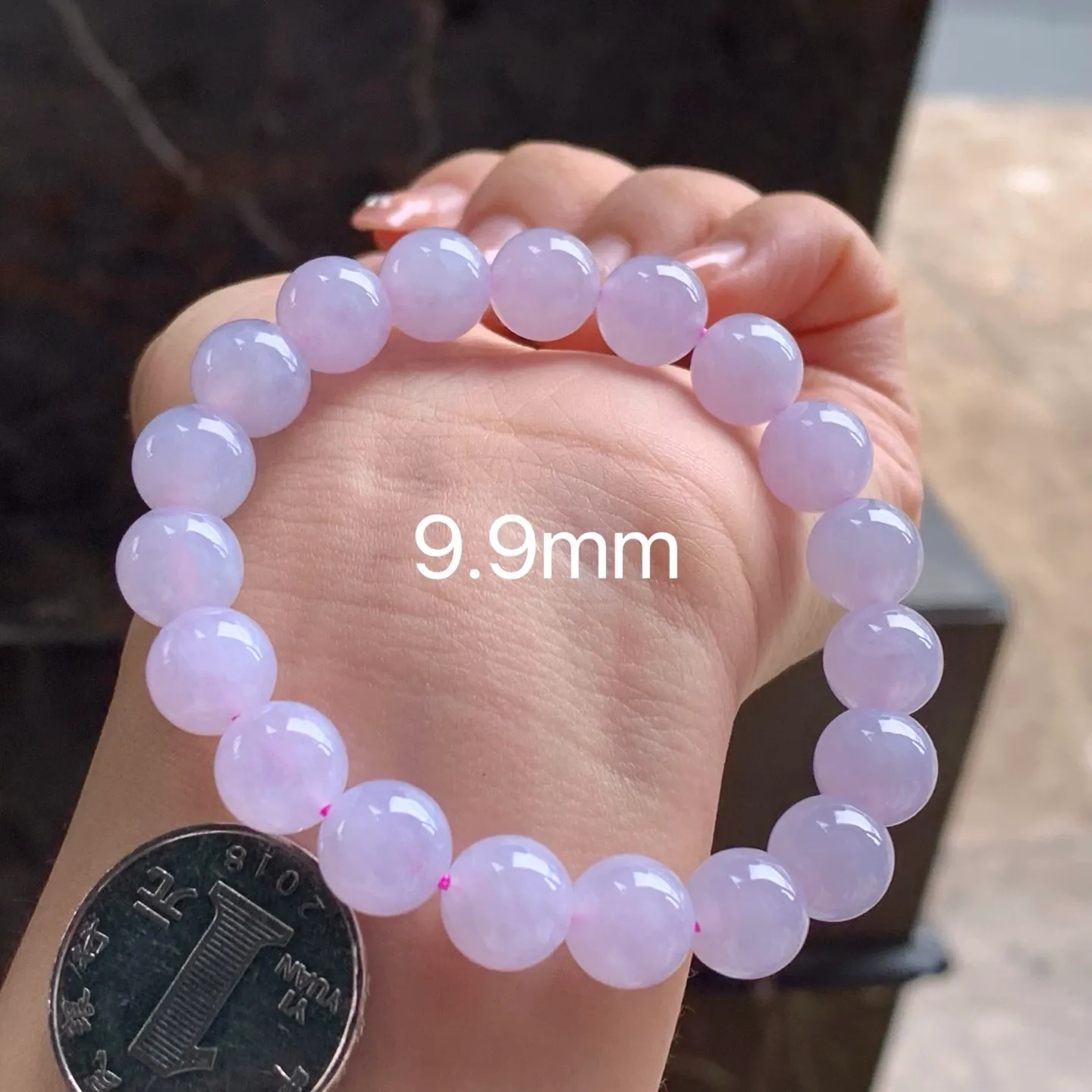
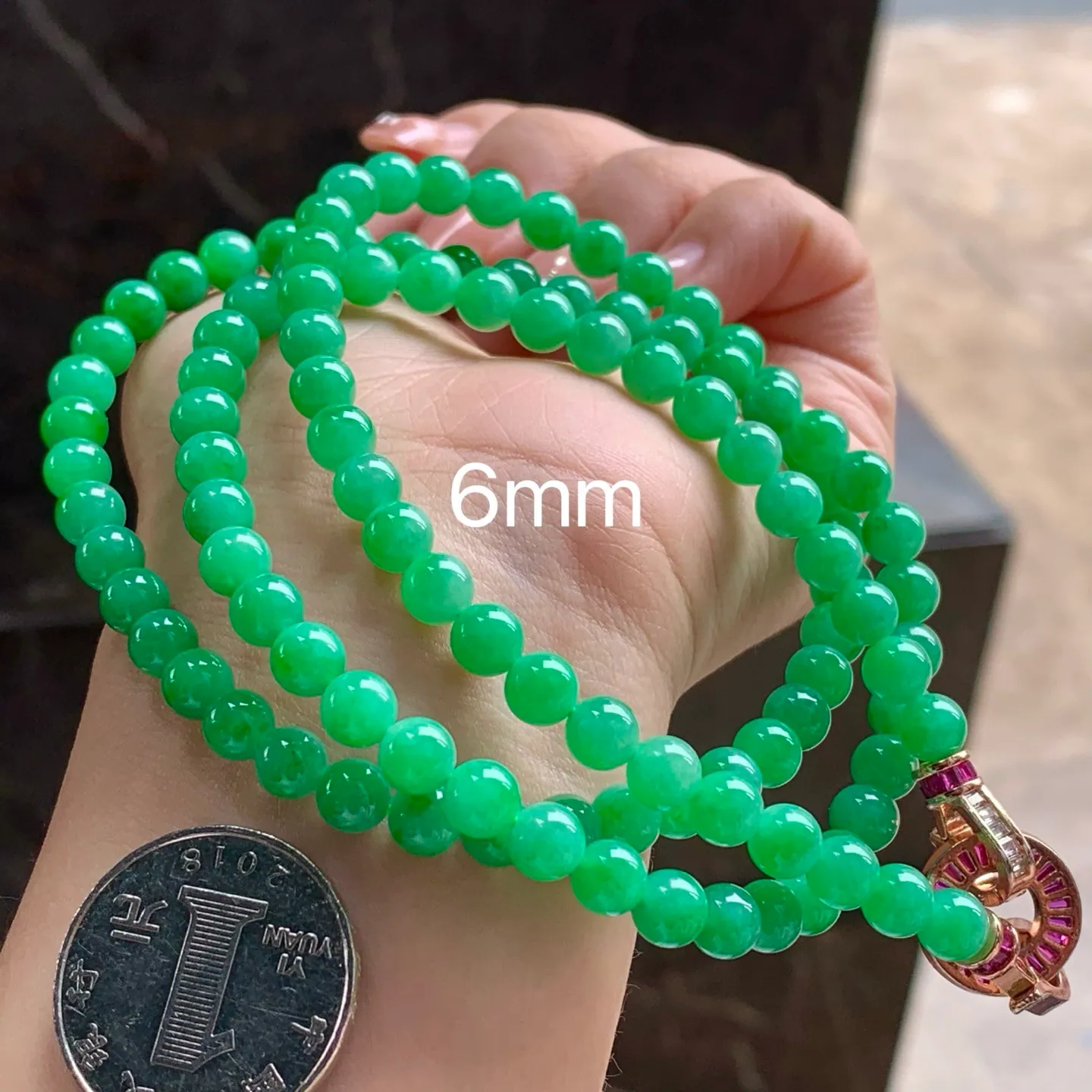
A jade bead bracelet is a strand of round, drilled jadeite beads threaded on a cord and worn on the wrist. In Chinese it is called 手串 (shǒuchuàn, "hand strand"). The same beads on a longer strand make a bead necklace (珠链), and a strand of 108 beads is a Buddhist mala (念珠), worn around the neck or wound several times around the wrist.
| Type | Chinese | How it is worn | Typical build |
|---|---|---|---|
| Bead bracelet | 手串 | One loop on the wrist | Elastic cord, sometimes with one larger or carved accent bead |
| Bead necklace | 珠链 | Around the neck | Knotted thread with a clasp; beads of one size or graduated |
| 108-bead mala | 108 子念珠 | Around the neck, or wound around the wrist | Elastic or knotted cord, often with a larger "guru" bead (佛头) and a tassel |
This guide is about natural jadeite beads. Strands of glass, dyed quartzite and other stones are also sold as "jade", and they are a different material.
Why does a matched strand cost more than its bead count suggests?
A strand is not priced as one bead times the number of beads. You pay for a set, and a good set is hard to make:
- Matching. For a strand to look even, every bead should have a similar color, texture and translucency. In practice the beads have to come from the same piece of rough, often from the same part of it.
- Wastage. Turning a block of stone into a sphere wastes a lot of material. Any bead with a crack, a dark spot or a shift in color does not make it into a matched strand.
- Bead size. Large beads need large clean blocks, and in a matched strand every single bead has to be large and clean.
- Graduated necklaces. Beads that step down evenly in size while keeping the same color need even more selection.
So a strand in which every bead matches can cost much more than a mixed strand of similar material. For the wider picture, see what determines jadeite price.
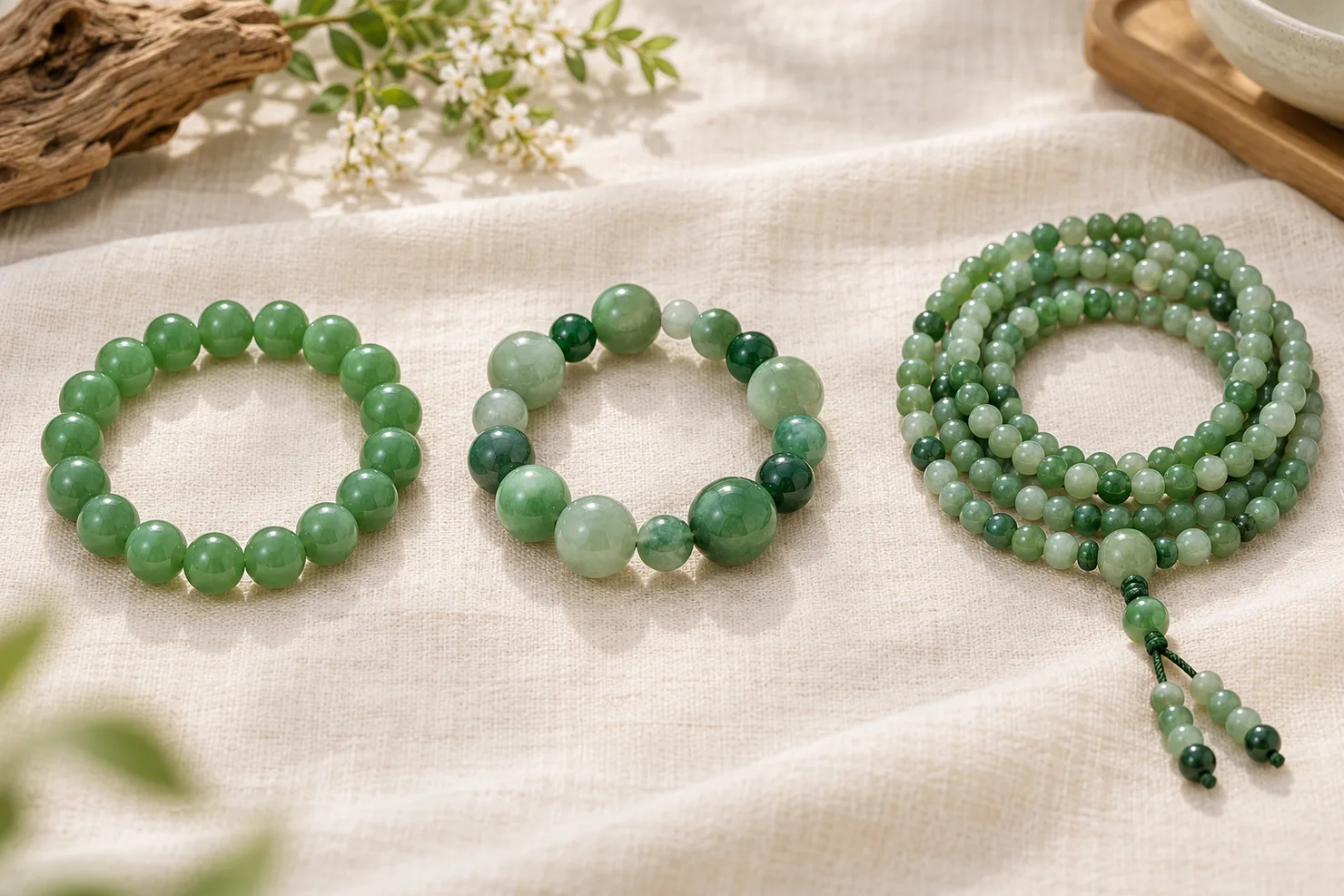
| What to check | A good sign | A warning sign |
|---|---|---|
| Color | Every bead a similar shade | One or two beads clearly lighter, darker or a different hue |
| Texture and translucency | Beads glow in a similar way under light | Some beads clear, others cloudy or grainy |
| Size and shape | Same diameter, round, even polish | Mixed sizes, flat spots, dull patches |
| Drill holes | Centered, with clean edges | Chips or cracks at the hole |
| Cracks | None visible under a flashlight | Lines running across a bead |
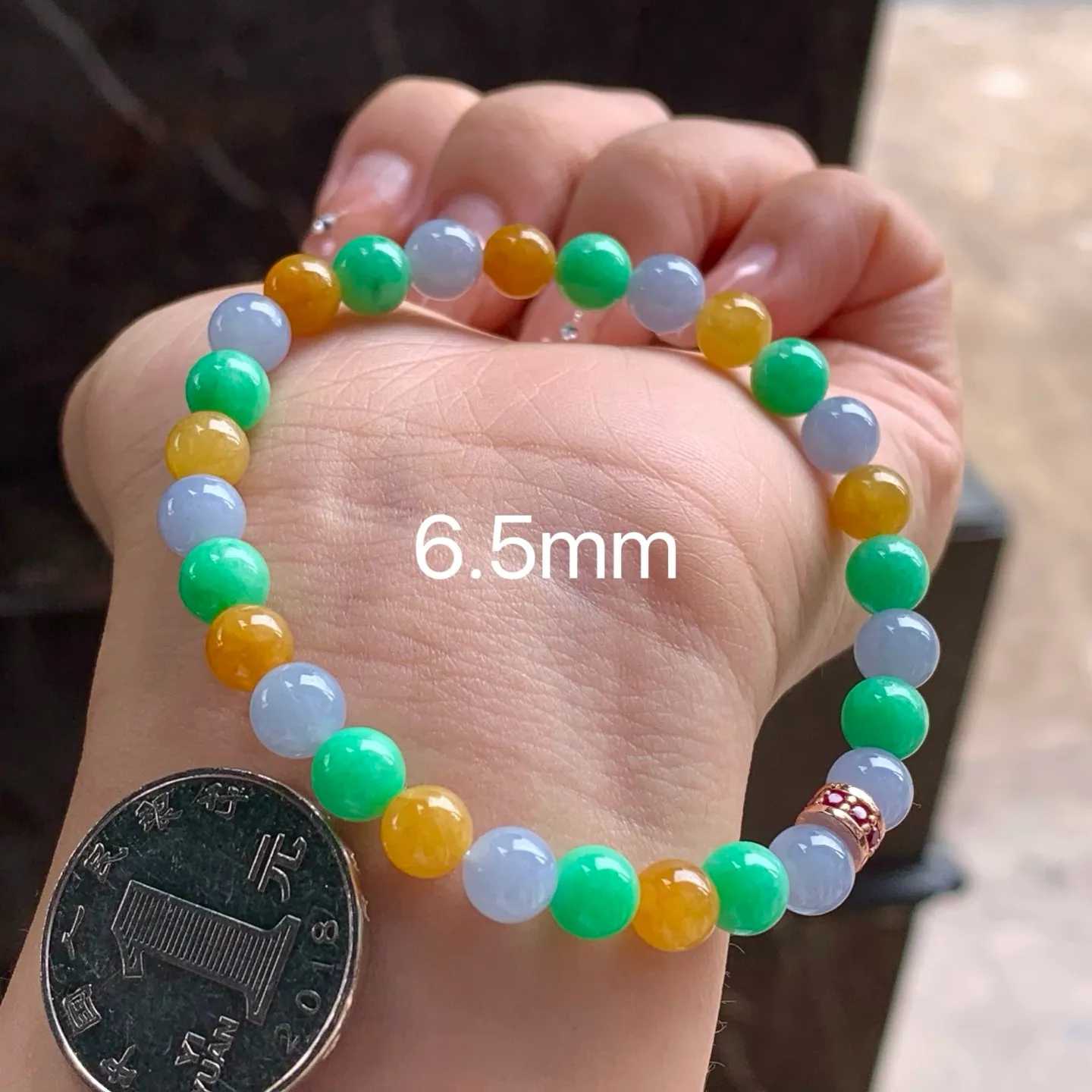
Some strands mix colors on purpose, and icy beads with green "floating flowers" (飘花) are a popular style in which each bead's pattern is different. There, judge whether the strand looks balanced as a whole. Mixed is fine when it is sold and priced as mixed.
What bead size and length do I need?
Bead size is the diameter of each bead in millimeters, so a listing may say "8 mm" or "10 mm". Small beads look fine and delicate. Large beads look bold and use more stone per bead.
To size a bracelet:
- Measure your wrist where you will wear the strand, with a soft tape or a strip of paper.
- Add a little room so the strand can move and does not press. Some people like it snug, others loose.
- Allow more room for large beads. Big beads take up space inside the loop, so a strand of large beads feels tighter than one of small beads with the same total length.
- Ask the seller for the inner circumference or length, the bead size and the bead count, and compare them with a bracelet you already own that fits.
A jeweler can make an elastic strand smaller by taking out beads. Making it bigger needs extra beads that match, which are hard to find, so it is better to get the size right before you buy.
| Cord | Good points | Drawbacks | Common use |
|---|---|---|---|
| Elastic cord | No clasp; rolls over the hand | Stretches and wears; needs restringing | Bracelets, many malas |
| Knotted silk or nylon thread with a clasp | Knots keep beads apart, and a break does not scatter them all | Fixed length; silk weakens when wet | Necklaces |
| Braided cord with a sliding knot | Adjustable | The fabric wears and gets dirty | Casual bracelets |
How do I check that every bead is natural (Type A)?
Each bead in a strand is a separate piece of stone. One natural bead says nothing about the next one. Dyed (Type C) and bleached, resin-filled (Type B) beads are common in the market, especially in cheap strands, and beads are easy to dye because the drill hole lets the dye in. See Type A vs Type B vs Type C jadeite.
- The certificate should cover the whole strand. A strand is normally tested as one item. Check that the photo on the certificate shows the whole strand, that details such as bead count, size or weight match where they are given, and that the conclusion says jadeite with no treatment. A certificate for one bead, or for a different strand, covers nothing else. See how to verify a jadeite certificate.
- Look at the drill holes. Dye tends to enter through drill holes and cracks. In dyed beads the color often looks deeper around the hole and runs along fine cracks like threads. Natural color usually sits in irregular patches that do not follow the hole. This is a clue, not proof: a natural bead can have color near its hole, and careful dyeing may show nothing.
- Compare the beads under a flashlight. Shine a small white light through each bead in turn. Beads that look very different from their neighbors deserve a closer look.
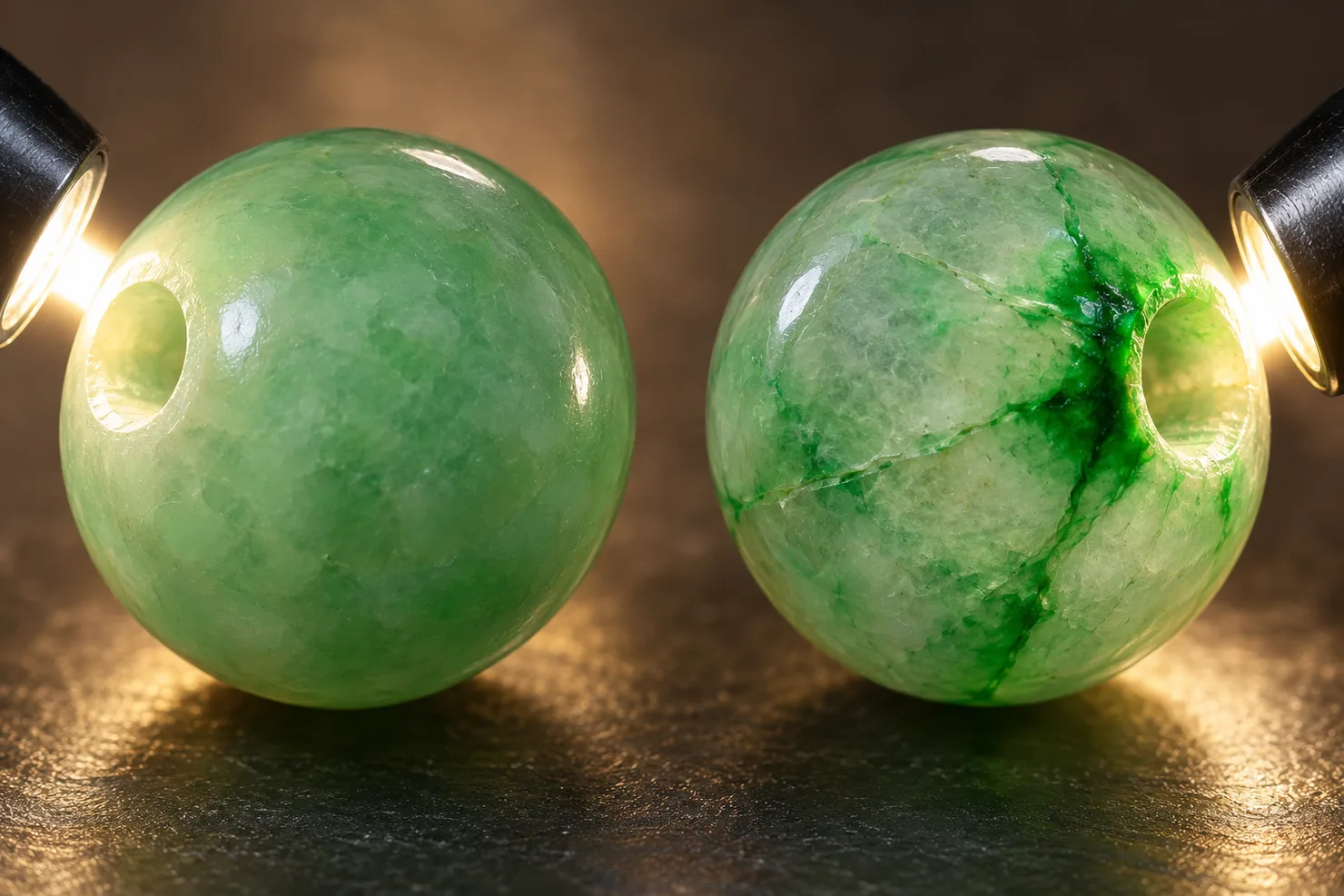
Resin filling (Type B) usually cannot be confirmed by eye at all. The clues and their limits are in how to spot treated jadeite. If a strand matters to you, the lab result is what counts.
How do I care for and restring a jade bead bracelet?
The beads are as tough as any jadeite. The cord is the weak point.
- Restring from time to time. Elastic slowly loses its stretch and frays, faster if you roll the bracelet on and off often or it gets wet. Gaps between beads, a thin or fuzzy cord, or a worn knot mean it is time. Restring before it breaks, not after.
- Roll it on. Roll the strand over your hand instead of stretching it wide.
- Keep the cord dry where you can. Take the bracelet off for showers, swimming and washing up. To clean it, wipe the beads with a soft cloth; if it needs more, wash it briefly in lukewarm water with a little mild soap and let the cord dry fully. Avoid ultrasonic cleaners and household chemicals, as with any jadeite. See how to care for jadeite.
- Keep the beads in order when it is restrung. On a matched or graduated strand the order was chosen. Count the beads first and check the count against the certificate.
- Store it on its own, lying flat in a soft pouch, away from harder stones.
- Take it off for sports, the gym and heavy work.
Which wrist should I wear a jade bead bracelet on?
Either wrist is fine. A bead bracelet is lighter and less fragile than a solid bangle, so the choice matters less. The practical advice is the same as for a bangle: the non-dominant hand takes fewer knocks, and the bracelet should not share a wrist with a metal watch or a bangle, which knock against the beads.
Customs exist too. A Chinese folk saying, "left takes in, right gives out" (左进右出), is why many people choose the left wrist. These are traditions, not rules. See which hand to wear a jade bangle on for more.
What does a jade bead bracelet mean?
The meanings are traditions and wishes:
- A closed circle. In Chinese, round beads joined in a loop are often read as completeness and harmony (圆满).
- 108 beads. In Buddhist practice, a mala of 108 beads is used to count recitations of prayers or mantras. A common explanation links the number to the many afflictions in Buddhist teaching; other explanations exist, and practice differs between traditions.
- A gift. A bead bracelet needs only a rough size, which makes it an easy gift. It is often given with wishes for safety and good health.
These are customs and beliefs. A jade bracelet does not change health or luck.
Is a jade bead bracelet for men or women?
Both. There are common patterns rather than rules: many men choose larger beads in dark or solid green, and many women choose smaller beads, lavender, icy or floating-flower strands. For rings, pendants and other pieces men wear, see jade for men.
How do I buy a jade bead bracelet?
- Decide on bead size and length, and measure your wrist.
- Ask what the material is, in writing: natural jadeite with no treatment.
- Ask for a certificate that covers the whole strand, and check that it matches.
- Ask for photos and video of the whole strand in daylight and under a flashlight, with close-ups of the drill holes.
- Judge the matching, not the bead count. Look at color, texture and size across all beads.
- Check the cord: elastic or knotted, and whether it is new.
On JadeiteHub, listings use real photos from the seller, and some include video. Every sold piece is checked against its certificate before it ships, travels with insured shipping, and is fully refunded if it does not match the description.
FAQ
How much is a jade bead bracelet worth?
There is no single price. It depends on whether the beads are natural Type A jadeite, how well they match in color and texture, the color itself, translucency, bead size and cracks. A strand of large, clean, matched beads costs far more than a mixed strand.
How can I tell if a jade bead bracelet is real?
Look at every bead under a flashlight, especially around the drill holes, where dye tends to collect. Home checks only raise questions. A lab certificate that covers the whole strand and states no treatment is the proof.
Which hand should I wear a jade bead bracelet on?
Either. Many people choose the non-dominant hand, usually the left, because it takes fewer knocks. Keep it off the wrist where you wear a watch or a bangle.
How often should I restring an elastic jade bracelet?
It depends on how much you wear it. Restring when you see gaps between beads, a thin or fuzzy cord or a worn knot, and before it breaks. Bracelets that get wet or are rolled on and off often wear out sooner.
Why does a mala have 108 beads?
In Buddhist practice the 108 beads are used to count recitations. A common explanation links the number to the many afflictions in Buddhist teaching, but explanations and customs differ between traditions.