Floating Flower Jade: Meaning, Grading and Prices
Updated
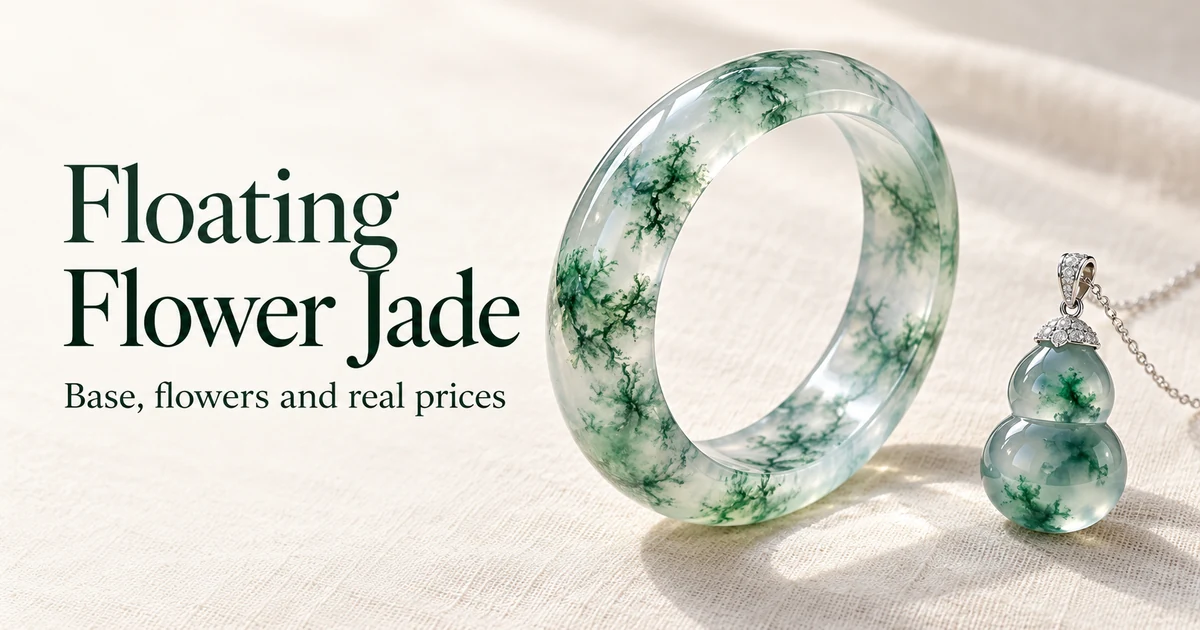
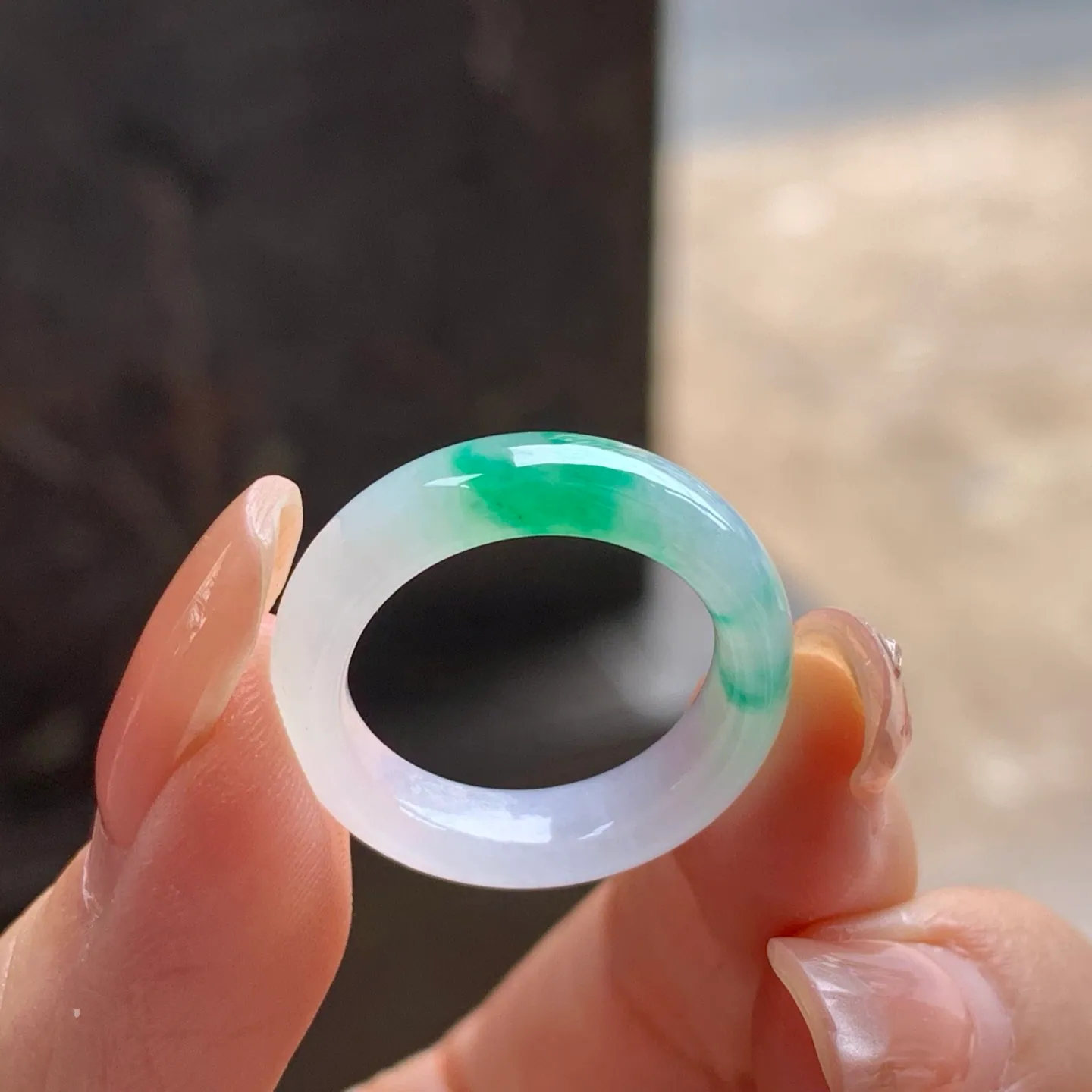
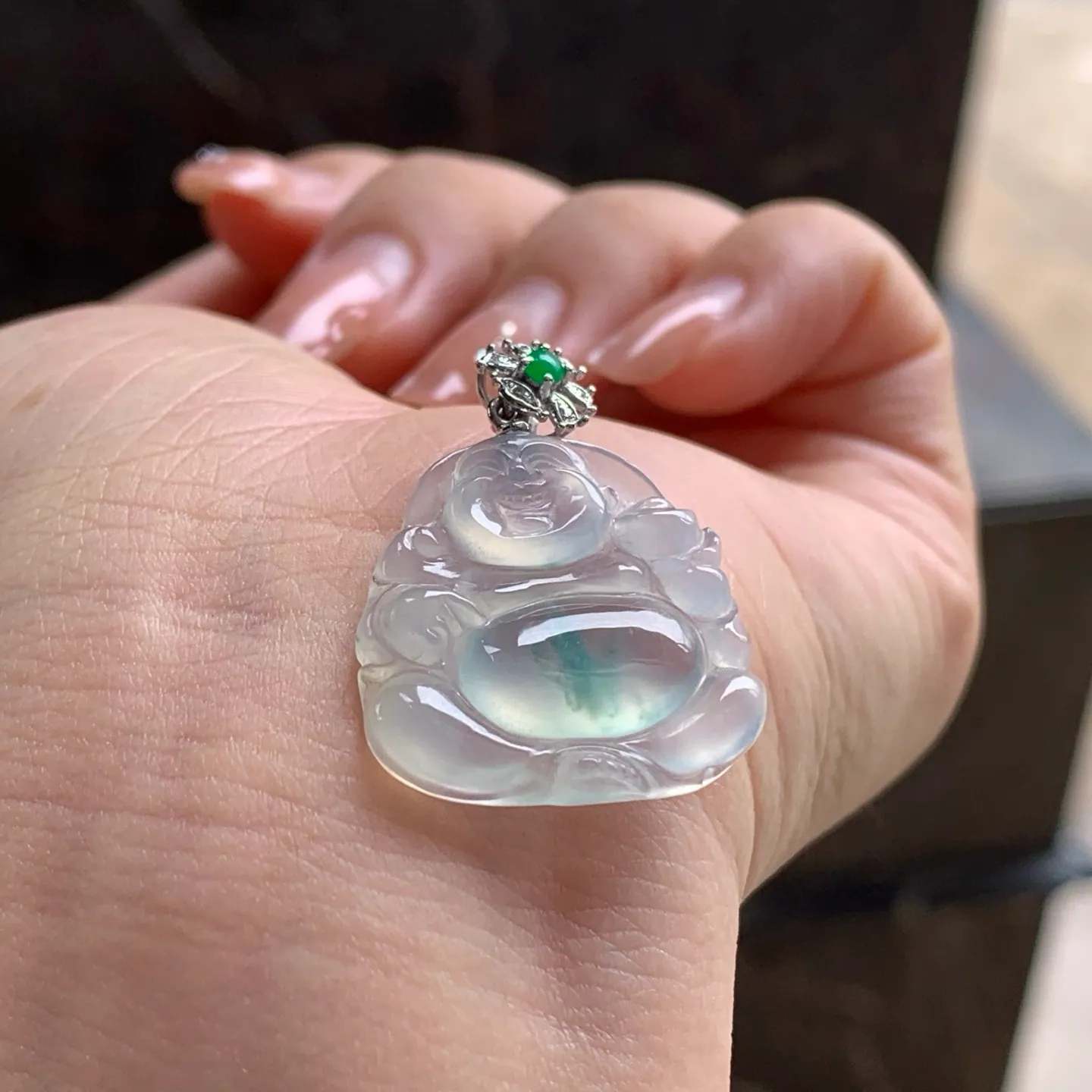
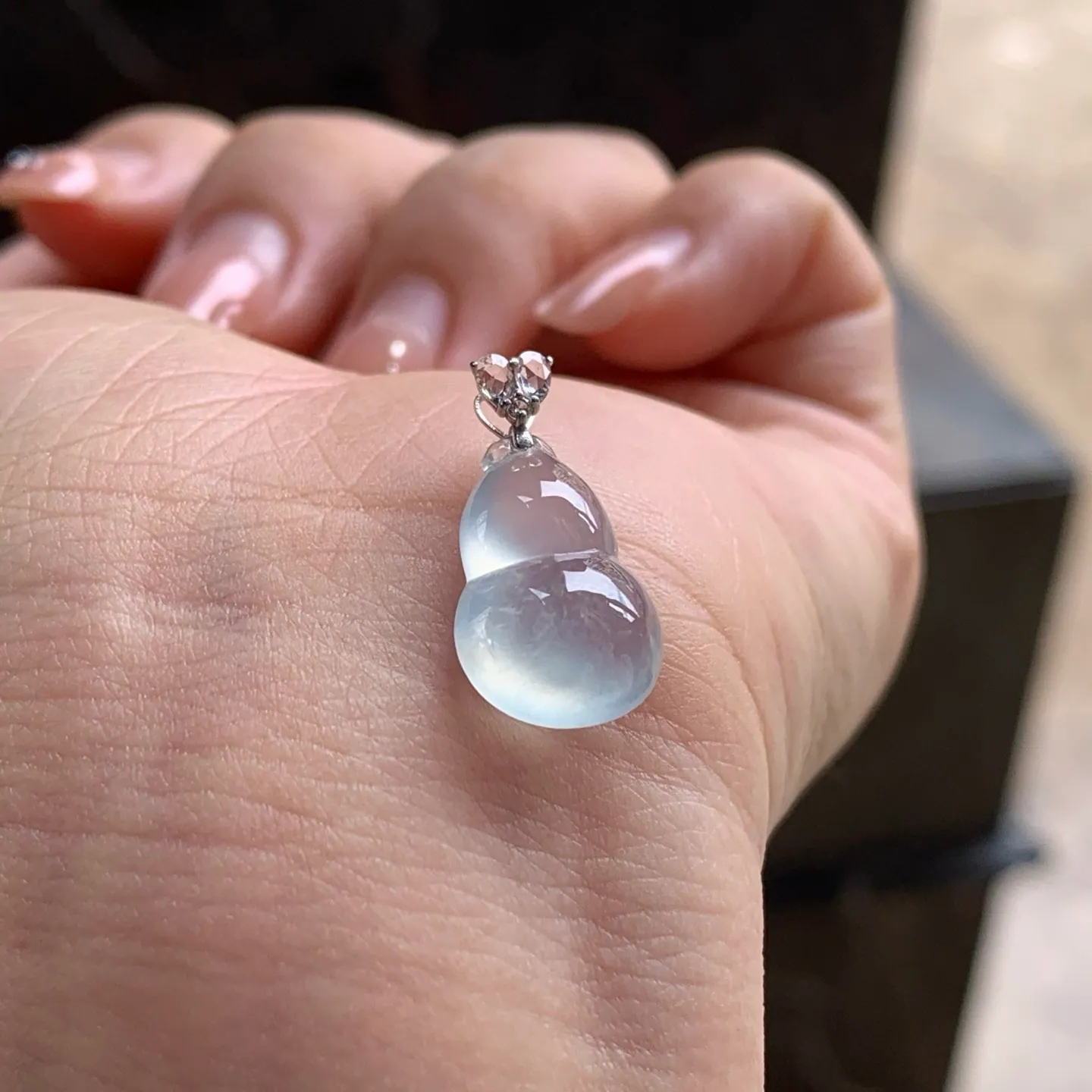
Floating flower jade (飘花翡翠) is jadeite with natural wisps or patches of green, blue-green or blue color floating inside a pale, translucent base, usually icy or icy-glutinous. The base matters most: on a clear base the flowers seem to float; on a cloudy one the same color looks like dirt. Then judge flower color, shape and placement; more flowers is not always better. Natural flowers have soft edges, while color that sits in cracks may be dye. As of 21 October 2026, certified Type A floating-flower bangles on JadeiteHub range from US$7,209 to US$20,579.
What is floating flower jade (飘花翡翠)?
Floating flower jade is jadeite with streaks, wisps or patches of color that seem to hang inside a light, translucent body, like weed drifting in clear water. The Chinese trade name is 飘花 (piāohuā, "floating flowers"); in Vietnamese it is cẩm thạch hoa bay, in Thai หยกพม่าลายดอกลอย. Some English listings say "floating blossom jade".
The "flowers" are not carved and not added. They are natural color, mostly from chromium and iron, that grew unevenly in the stone. What makes them float is the base around them (the 底子 or 地子): it is usually icy (冰种) or icy-glutinous (糯冰种, also written 冰糯), clear enough that you see the color at different depths, not just on the surface.
The common names in listings describe the color of the flowers:
| Name | Chinese | What it means |
|---|---|---|
| Green floating flowers | 飘绿花 | Green wisps in a pale base; the classic look |
| Blue floating flowers | 飘蓝花 | Blue to blue-green wisps; icy jadeite with blue flowers is one combination you will see on the market, and a clearer base makes the flowers stand out |
| Bright-green flowers | 飘阳绿 | Vivid, fresh green flowers; less common and sought after |
| Blue-water flowers | 飘蓝水 | A softer bluish tint spreading through part of the piece, rather than sharp wisps |
| Dark flowers | 飘黑花 / 墨绿花 | Very dark flowers that look almost black in daylight; some may show deep green when strongly backlit |
Dark flowers are worth a closer look. Some very dark floating flowers look almost black in daylight and may show deep green when strongly backlit. Other black areas do not change this way, and a flashlight alone cannot tell you what they are made of or whether the piece is treated. Dark wisps that read as ink strokes can look striking on a clear base, and some buyers like them. Hard black dots or patches (黑点, 癣) are usually counted as flaws, not flowers.
A related name you may meet is wuji ("black chicken") jade, 乌鸡 or 乌鸡种 in Chinese; Vietnamese sellers say cẩm thạch gà đen or hoa bay gà đen. It means jadeite with a light base carrying gray-black streaks, bands or spots. The name applies only to these gray-black patterns, not to green or blue floating flowers. For the wider picture of icy material, see what icy jadeite is.
Why does the base matter more than the flowers?
Because flowers only float if the base is clear; on a cloudy, opaque base the same color looks like a dirty patch. Dealers look at the base first and the flowers second. That is the old trade rule 种好色才好看: good texture makes color look good.
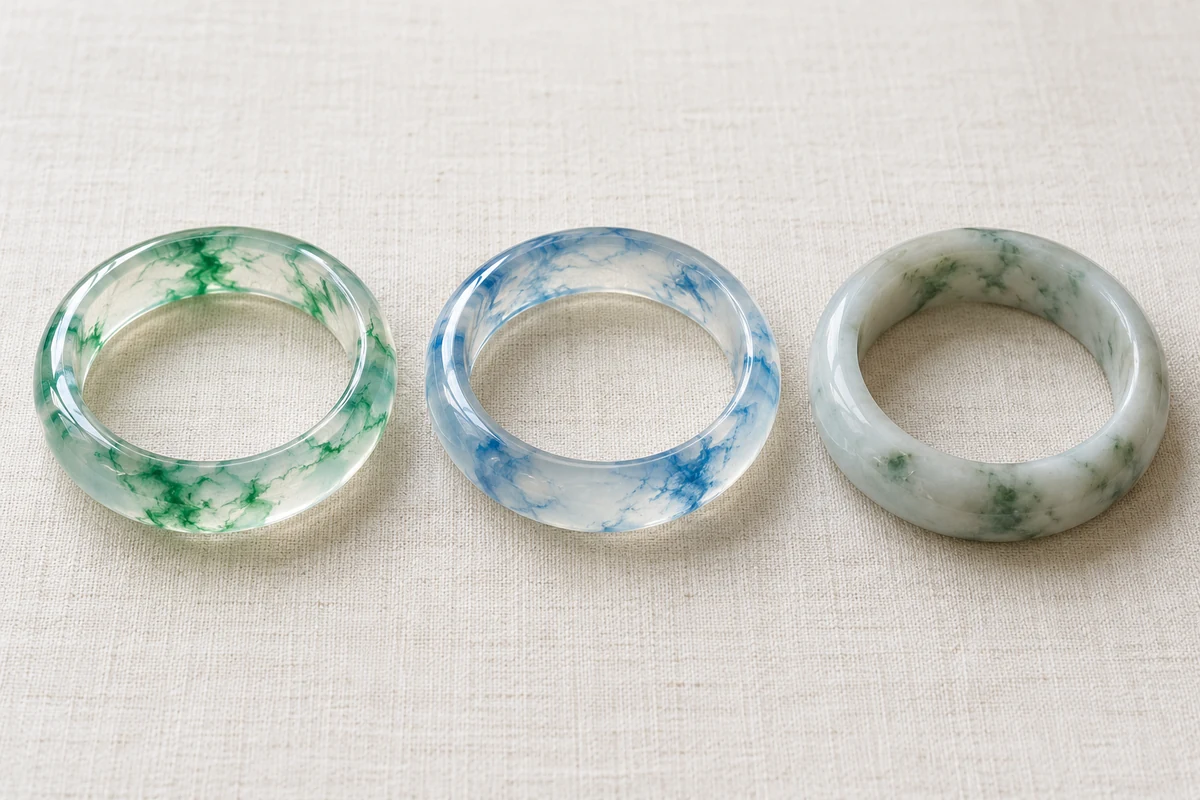
On an icy base, light goes into the stone, the wisps sit at different depths, and the piece looks alive when you turn it. On a dry, glutinous or grayish base the light stops at the surface, so the color sits flat, and the wisps lose their edges. Sellers use words like 底子干净 (clean base), 底子灰 (gray base) and 底子脏 (dirty base) for exactly this. A gray tone in the base drags the flowers down with it, even when the green itself is good.
So a floating-flower bangle is judged in this order:
| Factor | More valued | Less valued |
|---|---|---|
| Base | Clean icy or icy-glutinous, white or slightly bluish | Cloudy, gray, yellowish, heavy cotton |
| Flower color | Lively, fresh green or clean blue | Grayish, dull, muddy green, or flowers that read as black dirt |
| Shape | Flowing wisps with soft edges, like brushwork | Hard blobs, scattered dots, broken bits |
| Distribution | A balanced "picture"; on bangles, flowers that wrap around the ring | Everything clumped on one side or on the inside of the ring |
| Amount | Enough to form a picture, with clear space around it | Too little to see, or so much that the base disappears |
| Clarity around the flowers | Flowers sharp in a clean body | Flowers tangled with cotton or cracks |
More flowers is not automatically better. Dealers talk about 留白, leaving blank space, like a Chinese ink painting: a few well-placed wisps on a clear base can be worth more than a bangle crowded with color. Some buyers want bold, heavy flowers; others want a few fine threads. Taste decides here more than with plain icy jadeite, and two dealers can price the same piece differently.
Are green or blue floating flowers better?
Neither is better in a fixed way; it is a matter of taste and market demand. Green flowers, especially vivid 飘阳绿, are the traditional favorite, and Chinese buyers have long paid more attention to green. Blue and blue-green flowers have a cooler look, and whether you like them is mostly personal taste.
What matters within each color is the same: is it clean and lively, or grayish and dull? A clean blue flower on a clear base beats a muddy green one on a gray base. We do not quote a fixed price ratio between blue and green, because it does not exist: the base, the shape and the placement usually move the price more than the hue.
Is it a floating flower, a crack, cotton or dye?
Natural flowers have soft edges, fade into the base and follow no straight line; cracks, cotton and dye look different once you shine a light through the stone. Do this with a small white flashlight pressed against the back or the inside of the bangle, and move it slowly.
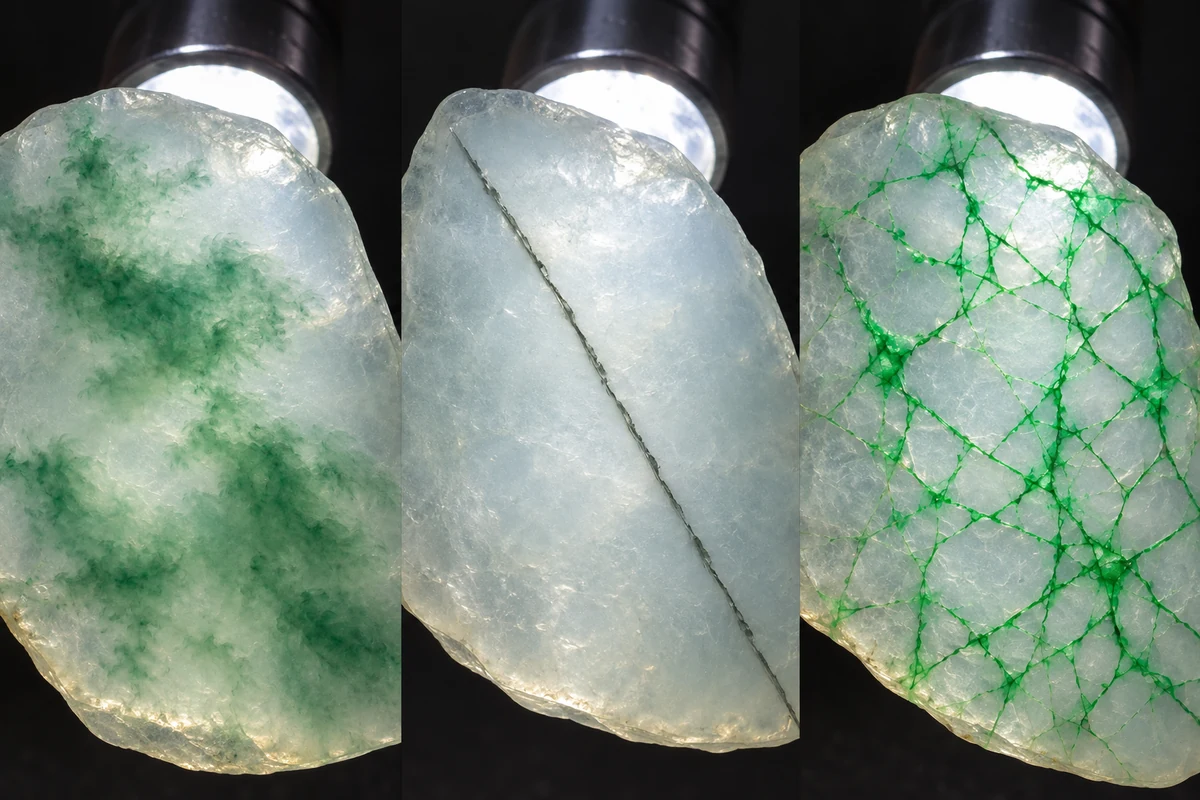
| What you see | Natural floating flower | Crack (裂) | Cotton (棉) | Dye (Type C) |
|---|---|---|---|---|
| Edges | Soft, fading out | Sharp, a thin line | Fluffy white | Color stops sharply at lines |
| Shape | Wisps, clouds, irregular | Straight or gently curved line | Specks, clouds | A net or spider web following cracks and grain boundaries |
| With a flashlight | Color glows inside the stone | Blocks or breaks the light; often visible on the surface under reflected light | White, not colored | Color seems to sit in the lines, not in the body |
| Effect on value | The point of the piece | The biggest value killer, and a risk on bangles | Fine cotton is normal; heavy clumps lower the grade | Treated; worth a fraction of natural color |
The warning sign is green or blue color that sits along cracks or between the grains, in thin lines that join into a net. Natural color can also follow a fracture in places, so this is a reason to check, not a verdict. Dyed (Type C) and bleached-and-filled (Type B) jadeite are real jadeite but treated; see Type A vs Type B vs Type C jadeite and how to spot treated jadeite. For telling cotton and stone lines from cracks, see jadeite cotton and cracks.
One more look-alike: albite jade (水沫子) is also clear and white with blue-green flowers, and it fools many buyers. It is lighter in the hand and has a softer luster, and a certificate names it albite, not jadeite.
The final word is the lab certificate. It should state jadeite and natural (Type A). It will not say "floating flower" or "icy"; those are trade descriptions from the seller.
Which jewelry suits floating flowers best?
Bangles first, because the flowers wrap around the ring and change as it turns on the wrist. Then pendants cut so the flowers form a picture:
- Bangles. A round-bar bangle (圆条) shows depth best; a flat-inside bangle (内平外圆, rounded outside, flat inside) sits closer to the wrist and shows a wider face. Check where the flowers are: on the outside face they show; on the inside of the ring they mostly do not.
- Gourds and leaves. A carver puts the color on the body of the gourd or along the veins of a leaf. A floating-green leaf is a classic small pendant.
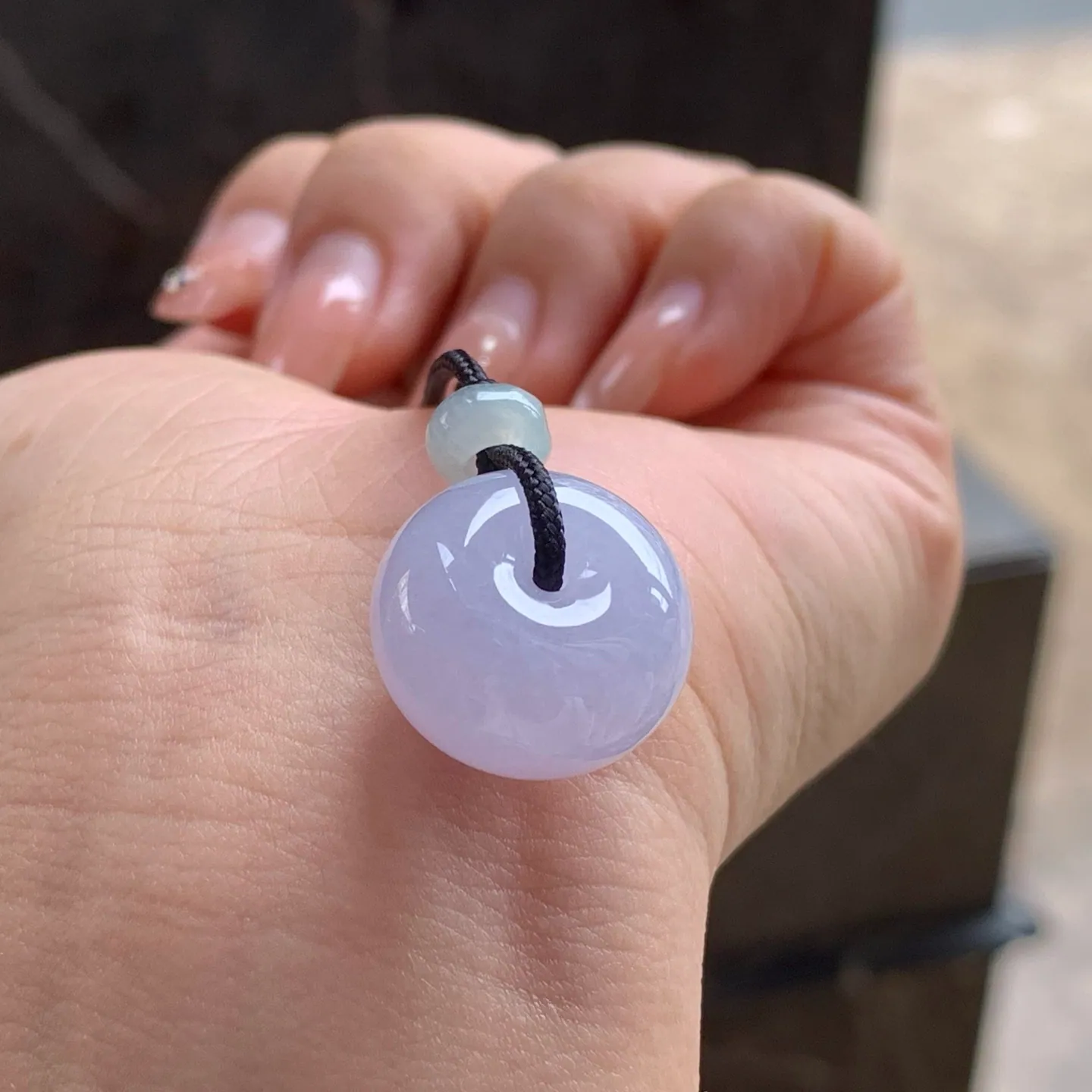
- Plain tablets (无事牌) and safe-buckle donuts. A flat, uncarved surface works like a frame for one strong wisp, like a landscape painting.
- Bean pods, beads and earrings. Small pieces cut from the same material; on beads the flowers vary from bead to bead, which many people like.
Carvers usually leave floating-flower material lightly carved or plain. Heavy carving would cut through the color and hide the base, which is what you are paying for.
How much does floating flower jade cost?
Price depends first on the base, then on flower color, shape and placement, then on size, cut and setting, so the range is very wide. As a real reference, here are the certified Type A floating-flower pieces listed on JadeiteHub as of 21 October 2026. Prices may change; check the live listing.
| SKU | Piece | Base and flowers | Size | Price (US$) |
|---|---|---|---|---|
| JH-000026 | Bangle, flat-inside | Icy, floating flowers | 51.6 mm | US$20,579 |
| JH-000037 | Bangle | Icy-glutinous, blue floating flowers | 55.8 mm | US$15,749 |
| JH-000036 | Bangle | Icy-glutinous, green floating flowers | 56 mm | US$14,739 |
| JH-000028 | Bangle | Icy, green floating flowers | 56.3 mm | US$7,939 |
| JH-000038 | Bangle, round-bar | Icy-glutinous, green floating flowers | 53.2 mm | US$7,209 |
| JH-000007 | Gourd pendant, 18K white gold | Icy, floating flowers | Jadeite 19 mm | US$5,079 |
| JH-000003 | Leaf pendant, 18K white gold | Icy, floating green | 37 mm | US$1,629 |
| JH-000013 | Bean pod pendant, 18K white gold | Icy, blue floating flowers | 29 mm | US$809 |
Three things the table shows:
- The trade name does not set the price. Two bangles both described as icy with floating flowers (JH-000026 and JH-000028) are more than two times apart. Across the market, differences like this typically come from how clean the base is, how vivid the flowers are, and how well the flowers are placed around the ring. Photos and videos show this better than the words in the title.
- Size is not the main driver. The most expensive bangle here is also the smallest inner diameter.
- "Icy" is not always above "icy-glutinous". Two icy-glutinous bangles are priced above an icy one, because base grade is only one factor.
Pendants cost less mainly because they use far less material. The gold settings are 18K white gold, and gold-set jadeite is mostly made in China in 18K (75%) gold. For the full list of what moves price, see what determines jadeite price. You can browse every current piece in the shop.
What does floating flower jade mean in the five elements?
In the traditional five-element (五行) belief, color decides the element, and floating flower jade carries two: the pale base and the flowers. Traditionally, green belongs to Wood, blue and dark colors to Water, and white or colorless to Metal.
| Flower color | Element traditionally linked | Traditionally said to suit |
|---|---|---|
| Green flowers | Wood (木) | Wood people (own color) and Fire people (Wood feeds Fire) |
| Blue or dark flowers | Water (水) | Water people, and Wood people (Water feeds Wood) |
| Colorless icy base | Metal (金) | Metal and Water people |
This is the question Vietnamese buyers ask as "cẩm thạch hoa bay hợp mệnh gì". The answer is a folk tradition and personal meaning, not a property of the stone, and it guarantees nothing about luck or health. Readings also differ between masters. For how the tables work, see jade and the five elements. In China the clear base is also linked with the saying 冰清玉洁, "pure as ice, clean as jade".
How do you buy a floating flower bangle online?
Ask for a daylight video and watch the bangle rotate a full turn; floating flowers change a lot with light, angle and which side faces the camera.
- Daylight first. By a window, out of direct sun, over white paper. This shows the true base tone and whether the flowers are fresh or grayish.
- Rotate the whole ring. Count where the flowers are. A photo of the best side can hide a bare or gray back.
- Then a flashlight. Strong light makes the base look icier and the flowers brighter than in daily wear. It is for finding cracks and dye lines, not for judging beauty.
- Ask about wet or oiled photos. Water and oil make the base look clearer than it is dry.
- Get the certificate and check it. It should say jadeite, natural, Type A.
For a full checklist of filters, lighting tricks and what to ask, see how to judge jadeite from online photos and videos.
On JadeiteHub we list only jadeite with a lab certificate. Every sold piece is checked against its certificate at our inspection center before it ships, and if it does not match its description you get a full refund.
FAQ
What is floating flower jade?
It is jadeite with natural wisps or patches of color, usually green, blue-green or blue, that seem to float inside a pale, translucent base, most often icy or icy-glutinous. The Chinese trade name is 飘花.
Is floating flower jade valuable?
It can be. Value depends first on how clear and clean the base is, then on how vivid, well shaped and well placed the flowers are. Certified Type A floating-flower bangles on JadeiteHub range from US$7,209 to US$20,579 as of 21 October 2026.
Is blue or green floating flower jade better?
Neither is better by rule. Vivid green is the traditional favorite; blue flowers have a cooler look, and liking them is mostly personal taste. A clean, lively color on a clear base matters more than the hue itself.
How can I tell floating flowers from dye?
Shine a flashlight through the piece. Natural flowers fade softly into the base. Color that sits in thin lines along cracks or between grains, forming a net, may be dye. A lab certificate stating natural Type A jadeite is the final answer.
Can floating flower jade be fake?
Yes. Look-alikes include dyed (Type C) jadeite, bleached and filled (Type B) jadeite and albite jade (水沫子), which also shows blue-green flowers in a clear white body. A lab certificate names the material and any treatment.
What element is floating flower jade in feng shui?
By tradition, green flowers belong to Wood, blue or dark flowers to Water and the colorless base to Metal. This is a folk belief, not a property of the stone, and it guarantees nothing.