Jade Photos vs Real Life: How to Judge Jadeite Online
Updated
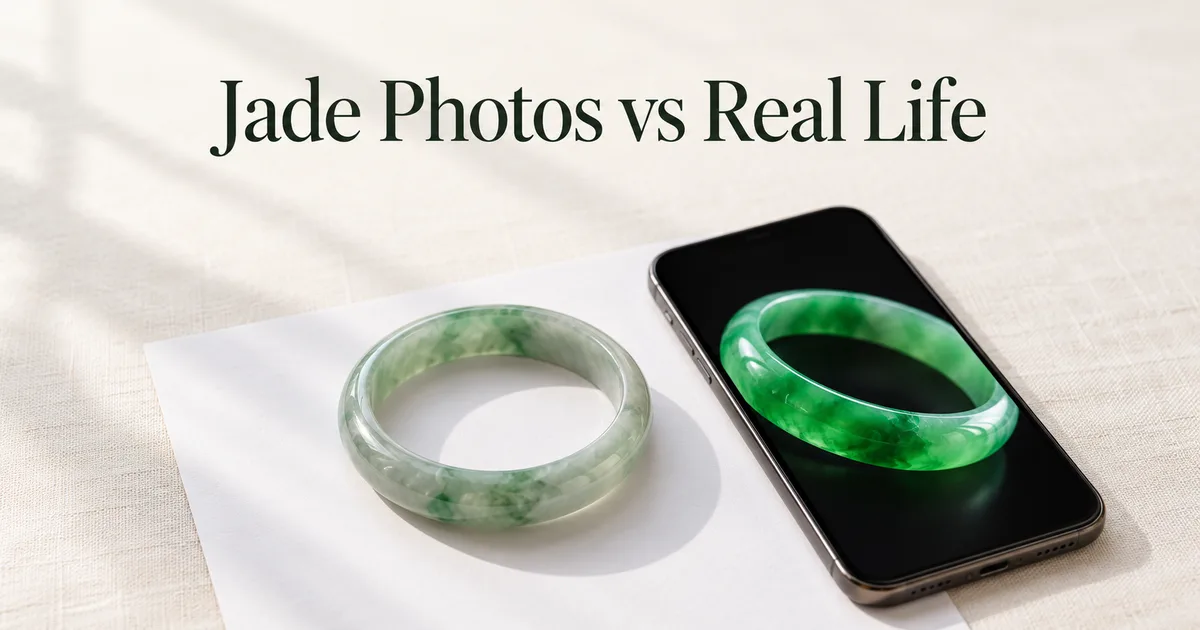
Online jade photos are rarely accurate on their own: jadeite's colour and translucency change with the light, and backlight, black backgrounds, water, jade lamps and phone filters all make a piece look greener and clearer. Ask for a continuous daylight video of the exact piece, turning it on white paper with a ruler and its certificate, plus a flashlight shot for cracks.
Are online jade photos accurate?
Online jade photos are rarely accurate on their own, because jadeite's colour and translucency depend on the light far more than most gems, and the seller controls the light, the background and the camera.
That does not mean every seller is cheating. It means a single beautiful photo tells you how the piece looks under one chosen set of conditions. Your job is to ask for the conditions you will actually see it in, and to read what comes back. This guide is only about that: reading photos, videos and livestreams. For the wider buying checklist (certificate, payment, shipping, duties), see how to buy jadeite from China safely.
Why does jadeite look so different in photos than in real life?
Jadeite is translucent, so light goes inside it. Light enters the stone, scatters between the interlocking grains and comes back out. What you see is partly the stone and partly the light behind and around it. A gold ring or an opaque stone looks much the same under most lamps; a piece of jadeite can look like two different stones.
Dealers separate two kinds of light:
| Light | What it shows | What it hides |
|---|---|---|
| Reflected light (light bouncing off the surface) | Polish, surface pits, orange-peel texture (橘皮), surface cracks | The inside of the stone |
| Transmitted light (light passing through) | Texture, cotton (棉), internal cracks, how deep the colour goes | Surface flaws, and the real body colour in daylight |
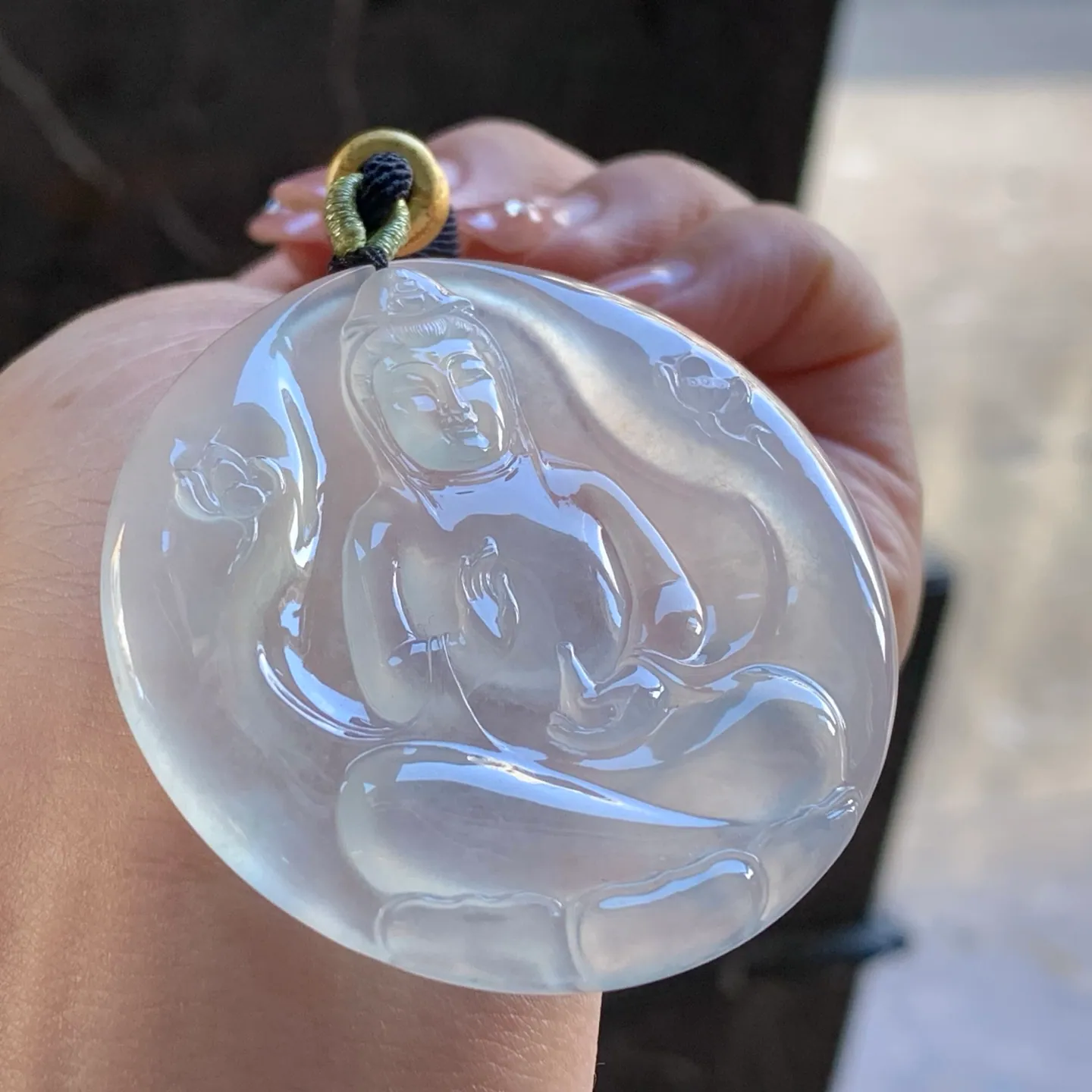
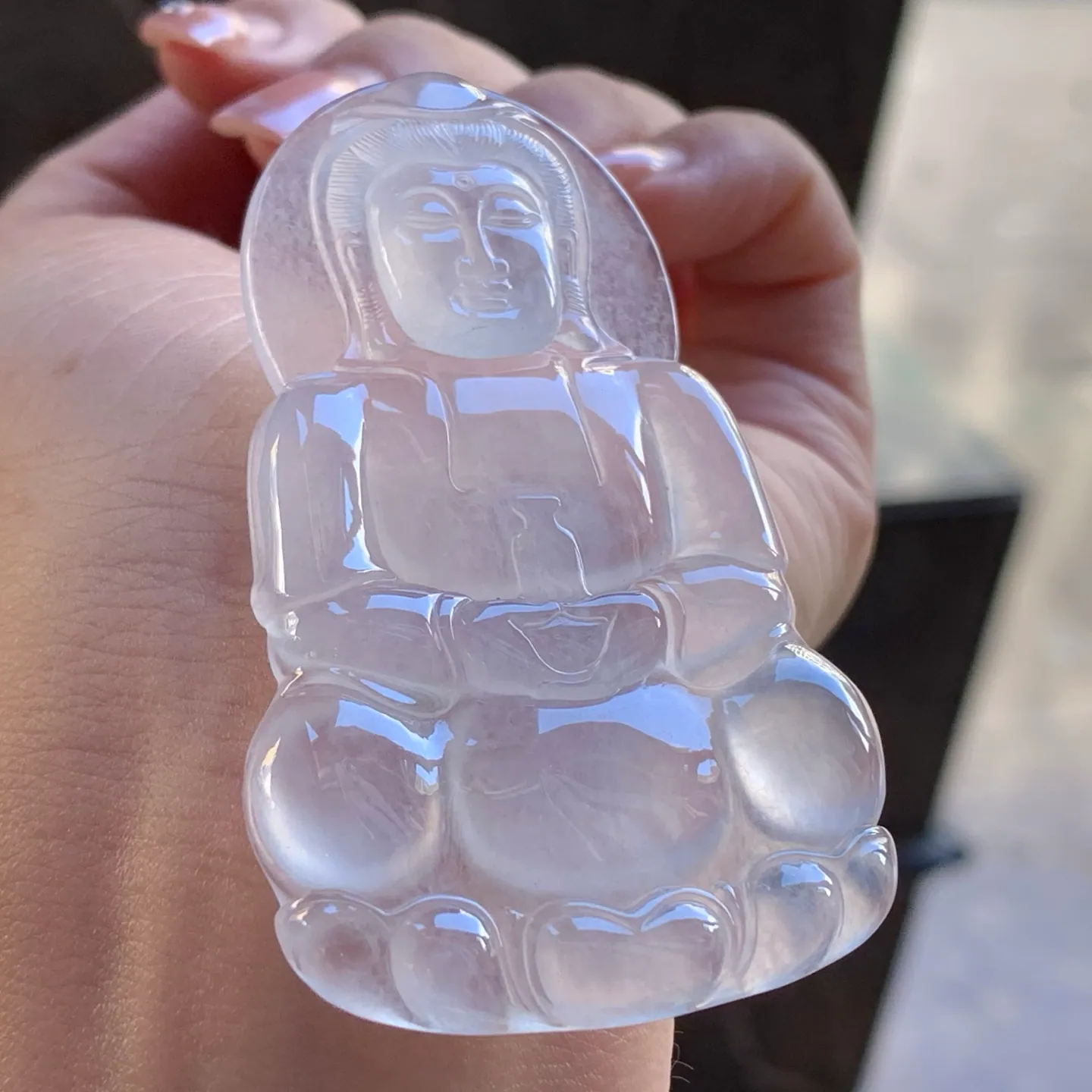
A good photo shows both in a balance that matches daylight. A flattering photo pushes the transmitted light: the stone glows, the texture looks finer and the colour spreads. For what texture (种) and translucency (水) mean, see zhong, shui and se explained.
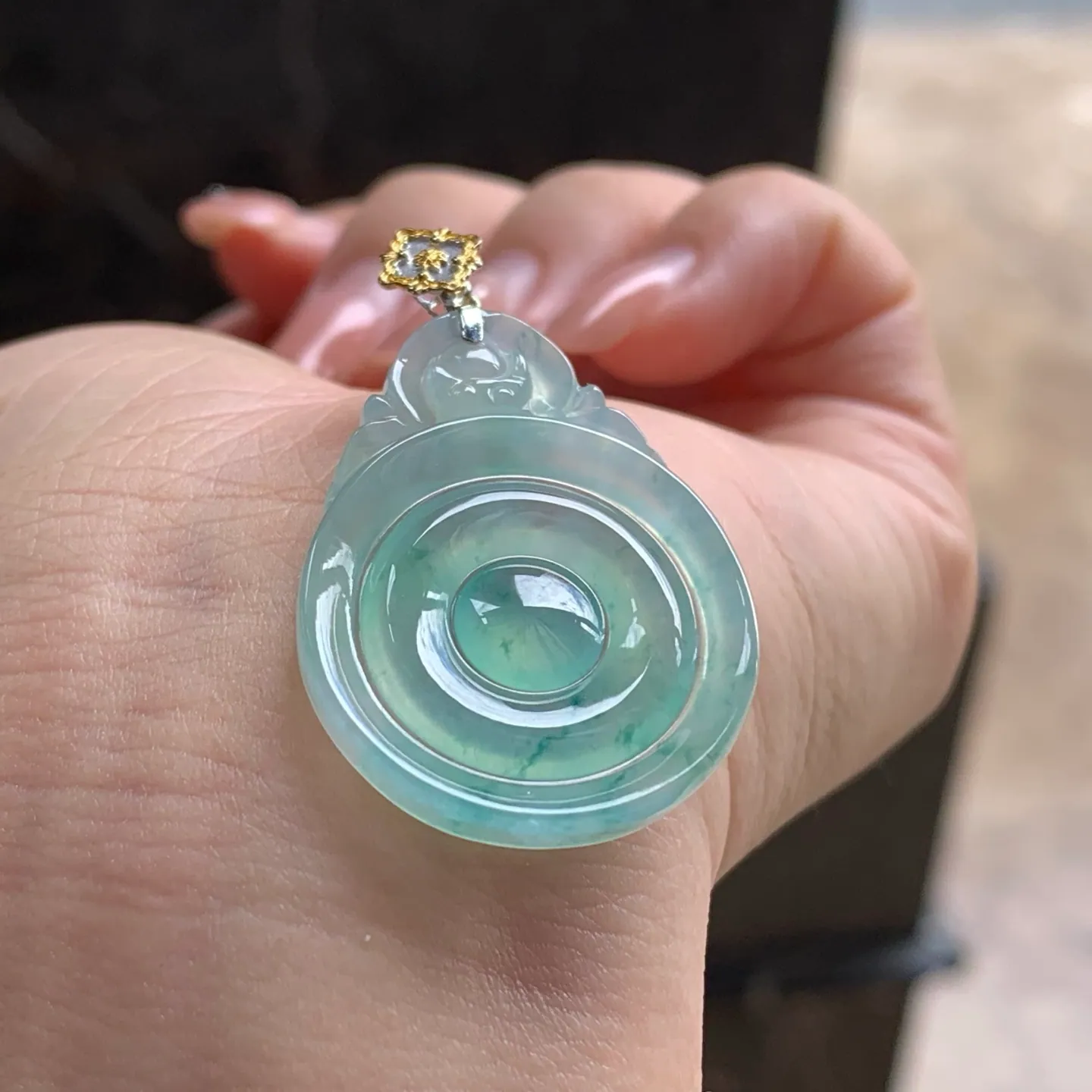
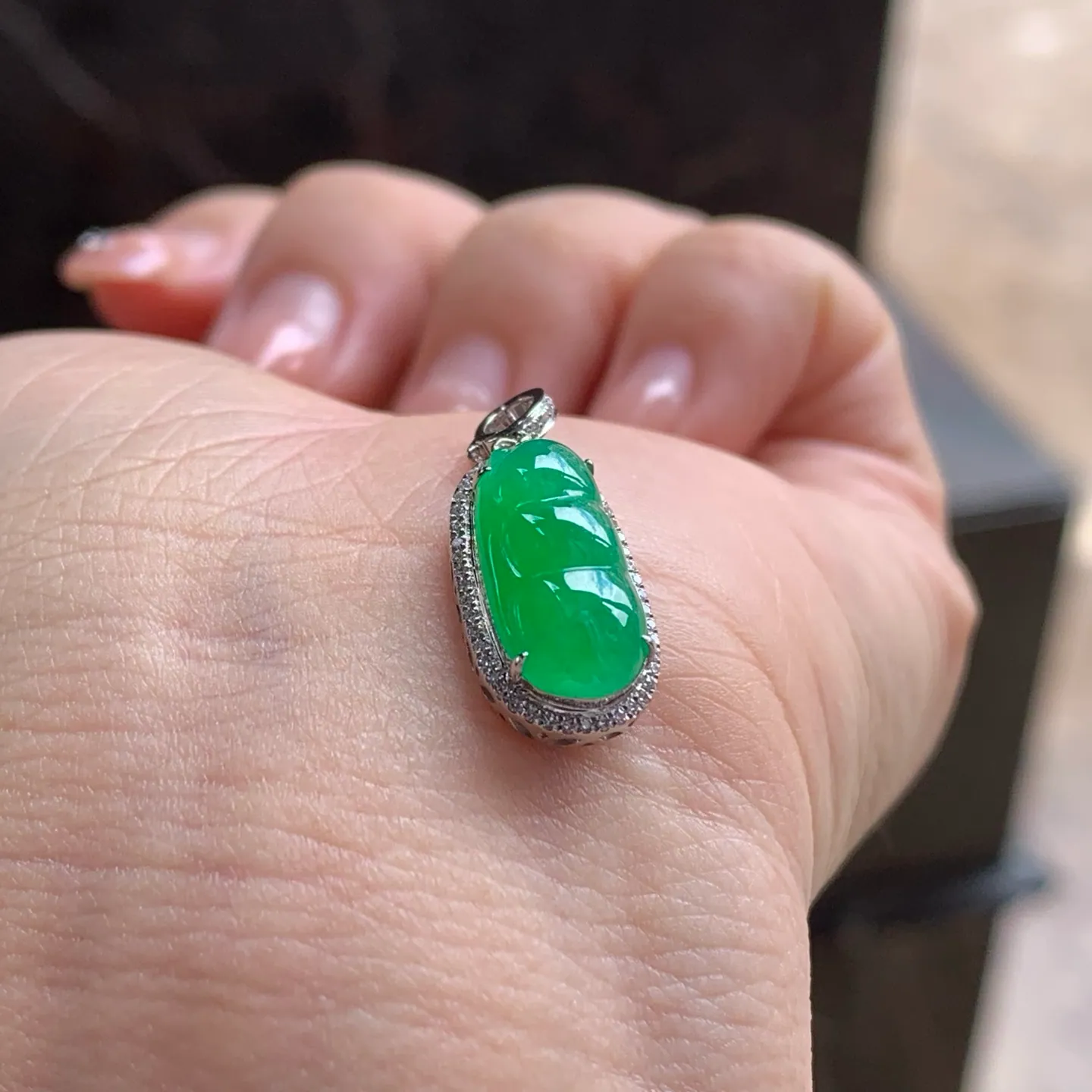
Colour shifts with the light. Green jadeite sits between yellow-green and blue-green. Warm light pushes it towards a richer, yellower green; cool or overcast light pushes it towards bluish or greyish green. Lavender is the most sensitive: it can look pink under warm lamps and grey-blue, or almost colourless, in daylight. The jadeite colors guide explains the colour names; this article is about why the photo of a colour can mislead.
Phone cameras add their own changes. Automatic white balance, HDR, "scene optimisation" and default saturation all make greens look stronger. Sharpening and noise reduction smooth away fine texture and hairline cracks. Chat apps then compress the file again, which smooths it further.
The Chinese internet has a phrase for this gap: 卖家秀 vs 买家秀, "seller's show vs buyer's show", the photo in the listing versus the photo the buyer takes at home. People in the trade will tell you jadeite is the jewellery where that gap is the widest. Their old rule is 灯下不观色: do not judge colour under a lamp.
What lighting and shooting tricks should you know?
Most of these are not lies. They are ways of showing a stone at its best, and many shops use them. The trade genuinely disagrees about how far that is fair: some dealers say a lamp photo is just the stone dressed up, like a shop counter; others say a listing should lead with daylight. Either way, you need both.
| Trick | What it hides or exaggerates | What to ask for |
|---|---|---|
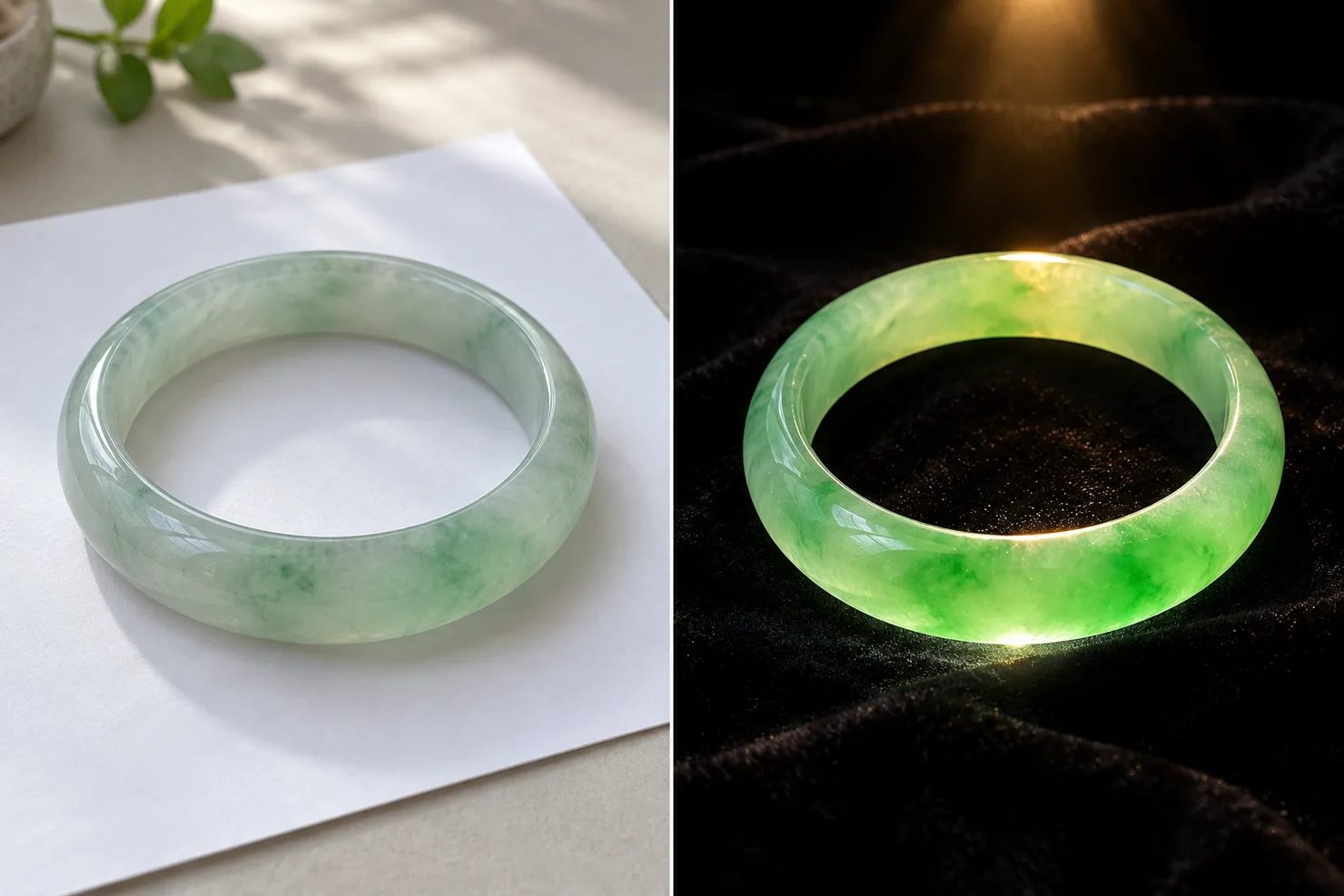
| Strong backlight or a flashlight through the piece (透光, 打灯) | Coarse texture and cotton; the whole piece looks finer and more translucent; green looks larger | The same piece in daylight with no lamp |
| Black background with a spotlight from above | Raises contrast; pale green looks vivid; the body looks clearer | A white paper background in daylight |
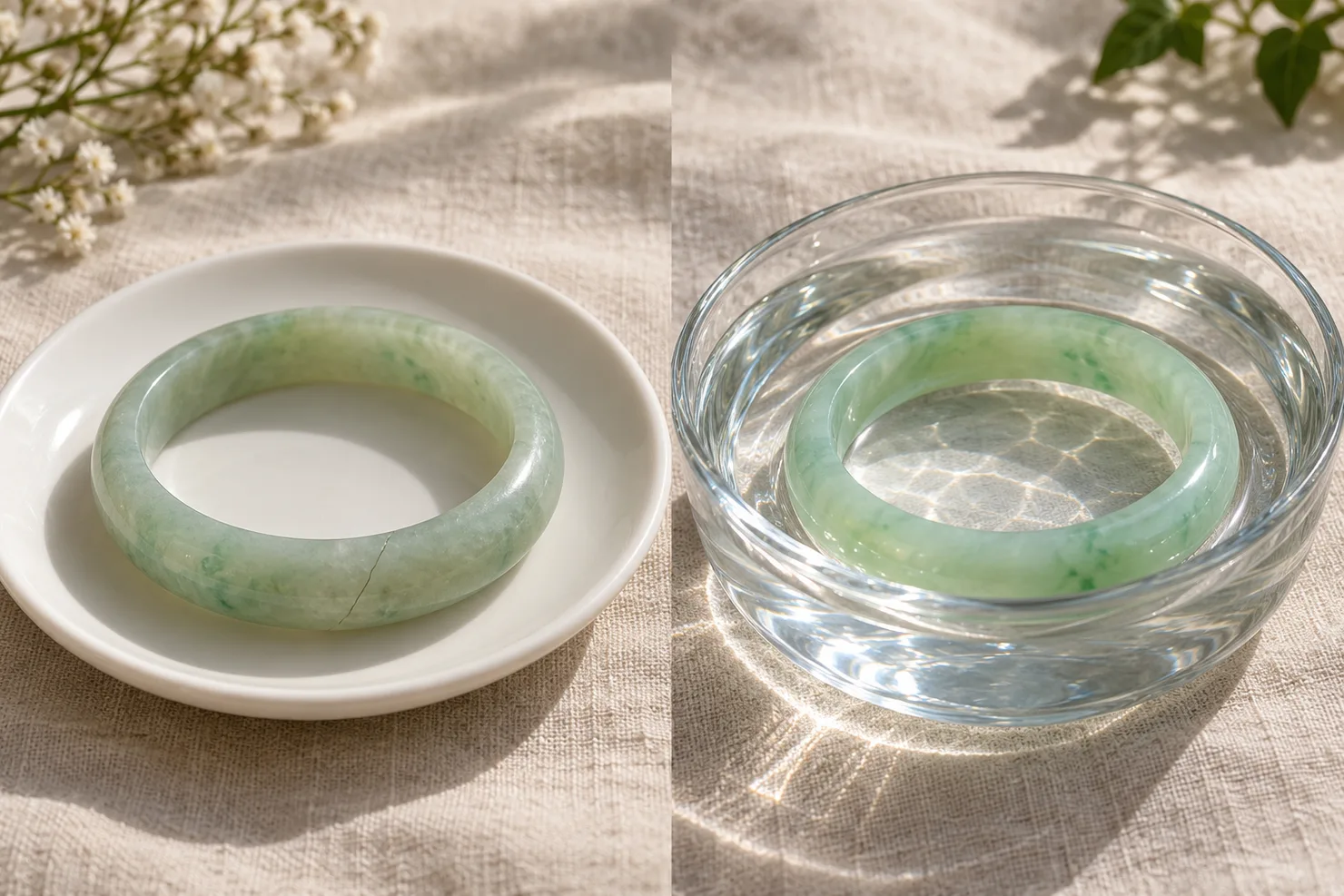
| Shooting in water or wet (泡水拍), or with oil on the surface | Fills surface cracks and pits; hides a coarse or dull polish; looks more transparent | The piece dry and wiped clean, in daylight |
| Jade lamps and livestream lighting (翡翠灯, 直播灯) | Shifts colour towards green, whitens a greyish body, adds a floating "glow" | A daylight re-shoot after the stream |
| Filters, beauty mode, saturation boost | Colour and smoothness; small flaws disappear | The original, unedited file |
| Macro close-ups | Uneven colour, flaws elsewhere, real size | The whole piece in frame next to a ruler |
| Only the best side | Colour that sits on one section; cotton, cracks or a dark spot on the back | A rotating video that shows the edge, the inside and the back |
| A different piece in the video than the one shipped (调包, 货不对板) | You receive a near-twin, often a bangle cut from the same stone | One continuous video with the certificate, and notes of unique marks |
A few of these need more explanation.
Backlight and the flashlight. A light behind or under a stone pushes transmitted light through it. Almost any jadeite looks more translucent this way, and a small patch of green spreads into a glow. A flashlight is still a useful tool, but for one job: finding cracks. It is not the light to judge colour or translucency.
Water and oil. Water and oil fill the tiny gaps of surface cracks, pits and orange-peel, so light no longer scatters there. The surface looks glassy, the piece looks clearer and fine cracks can almost disappear. Normal waxing during polishing is standard in the trade; a piece photographed dripping wet is something else.
Jade lamps. Jewellery counters in China often use spotlights chosen to flatter jadeite, and lamps sold as "jade lights" (翡翠灯) are common in shops and livestream rooms. Their tint and angle make green look greener and give icy pieces a floating blue-white sheen that the trade calls 起荧光, "showing fluorescence". The stone does have some sheen, but a lamp can make a modest one look dramatic. You buy the stone, not the lamp.
Twin pieces. A single block of rough often yields several bangles that look almost the same. That is normal production, but it means a seller can show the best of them and ship another. Each piece still has its own marks: a particular line, a cotton spot, where the colour sits, its exact weight. Those are what you match.
What should you watch for in a jade livestream?
Livestream sales (翡翠直播) are now one of the main ways jadeite is sold in China, and many Vietnamese and Thai sellers now sell the same way on TikTok and Facebook. They are live, so they are not edited afterwards, but the room is built for selling:
- Hands under strong lights. The host holds the piece close to a ring light or a jade lamp, often against a fair hand, so the green glows. Look for the lamp's reflection in the stone: if you see a bright ring or a row of dots, you are looking at studio light.
- Quick turns. The piece turns for a second and comes back to its best side. You rarely see the back held still.
- Countdown pressure. "Three, two, one, link is up", "only this one", "type 1 in the chat to claim it" (扣1). The point is to make you decide before you can check.
- "I'll hold this one for you" (这条给你留着). It feels like a favour. In practice it commits you to a piece you have only seen under studio light, and it is often followed by a request to pay now.
- Lot numbers. A room shows dozens of similar items and refers to them by a number or code. If the number is only spoken, not shown on a tag next to the piece, you cannot be sure which piece you bought.
After the stream, ask for the item code and a re-shoot of that exact piece in daylight, with the code tag in the frame. A seller who sells live can do this in a few minutes. Livestream rough cutting is a separate risk with its own scams; see jade gambling explained.
What should you ask the seller for?
Ask before you pay, and ask in writing so it is on record. A short message is enough: "Please send a daylight video of this exact piece, no lamp, no filter, turning it all the way round, with the certificate in the same shot."
- Natural daylight by a window, with no lamp. Bright but indirect daylight, out of direct sun, in the middle of the day. In the northern hemisphere a north-facing window is the jeweller's classic choice. Early morning and late afternoon light is too warm.
- A video rotating the piece. Slowly, all the way round, including the edge, the inside of a bangle and the back of a pendant.
- The piece for scale. Next to a ruler, and worn on a hand or wrist. For bangles, ask for the inner diameter in millimetres; see how to choose a jadeite bangle size.
- A flashlight shot for cracks. A small white torch pressed against the piece and moved slowly around it. Cracks stop the light; natural lines usually let it pass. See crack or natural line.
- A white paper background. A plain sheet of white paper under the piece, in daylight. It is your colour reference.
- The certificate. A clear photo of the whole certificate, with the number, so you can look it up on the lab's website; see how to verify a jadeite certificate.
- One continuous video with the certificate and the piece. No cuts: the certificate, then the piece, then both together, ideally with the piece on a scale showing a weight that matches the certificate.
- The original files. Many chat apps have an "original" or HD option. A compressed preview loses exactly the fine detail you need.
A seller who will not send a daylight video of a piece they have in hand is giving you an answer too.
How do you read the photos and videos you receive?
Use the white paper as your reference. If the paper looks yellow, the light is warm and the green is warmer and richer than it really is. If the paper looks blue, the opposite. If the paper looks white and the jade still looks green, you are close to the real colour.
Look at the edges and the thick parts. Thin edges always look more translucent. Judge translucency where the piece is thickest, such as the middle of a bangle's bar. If only the edges glow, the material is less translucent than the hero photo suggests.
Follow the reflections. The window or a lamp leaves a bright reflection on the polished surface. On a smooth surface it is a clean, unbroken shape. If it looks slightly dimpled, that is orange-peel (橘皮), which is normal in jadeite and stronger on coarser material. If it breaks or jumps along a line, there may be a surface crack. Small dark dots in the reflection are pits. Glass usually gives a perfectly smooth reflection.
Check the size against the certificate. The certificate lists dimensions and weight. Compare them with the ruler and the scale in the video. Phone lenses make objects close to the camera look bigger, so a ruler in the same shot matters more than how big the piece "feels".
Watch the colour while the piece turns. If the green appears only at one angle, or only near the lamp, it sits in one section or one layer. That is not a defect, but it is not an even colour either.
| What you notice | What it may mean |
|---|---|
| Every photo is on a black background | Contrast is hiding a pale or uneven colour |
| The piece always looks wet or very glossy | Water or oil may be hiding cracks or a rough surface |
| A ring of light or a row of dots reflected in the stone | Studio lighting; colour and glow are boosted |
| The video cuts between the certificate and the piece | You cannot be sure they belong together |
| The weight or size in the video differs from the certificate | Possibly a different piece |
| The seller sends only screenshots from a stream | Ask for a fresh daylight video before paying |
Does your own screen change what you see?
Yes. Night mode, "eye comfort" and blue-light filters turn the whole screen warmer, which makes green look yellower. Automatic colour adjustment (such as True Tone) shifts with your room. Many phones ship in a "vivid" colour mode that boosts saturation, and low brightness hides fine cracks and cotton.
Before you decide, turn those modes off, raise the brightness, and look at the original file on two devices, such as your phone and a laptop. If the colour looks very different between them, neither one is the truth, and the white paper in the shot becomes your best guide.
What should you expect when the piece arrives?
Small colour differences are normal. Your room light is not the seller's window. Daylight in the tropics at noon, on a cloudy afternoon or under indoor LED lamps all differ, and the piece on your skin looks different from the piece on white paper. If it looks like the seller's daylight video, it is as described, even if it is paler than the lamp photo. Jadeite does not lose colour in the post.
What counts as "not as described":
- A different piece: the certificate number, weight, size or unique marks do not match.
- Cracks that were not shown or mentioned, or damage that was not there in the video.
- Treatment: a lab finds Type B or Type C when the piece was sold as natural.
- A colour far from the daylight video, not just from the lamp photo.
Keep an unboxing video. Film in one continuous take from the sealed parcel: the shipping label, the opening, the piece, the certificate number, and the weight on a scale if you have one. Keep the video until the return window has closed. It is the clearest evidence you can have.
Buying on JadeiteHub
On JadeiteHub, sellers show real photos of the piece, some with video, and you can ask them for daylight shots before you buy. Every sold piece is checked against its certificate before it ships, and if it does not match the description, you get a full refund.
FAQ
Why does my jade look lighter than in the photo?
Most listing photos are taken under lamps, against dark backgrounds or with a light behind the stone, and phone cameras add saturation. In your room's daylight the same piece looks paler. Compare it with the seller's daylight video, not the lamp photo.
Is a livestream more reliable than photos?
Not really. A livestream is not edited afterwards, but the lighting, the hands and the speed are all controlled. Note the item code and ask for a daylight re-shoot of that exact piece after the stream.
What is the best light to judge jade?
Bright, indirect daylight by a window, out of direct sun, in the middle of the day, with the piece on white paper. Use a flashlight only to look for cracks, not to judge colour or translucency.
Can a seller refuse a daylight video?
They can, but a seller who has the piece in hand can film it by a window in a few minutes. If they refuse, treat it as a reason not to buy.
Why do sellers photograph jade in water?
Water fills surface cracks, pits and orange-peel texture, so the piece looks clearer and more glassy. Ask for the piece dry and wiped clean in daylight.