Jade Pea Pod Pendant Meaning: Styles, Choosing and Price
Updated
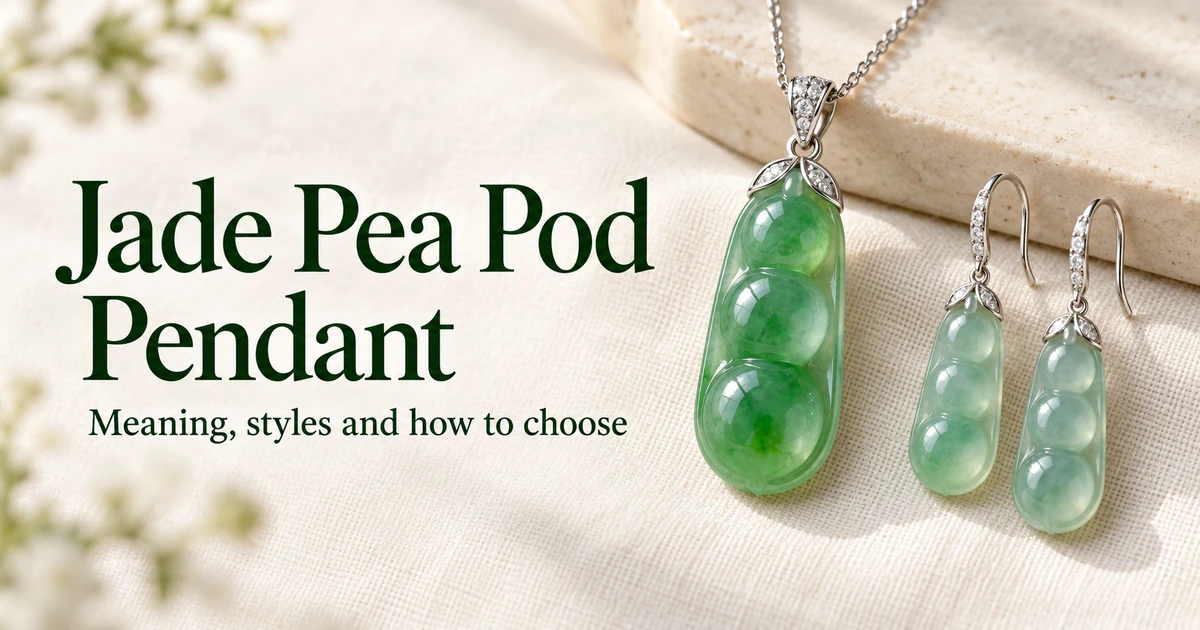
A jade pea pod (福豆, fu dou, the "blessing bean") traditionally stands for blessings, because 豆 (bean) sounds like 都 (all): "blessings, all of them". The number of peas adds a saying: two for 两全其美 (both sides perfect), three for 连中三元 (top in three exams) or 福禄寿 (fortune, prosperity, long life), four for 四季平安 (peace all year). A pod full of seeds also stands for children. These are traditional wishes, not promises. Pea pods need little carving and are often cut from good small pieces, so color and translucency show. Choose full, round, cleanly separated peas, smooth pod lines, glassy polish and no cracks at the thin edges.
What does a jade pea pod pendant mean?
A jade pea pod pendant traditionally stands for blessings, many of them. In Chinese the pod is called 福豆 (fu dou), the "blessing bean": 福 (fu) means good fortune, and 豆 (dou, bean) sounds like 都 (dou, "all"), so the name is read as "blessings, all of them" or "blessings for the whole family". Another common trade name is 四季豆 (si ji dou), literally the "four-seasons bean", which is the everyday Chinese word for the green bean and carries its own wish: 四季平安, "peace in all four seasons".
Around those two puns the pea pod has gathered a few more readings, all of them traditional sayings rather than promises: the number of peas inside adds a wish of its own, and a pod full of seeds stands for children and a growing family. Sellers in Guangdong and in Chinese-run jade shops across Southeast Asia use these lines every day. For an overview of every common motif side by side, see jadeite pendant meanings. This guide covers the pea pod alone: what it means, why dealers cut it from good material, the styles, how to check one, and what the three pea pod pieces on JadeiteHub cost.
A note on names. In English you will see "pea pod", "bean pod", "jade bean" and "fortune bean" for the same design. They all mean the same carving: a slim, slightly curved pod with two to four round peas showing through or bulging from it.
What do two, three or four peas mean?
The count of peas adds a second wish to the basic "blessings" meaning. These readings are common trade usage in China and among Chinese jewelers in Southeast Asia, but they are sayings, not rules, and families tell them in slightly different ways.
| Peas | Saying | Literal sense | Often given to |
|---|---|---|---|
| Two | 两全其美 (liang quan qi mei) | "Both sides perfect", having it both ways | Couples, newlyweds; also anyone balancing work and family |
| Three | 连中三元 (lian zhong san yuan) | Coming first in three imperial exams in a row | Students before exams, graduates |
| Three | 福禄寿 (fu lu shou) | Fortune, prosperity and long life | Parents and grandparents |
| Four | 四季平安 (si ji ping an) | Peace in all four seasons | Anyone; a common baby and travel gift |
Two things worth knowing at the counter:
- Three peas is the most quoted count. 连中三元 comes from the old imperial examinations, where a scholar who came first at the provincial, metropolitan and palace levels was said to have "hit the top three times in a row". Today it is a wish for exam and career success, which is why a three-pea pod is a classic gift for students. The same three peas are just as often read as 福禄寿, the three star gods of fortune, prosperity and long life.
- Four peas doubles up the 四季豆 pun. The name already says "four seasons", and four peas, one per season, make the point twice.
You will also hear sellers find a saying for one, five or more peas. Treat those as sales talk; the counts above are the ones you will meet most often.
Why is the pea pod linked with children and family?
Because a pod is full of seeds lined up side by side. Chinese decorative art has long used seed-filled plants (the pomegranate, the gourd, the lotus pod) to stand for 多子多福, "many children, many blessings", and the pea pod belongs to the same family of motifs. In that reading the peas are the children growing safely together inside one home, the pod.
That is why the pea pod is a popular gift for newlyweds and for new parents, and why families often choose one as a first jade piece for a baby. The meanings are wishes, not effects: a pod does not bring children, health or luck. People give it because the message is warm and easy to explain.
Who wears a jade pea pod, and is it a good first gift?
Anyone can wear a jade pea pod; there is no rule for men or women, age, zodiac sign or birth year. In practice it is one of the safest motifs to give when you do not know someone's taste or beliefs well:
- New babies and first birthdays: blessings and peace through the year. Parents usually keep it until the child is older; a cord around a baby's neck is a choking and strangling risk. See jade gifts for babies.
- Students: three peas for 连中三元.
- Couples and newlyweds: two peas, or a matching pair of pea pod earrings.
- Parents and grandparents: three peas read as 福禄寿.
- A first piece of jade: a small, rounded, light pendant that suits daily wear and an office dress code.
Pea pods are worn as pendants on a cord or chain and as drop earrings, where two matching pods hang one from each ear. For how earring styles compare, see how to choose jadeite earrings.
Why do pea pods suit good jadeite?
Because a pea pod needs very little carving and its rounded peas show off translucency and color. Dealers say a carving "follows the material" (因材施艺), and good material is usually given a simple, smooth shape so nothing distracts from it. The pea pod fits that rule well:
- Rounded peas work like small cabochons. Each pea is a smooth dome, and a dome gathers light. On an icy or high icy base, the peas glow from inside; on green material, the color looks deeper at the center of each pea.
- Little carving means little waste. The design is an outline, a few smooth curves and the grooves between the peas. Most of the stone's volume stays in the finished piece.
- It uses good small pieces. A pod is long and slim. That shape fits the narrow, high-quality offcuts left after bangles are cut, or a short band of strong color that is too small for anything else. That is one reason you see so many high icy and full-color pea pods for their size.
- Nothing hides a flaw. With so few carved lines, there is nowhere for a crack to disappear. A clean, smooth pod is honest material.
In the Guangdong workshops, Jieyang is known for exactly this kind of work: high-end small pendants in fine material. Sihui is known for mid- and low-grade carvings, where pods are often cut on CNC carving machines and then finished by hand. Machine-cut pods tend to be identical, with peas of the same height and shallow grooves; well-finished hand work gives fuller peas and deeper, cleaner separations. For more on telling the two apart, see jadeite carving craftsmanship.
Is a jade bean pendant the same as "bean jade" (豆种)?
No. They are two different things that share the word "bean". A bean pendant (福豆) is a shape: the carved pea pod this article is about. Bean jade (豆种, dou zhong) is a texture grade: coarse-grained jadeite whose crystals are big enough to see, like beans packed together, usually with low translucency.
A pea pod can be carved from any texture, from coarse bean jade to glassy material. Most good pea pods are cut from finer textures, icy (冰种) or better, because the rounded peas are made to show translucency. For the full texture ladder from bean to glass, see jadeite texture, translucency and color.
What styles of jade pea pod are there?
Pea pods vary mostly in the number of peas and in how they are worn.
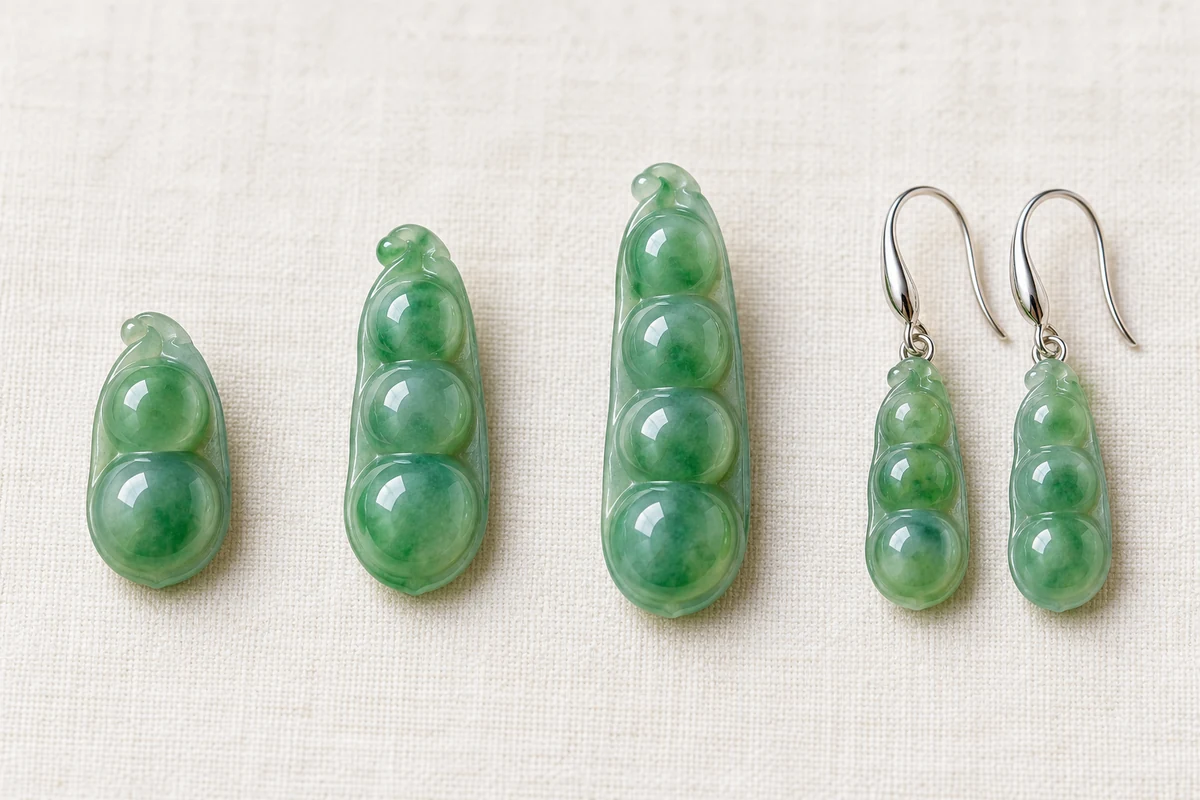
| Style | Chinese name | What it looks like | Notes |
|---|---|---|---|
| Plain pod on a cord | 福豆, 四季豆 | Smooth pod, drilled through the stem end | The traditional way; cheapest to finish |
| Gold- or silver-capped pod | 金镶福豆 | A metal cap and bail over the stem, sometimes a small metal leaf or tendril | Protects the stem end; suits a chain |
| Pod with leaf | 叶子福豆 | A pod carved with a leaf beside it | Leaf (叶) sounds like career (业): career plus blessings |
| Pea pod earrings | 福豆耳环 | Two small pods hanging from hooks or studs | Matching the pair is the hard part |
| Pods on bead bracelets | 福豆手链 | A small pod as a charm between beads | A light, everyday version |
Peas are either exposed (the pod is cut open on the front and the peas sit inside like a row of beads) or enclosed (the pod is smooth and the peas show only as bulges along its length). Enclosed pods need more careful shaping to keep the bulges full; exposed pods need clean grooves between the peas.
How do you choose a good jade pea pod?
Check the material first, then the carving, then the setting.
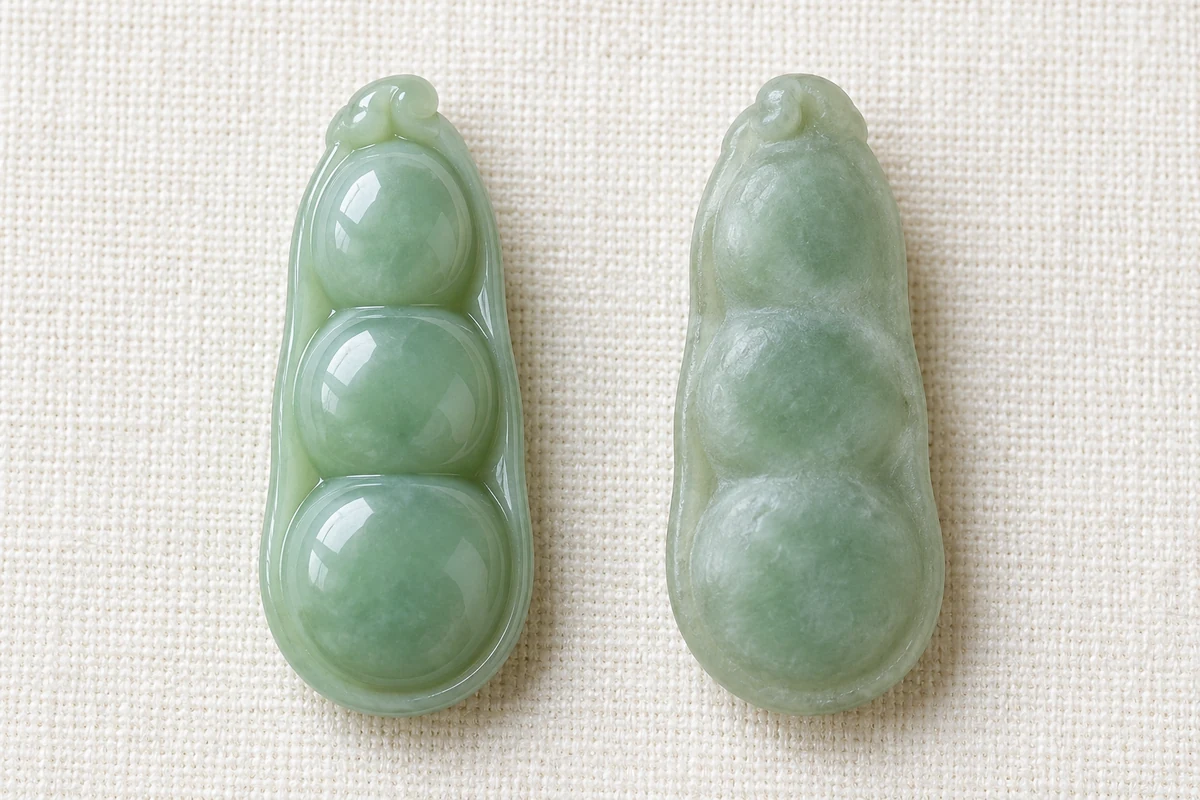
- Look at the peas. Good peas are full and round (饱满), stand out clearly from the pod and are cleanly separated from each other. Sizes should be even, or taper naturally toward the tip. Flat peas, peas that blur into one another, or one pea much smaller than the rest are signs of thin rough or hurried cutting, as in the right-hand pod above.
- Follow the pod lines. The outline and the seam of the pod should be one smooth, continuous curve, with no kinks or wobbles. Look from the side as well: a good pod has body, and the peas bulge on both faces or at least sit high on the front. A pod cut from a thin slice looks fine from the front and flat from the side.
- Check the polish. The peas should be glassy. The hard part is the grooves between them; dealers look there first, because dull, rough grooves show where finishing time was saved.
- Judge translucency and color. Hold the pod up to daylight. On an icy or high icy base, light should pass easily through the peas. With green, look at whether the color is even through all the peas or fades in one of them. For floating-flower pods (飘花), see how the flowers fall across the peas; floating flower jadeite explains what to look for.
- Backlight the thin edges. The pod's edges, its pointed tip and the stem end are the thinnest parts and the places most likely to chip or crack. Shine a small flashlight through them and turn the pod slowly. A line that cuts the light sharply is a crack; a fine line that does not break the light may be a healed stone line.
- Check the setting and bail. On a capped pod, the cap sits exactly on the stem end, one of the weakest spots. Ask for photos of the stone before setting, or check the certificate photo. Prongs should hold firmly, the back should be smooth, any small diamonds or rhinestones should be set evenly, and the bail should be closed and wide enough for your chain.
- Ask for the certificate. Small, bright green pea pods are a common shape for bleached and resin-filled (Type B) and dyed (Type C) jadeite. Buy natural Type A with a lab certificate.
When buying online or from a livestream, ask for a video of the pod turned under a flashlight, a side view and both faces.
Gold or silver: how are jade pea pods set?
Most finished pea pods are set in 18K gold or 925 silver. The setting usually covers the stem end with a cap and bail; some add a small metal leaf or curling tendril, and some line the cap with small diamonds or rhinestones for sparkle.
- 18K gold. Gold-set jadeite is mostly made in China in 18K (75%) gold. White gold is the usual choice for icy, colorless and blue pods because it keeps the stone looking clean; yellow and rose gold suit warmer greens.
- 925 silver. Every silver setting sold on JadeiteHub is 925 sterling silver. Silver costs much less than gold, so more of the price goes into the stone itself. It needs more cleaning, as it tarnishes.
The metal matters less to the price than the jade does, as the table below shows. For a fuller comparison, see silver vs gold settings for jadeite.
How much does a jade pea pod pendant cost?
Price depends first on the material (color, translucency and texture), then on size, carving and setting. The three pea pod pieces listed on JadeiteHub show how this works in practice. All three are certified natural Type A jadeite; prices are as of 21 October 2026 and may change.
| Listing | Piece | Material | Setting | Size | Price |
|---|---|---|---|---|---|
| JH-000013 | Pea pod pendant | Icy, blue floating flowers | 18K white gold | 29 mm | US$809 |
| JH-000009 | Pea pod pendant | High icy, vivid green, full color | 925 silver | — | US$949 |
| JH-000008 | Pea pod earrings (pair) | High icy | 18K white gold | 27.5 mm | US$2,109 |
What the table shows:
- The material outweighs the metal. The full-color green pod set in silver costs more than the blue floating-flower pod set in 18K gold. A pod that is green all through, on a high icy base, needs rarer rough than one with scattered blue flowers on an icy base.
- A pair of earrings costs more than either pendant. Earrings need two pods, and a pair is sold as a match, so the two pieces have to look alike in base and color.
For every pendant currently listed, including other motifs, browse the JadeiteHub pendants.
How do you care for a jade pea pod?
- Take it off for sport, heavy work and sleep. The tip and edges of the pod are the parts most likely to chip if they hit something hard.
- Wash it in lukewarm water with mild soap and dry it; a soft toothbrush cleans the grooves between the peas.
- Store it on its own, away from harder stones and other jewelry, and keep perfume and strong cleaners off it.
- Check the cap, prongs and bail now and then, and replace a cord as soon as it frays at the drill hole.
On JadeiteHub we list only jadeite with a lab certificate. Every sold piece is checked against its certificate at our inspection center before it ships, and if it does not match its description you get a full refund.
FAQ
What does a jade pea pod pendant mean?
Traditionally it means blessings for everyone: the pod is called 福豆 (blessing bean), and 豆 (bean) sounds like 都 (all). It is also called 四季豆, the four-seasons bean, read as peace all year, and a pod full of seeds stands for children. These are traditional wishes, not promises.
What does a jade pea pod with three peas mean?
Three peas are most often read as 连中三元, coming first in three exams in a row, a wish for study and career success, or as 福禄寿, fortune, prosperity and long life. Two peas stand for 两全其美 and four for 四季平安.
Is a jade pea pod a good gift for a baby?
It is a traditional baby gift, read as blessings and peace through the year. For safety, parents usually keep it until the child is older, since a cord or small pendant is a choking and strangling risk.
Is a jade bean pendant the same as bean jade?
No. A bean pendant (福豆) is a carved shape. Bean jade (豆种) is a coarse-grained texture grade with low translucency. A pea pod can be cut from any texture, and good ones are usually icy or better.
How do I tell a well-carved jade pea pod?
Look for full, round peas that are cleanly separated, a smooth and continuous pod outline, body when seen from the side, and glassy polish even in the grooves between the peas. Flat, blurred peas and dull grooves mean thin rough or hurried work.
Can men wear a jade pea pod?
Yes. The pea pod has no gender rule. Men often choose a longer, fuller pod on a dark cord or a sturdy chain; it is also a common pendant for children and for couples.