What Is a Jadeite Cabochon? How to Choose a Good One
Updated
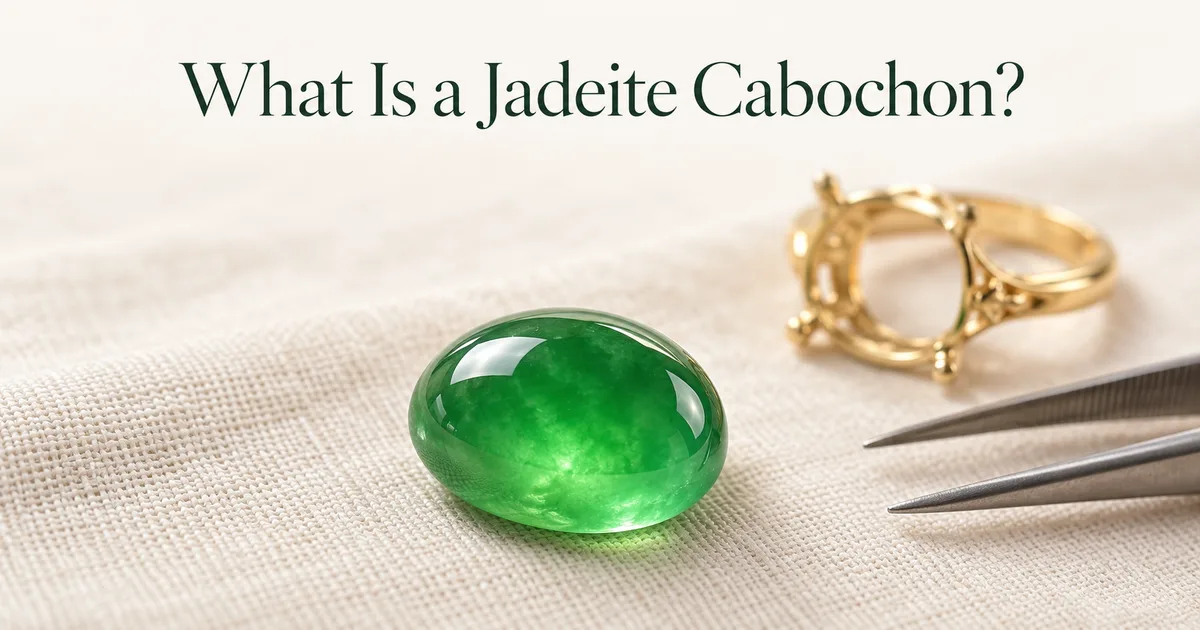
A jadeite cabochon (蛋面) is a smooth, domed oval or round stone, the classic cut for the best jadeite. Dealers judge it by translucency and color first, then the fullness of the dome, thickness, outline, cracks, polish and size. Always look from the side and at the back: a hollowed back (挖底), a thin stone or a foil in a closed setting can make it look better than it is.
What is a jadeite cabochon?
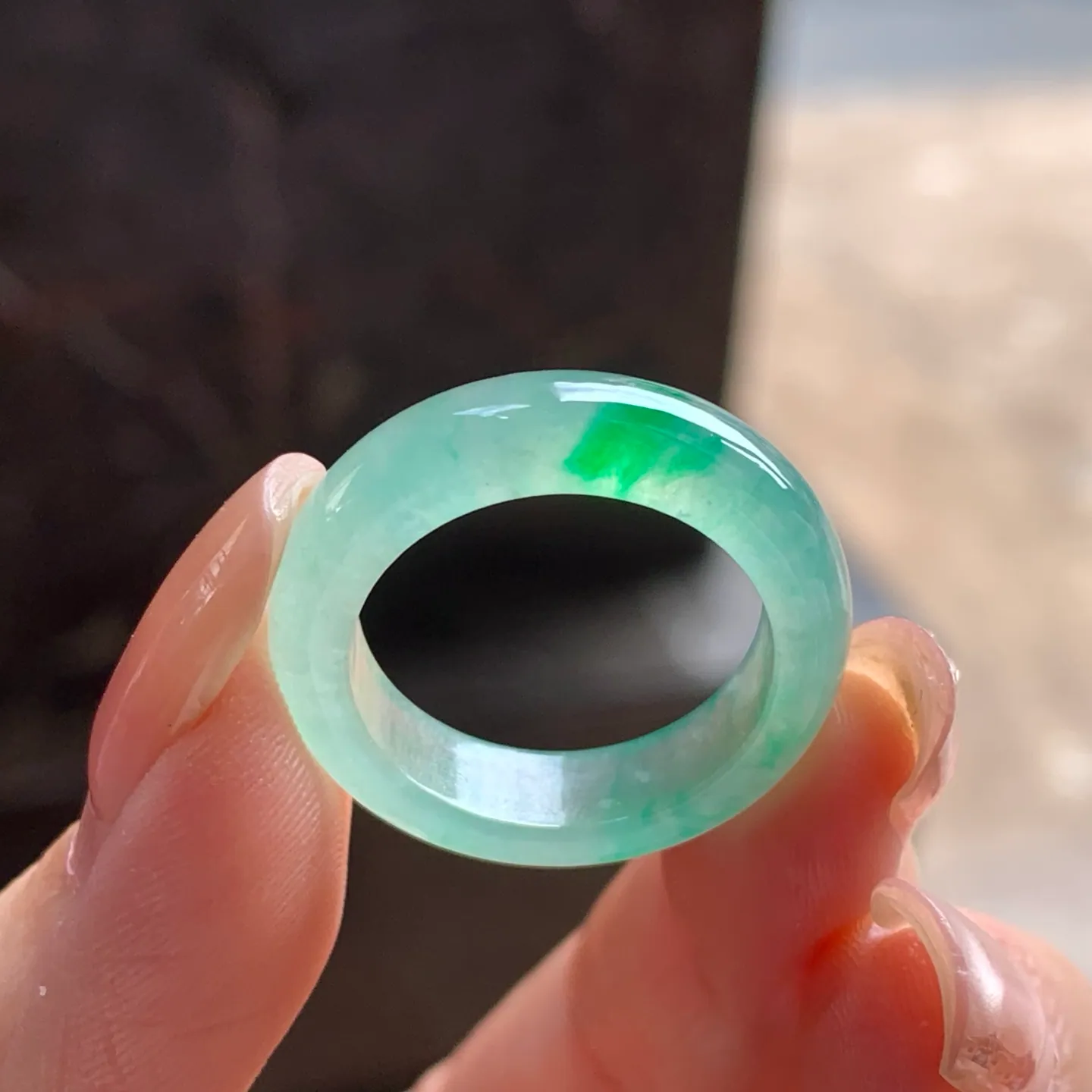
A jadeite cabochon is a smooth, domed stone with an oval or round outline and no facets, cut to show the color and translucency of the jadeite. In Chinese it is called 蛋面, literally "egg face", because the top looks like the end of an egg.
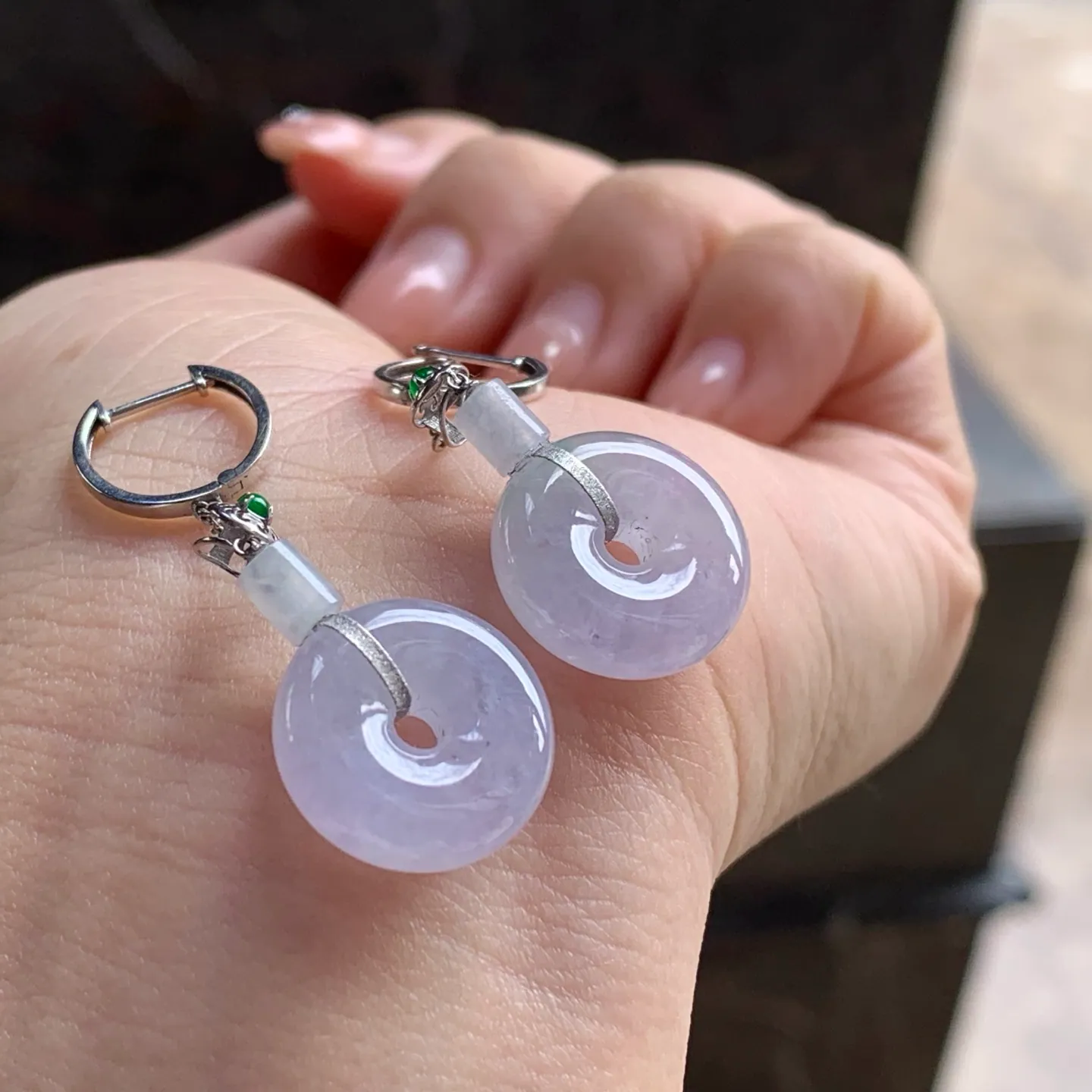
Cabochons are the classic shape for the best jadeite. Most top-quality ring stones, earring pairs and many fine pendants are cabochons, loose or set in gold. This guide is about judging the stone itself. For ring styles, settings, metals and sizing, see the jadeite ring guide.
Is 蛋面 the same as 戒面?
Not quite. 戒面 ("ring face") is the general trade word for any small polished stone made to be set on top of a ring, pendant or earring. The cabochon (蛋面) is one shape of 戒面, and the most important one.
| Shape | Chinese | What it looks like | Typical use |
|---|---|---|---|
| Cabochon | 蛋面 | Smooth oval or round dome | Rings, pendants, earrings; the classic shape for top material |
| Saddle | 马鞍 | Long, narrow top curved across the finger | Rings, often men's rings |
| Drop or pear | 水滴 / 梨形 | Domed, wider at one end | Pendants and earrings |
| Square or rectangle | 方形 | Flat or slightly domed top with straight sides | Men's rings and signet-style rings |
| Free-form | 随形 | Follows the natural shape of the material | Pendants and designer pieces |
Why does the best material become cabochons?
Three reasons. A dome gathers light and sends it back through the stone, so color looks richer and translucency looks deeper than in a flat piece. A cabochon is a simple shape, so very little of an expensive piece of rough is lost when it is cut. And with no carving, nothing hides the material: a buyer sees exactly what the stone is, which is why dealers say good material does not need carving. Material with cracks, uneven color or coarse grain is more often carved, because carving can cut around flaws.
What do dealers check first?
A dealer looks at a cabochon in roughly this order. Translucency and color decide most of the value; the rest can raise or lower it a lot.
| Order | What | How to look | What is valued |
|---|---|---|---|
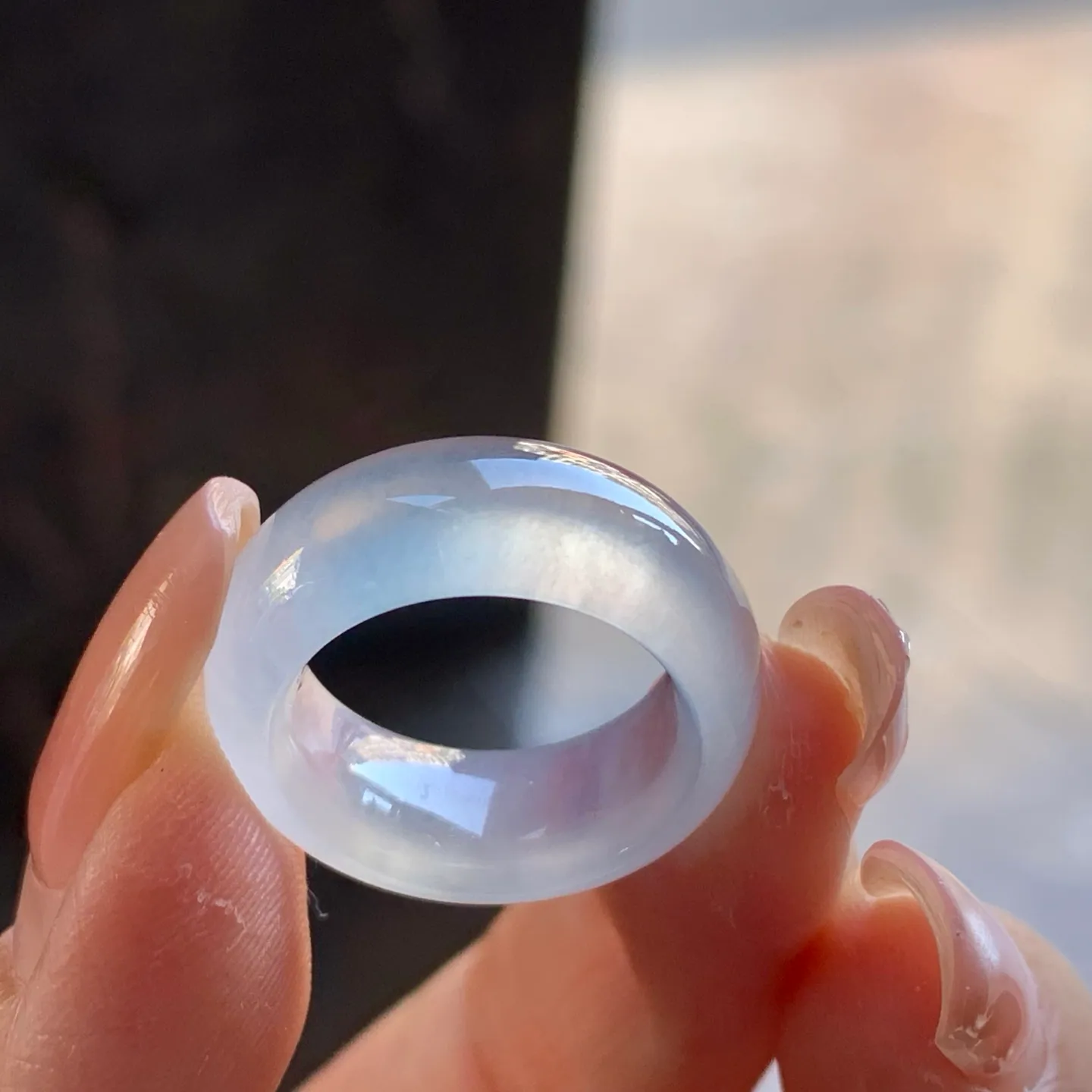
| 1 | Texture and translucency (种水) | Daylight near a window, then a flashlight from the side | Fine, tight grain; light passes deep into the stone |
| 2 | Color | Daylight, away from direct sun and warm lamps | Pure, bright, even color; see the jadeite colors guide |
| 3 | Fullness of the dome (饱满度) | From the side, at eye level | A high, full, rounded dome |
| 4 | Thickness | From the side, and the thickness figure on the certificate | Enough depth for the color to show; no thin "chip" |
| 5 | Outline and proportion | Face-up, then fold it in your mind along both axes | Symmetrical oval or round; no flat sides or wobbly curves |
| 6 | Clarity | Flashlight from the side and behind; 10× loupe | No cracks; few cotton patches or black spots |
| 7 | Polish | Tilt it so a window reflects on the dome | A sharp, unbroken reflection; no orange-peel ripple |
| 8 | Size | Length × width × thickness in mm, and weight | Larger is rarer, but only if the other points hold |
For what 种 and 水 mean in detail, see zhong, shui and se explained.
What is fullness (饱满度), and why does it matter?
Fullness is how high and round the dome is compared with the size of its face. Traders call a good one 饱满 (full). A low, flat dome is called 薄 (thin) or 扁 (flat).
A full dome matters for three reasons:
- It looks alive. On fine, translucent material a high dome makes a soft glow seem to float under the surface and move as you tilt the stone. The trade calls this 起荧 (a "glow" or "sheen"; it is not the same as fluorescence under UV light). A flat stone rarely shows it.
- It shows more color. Light travels through more jadeite in a deep dome, so the color looks stronger and more even. The same material cut thin looks paler and more watery.
- It is harder to cut. A high dome needs a thick piece of rough. Cutting it thin gives a bigger face from the same piece, so a thin stone often has a large face for its weight.
For the same face size and similar material, a full cabochon is usually valued well above a flat one.
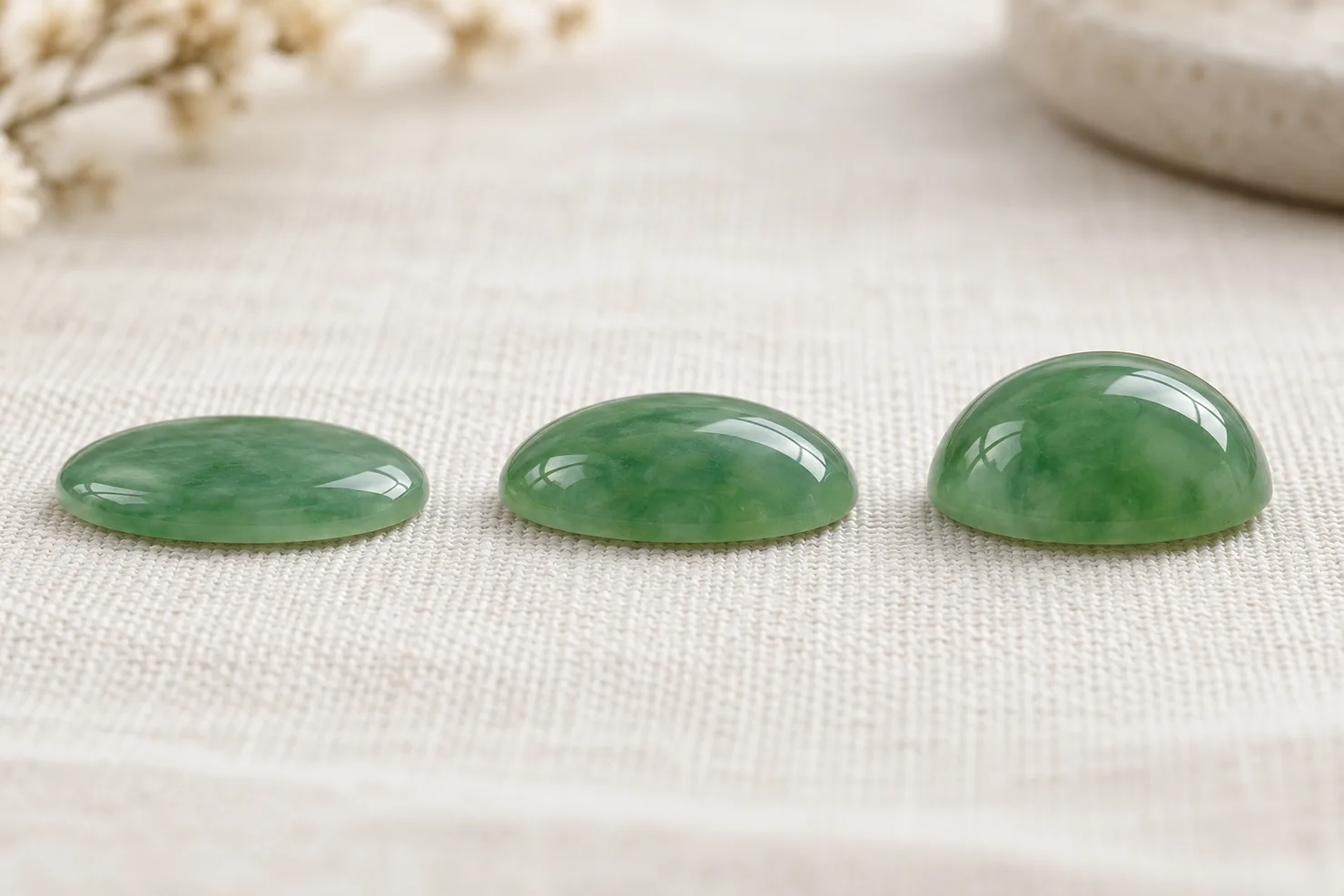
How to check it: hold the stone at eye level and look at it from the side, from both the long and the short side. A full dome curves up smoothly from the edge to the top. A flat one rises a little and then runs nearly straight across. Also look at the edge (girdle): a very thin, sharp edge chips easily when the stone is set.
Outline and proportion
Face-up, a good cabochon is symmetrical. Imagine folding it in half lengthwise and then across: both halves should match. Common faults are one flat side, a pointed end, or a curve that wobbles because the cutter followed a crack or kept as much weight as possible.
The length-to-width ratio is a matter of taste. A slightly long oval sits well on a finger; a round or near-round stone suits pendants and earrings. There is no fixed ideal ratio, and dealers disagree. Very long, narrow ovals or nearly round "egg ends" are usually less sought after than a balanced oval.
What should I check on the back of the stone?
This is where buyers are most often surprised. Two cabochons can look the same from the front and be very different underneath.
What is hollowing (挖底)?
挖底 or 掏底 means grinding the underside into a shallow bowl, so the stone is thinner in the middle than at the rim. Cutters do it for two reasons:
- To make dark color look brighter. A thick stone with deep green can look heavy, even blackish. Thinning the middle lets more light through, so the color looks brighter and the stone more translucent.
- To reduce weight. It is also done simply to make a stone lighter, or to make a heavy piece more comfortable to wear.
Hollowing is not a treatment. The jadeite is still natural, and a certificate will usually not mention it, because it is a cutting choice. But it changes how the stone looks, and a hollowed stone has less jadeite in it than a solid one of the same outline. A good seller will tell you. A seller who says nothing has not lied, but you should ask.
One detail: thickness is usually measured from the top of the dome to the base, so a hollowed stone can show the same thickness figure as a solid one. Its weight will be lower. Compare weight with size.
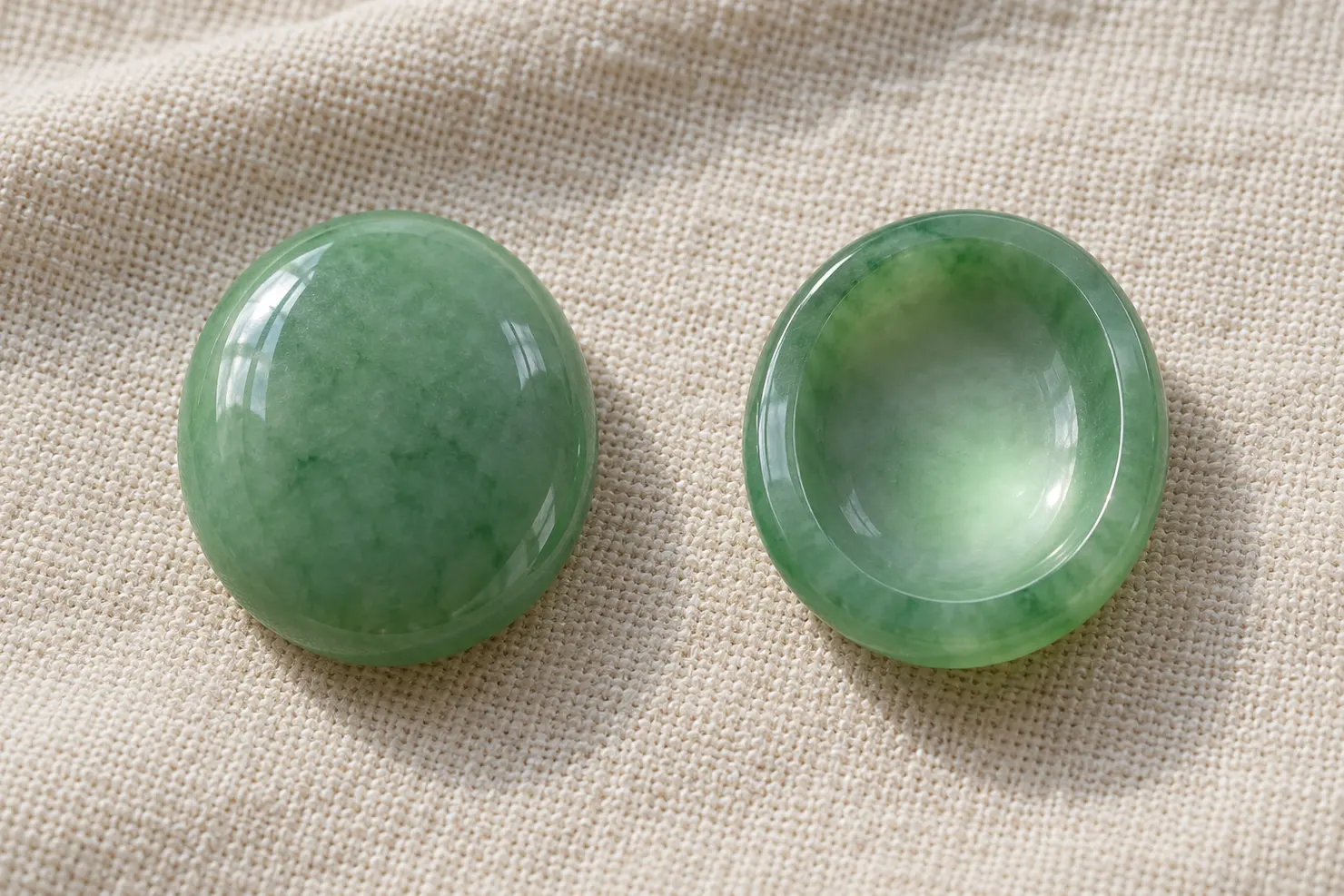
Flat back, domed back and closed settings
| Back | What it does to the look | What to ask |
|---|---|---|
| Flat back (平底) | Neutral; the stone looks as it is | Nothing special; check the back for cracks |
| Domed back (凸底 / 双凸) | Back is rounded too; more material and weight; often a sign the cutter kept everything | How thick is it in total? Will a setting fit it? |
| Hollowed back (挖底 / 掏底) | Brighter, more translucent look; less weight | Is the back hollowed, and how deep? Photo of the back, please |
| Thin stone over a closed back (包底) | Metal behind the stone reflects light; a thin stone can look brighter and greener | How thick is the stone? Photos before setting? |
| Foil or colored backing in a closed setting | An old trick: silver foil or a green layer behind the stone adds sparkle or color | Is there anything behind the stone? Can the setting be opened? |
A closed setting can hide all of these: a hollowed back, a thin stone, a foil, a crack, even a glued stone. That does not make every closed back a trick. Closed bezels protect thin stones and are common in older jewelry. But it means you are trusting what you cannot see.
What to do:
- Buy loose, or with an open back, where you can. A loose stone can be seen from every side, measured and weighed.
- For a set piece, ask for photos of the back, and of the stone before it was set if they exist.
- If you are having a stone set, ask the workshop to photograph it loose, with its measurements and weight, before setting.
More on open and closed backs is in the jadeite ring guide, and on settings and what gold can hide in gold-set jadeite.
How do I read a cabochon's size?
Cabochons are measured in millimeters as length × width × thickness, for example 15.2 × 12.1 × 6.3 mm. The first two give the face size; the third is the depth from the top of the dome to the base.
Thickness changes everything. Two stones with the same face can differ a lot in weight, look and value. A deep one shows richer color and the glow described above; a thin one looks paler and is cheaper, even if its face is just as big. That is why listings that give only the face size, or only a photo from the top, leave out half the story.
On a certificate:
- Dimensions are usually listed as length × width × thickness in mm. For a set piece, they may describe the whole piece, not the stone.
- Weight is given in grams or carats (1 carat = 0.2 g). For a set piece it is usually the total weight, metal included.
- The photo shows the face. Check that the outline and color match the stone in front of you.
See how to verify a jadeite certificate for checking the report number and conclusion.
As a rough guide, many ring cabochons are about 10 to 15 mm long. Smaller stones often go into earrings or rings with a diamond halo; larger ones, from about 18 to 20 mm, usually look best as pendants. Hands differ, so try the size against your own finger. Earrings need a matched pair, and two stones that match in color, translucency and size are harder to find than one.
What should I know about color in a cabochon?
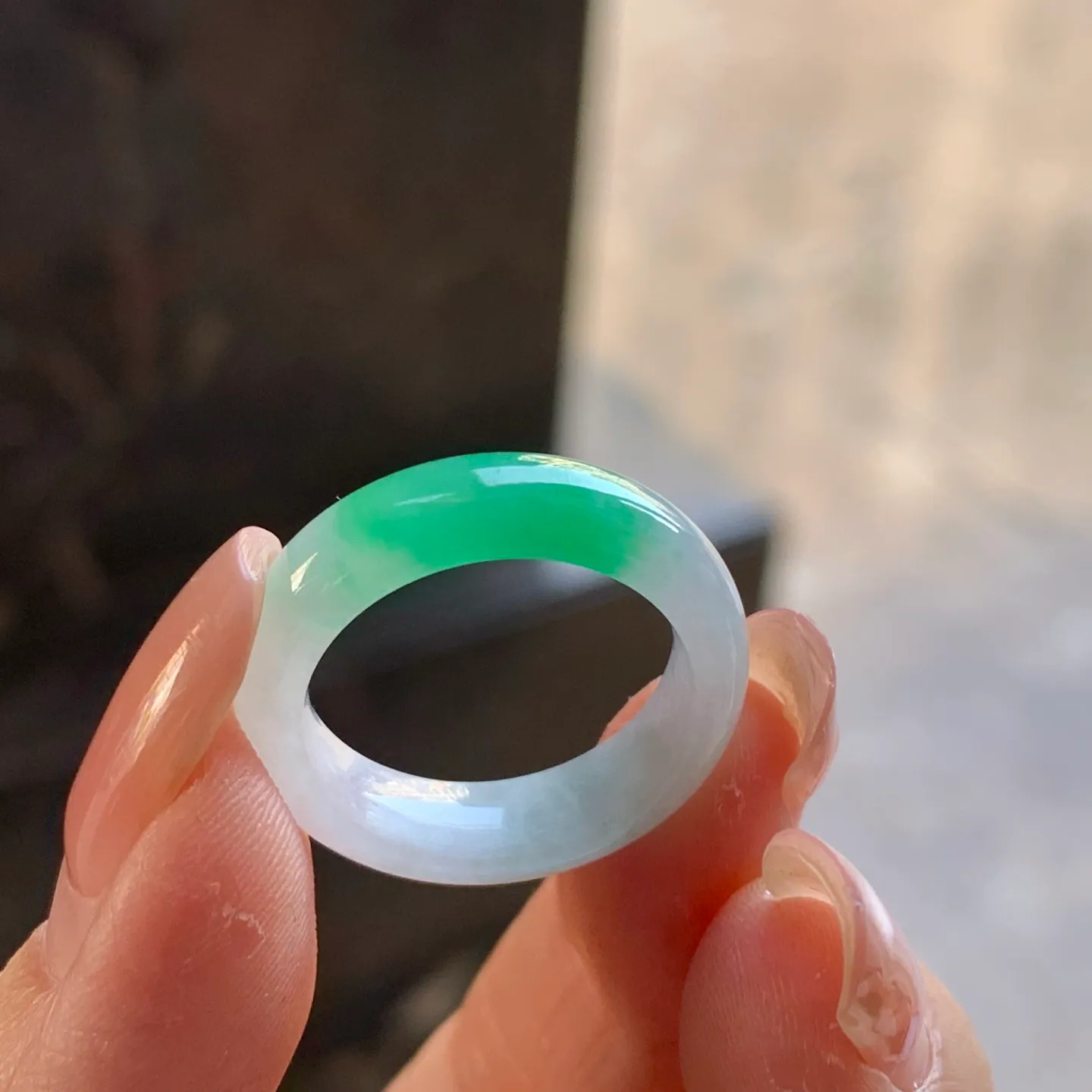
- Full color vs partial color. 满色 means the color runs through the whole stone. 局部 means color in only part of it, such as one end or a patch. Full, even color is valued far more.
- Center vs edge. In a domed stone, the thick center usually looks darker and the thin edges paler. That is normal. What to watch for is a stone that is deep green in the middle and nearly white at the rim, which can mean the color is only in a small area.
- Color only on top. Some rough has color in a thin layer. A cutter puts that layer at the top of the dome, so the stone looks green face-up and whitish from the back or side. Always ask for side and back views.
- Looking different once set. A setting changes the color. Yellow gold adds warmth and can make green look deeper, and a dark stone can look darker still once its back is closed. Most gold-set jadeite is set in China, usually in 18K gold.
For how fine green is graded, see imperial green jadeite.
What mistakes do buyers make, and how do sellers word things?
| What you see or hear | What it can mean | What to do |
|---|---|---|
| "Full green" (满绿) | Sometimes the green is only on the top layer or one side | Ask for side and back photos in daylight |
| Photos taken through a loupe or with a light behind the stone | Backlight makes almost any stone look more translucent and greener | Ask for daylight photos with no light behind it |
| "Can be set" (可以镶) | Often said of a stone with a crack, meaning the setting will cover it | Ask directly: is there a crack, and where? |
| "A small line, it doesn't matter" | May be a crack, not a harmless grain line | Ask for a flashlight photo from the side |
| Big face, low weight | Thin stone or hollowed back | Ask for thickness, weight and a side photo |
| A very bright stone in a closed setting | Possibly a thin stone, a hollowed back or a foil behind it | Ask what is behind the stone |
There is also a rare imitation: the doublet or triplet (二层石 / 三层石). A doublet is a thin slice of real jadeite glued onto a cheaper base. A triplet has a clear top, a green layer or glue in the middle and a base. They are uncommon, but they turn up among imitation cabochons, usually hidden in a closed setting. Look at the side with a loupe for a straight glue line around the stone. For other materials sold as jadeite, see jade look-alikes.
Two more common mistakes: judging a cabochon only from a face-up photo, and comparing two stones by face size alone.
Practical checklist
- Look in daylight near a window first, then under a flashlight.
- Judge texture and translucency, then color.
- Look from the side at eye level: is the dome full or flat?
- Turn it over: flat, domed or hollowed back? Is anything behind it?
- Check the outline for symmetry and the edge for chips.
- Shine a flashlight from the side to look for cracks; a crack stops the light in a line.
- Tilt it under a window reflection to check the polish.
- Get length × width × thickness and the weight, and compare weight with size.
- Ask for a certificate stating natural (Type A) jadeite, and check that the photo matches.
- For set pieces, ask for photos of the back and, if possible, before setting.
On JadeiteHub, listings use real photos from the seller, and some include video. Every sold piece is checked against its certificate before it ships, travels with insured shipping, and is fully refunded if it does not match the description.
FAQ
Is a thicker jadeite cabochon better?
Usually, yes, for the same face size and material. A full, deep dome shows richer color and more glow, and needs more rough to cut. But a very dark stone can look blackish when too thick, which is why some are hollowed underneath.
What is 挖底 (a hollowed back), and does it mean the stone is fake?
No. 挖底 means the underside was ground into a shallow bowl to make dark color look brighter or to reduce weight. The jadeite is still natural, but the stone has less material than a solid one of the same size, so it should be disclosed and priced accordingly.
Should I buy a cabochon loose or already set?
Loose, if you can. You can see the back, measure it and weigh it. If you buy it set, prefer an open back, and ask for photos of the back and of the stone before setting.
What size cabochon is good for a ring or a pendant?
As a rough guide, many ring cabochons are about 10 to 15 mm long, and stones from about 18 to 20 mm usually suit pendants. Try the size against your own finger, and remember that thickness matters as much as face size.
What is the difference between 蛋面 and 戒面?
戒面 is the general word for any small stone made to be set in a ring, pendant or earring, including saddle, pear, square and free-form shapes. 蛋面 is the domed oval or round cabochon, the most classic of them.