What Is White Jadeite? White Jade vs Nephrite and Fakes
Updated
White jadeite is jadeite with little or no color, from clear icy white to opaque milky white; pure jadeite is naturally white. But "white jade" can also be nephrite, such as mutton-fat Hetian jade, a different mineral with an oily rather than glassy luster. White is also the look most often faked by bleaching (Type B) and by quartzite or glass, so a lab certificate is the proof.
What is white jadeite?
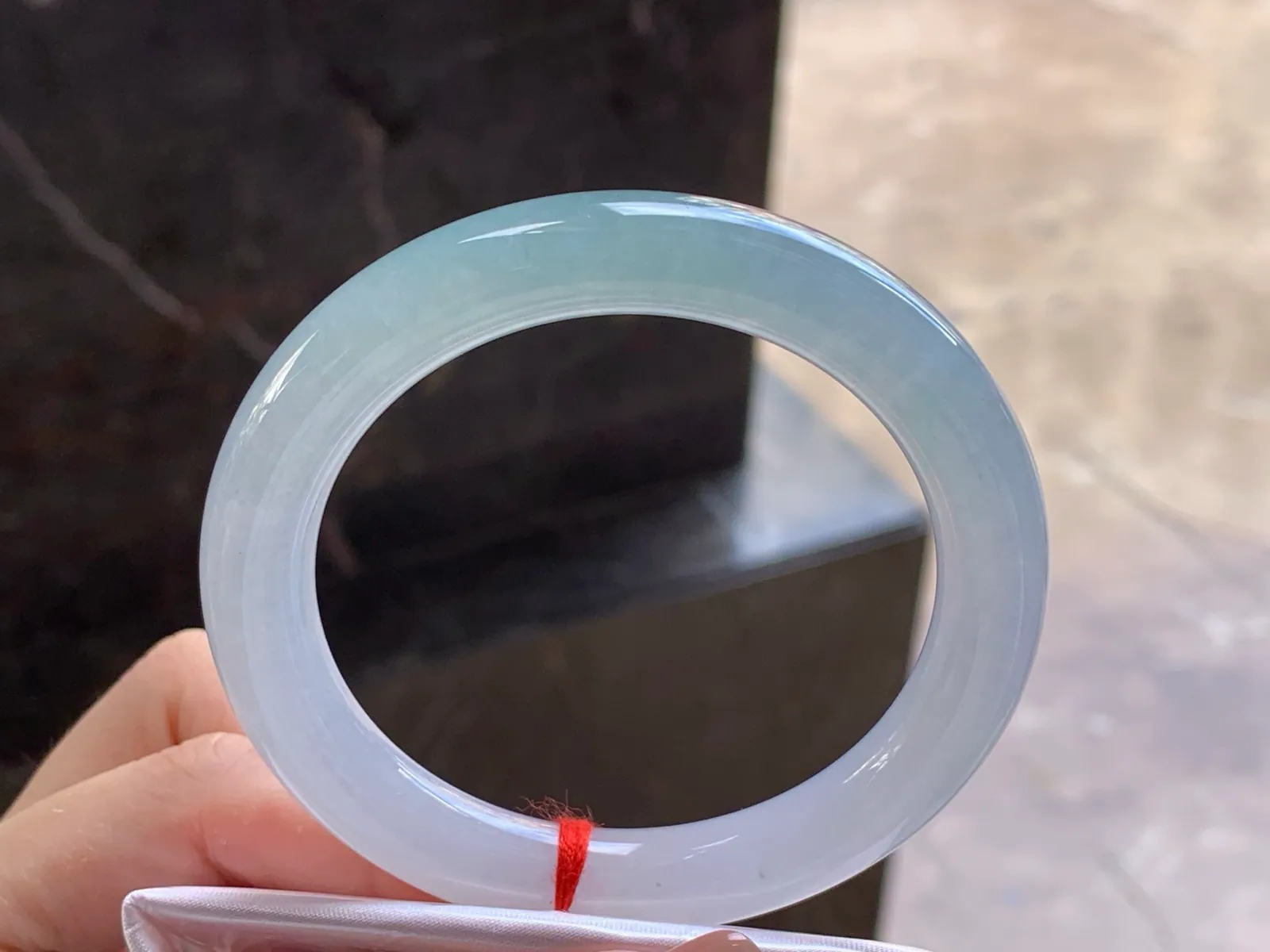
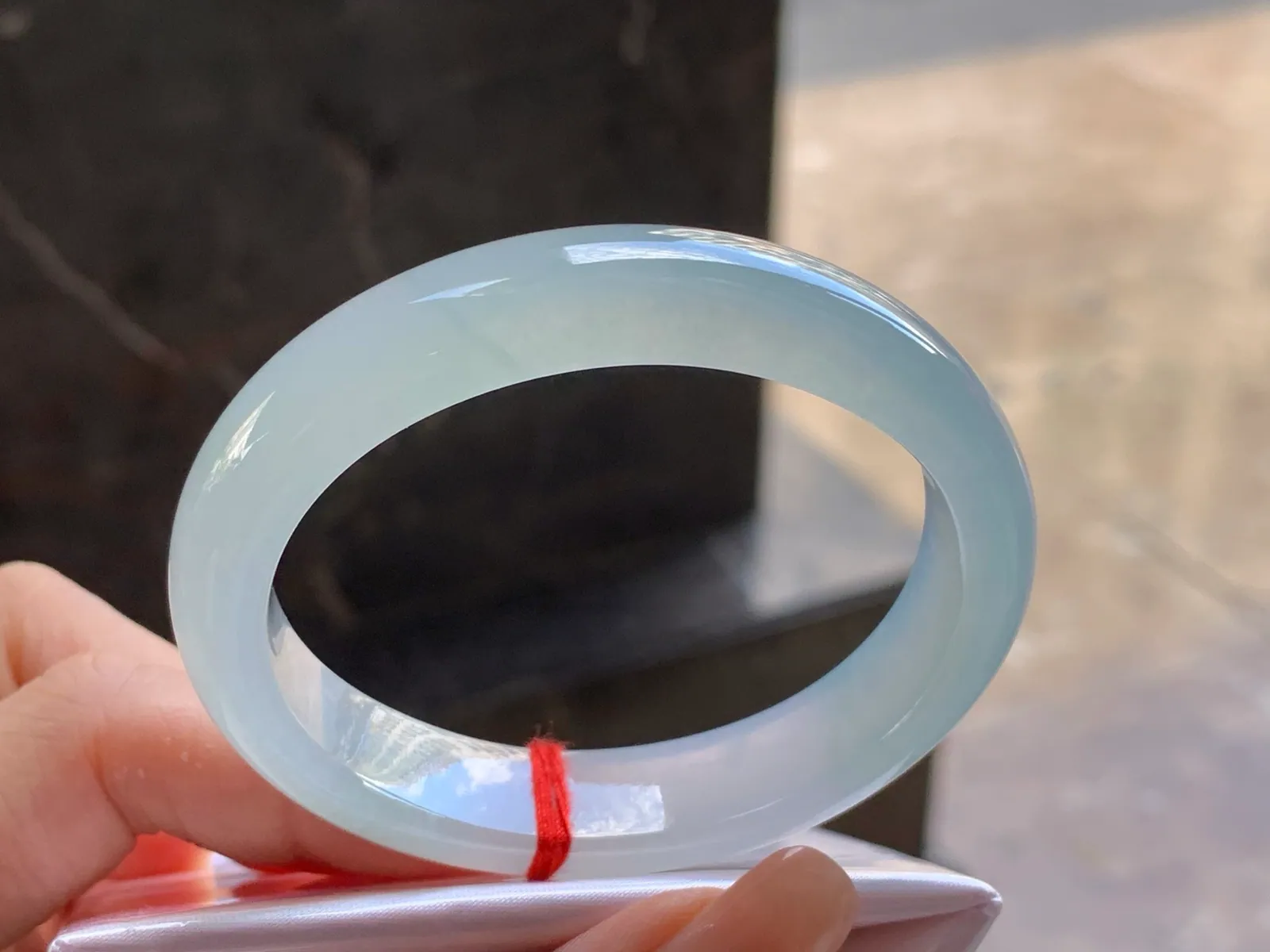
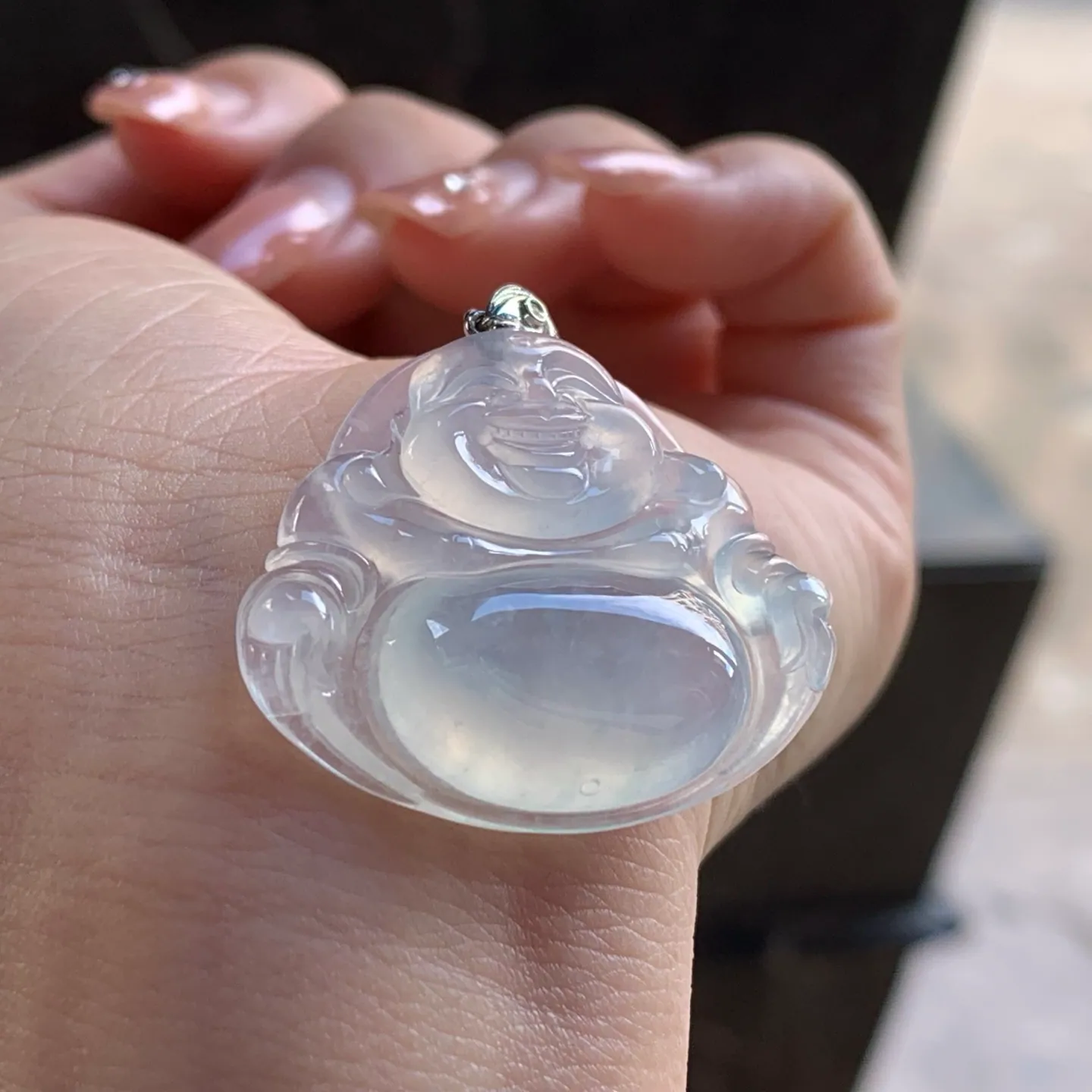
White jadeite is jadeite (翡翠) with little or no color, ranging from clear, ice-like and colorless to milky and opaque white. Pure jadeite is naturally white or colorless. Green, lavender and the other colors come from small amounts of other elements in the stone. So white is not a rare color of jadeite but its base color, and a large share of the jadeite that comes out of the ground is white or close to it.
Can jade be white? Yes. Both kinds of jade, jadeite and nephrite, come in white. That is the first thing to understand before you buy "white jade": the name alone does not tell you which mineral you are looking at. In many markets, white jade more often means nephrite. In Thailand, for example, หยกขาว (white jade) and หยกขาวมันแพะ (mutton-fat white jade) usually refer to white nephrite, not to Burmese jadeite.
What kinds of white jadeite are there?
Dealers rarely just say "white". They describe how the white looks, and that description already tells you most of the quality.
| Trade name | Chinese | What it looks like | How the trade sees it |
|---|---|---|---|
| Colorless, glassy | 无色玻璃种 / 高冰 | Almost transparent, like clear glass or still water; often a soft glow that moves across the surface | The top of white jadeite; rare |
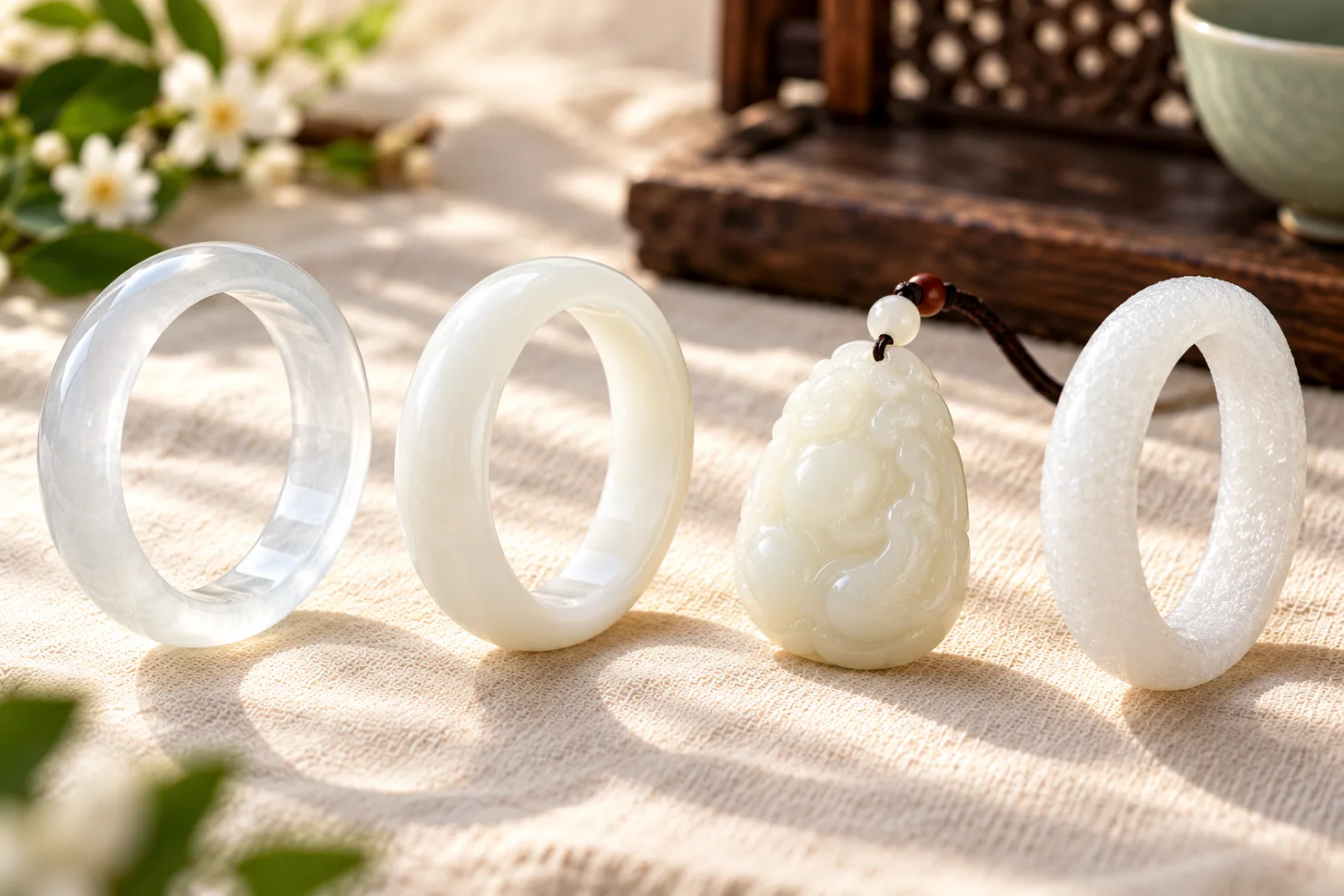
| Icy white | 冰白 / 白冰 | Clear to semi-clear with a slight milkiness, like ice | Popular; prized when even and clean |
| Glutinous white | 糯白 | Semi-translucent, soft and milky, like cooked sticky rice | Everyday middle range; a smooth, gentle look |
| Porcelain or dry white | 瓷白 / 干白 | Opaque, flat, chalky white; light barely gets in | The most affordable; "dry" (干) means it has no "water", no translucency |
| White with green | 白底青 | White, mostly opaque base with bright green patches | A classic, old-style material; judged by the green and how cleanly it sits in the white |
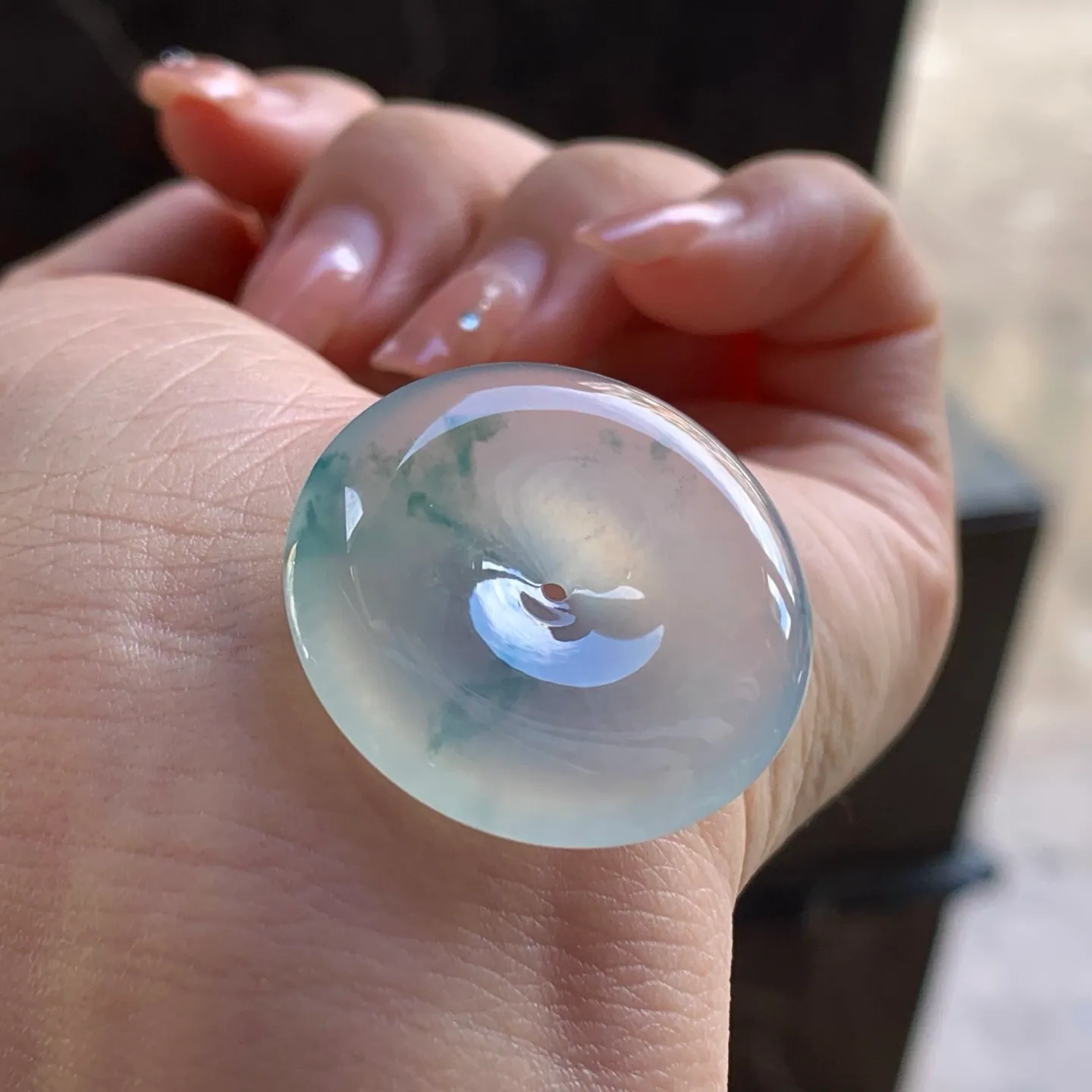
| White with floating color | 白底飘花 / 冰底飘花 | White or icy base with green or blue-green wisps ("floating flowers") | Valued for an attractive, balanced pattern |
Two cautions. These names are not standardized, so one seller's "icy" is another seller's "glutinous". And most certificates do not state them: a certificate confirms the material and whether it is treated, not whether it is "icy". For how texture and translucency are judged in general, see jadeite texture, translucency and color.
Is white jade jadeite or nephrite?
It can be either. Jadeite and nephrite are two different minerals that share the English word "jade".
- Jadeite is made of interlocking granular crystals. Polished, it has a bright, glassy luster, and it is dense (specific gravity about 3.33).
- Nephrite is made of tightly felted fibers. Polished, it has a softer oily or waxy luster, and it is lighter (about 2.95).
Nephrite's most famous white is mutton-fat white (羊脂白玉): dense, creamy, slightly oily white, sold in China as Hetian jade (和田玉). Mutton-fat jade is nephrite, not jadeite. Some sellers borrow the phrase for milky jadeite, which only adds to the confusion. A certificate settles it.
What "white jade" usually means depends on where you are:
| Market | Words you will see | What they usually mean |
|---|---|---|
| China | 白玉, 和田白玉, 羊脂玉 | White nephrite. White jadeite is called 白翡翠 or 冰白翡翠 |
| Thailand | หยกขาว, หยกขาวมันแพะ, หยกขาวเหอเทียน | Usually white nephrite. White jadeite is หยกพม่าสีขาว |
| Vietnam | bạch ngọc, ngọc Hòa Điền, ngọc mỡ cừu | Usually white nephrite; bạch ngọc is also used loosely for cheaper white stones. White jadeite is cẩm thạch trắng or phỉ thúy trắng |
| English | white jade | Either mineral, and many look-alikes |
Neither material is "better". Both range from inexpensive to very valuable. But they are priced by different rules, so you need to know which one you are being offered. For a full comparison, see jadeite vs nephrite.
How do you tell white jadeite from white nephrite?
Dealers check luster first, then the surface, then the inside, and only then the weight. You need a window or a lamp, a small white flashlight and a dim room.
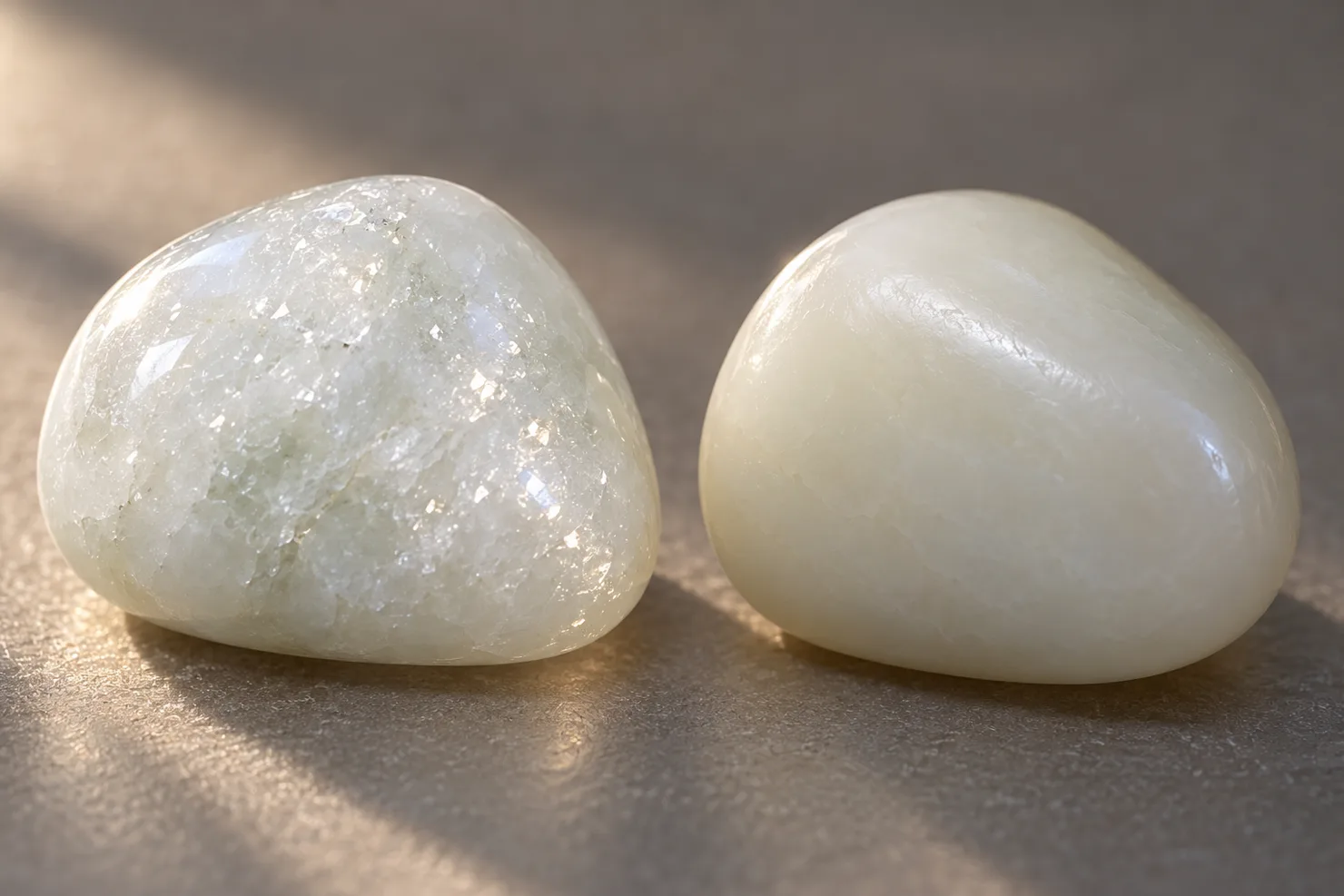
- Luster in reflected light. Turn the piece slowly under a window or lamp and watch the bright highlight on its surface. On jadeite the highlight is sharp and glassy. On nephrite it is soft and spread out, oily or waxy, a bit like fat. That oily look is where the name "mutton fat" comes from.
- Surface under a low-angle light. In a dim room, hold the flashlight almost flat against the surface, not behind it, and rock the piece a little. Jadeite often shows tiny glinting flashes where light catches the flat faces of its crystals. The trade calls this 翠性, and describes the flashes as "fly wings" or "snowflakes". Nephrite never shows them; its fibers give an even sheen. Polished jadeite may also show a faint, dimpled "orange peel" texture in the reflection, while nephrite looks smooth.
- Inside, with light shining through. Now put the light behind or against the side of the piece. Jadeite shows a grainy structure, white cotton flecks and sometimes fine healed lines. White nephrite looks even, cloudy and felt-like, with no grains; good mutton-fat nephrite lets light through as a soft, uniform glow.
- Weight. Jadeite is about 13% denser than nephrite, so a jadeite bangle feels heavier than a nephrite one of the same size. This only helps when you can compare two pieces.
- Certificate. A gem lab names the material: jadeite (翡翠) or nephrite (软玉, often written 和田玉). The refractive index on the certificate, about 1.66 for jadeite and about 1.61 for nephrite, tells the same story.
A limit to keep in mind: fine, highly translucent jadeite may show almost no flashes, because its crystals are too small to see. No flashes is not proof of nephrite.
| White jadeite | White nephrite (mutton-fat style) | |
|---|---|---|
| Mineral | Jadeite (pyroxene), granular crystals | Nephrite (amphibole), felted fibers |
| Luster | Bright, glassy | Soft, oily or waxy |
| Low-angle light | Often tiny crystal flashes (翠性); may show "orange peel" | Even sheen, no flashes |
| With light through it | Grains, cotton flecks | Even, cloudy, no grains |
| Translucency | From fully opaque to almost transparent | Usually semi-translucent to opaque |
| Weight | Heavier (about 3.33) | Lighter (about 2.95) |
| What the trade pays for | Translucency, clean and even white, no grey or yellow | Dense, fine, pure white with a strong oily luster |
The last row is the reason the difference matters. With white jadeite, more translucency usually means more value. With white nephrite, the trade is not looking for clarity at all, but for a dense, creamy, fine white. Two white bangles that look similar in a photo can be valued in completely different ways.
Which white stones are sold as white jade?
Several cheaper white materials are sold as "white jade", sometimes under their own names, sometimes not.
| Material | Names you may see | How it looks | Key clue |
|---|---|---|---|
| White quartzite | "White jade", 京白玉 | Even, sugary white; can look icy | Very uniform fine grains with no crystal flashes; lighter (about 2.65) |
| Glass | "White jade", "ice jade" | Milky or clear, perfectly even | Round bubbles, swirl lines, mold seams; shell-shaped chips |
| Marble | "Afghan jade", 汉白玉; in Vietnamese, đá cẩm thạch | Opaque, white, sometimes banded | Soft (about 3 on the Mohs scale), scratches easily, dull luster |
| White chalcedony | 白玉髓, "white jade" | Waxy, very even, translucent | No grain at all; lighter than jadeite |
| Pale serpentine | 岫玉, "new jade" | Yellowish white to pale green, oily | Soft and light; picks up scratches |
A note for Vietnamese readers: đá cẩm thạch means marble. Vietnamese buyers call jadeite cẩm thạch or ngọc cẩm thạch, but a piece described as "đá cẩm thạch" is the building and carving stone marble, a common white look-alike, not jade.
For more on look-alikes and the flashlight clues that expose them, see fake jade look-alikes.
How do dealers judge white jadeite quality?
With green jadeite, color does most of the work. With white, the eye goes straight to the base, so small faults show. Dealers usually look in this order:
- Tone, in daylight against white paper. A good white is clean. Many pieces are slightly grey (发灰) or yellowish (发黄, often a "yellow mist" near the surface). Warm shop lamps hide yellow; cool white LEDs make grey look icy. Daylight shows the truth.
- Translucency. How far light gets into the stone: icy, then glutinous, then dry. Judge it in normal light first; a strong flashlight behind a stone makes almost any jadeite look translucent.
- Cotton (棉). White flecks or cloudy patches. On white jadeite they are hard to see by eye, but obvious with a flashlight. Small, even, fine cotton is normal; heavy lumps cut translucency and value.
- Cracks versus stone lines. Shine the light along the surface. A crack (裂) often catches the light as a bright or dark line and may run to the surface. A stone line (石纹) is a healed natural vein inside the stone that does not break the surface.
- Glow (起光). On fine icy white material, a soft bluish-white light seems to float on the surface as you turn it. Dealers prize this. In the trade it is sometimes called 荧光, but it has nothing to do with fluorescence under a UV lamp.
- Evenness and finish. Even texture across the piece, good proportions and a bright polish.
| Feature | Higher value | Lower value |
|---|---|---|
| Tone | Clean, pure white or colorless | Grey cast, yellow mist, dirty patches |
| Translucency | Icy to glassy, with a glow | Dry, chalky, opaque |
| Cotton | Little, fine and evenly spread | Heavy lumps, especially in the middle of a bangle |
| Texture | Fine, no visible grain | Coarse grain visible to the eye |
| Cracks | None | Cracks you can see from the surface |
Common buyer mistakes: judging a piece only from photos taken on a black background under cool LED light, which makes ordinary material look icy; comparing white jadeite prices with green; and assuming that the cleanest, brightest white must be the best. That last one leads straight to the next section.
Why is white jadeite so often bleached (Type B)?
Bleached, resin-filled jadeite is called Type B. The acid removes the brown, yellow and grey stains that make natural white jadeite look dirty, and the resin fills the gaps the acid leaves. The result is exactly what buyers want in a white piece: a clean, bright, even base, often with green that seems to float in it. So white and white-with-green material is one of the most common targets of this treatment, and a very clean, bright white piece at a low price is the classic Type B profile.
Clues to watch for:
- Too clean. No grey, no yellow, no natural variation at all.
- Softer luster. Resin gives a waxy, plastic-like shine instead of a crisp glassy one.
- Acid-etch network. Under a low-angle light and a loupe, the surface of Type B often shows a fine network of tiny grooves, like a spider web or dried mud.
- Ageing. Over the years, the resin can yellow or lose its shine, so a bleached white bangle may slowly turn yellowish.
- UV lamp and tapping. Many resins glow under UV, and Type B is said to sound dull when tapped, but both give false results in both directions.
Natural Type A jadeite is usually finished with a light coat of wax, which is accepted practice. The trade disagrees on whether heavy waxing should be disclosed; on certificates, light wax is generally not treated as a treatment. Dyed green on a white base (Type C, often combined with B) is the other risk with white-with-green pieces.
Only a lab can confirm treatment. See how to spot treated jadeite and Type A vs Type B vs Type C jadeite.
Wording to read carefully:
| What the seller says | What it may hide |
|---|---|
| "Natural jade", "white jade" | No mineral named: could be nephrite, quartzite, glass or marble |
| "Icy white jade" | "Icy" describes a look, not a material; quartzite and glass can look icy |
| "Mutton-fat jadeite" | A nephrite term borrowed for milky jadeite or for something else |
| "Type A" with no lab certificate | A promise, not proof |
Is white jadeite valuable?
It depends entirely on the piece. Opaque, dry white is among the most affordable jadeite you can buy. Icy white with an even, clean base sits in the middle to upper range. Colorless, glassy material with a strong glow is rare, and fine pieces can be valued alongside good colored jadeite. Grey or yellow tones, heavy cotton and cracks pull value down at every level. In short, white jadeite is judged by its texture and translucency, not by the word "white".
What does white jade mean?
These are traditions and sayings, not promises of any effect.
- China. White jade stands for purity and integrity. The saying 冰清玉洁, "clear as ice, pure as jade", describes a person of clean character. In the five-element tradition, white belongs to Metal, and white jade is commonly said to suit people of the Metal and Water elements, while some advise Wood people against it.
- Vietnam. Cẩm thạch trắng is usually said to suit people of the Kim (Metal) and Thủy (Water) elements.
- Thailand. หยกขาว is usually linked with purity, calm and simplicity. Many people choose it simply because it goes with everything and looks good with gold.
- Everyday wear. White is quiet. It suits any clothing and skin tone, works in an office, and is an easy first piece of jadeite.
For more on these traditions, see jadeite meaning and beliefs.
How do I buy white jadeite safely?
- Ask which mineral it is, in writing: jadeite or nephrite. "White jade" is not an answer.
- Ask for a lab certificate that names jadeite and states no treatment. Check that the certificate number, weight and photo match the piece.
- Ask for photos in daylight on a white background, plus a photo or video with a flashlight, not only studio shots on black.
- Ask directly about grey or yellow tones, cotton and cracks. A seller who knows the piece can answer.
- Be careful with very clean, bright white at a low price. That is what bleaching is designed to produce.
- Buy where a mismatch means a refund.
On JadeiteHub, listings use real photos from the seller, and some include video. Every sold piece is checked against its certificate before it ships, travels with insured shipping, and is fully refunded if it does not match the description.
FAQ
Can jade be white?
Yes. Pure jadeite is naturally white or colorless, and nephrite also comes in white. So "white jade" can be either mineral, as well as a look-alike such as quartzite, glass or marble. A lab certificate names which one it is.
Is mutton-fat jade jadeite?
No. Mutton-fat white (羊脂白玉, หยกขาวมันแพะ) is a dense, creamy white nephrite, sold in China as Hetian jade. Jadeite is a different mineral with a glassier luster and a grainy structure.
Is white jadeite valuable?
It ranges widely. Opaque, chalky white is among the most affordable jadeite, while clean icy or colorless glassy white with a soft glow can be very valuable. Translucency, a clean tone, little cotton and no cracks drive the value.
Is very clean, bright white jadeite bleached?
Not always, but it is the look that bleaching (Type B) produces. Be careful when a perfectly clean white piece is cheap, look for a waxy luster and an etched surface, and rely on a lab certificate that states no treatment.
Will white jadeite turn yellow?
Natural Type A jadeite keeps its color in normal wear, though skin oil and dirt can make it look dull until it is cleaned. Resin in bleached Type B jadeite can yellow over the years.