What Is Black Jadeite? Mo Cui vs Black Chicken Jade
Updated
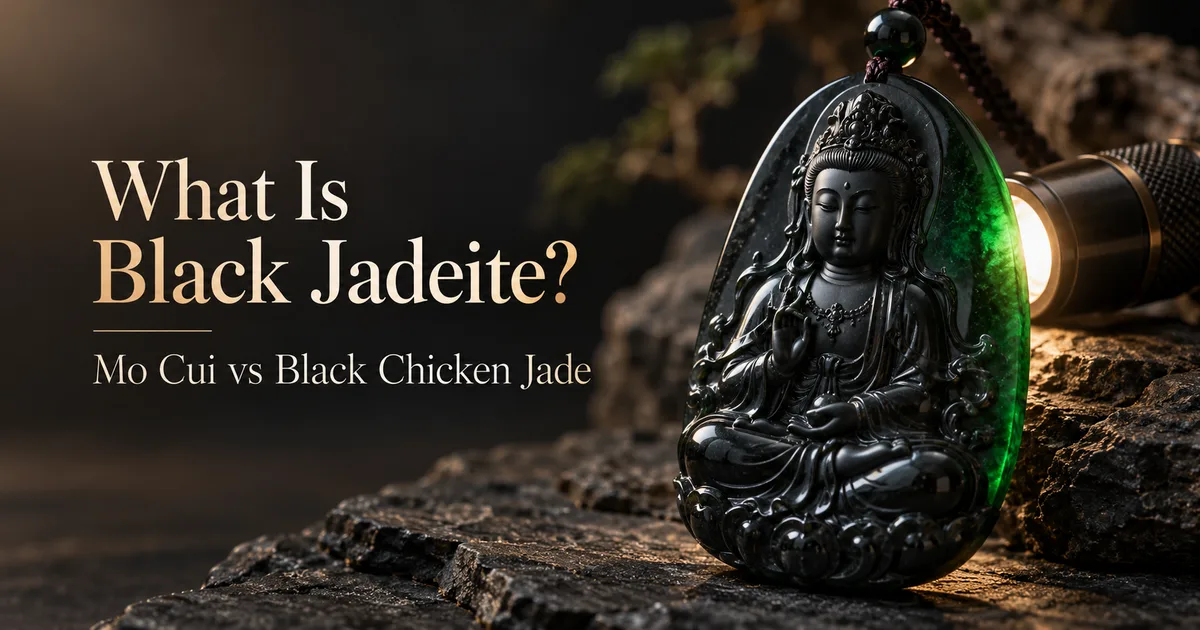
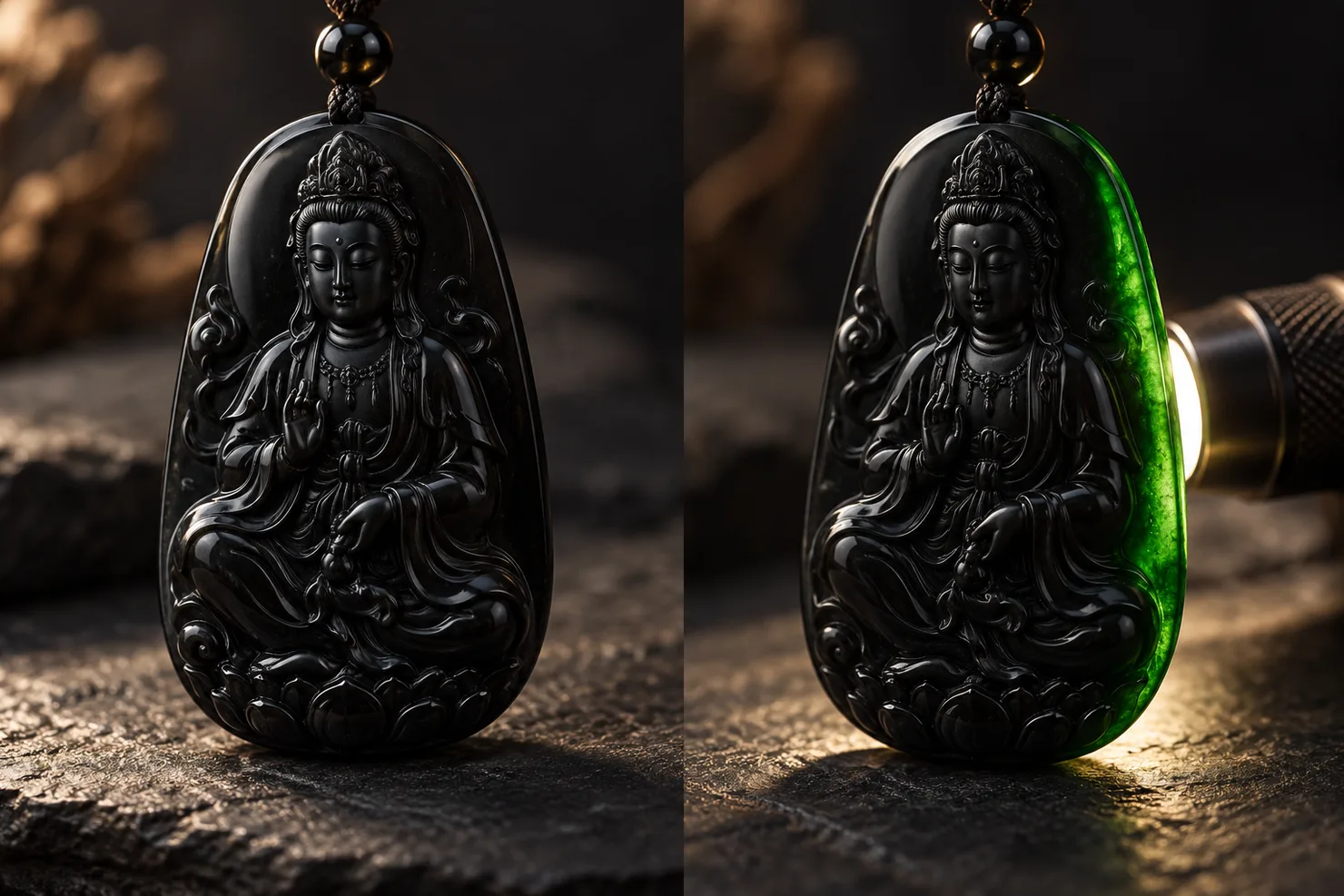
Black jadeite (墨翠, mo cui) is very dark green jadeite that looks black in normal light but glows deep green when a strong light shines through a thin edge. It differs from black chicken jadeite (乌鸡种), which has a grey-white base with black or dark grey spots. Black nephrite, obsidian, black glass and dyed onyx can look similar, so the flashlight is only a clue; a lab certificate naming the material is the proof.
What is black jadeite?
Black jadeite (墨翠, mò cuì, "ink green") is very dark green jadeite that looks black in normal light but glows deep green when a strong light shines through a thin edge. The green is so dense that, in reflected light, your eye reads it as black. Put a small flashlight behind a thin part and the light that comes through is green.
In the trade, "black jadeite" can mean two different things:
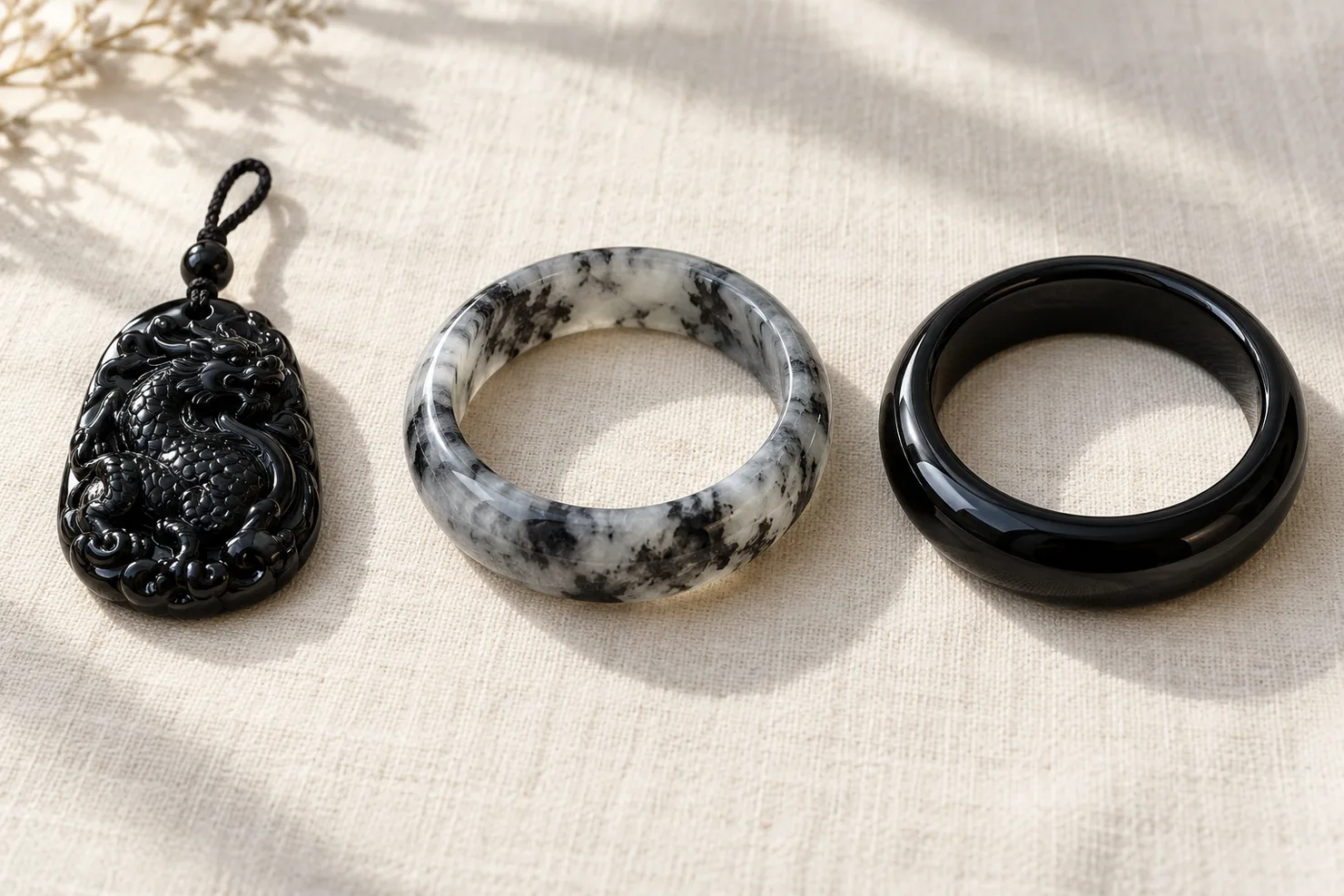
- Mo cui (墨翠): the solid, black-looking kind that turns green under a flashlight. This is what most sellers mean by black jadeite.
- Black chicken jadeite (乌鸡种, wū jī zhǒng): a white to grey base with black or dark grey dots and patches. The name comes from the black-skinned silkie chicken, which has pale feathers over dark skin.
A note on minerals. Much black jadeite is rich in omphacite, a close relative of jadeite from the same mineral family. Chinese national standards include omphacite-rich material under 翡翠 (jadeite), so Chinese certificates usually call mo cui jadeite. Some labs elsewhere may name it omphacite or omphacite jade instead. That is a naming difference, not a sign of a fake.
What is black chicken (wu ji) jadeite?
Black chicken jadeite has a light base, usually greyish white, with black or dark grey dots, flecks or cloud-like patches running through it. No two pieces have the same pattern. It is often made into bangles, bead bracelets and simple pendants, and many buyers like it for its ink-painting look.
Under a flashlight it behaves differently from mo cui. The light base lets light through, but the dark spots usually stay grey or black instead of turning green.
How do you tell mo cui from black chicken jadeite?
| Mo cui (墨翠) | Black chicken (乌鸡种) | |
|---|---|---|
| Color in daylight | Even black or near-black all over | Grey-white to grey base with darker areas |
| Where the dark color is | Fills the whole piece | Dots, flecks and patches |
| Under a flashlight | Thin edges glow deep green | Base lets light through; dark spots usually stay grey or black |
| Typical pieces | Carved pendants (Guanyin, Buddha, Zhong Kui), cabochons, rings | Bangles, bead bracelets, plain pendants |
| What buyers look for | Deep, even black; clean green glow; fine texture; good carving | An attractive pattern, clear contrast, a fine base |
Both are natural colors of jadeite. For how they fit among the other colors, see the jadeite colors guide.
Which black stones are sold as black jade?
"Black jade" is a loose name. Several black materials are sold under it, some honestly under their own names, some not.
| Material | Also called | How it looks | Under a flashlight | Specific gravity (typical) |
|---|---|---|---|---|
| Black jadeite (mo cui) | 墨翠 | Black with a soft, glassy to slightly oily shine | Thin edges glow deep green | about 3.3–3.4 |
| Black nephrite | 墨玉, black Hetian jade | Black, often with grey or white areas; oily shine | Graphite-black kinds stay black; very dark green nephrite can also glow green | about 2.95 |
| Obsidian | Volcanic glass | Very glossy, even black; sometimes a silver or rainbow sheen | Thin edges may look smoky grey or brown | about 2.4 |
| Black glass | Sold as "black jade" in cheap jewelry | Even black, glassy shine | Usually stays dark; look for bubbles and mold lines | varies, often 2.4–2.8 |
| Black onyx | Agate or chalcedony dyed black | Perfectly even, deep black, very smooth | Stays black | about 2.6 |
| Dyed or coated stones | No standard name | Black that looks painted on or unnaturally even | Color may sit in cracks or wear off at edges | depends on the stone |
These are textbook values; individual stones vary. Two things follow from the table:
- A green glow is a good sign, not proof. It rules out obsidian, glass and onyx, but very dark green nephrite can glow green too. See jadeite vs nephrite.
- Cheap "black jade" beads are often something else. Strings of perfectly even, glossy black beads at a low price are often onyx, obsidian or glass. That is fine if they are sold under that name.
Is Guatemalan black jadeite real?
Yes, Guatemala produces real jadeite, including black and very dark kinds. Much of it is sold as carvings, beads and jewelry in Guatemala and to collectors. Some of it is rich in omphacite, and some pieces show tiny metallic specks. It is a genuine material, but it does not always look or light up the same way as black jadeite from Myanmar, so judge each piece by its certificate, not by its place of origin. See where jadeite comes from.
How can I check if black jadeite is real?
- Shine a small white flashlight through a thin edge in a dim room. A deep green glow is a good sign. No glow at all, or a smoky grey or brown glow, means you should ask more questions.
- Look closely with a 10× loupe. Round bubbles or swirl lines point to glass. A shell-shaped (conchoidal) chip on an edge is typical of obsidian and glass. Color that sits only on the surface or collects in cracks points to dye or a coating.
- Feel the weight. Jadeite is dense, so a black bangle that feels light for its size deserves a closer look. This only works if you can compare it with a piece you know.
- Ask for a certificate that names the material. For mo cui, expect jadeite (翡翠) or, from some labs, omphacite, and check whether any treatment is noted. Glass, obsidian, onyx and nephrite will be named as what they are. See how to verify a jadeite certificate.
- Ask for photos in daylight and with a flashlight, and a video if the seller has one.
What affects the price of black jadeite?
There is no standard price for black jadeite. Two pieces of the same size can be far apart in value. These are the main factors:
| Factor | What buyers prefer |
|---|---|
| Blackness | Deep, even black in daylight, without grey or white patches |
| Green at the edge | When lit, a clean, even green glow, without dark spots or cracks showing |
| Fineness | Fine texture with no visible grain, and a polish with a bright shine |
| Carving | Clean lines; on Guanyin and Buddha pieces, a calm, well-proportioned face; careful finishing |
| Size and cracks | Larger pieces need more good material; visible cracks lower the value |
| For black chicken jadeite | An attractive, balanced pattern, clear contrast and a fine, clean base |
For how these factors work across all jadeite, see what determines jadeite price.
What does black jadeite mean?
These are traditions and sayings, not promises of any effect.
- China. Mo cui is often carved as Guanyin, the Buddha, Guan Gong or Zhong Kui, the demon queller of Chinese folk stories. With its dark, steady look and these guardian figures, it is widely described as a protective stone, said to ward off bad luck. In the five-element tradition, black belongs to Water; black jadeite is commonly said to suit Water and Wood, and some advise people whose element is Fire against it.
- Thailand. Black jade (หยกดำ) is commonly believed to protect the wearer and keep bad things away. Grey and black are also the colors of Wednesday night in the Thai birthday colors.
- Vietnam. Black jade (cẩm thạch đen) is usually said to suit people of the Water (Thủy) and Wood (Mộc) elements.
- Taboos. There are no fixed rules. Most "taboos" come from the five elements or from customs for Buddhist figures, such as treating Guanyin and Buddha pendants with respect and taking them off for bathing and heavy work.
For more on these traditions, see jadeite meaning and beliefs.
On JadeiteHub, listings use real photos from the seller, and some include video. Every sold piece is checked against its certificate before it ships, travels with insured shipping, and is fully refunded if it does not match the description.
FAQ
Is black jadeite real jade?
Yes. Black jadeite (mo cui) is very dark green jadeite, often rich in omphacite, a close relative of jadeite. But many stones sold as "black jade" are obsidian, onyx, glass or nephrite, so check the certificate.
Why does black jadeite turn green under a flashlight?
Its color is really a very dense green. In reflected light it looks black; when light passes through a thin edge, you see the green. Very dark green nephrite can do the same, so the glow is a clue, not proof.
Is black chicken jadeite the same as mo cui?
No. Mo cui looks evenly black and glows green under a flashlight. Black chicken jadeite (乌鸡种) has a grey-white base with black or dark grey spots, which usually stay dark under a flashlight.
Is black obsidian black jade?
No. Obsidian is natural volcanic glass. It is very glossy, lighter than jadeite and does not glow green; thin edges may look smoky grey or brown under a flashlight.
Does black jadeite have any taboos?
Only folk sayings. In the five-element tradition, black belongs to Water, so some say people whose element is Fire should avoid it. Guanyin and Buddha pendants are customarily treated with respect.