Jade Guan Yin Pendant: Meaning, Styles and How to Choose
Updated
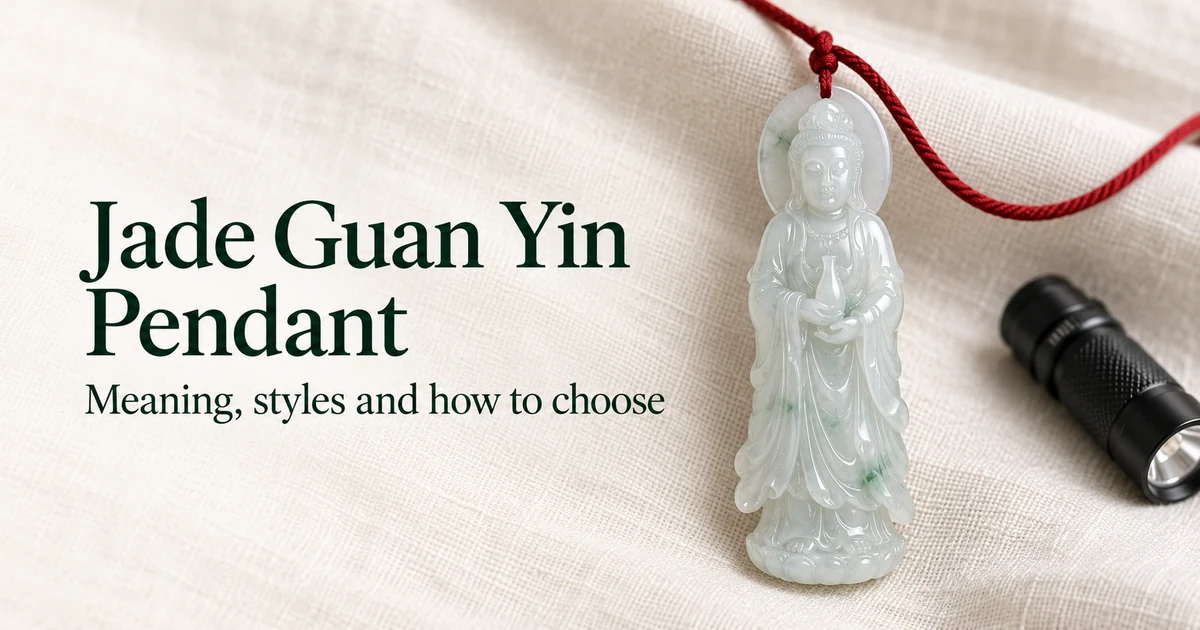
A jade Guanyin pendant is a jadeite carving of Guanyin (Quan Yin, Kuan Yin), the bodhisattva of compassion, traditionally worn for calm and as a sign of protection. Common forms are the standing Guanyin with a vase, the seated lotus Guanyin and the flat Guanyin plaque. Judge the face first (calm, symmetric, clean stone), then the hands and robe lines, and backlight every fold for cracks. Most low- and mid-price pieces are machine carved. Buy with a lab certificate that says natural (Type A).
Who is Guanyin, and why is she carved in jade?
Guanyin is the bodhisattva of compassion in Chinese Buddhism, and she is one of the two figures most carved in jadeite pendants, alongside the laughing Buddha. Her full Chinese name, 观世音 (Guanshiyin), means "the one who perceives the sounds of the world": she is said to hear the cries of people who call on her.
In Indian Buddhism she began as Avalokiteśvara, usually shown in male form. Over the centuries in China she came to be shown mostly as a gentle, feminine figure in flowing robes, and that is the Guanyin most people know today. Strictly she is a bodhisattva, not a Buddha, which is why careful sellers say "Guanyin pendant" rather than "Buddha pendant", although many people use both.
Her names change from market to market, and so do the search terms:
| Language | Name for Guanyin | How people ask for the pendant |
|---|---|---|
| English | Guanyin, Guan Yin, Quan Yin, Kuan Yin, Kwan Yin | jade Guan Yin pendant, jade Quan Yin necklace |
| Chinese | 观音, 观世音菩萨, 观音菩萨 | 翡翠观音吊坠, 翡翠观音牌 |
| Vietnamese | Quan Âm, Quan Thế Âm Bồ Tát, Mẹ Quan Âm, Phật Bà Quan Âm | mặt Quan Âm cẩm thạch, mặt Mẹ Quan Âm |
| Thai | เจ้าแม่กวนอิม (Chao Mae Kuan Im) | จี้หยกเจ้าแม่กวนอิม, จี้หยกพระแม่กวนอิม |
This guide goes deep on Guanyin only. For the laughing Buddha, Thai-style Buddha images, consecration and gold framing, see our wider guide to jade Buddha pendants.
What does a jade Guanyin pendant mean?
Traditionally, a Guanyin pendant stands for compassion, calm and peace of mind, and many wearers also see it as a sign of protection and safe travels. Those are beliefs and wishes, not effects: the jade does not do anything because of the figure carved on it. For many buyers it is first a religious image and a reminder to be kind, and only second a piece of jewelry.
You will hear the Chinese saying 男戴观音女戴佛, "men wear Guanyin, women wear Buddha". The usual explanation is that Guanyin's calm softens a man's temper. In real shops the saying is mostly ignored: many women choose Guanyin because they are devoted to her, and many men wear a laughing Buddha. In Thailand and Vietnam people choose by faith and taste. If you like a Guanyin, wear a Guanyin.
Which Guanyin styles and poses are most common?
Carvers work from a set of traditional forms. The pose and what she holds tell you which form it is, so it is worth knowing them before you talk to a seller.
| Style | Chinese trade name | How to recognise it | What it is traditionally associated with |
|---|---|---|---|
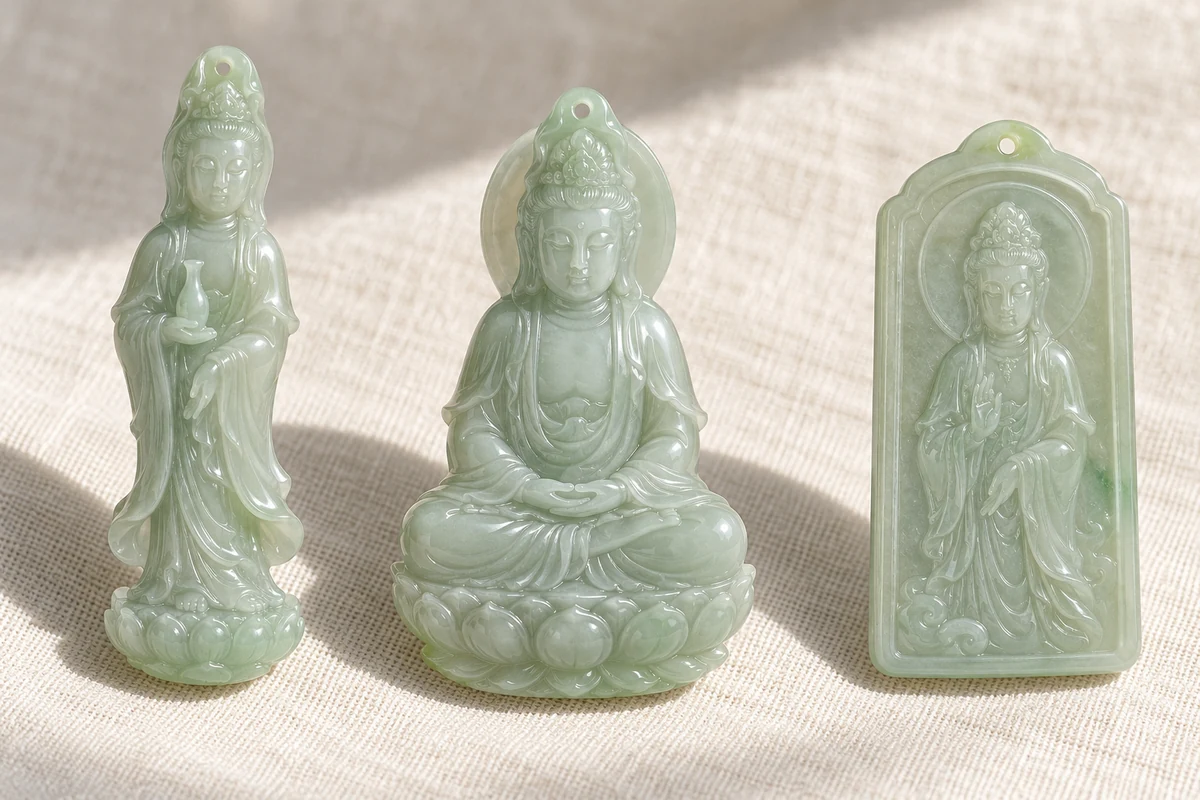
| Standing Guanyin with vase | 站观音, 净瓶观音 | Upright, slim figure holding a small vase of pure water, often on a lotus or cloud base | Mercy, purity; the most common pendant form |
| Willow branch Guanyin | 杨柳观音 | Holds a willow sprig, sometimes together with the vase | Healing and relief from suffering, in Buddhist tradition |
| "Dripping water" Guanyin | 滴水观音 | Vase tilted downward with drops falling from it | Sprinkling blessings (甘露, "sweet dew") on the world |
| Seated lotus Guanyin | 坐莲观音 | Seated cross-legged on an open lotus, hands in the lap or raised | Calm, meditation; a compact, durable shape |
| Guanyin at ease | 自在观音 | Seated with one knee raised, an arm resting on it | Ease and freedom from worry |
| Thousand-armed Guanyin | 千手观音 | Many arms fanning out behind the body | Associated with those born in the year of the Rat in Chinese birth-year custom |
| Guanyin with a child | 送子观音 | Holds or sits with a small child | Traditionally given to couples hoping for a child |
| Guanyin plaque | 观音牌 | A flat plaque with Guanyin in low relief inside a frame, often with a decorated top (牌头) | Same figure, in a quieter, more formal format |
Guanyin plaque or carved figure: which should you choose?
Choose a plaque if you want the colour and translucency to show and a pendant that sits flat; choose a carved figure if you love the carving itself. Dealers price them differently because they use the stone differently.
| Guanyin plaque (观音牌) | Carved figure (立体观音) | |
|---|---|---|
| How the stone is used | A thick, even slab with a shallow relief; much of the surface stays smooth | Material is cut away to free the figure; folds, hands and vase are deep |
| What it shows off | Colour, translucency and a clean surface | The carver's skill and the shape |
| What it can hide | Less: big smooth areas show every flaw | More: folds and hollows hide cracks and cotton |
| Feel on the chest | Flat, steady, a little heavier | Lighter, can turn over on a cord |
| Durability | Sturdy; the edge and the top decoration are the weak points | Thin fingers, willow branch and neck chip more easily |
| Who tends to choose it | Buyers who want a clean, formal piece | Buyers who like detail, or a lower price for the same look |
Clean, fine material is often kept as a plaque or carved lightly, because cutting it away would lose value. The trade saying 无绺不雕, "no flaw, no carving", is the other side of that coin: heavy carving on a figure is sometimes there to steer around cracks. It is not a rule that every carved Guanyin hides a crack, but it is a reason to look more carefully.
What makes a good Guanyin carving?
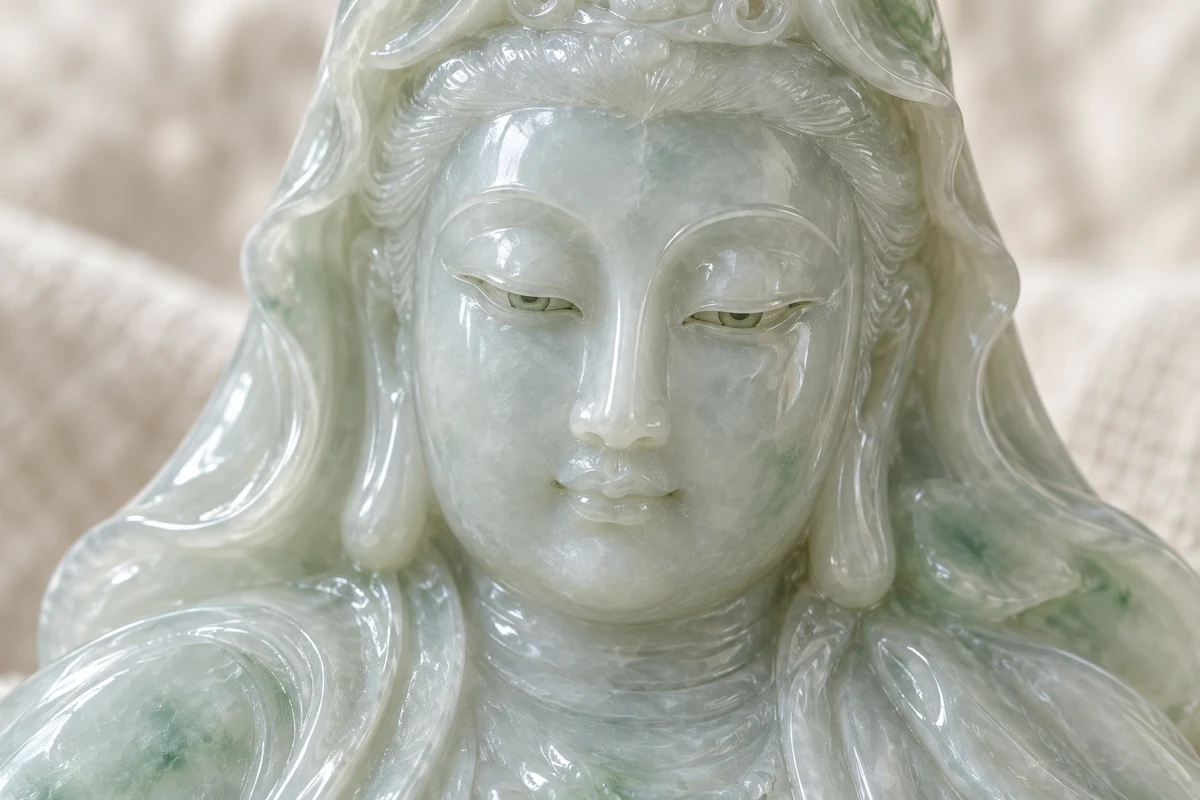
On a Guanyin, the face decides almost everything. Carvers call making the face 开脸, "opening the face", and a dealer looks there before looking at the colour.
A good Guanyin face is serene. The eyes are long and half closed, looking gently downward, and both are the same size and at the same height. The brows are smooth arcs. The nose is straight and centred. The mouth is small, with the faintest hint of a smile, and the earlobes are long. Seen at arm's length, the face should feel quiet and kind. Dealers describe a poor face in plain words: 斜眼 (crooked eyes), 苦脸 (a sad face), 凶相 (a fierce look), or a face that looks "dead" (呆板) because every line is the same depth.
| Part | Good work | Poor work |
|---|---|---|
| Face (开脸) | Symmetric eyes, smooth brows, a calm, kind expression; the face sits in clean stone | Uneven eyes, a crooked mouth, a blurred or flat face; a black spot, cotton or a crack across the face |
| Hands and fingers | Slim fingers that are separated, holding the vase or branch clearly | Mitten hands, fingers fused into the vase or the robe |
| Robe lines (衣纹) | Long, flowing folds of varied depth that follow the body | Stiff, evenly spaced grooves, all the same depth, like a comb |
| Proportion | Follows the carvers' rule of thumb 立七坐五: a standing figure about seven heads tall, a seated one about five; base level | A big head on a small body, a squeezed waist, a base that tilts |
| Vase, willow, lotus | Small details crisp and in proportion | Blobs that could be anything |
| Finish | Polished right into the hollows and around the fingers | Shiny high points, dull or gritty recesses |
| Back and bail hole | A finished, flat back; a centred hole with enough stone around it | A deeply hollowed back to brighten the front; a hole near the edge |
Colour placement matters too. Dealers like a face in clean, even white or icy stone, with any green falling on the robe, the vase or the lotus. A dark patch on the face is a real fault, even if the rest is good. When a carver deliberately puts the green where it belongs, for example on the willow branch, the trade calls it 俏色, and it adds value.
Is it hand carved or machine (CNC) carved?
Most low- and mid-price Guanyin pendants are carved by computer-controlled (CNC) machines, often with a little hand finishing on the face. That is normal and fine at a fair price. It only becomes a problem when a machine piece is sold as "pure hand carved" at a hand-carved price.
Signs that point to machine work:
- Identical copies. A tray or a livestream full of Guanyins with exactly the same face, pose and folds.
- Even depth. Every robe groove has the same depth and the same rounded bottom.
- Little undercutting. Fingers and the vase are joined to the body rather than freed from it.
- Colour that ignores the design. A machine follows a program, not the stone, so green often lands across the face or cuts through the figure at random.
- Fine parallel tool tracks in the recesses under a 10x loupe.
Signs of good hand work are the opposite: small differences between pieces, folds that change depth, undercuts around the hands, and a design that follows the colour. Many workshops do 机雕手修, "machine carved, hand finished": the machine roughs out the figure and a carver refines the face. Ask the seller which it is, and get the answer in writing. More on the signs in jade carving quality.
Which jade looks best for a Guanyin, and where do cracks hide?
White and icy jadeite are the classic choice for Guanyin, because a clear, cool stone suits the image of the "white-robed Guanyin" (白衣观音). Icy material with a few drifting green flecks (飘花) is popular, with the flecks reading as flowing robes. Pale green and evenly green Guanyins exist and cost far more for the same quality of stone.
Because a standing Guanyin is long and has many folds, cracks have plenty of places to hide:
- The neck, usually the thinnest part of a standing figure.
- Long robe folds running from shoulder to hem.
- The hands, vase and willow branch, which are thin and chip easily.
- The lotus petals and base edge, and the top decoration of a plaque.
- Around the drill hole, where a crack may start under the weight of the pendant.
Check with a small white flashlight in a dim room. Press it against the back and move it slowly along every fold. A crack stops the light and shows a sharp edge with a bright side and a dark side; a natural vein lets the light through and looks soft. If a line runs past the end of a carved fold, or shows on the back too, it is a crack, not a design line. Do not judge colour only from behind: a thin, backlit Guanyin looks greener and clearer than it will on the chest. How to tell cracks from veins and cotton is in jadeite cotton and cracks.
How do people in Thailand, Vietnam and China honour Guanyin?
Guanyin is honoured in all three markets, with different customs. These are things many people do, not rules.
Thailand. เจ้าแม่กวนอิม is revered in Thai-Chinese families and by many Thai Buddhists, with shrines and large statues in many provinces. Some people who are devoted to her do not eat beef, as a sign of respect; others do not follow this, and it is a personal choice. Many Thais take a new pendant to a temple or shrine to be blessed before wearing it.
Vietnam. She is lovingly called Mẹ Quan Âm ("Mother Guanyin") or Phật Bà Quan Âm, and statues of her stand at many pagodas. Many people visit a pagoda on her three festival days, the 19th day of the 2nd, 6th and 9th lunar months, and some have a pendant blessed (khai quang) there. Vietnamese buyers often say they "thỉnh" (invite) a Guanyin, not "mua" (buy) one.
China. People also "invite" (请) a Guanyin rather than buying one, and some have it consecrated (开光) at a temple. Whether to do so is a personal and religious choice. It does not change the stone: a crack or a treatment stays exactly as it was. Be careful with any seller who asks more money because a piece is "already consecrated"; our jade Buddha pendant guide covers that in detail.
How do you wear a Guanyin pendant respectfully?
Most etiquette around Guanyin comes down to one idea: treat the image with respect. These are common customs, and families differ.
- Wear it on the chest, on a neck cord or chain, not in a pocket, on a belt or below the waist.
- One main image. Many people wear Guanyin alone, or in the middle if they wear several pieces.
- Take it off for intimacy, and some people also before bathing or before visiting places they feel are unsuitable.
- Put it somewhere high and clean when it is off, such as a shelf or the family altar, not on the floor or the bed.
- Do not use it as a toy or a keychain, and avoid letting others play with it casually.
Some of these customs also protect the jade. Taking a pendant off for sport, heavy work, swimming and sleep keeps it away from the knocks that chip fingers and lotus petals, and keeps a cord from staying wet.
Cord, chain or setting: what suits a Guanyin?
A standing Guanyin is long, so it needs a bail or cord that keeps it upright and a chain strong enough for its weight.
| Option | Good for | Watch out for |
|---|---|---|
| Red or black cord | Light figures, daily wear, a traditional look | Frays and stretches; check it often, replace it when worn |
| Gold chain with a gold bail | Heavier figures and plaques | Metal rubbing in the drill hole can wear it; check the clasp |
| Gold top cap or bail (包头) | Protecting the weak top of a plaque | Whatever lies under the cap; inspect before setting |
| Full gold bezel on a plaque | Protecting the edge, a formal look | Hides the edge, where chips start |
| 925 silver bail or frame | A lighter budget, a white-metal look | Silver tarnishes and is softer than gold |
Gold-set jadeite is mostly made in China in 18K (75%) gold; every silver setting JadeiteHub sells is 925 sterling silver. See how to hang a jade pendant and silver vs 18K gold settings for more.
How do you avoid treated or fake Guanyin pendants?
Cheap Guanyin pendants are one of the commonest places for treated jade, because white and icy looks are exactly what bleaching produces. Look out for:
| What you see | What it may be | What settles it |
|---|---|---|
| Very clean, bright "icy" white at a low price | Type B (acid-bleached, resin-filled) jadeite | A lab certificate |
| Bright, even green on a cheap figure | Type C (dyed) jadeite | A lab certificate |
| Round bubbles, mould seams, many identical pieces | Glass | A loupe, then a certificate |
| Oily lustre, even spinach green or white, lighter in the hand | Nephrite, which is real jade but not jadeite | A certificate that names it |
| "Burmese jade, natural, grade A" with no paperwork | Anything | A certificate that says jadeite, natural (Type A) |
Seller talk to treat with care: "old-mine icy" (老坑冰种) with no certificate, "master carved" with no name you can check, "do not shine a torch on a consecrated Guanyin", and "grade A" when they mean "good quality", not untreated. See Type A vs B vs C jadeite and where to get jade tested.
What should you check before you buy a jade Guanyin?
- Name the style you want: standing, seated, at ease, dripping water or plaque.
- Look at the face first, in daylight and up close: symmetry, expression, and clean stone.
- Check the hands, vase and robe lines for chips and for crisp detail.
- Ask for a flashlight video along every fold, front and back, and around the drill hole.
- Ask: hand carved, machine carved, or machine carved and hand finished? Get it in writing.
- Ask for the size and thickness in millimetres and a photo next to a coin or ruler.
- Ask for a lab certificate that says jadeite, natural (Type A), and check that the photo, size and weight match.
- Choose the cord, chain or setting after you have inspected the piece.
On JadeiteHub we only list jadeite that comes with a lab certificate. Every sold piece is checked against its certificate at our inspection center before it ships, and if it is not as described you get a full refund. If a blessing matters to you, you can take your Guanyin to a temple or pagoda of your choice once it arrives.
FAQ
What does a jade Guanyin pendant mean?
Traditionally it stands for compassion, calm and peace of mind, and many wearers see it as a sign of protection. These are beliefs, not effects. For many buyers it is first a religious image and a reminder to be kind.
Can a woman wear a Guanyin pendant?
Yes. The Chinese saying "men wear Guanyin, women wear Buddha" (男戴观音女戴佛) is a custom, not a rule, and many women wear Guanyin. In Thailand and Vietnam people choose by faith and taste.
Is a Guanyin plaque or a carved figure better?
A plaque shows off colour and translucency and is sturdier; a carved figure shows off the carving and is usually lighter. Heavy carving can hide cracks, so backlight every fold on a figure.
How can I tell if a Guanyin pendant is machine carved?
Identical copies, grooves of the same depth, little undercutting around the hands, colour that ignores the design and parallel tool tracks under a loupe all point to CNC work. Most low- and mid-price Guanyins are machine carved, often with hand finishing on the face.
Should I take off my Guanyin pendant when bathing or sleeping?
Many people take it off for intimacy, and some also for bathing, as a sign of respect. Taking it off for sport, heavy work and sleep also protects thin fingers and petals from chips and keeps a cord dry.
Why do some Thais who wear Guanyin not eat beef?
Some people devoted to เจ้าแม่กวนอิม avoid beef as a sign of respect. It is a personal practice that many others do not follow, and it is not required to wear a Guanyin pendant.