Where to Get Jade Tested: Labs, Reports and What to Ask
Updated
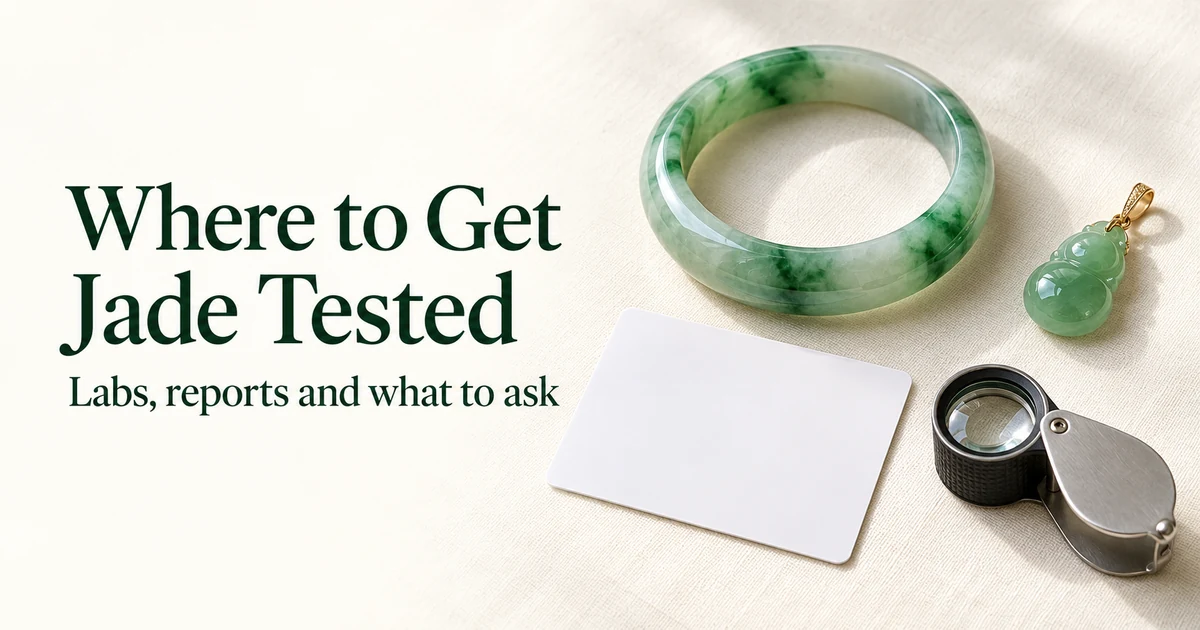
To know whether jade is natural, untreated Type A jadeite, take it to an independent gem lab that tests jadeite and issues a report you can look up on the lab's own website. Good choices are national or government-affiliated labs (such as GIT in Thailand or NGTC in China), major international labs such as GIA, and accredited independent labs. A lab measures refractive index (about 1.66) and density (about 3.33), looks through a microscope, and uses infrared (FTIR) to find resin (Type B) and spectroscopy to find dye (Type C). Testing lights, kits and home tricks give clues only. Fees and turnaround vary, so ask before you hand the piece over.
Where can I get my jade tested?
Take it to an independent gemological laboratory that tests jadeite and issues a written report you can look up on the lab's own website. A jeweler, a market dealer or an appraiser can give you an opinion, but only a lab with instruments can say whether jadeite has been bleached and filled with resin or dyed. Those treatments are what separate a Type A piece from a Type B or C one, and they are exactly what the eye and a loupe miss.
Here are the usual options, roughly from most to least widely recognized in the jade trade:
| Where | What you usually get | Watch out for |
|---|---|---|
| National or government-affiliated lab (for example GIT in Thailand, NGTC in China) | A numbered report with an online lookup | Drop-off hours, queues; use the lab's official address, not a branch someone names for you |
| Provincial or local testing centre (common in China) | A card or report carrying the CMA mark, often CNAS too | Quality varies; check accreditation and find the official site yourself |
| Major international lab (for example GIA) | An English-language report recognized in many markets | Shipping and insurance if there is no office near you; ask about time and fees |
| Lab run by a large jewelry company | Convenient, sometimes in the shop | Independence: the same company may sell jade. Check accreditation |
| Independent private lab | Often fast and local | Equipment and standards vary; ask what instruments they use |
| Jeweler or appraiser | An opinion or a value for insurance | Not an identification report; cannot detect resin by eye |
Searching "jade testing near me" or "jade appraisal near me" will mix all of these together. Note the difference in words: testing or identification tells you what the material is and whether it is treated. Appraisal puts a money value on it, usually for insurance or an estate. Most gem labs do the first and not the second. If you need both, get the lab report first and give it to the appraiser.
What does a gem lab actually do to test jade?
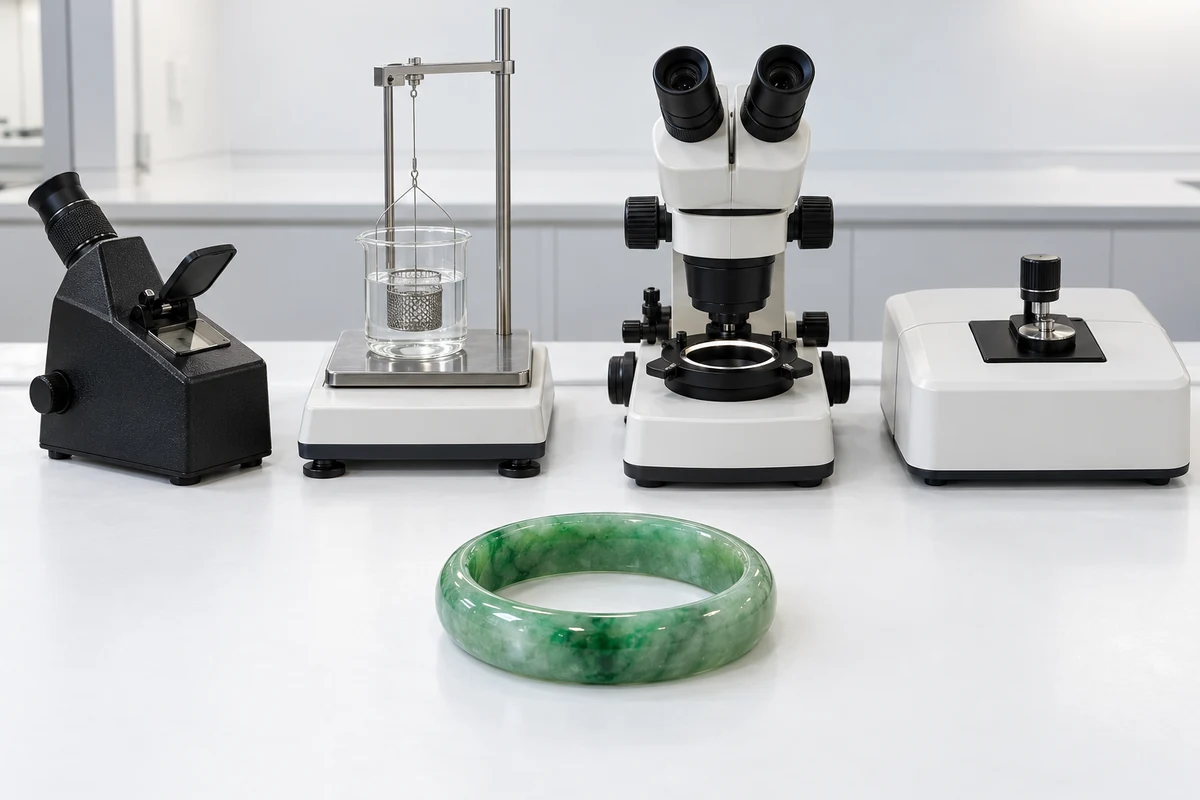
A lab combines several measurements, because no single test settles both questions: is it jadeite, and is it untreated?
| Test | What it measures | What it tells the lab |
|---|---|---|
| Refractometer | Refractive index; jadeite reads about 1.66 | Separates jadeite from nephrite (about 1.61), serpentine, quartzite and glass |
| Hydrostatic weighing | Specific gravity; jadeite is about 3.33 | Jadeite is heavier than most look-alikes (quartzite about 2.65). Only possible on unset pieces |
| Microscope | Texture, surface and color distribution | Interlocking grains; the crazed, etched surface acid leaves in Type B; dye gathered along grain boundaries and cracks in Type C |
| Infrared spectroscopy (FTIR) | How the stone absorbs infrared light | Resin and polymer show their own absorption peaks. This is the main test for Type B |
| Absorption spectrum (spectroscope or UV-Vis) | Which colors of light the stone absorbs | Natural chromium green shows narrow lines at the red end; dye usually shows a broad band. Jadeite also has a typical line near 437 nm |
| UV fluorescence | Glow under ultraviolet light | A clue only. Resin often glows chalky blue-white, but wax and some natural pieces glow too |
| Raman spectroscopy (some labs) | The mineral's own vibration pattern | Confirms the mineral when other readings are borderline |
The fluorescence point trips up a lot of buyers. A seller shining a UV torch on a bangle and saying "no glow, so it's Type A" proves nothing, and a faint glow does not prove Type B either. Read what UV fluorescence can and cannot tell you about jadeite before you rely on it.
Can a jade testing light, kit or machine tell if jade is real?
No. Home tools can rule out obvious fakes, but none can confirm untreated Type A jadeite. What the popular gadgets actually do:
- "Jade testing light" (a strong white flashlight). Shows texture, cracks, glitter in aventurine, bubbles in glass and dye collected in cracks. Useful, and every dealer carries one, but resin-filled jadeite can look clean and bright under it.
- UV torch. Shows fluorescence, which is a clue, not a verdict.
- Chelsea or "jade" filter. Some dyed green stones turn reddish through it, while natural jadeite stays green. Many dyes do not react, so a green result proves nothing.
- Pocket "gem testers" or "jade testing machines". Most are built to tell diamond from its simulants by heat or electrical conductivity. They are not designed for jade.
- Scratch, burn and "hair" tricks. Unreliable, and they can damage the piece.
If you want to narrow down what you have before paying for a lab, use the look-alike checks and the signs of treated jadeite. Then let the lab decide.
How do I choose a jade testing lab?
Choose by what the lab can prove about itself, not by its name on a shop wall.
| Criterion | What to look for | Why it matters |
|---|---|---|
| Accreditation | ISO/IEC 17025 accreditation from a national body (CNAS in China, VILAS in Vietnam, others elsewhere); the CMA mark on Chinese reports | Shows an outside body audits the lab's methods and equipment |
| Equipment | An infrared spectrometer (FTIR) and a spectrometer, not only a refractometer and a lamp | Without FTIR, resin filling cannot be ruled out with confidence |
| Wording of the report | Names the material and states whether treatment was detected | "Natural jade" with no mineral name or treatment line is not enough |
| Online lookup | Report number checkable on the lab's own website | Lets you, and a future buyer, confirm the report is real |
| Independence | Not owned by, or sharing an address with, the seller | A lab paid by the seller has a conflict of interest |
| Recognition | Known in the market where you might resell | A buyer in Bangkok or Guangzhou will trust some reports more than others |
| Mounted pieces | A clear answer on what they can and cannot test in a setting | Avoids a report that quietly skips the hard part |
| Fees and turnaround | Ask before you leave the piece; get a receipt | Prices and waiting times vary by lab and by item |
One warning that applies everywhere: find the lab's website yourself. NGTC staff have warned about fake websites that imitate lab lookup pages, and a seller's link or QR code can lead to one of them. Type the official address, or search for it independently, and then enter the report number.
What is the difference between a lab report, a small card and a seller's certificate?
Not everything called a "certificate" comes from a lab.
| Document | Who issues it | What it is worth |
|---|---|---|
| Full lab report | The lab | Photo, weight, measurements, test results and a conclusion. The strongest proof |
| Small card (credit-card size) | The lab | Shorter version, common for jadeite in Asia. Real proof if it is from an accredited lab and checks out online |
| Seller's "certificate", warranty card or "guarantee of authenticity" | The shop | A promise from the seller, not a test. Useful for returns, not for identification |
| Appraisal | An appraiser | A value estimate. Ask whether it relies on a lab report |
Whichever document you hold, it only counts if it matches the piece: same photo, same weight, same size. Our step-by-step guide on how to verify a jadeite certificate covers the checks.
What should I bring to the lab, and what should I ask?
Bring the piece clean and dry, any existing certificate, and the receipt. Do not soak it in oil or polish it with anything before testing.
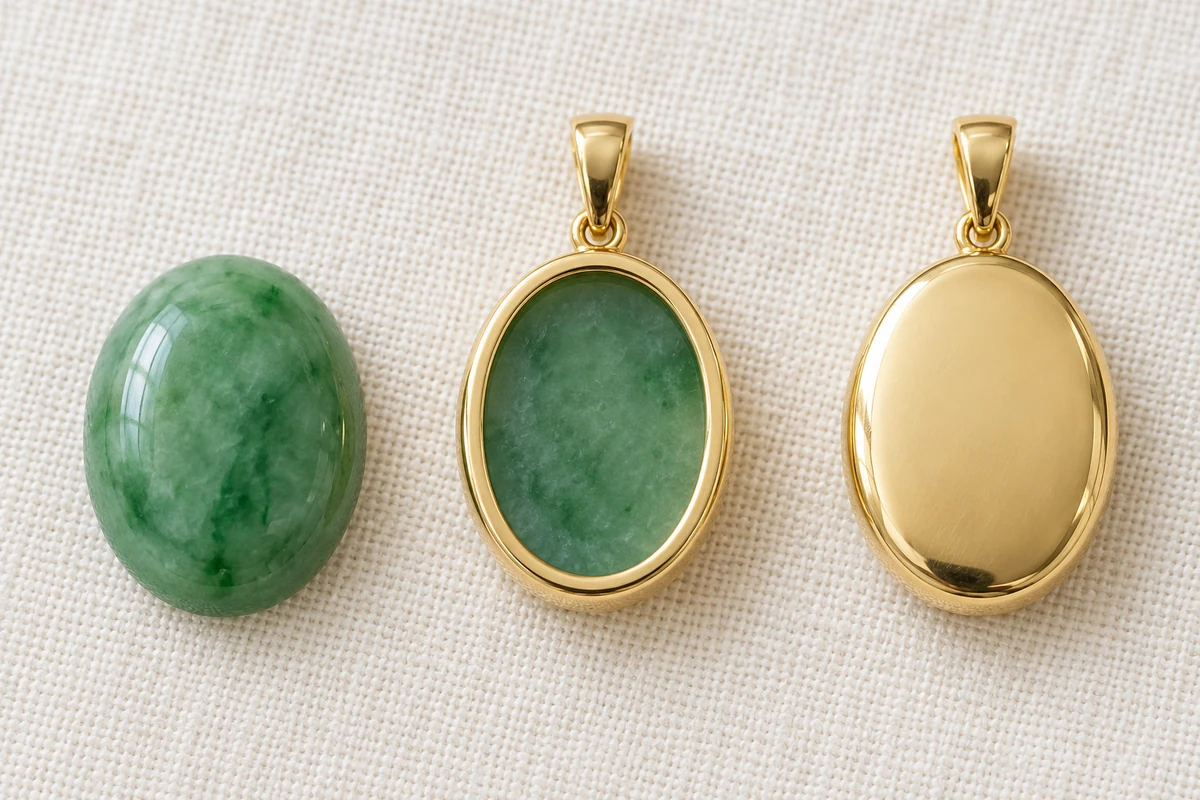
Whether the piece is set matters more than most people expect:
- Unset stones and bangles can go through every test, including density.
- Open-back settings still let light through the stone, so most tests work. Density cannot be measured because the metal adds weight.
- Closed-back settings and pieces wrapped in gold block light from passing through, which limits the infrared and absorption tests, and metal can hide the edges where dye and resin show. Some labs will test what they can and note the limitation; some will decline. Our guide to gold-set jadeite explains why so many pieces are made this way.
Questions worth asking at the counter:
- Is the lab accredited to ISO/IEC 17025, and for which tests?
- Do you run FTIR on every jadeite item, or only on request?
- Can you fully test this piece in its setting? If not, what will the report say?
- Will the report state the mineral name and whether treatment was detected?
- How can I check the report online, and what is the official web address?
- What is the fee, and how long will it take?
Can I get jade tested before I pay for it?
Often yes, and for an expensive piece you should try. Ways to arrange it:
- Test before payment. When buying expensive jadeite, you can agree with the seller that buyer and seller take the piece together to an independent testing lab that both sides accept, for re-testing.
- Buy with a written return window. Pay, take the piece straight to a lab, and return it within the window if the result does not match what you were told. Get the return terms in writing first.
- Accept an existing report, then verify it. Look up the report number on the lab's own site and check that photo, weight and size match the piece in your hand.
A seller who refuses all three for an expensive green piece is telling you something. Online, where you cannot hold the piece, the return window and a report you can verify yourself matter even more.
Should I test an old jade heirloom?
Yes, if you want to know what it is before you insure, sell or divide it. Age does not guarantee Type A: resin-filled jadeite has been on the market for decades, so a bangle bought long ago can still be treated. Do not try to "restore" the piece with oil or chemicals first. For what to expect and how to handle family pieces, see old jade heirlooms.
How do I read the result?
Look at the conclusion line first.
- "Jadeite" (翡翠) with no treatment noted: natural, untreated, what the trade calls Type A.
- "Jadeite, treated" (翡翠(处理)), "impregnated", "polymer" or "dyed": Type B, C or B+C. Still jadeite, but worth far less.
- Another mineral name (nephrite, serpentine, quartzite, glass): not jadeite at all.
The grades are explained in Type A vs Type B vs Type C jadeite. A lab report identifies; it does not grade color, translucency or value, and it does not state where the stone was mined unless the lab specifically offers origin work.
How does JadeiteHub handle testing?
JadeiteHub only lists jadeite that comes with a lab certificate. Before a sold piece ships, it is checked against its certificate at our inspection center, so the piece you receive is the one the report describes. If it does not match its description, you get a full refund. You are always welcome to verify the certificate number on the lab's official website yourself, or to take the piece to a lab of your choice.
FAQ
Where can I get my jade tested?
At an independent gem lab that tests jadeite and lets you look up reports online, such as a national lab (GIT in Thailand, NGTC in China), a major international lab such as GIA, or an accredited local lab. Choose one with ISO/IEC 17025 accreditation and an infrared spectrometer.
Can a jeweler tell if jade is real?
An experienced jeweler can often tell jadeite from obvious look-alikes, but cannot reliably see resin filling or some dyes. Confirming untreated Type A jadeite needs lab instruments such as FTIR.
Do jade testing lights or kits work?
They give clues only. A flashlight shows texture, cracks and dye in cracks; a UV torch shows fluorescence; a Chelsea filter catches some dyes. None can confirm Type A jadeite.
How much does jade testing cost?
It varies by lab, country, the type of report and the piece. Ask the lab for the fee and the turnaround time before you leave the piece, and keep the receipt.
Can jade be tested while it is set in gold?
Partly. Open-back settings allow most tests. Closed-back or gold-wrapped settings block light, which limits infrared and absorption tests, and density cannot be measured on any set piece. Ask the lab what the report will say.
Is a jade appraisal the same as a lab test?
No. A lab test identifies the material and any treatment. An appraisal estimates a value, usually for insurance. Get the lab report first.
What does a Type A result look like on a report?
The conclusion names the material as jadeite (翡翠 on Chinese reports) with no treatment noted. Words like treated, impregnated, polymer or dyed mean Type B or C.