Is My Grandmother's Jade Real? Old Jade Heirloom Guide
Updated
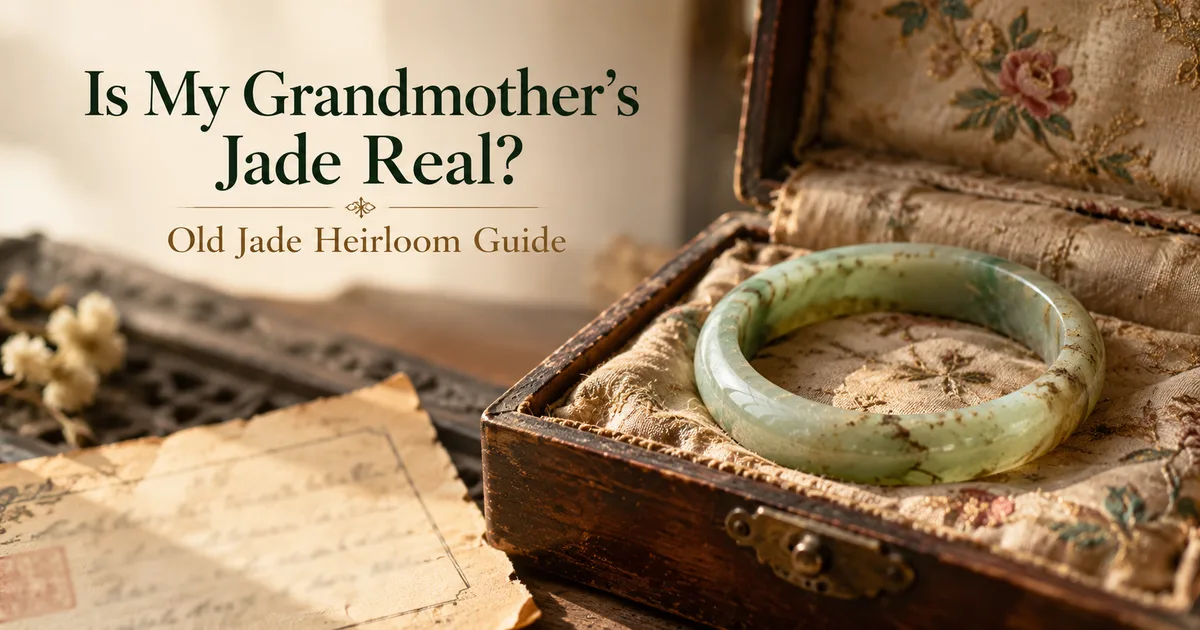
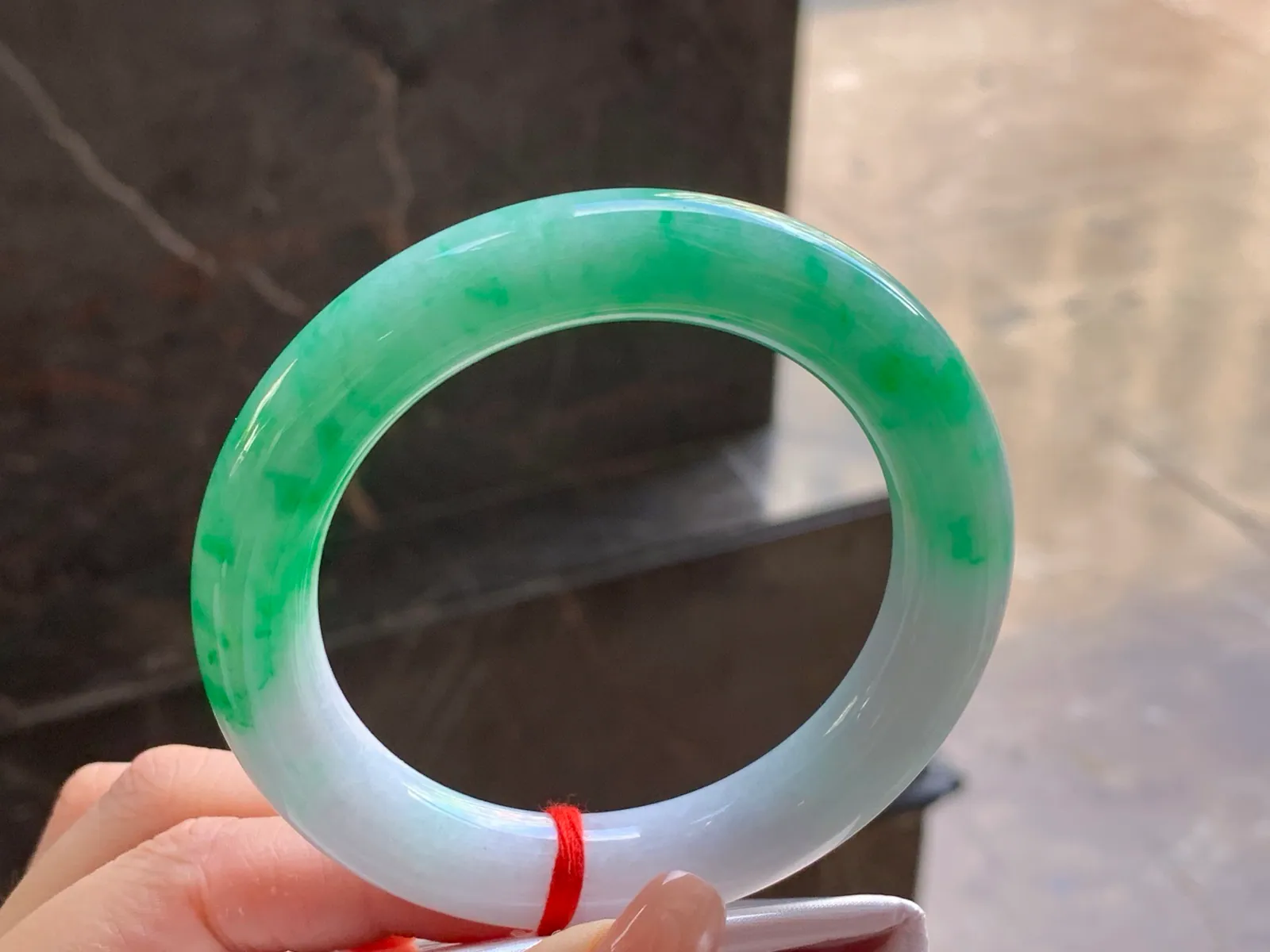
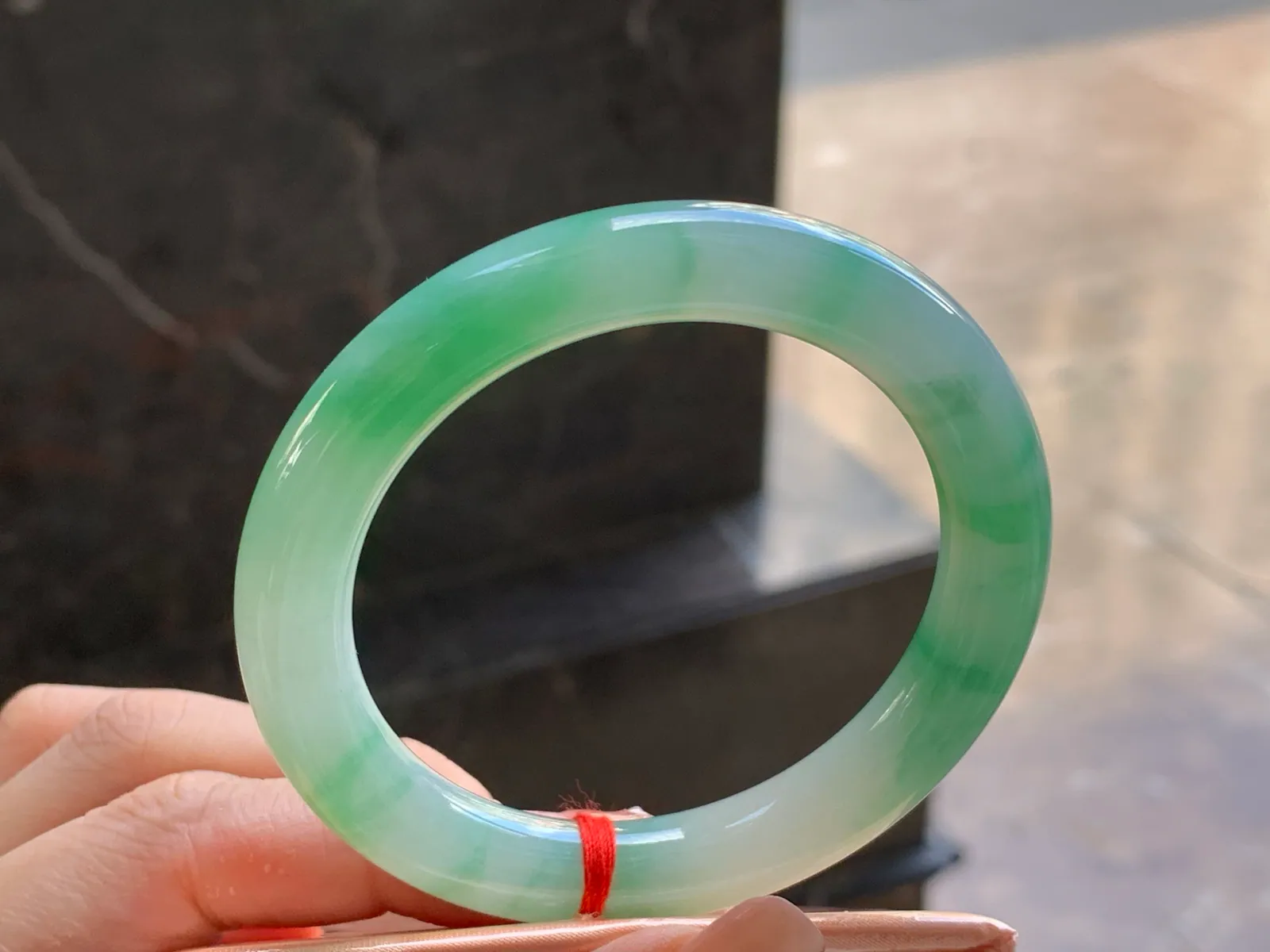
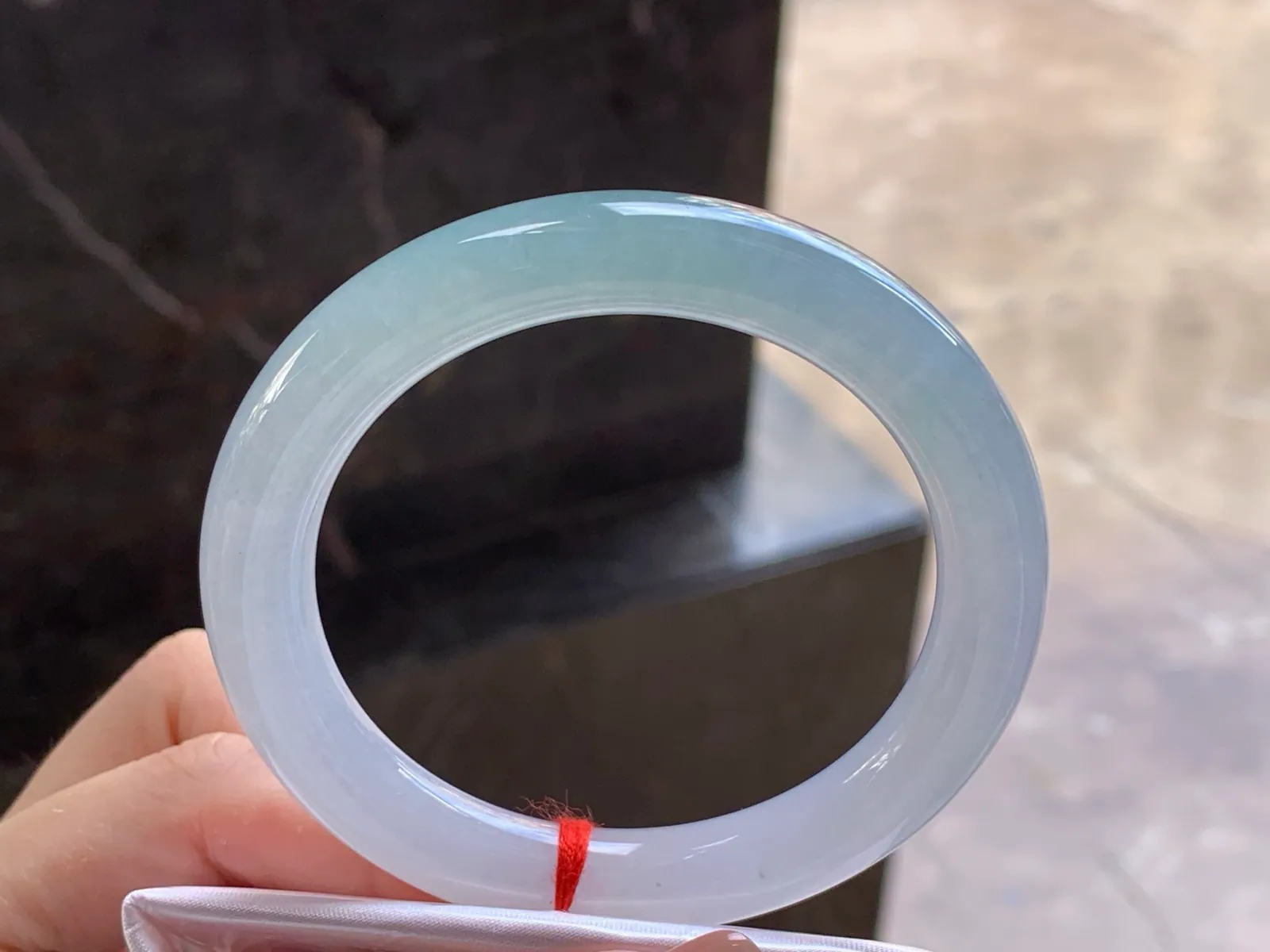
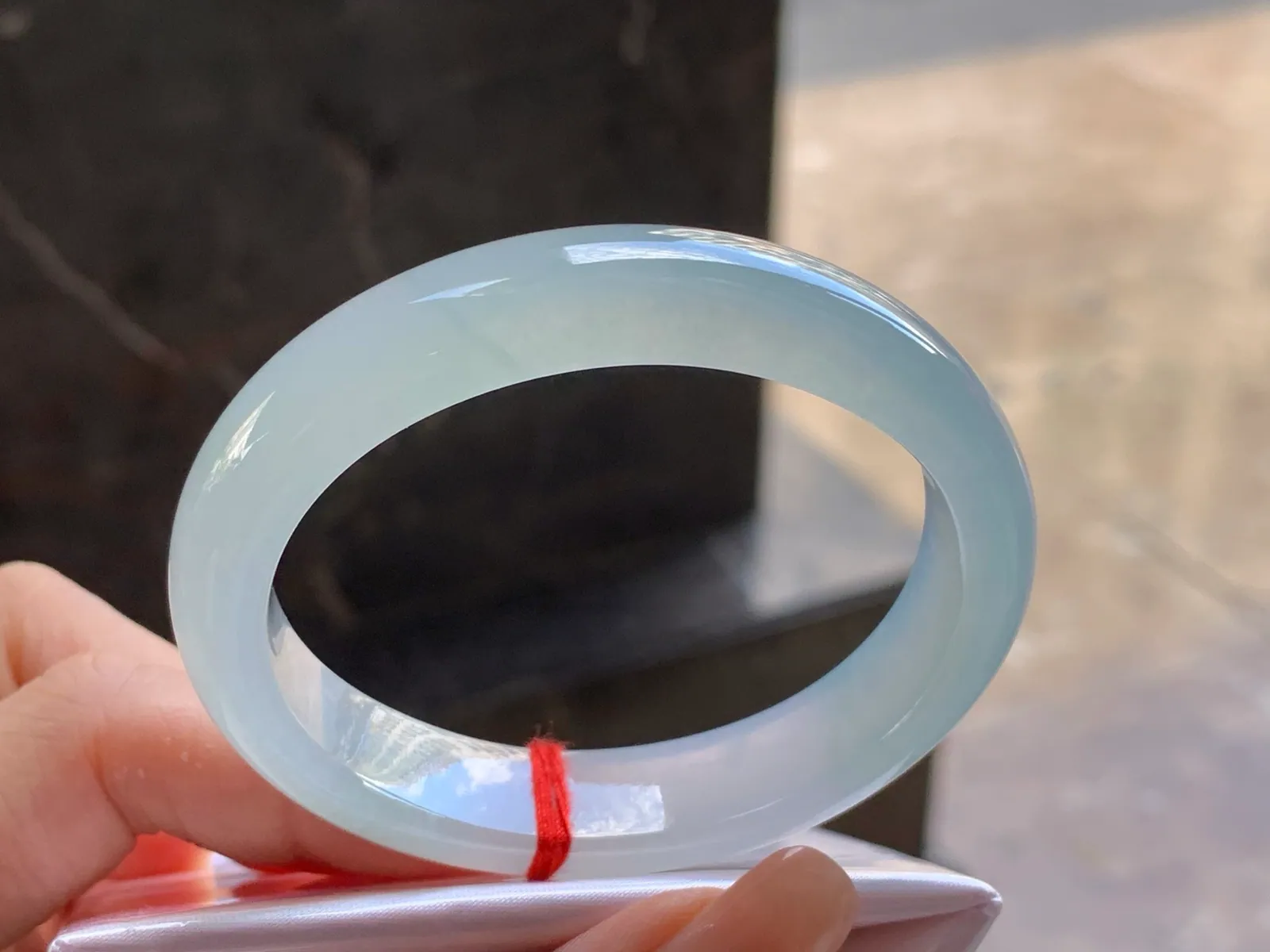
An old jade heirloom may or may not be jadeite: many family "jade" pieces are nephrite, serpentine, aventurine, dyed quartz or glass, and some are fine natural jadeite. Wear, dirt in cracks and old styles hint at use, not age or authenticity, and fakes are aged too. Only a gem lab report confirms the material. Value comes from the jadeite's quality and condition, not its age.
Is my grandmother's jade real jadeite?
An old jade heirloom is a piece handed down in a family, and it may or may not be jadeite. Many family "jade" bangles and pendants turn out to be nephrite, serpentine, aventurine, dyed quartz or glass, because all of these were sold as "jade" for decades. Others are fine natural jadeite. You cannot tell which by its age, its story or how it feels. Only a report from a gem testing lab settles it.
That is not a reason to worry. It simply means the first step with any inherited piece is the same: find out what the material is. Everything else, such as age, value and what to do with it, depends on that answer.
Why do so many families have an old jade bangle?
In Chinese families, and in many Vietnamese and Thai-Chinese families, a jade bangle has long been a common gift between generations. A mother or mother-in-law often gives a bangle to a daughter or daughter-in-law at marriage, and a grandmother's bangle is often kept for a granddaughter. These are family customs, not rules, and they vary from family to family.
Many of these pieces were bought decades ago in Hong Kong, in Burma (Yangon or Mandalay), in Chinatown jewelry shops in Bangkok, Saigon (Cho Lon) or abroad, or from traveling traders. Those markets sold fine jadeite. They also sold nephrite, dyed stone and glass, sometimes honestly under their own names and sometimes simply as "jade". A receipt or a shop name tells you where it was bought, not what it is.
What else was sold as "jade" decades ago?
| Material | Often sold as | What you may notice on an old piece |
|---|---|---|
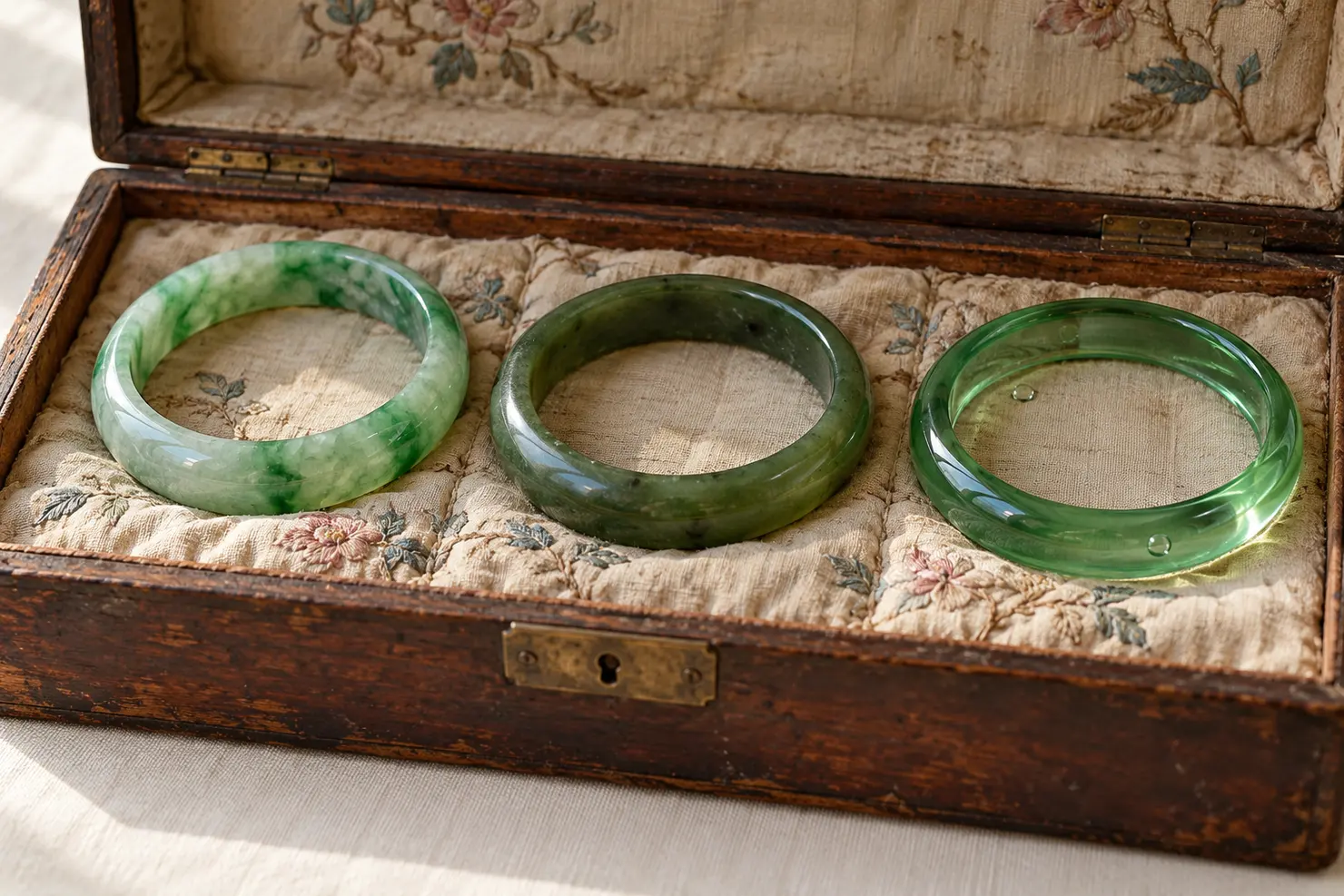
| Jadeite (翡翠) | Jade, Burmese jade, feicui | Fine grainy structure under a flashlight, glassy shine, color in irregular patches; feels heavy for its size |
| Nephrite (软玉, incl. Hetian jade) | Jade, "spinach jade" (dark green) | Oily, waxy shine, very even texture, often dark spinach green or creamy white, black specks |
| Serpentine (岫玉) | New jade, Korean jade, Xiuyan jade | Yellow-green, soft and easily scratched, edges worn round quickly |
| Aventurine quartz (东陵玉) | Indian jade | Tiny glittering flakes under light |
| Dyed quartzite (马来玉) | Malaysia jade | Bright, very even green that sits in a net along grains and cracks |
| Glass | Imitation jade, "Peking glass" | Very even color, round bubbles, swirl lines, sometimes mold seams |
For the full list of look-alikes and their clues, see fake jade look-alikes. If you think the piece could be nephrite, jadeite vs nephrite explains the difference. Both are genuine jade, but they are different minerals with different markets.
How old is my jade likely to be?
Usually you cannot know. No lab can date when a jadeite piece was cut or polished. A lab report tells you the material and whether it was treated, not its age. What you have is a family story plus a few clues, and each clue has limits.
- Type B treatment is relatively recent. Bleaching jadeite with acid and filling it with polymer resin (Type B) began to appear around the late 1980s and became common in the 1990s. So a piece with a well-documented family history from well before that is less likely to be Type B. "Less likely" is not "impossible": family stories get blurred, and pieces get swapped, repaired or replaced over the years.
- Dyeing (Type C) is much older. Jadeite has been dyed green for a long time, so age gives no protection against dye. See Type A vs Type B vs Type C jadeite.
- Wear patterns. Decades of daily wear soften the edges, round off the high points and leave fine scratches on the surface, mostly on the outer curve of a bangle. Dirt can settle into fine cracks and surface pits.
- Older shapes. Older bangles are often round-band (圆条, round in cross-section) and are often small by today's standards. Flat-inner (正装) and oval (贵妃) bangles became more common later, though all of these styles are still made today. See jadeite bangle styles.
- Older carving. Hand-carved pieces show uneven depth and individual tool marks. Modern machine-carved pieces tend to have uniform, shallow cuts repeated exactly. See jadeite carving craftsmanship. Hand carving is still done today, so this points to how a piece was made, not when.
None of these proves age, and none proves the piece is jadeite. Sellers of fakes know the clues too: wear, dirt, stains and "old" boxes are routinely added to new pieces to make them look antique.
What do these clues mean, and what do they not prove?
| What you see | What it might mean | What it does not prove |
|---|---|---|
| Softened edges, worn high points | Many years of wear | That it is old (wear can be faked with abrasives) or that it is jadeite |
| Fine scratches all over the surface | Daily wear, or a soft material such as serpentine or glass | That it is jadeite: jadeite resists scratching better than most look-alikes |
| Brown or black dirt inside cracks | The crack has been open for a long time | Age: fakers rub stains into cracks on purpose |
| Thin round-band bangle, small size | A traditional style, common in older bangles | Age: round bands are still made today |
| Dull, slightly hazy surface | Worn polish or wax, normal on old pieces | Treatment: a re-polish often brings back the shine |
| Very even, bright green | Possibly fine jadeite | It can also mean dye or glass; needs a lab |
| An old receipt or shop box | Where and roughly when it was bought | What the material is |
| "Grandma said it was Burmese jade" | It was sold to her as jadeite | That it is jadeite, or untreated |
How do dealers look at an old piece, step by step?
A dealer who is handed an inherited bangle checks things in a fixed order, because each step can end the conversation.
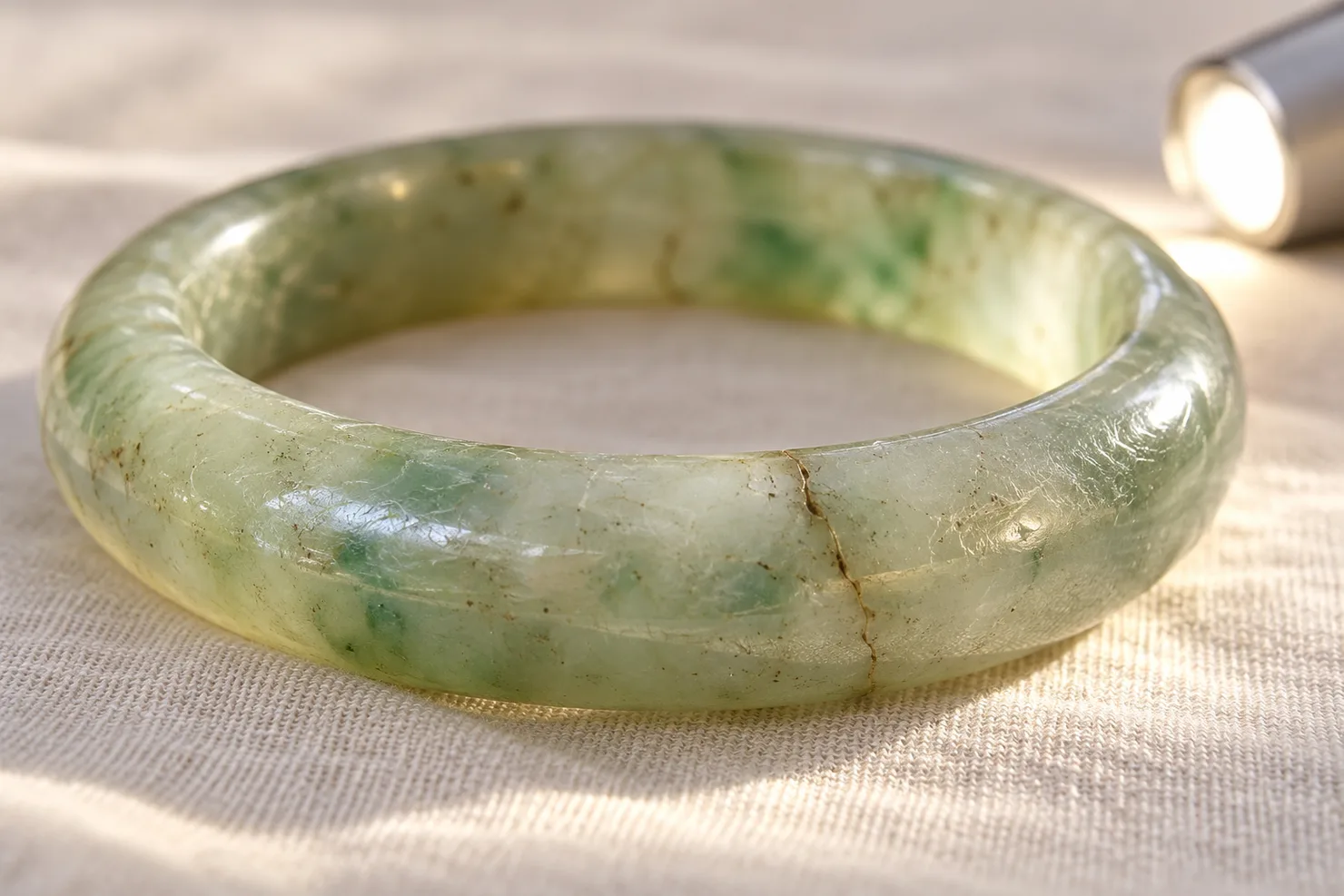
- Material. Is it jadeite at all? A dealer uses reflected light first: holding the piece under a window or a lamp and tilting it, they look at the surface shine. Jadeite has a glassy luster and sometimes small dimples where softer grains polished lower (橘皮, "orange peel"). Nephrite looks oily and smooth. Then transmitted light: a small white flashlight pressed against the piece shows the inner structure, interlocking grains in jadeite and glitter, bubbles or dye nets in the look-alikes. Weight in the hand is a hint only.
- Treatment. If it is jadeite, is it untreated (Type A)? Under a loupe in reflected light, a crackled "spider web" of etched lines on the surface or a resin-like shine raises suspicion of Type B. Color that collects along cracks suggests dye. Dealers know they cannot be sure by eye, which is why they ask for a lab report. See how to spot treated jadeite.
- Quality. Texture, translucency and color, the trade's 种, 水 and 色. A fine-grained, translucent piece with good color is a different thing from a coarse, opaque one, even if both are natural. See texture, translucency and color.
- Condition. Cracks matter most. A dealer shines the flashlight from inside the bangle and turns it slowly: a crack stops the light and flashes as a bright plane at some angles, while a natural healed line (石纹) lets light through. Old pieces often have both. See cracks and cotton in jadeite and cracked or broken bangles.
- Size and wearability. A beautiful bangle that fits almost no adult wrist is much harder to sell than a common size. Pendants and rings matter less here.
Notice that "how old is it" is not on the list.
Does "old" make jade more valuable?
In the jadeite trade, not by itself. A jadeite bangle from the 1960s and one cut last year are judged the same way: material, treatment, quality, condition and size. Old pieces were not made from better jadeite as a rule; some were, many were ordinary. A fine old bangle is valuable because the jadeite is fine, not because it is old.
There is one exception, and it is a different market. Genuinely antique carved pieces, for example from the Qing dynasty, with documented provenance can be sold through antiques dealers and auction houses, where age, history and carving style count. Very few family pieces belong there, and that market needs its own specialists, not a jewelry shop. The trade itself does not fully agree on how much an old style or "old mine" story adds to plain jewelry pieces; in practice, most dealers pay for the material.
Which family stories should I not rely on?
| Family belief | What is actually true |
|---|---|
| "It got greener because Grandma wore it." | Natural jadeite does not change its body color with wear. Wear can polish the surface so it looks a little glossier and more translucent. See does jade change color? |
| "Old jade is always Type A." | Type B became common later, but dye is old, and pieces can be swapped or treated later. Only a lab can say. |
| "The heavier it is, the more real it is." | Jadeite is dense, but nephrite, hydrogrossular and lead glass feel heavy too, and a thicker piece is simply heavier. |
| "It was bought in Burma (or Hong Kong), so it must be real." | Those markets sold imitations and treated stones too, then and now. |
| "It feels cold, so it is real jade." | All stone and glass feel cold. This only rules out plastic. |
| "It is worth a fortune because it is old." | Value comes from the material. Many heirlooms are worth far more to the family than to the market. |
What should I do with an inherited jade piece?
- Clean it gently. Lukewarm water, a drop of mild soap and a soft brush or cloth, then dry it. No ultrasonic cleaner, no steam, no bleach or strong chemicals, especially if you do not yet know whether it is treated or cracked. See how to care for jadeite.
- Photograph it and write down what you know. Who bought it, roughly when and where, and any receipt or box. Keep this with the piece.
- Get a lab test. Ask a recognized gem testing lab for a report that names the material and states whether it is treated. Do not let anyone scratch it, file it or test it with acid. A report from a recognized lab can be checked online; see how to verify a jadeite certificate.
- Decide what you want from it. Keep it as it is, wear it, rework it or sell it.
| Situation | Options | What to know |
|---|---|---|
| Fits, no cracks | Wear and enjoy it | Take it off for sport, heavy work and sleep if you are worried about knocks |
| Too small to wear | Keep it, or have it reworked | A jadeite bangle cannot be made larger. A cutter can turn the band into smaller pieces, such as saddle rings, small pendants or cabochons, but the bangle is gone after that |
| Cracked | Stop wearing it daily | A crack can open further with a knock. A gold band can hold it and protect it |
| Broken | Repair with gold, or rework the pieces | Broken bangles are often joined with gold sections; most gold-wrapped jadeite is made in China, usually in 18K. See gold-set jadeite |
| You want to sell | Get the lab report first, then several quotes | Expect offers well below what similar new pieces sell for. See selling jadeite and resale value |
No honest dealer can tell you what a piece is worth from a story or a phone photo, and neither can we. Be careful with anyone who offers a quick high value before the material is confirmed, or a quick low offer before you have a report.
What if it turns out not to be jadeite?
Then it is still your grandmother's bangle. A nephrite or serpentine bangle she wore for forty years, or even a glass one, carries the same memories it did before the test. Market value and family value are measured differently, and both are real. Many people keep the piece, wear it, or pass it on with its story, and simply stop worrying about what it is "worth".
If it turns out to be fine natural jadeite, the same applies: the decision to keep it or sell it is a family one, and there is no rush.
On JadeiteHub, every listed piece comes with real photos from the seller (some with video), every sold piece is checked against its certificate before it ships, and if it does not match the description you get a full refund. We do not appraise or buy back jewelry, but our guides can help you understand what a lab report on your family piece means.
FAQ
How can I tell if my grandmother's jade is real?
A flashlight and a loupe can raise clues, such as a grainy structure in jadeite, bubbles in glass or glitter in aventurine, but they cannot prove it. Only a gem lab report that names the material and states any treatment confirms jadeite.
Is old jade more valuable than new jade?
Not by itself. In the jadeite trade, value comes from material, treatment, quality, condition and size. Only genuinely antique carved pieces with provenance enter the antiques market, which is a separate market.
Can an old jade bangle be Type B?
It is less likely if its family history clearly goes back before Type B became common in the 1990s, but it is not impossible. Dyeing is much older, so an old piece can still be dyed. Only a lab can tell.
Can a lab tell how old my jade is?
No. A lab can identify the material and any treatment, but it cannot date when a jadeite piece was cut or polished.
My grandmother's bangle is too small. Can it be resized?
No. A jadeite bangle cannot be made larger. You can keep it, or have it cut into smaller pieces such as saddle rings or pendants, which ends its life as a bangle.