Where Is Jade Traded? From Myanmar Mines to Your Wrist
Updated
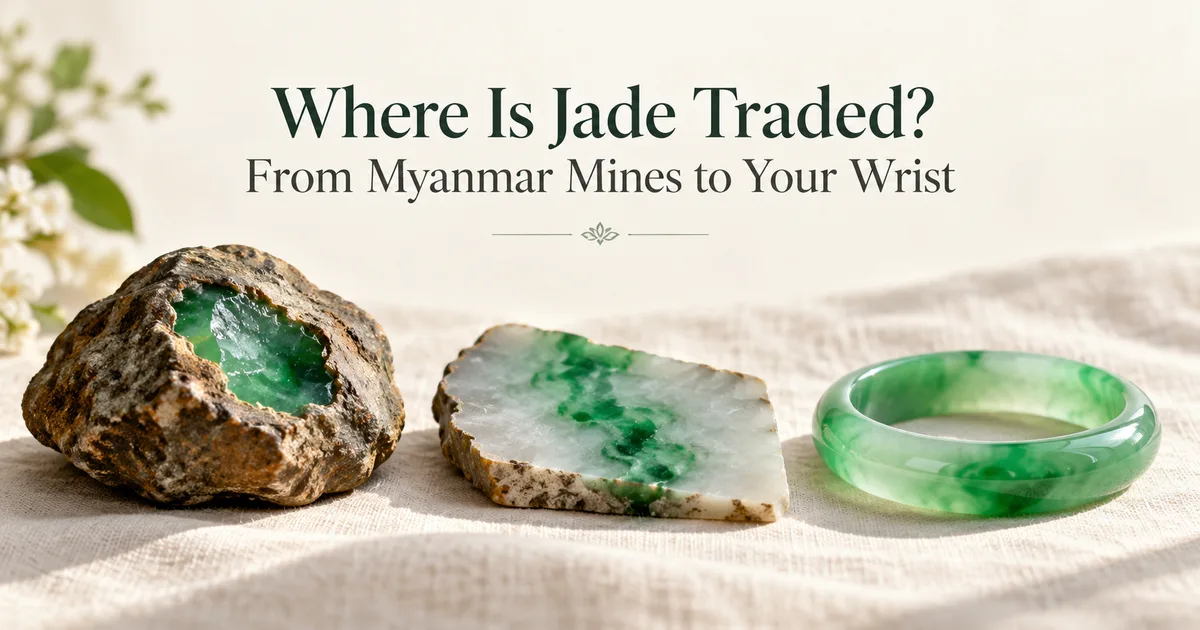
The jadeite supply chain is the route a stone takes from the mines around Hpakant in Myanmar to a shop or livestream. Rough is sold in Myanmar, crosses into Yunnan at Muse and Ruili, is cut and carved in Yunnan and Guangdong, then passes through wholesalers to retailers. Each hand adds selection, risk, labour or marketing. That, plus grading differences photos hide, is why look-alike bangles are priced so differently. "Factory direct" guarantees neither price nor authenticity.
What is the jadeite supply chain?
The jadeite supply chain is the route a piece of jadeite takes from the mines in northern Myanmar, through rough sales, cutting, carving and polishing, mostly in China, to the shop, website or livestream where you buy it.
JadeiteHub is run from Ruili, the Chinese border town where much of this trade crosses from Myanmar, so this is the route we see every day. The short version: almost all gem jadeite starts as rough boulders around Hpakant, changes hands several times as rough, is cut into slabs and blanks, is worked into bangles, pendants and beads, and is then sold, often several more times, before it reaches a buyer. See where does jadeite come from for the geology and the mining areas.
Where does rough jadeite start, and how is it sold in Myanmar?
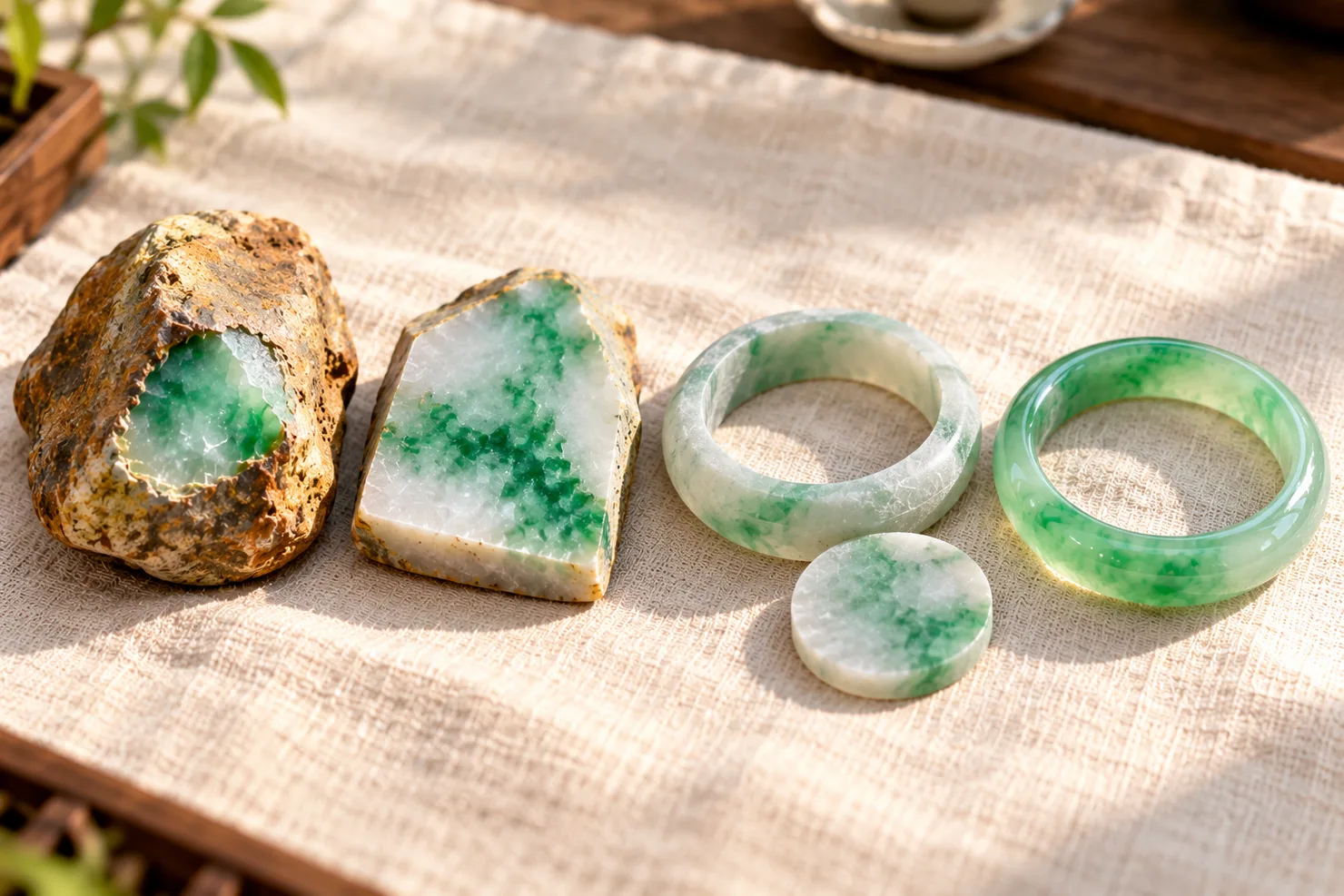
Gem jadeite is mined in the hills and river valleys around Hpakant (帕敢) in Kachin State. Rough comes out as boulders and blocks, many with a weathered skin that hides the inside.
From there, rough is sold in two broad ways:
- Official sales. The Myanmar government has long held gem and jade sales, the Myanma Gems Emporium, where licensed traders bid on numbered lots of rough. In recent years these have been held in Naypyitaw, and they have not run on a fixed yearly schedule.
- Private and informal channels. A great deal of rough is sold directly between miners, brokers and traders, in Myanmar and across the border.
Mandalay has a well-known jade market on the Myanmar side, where rough, slabs and finished pieces all change hands.
Myanmar's jade industry also has well-documented problems, including dangerous working conditions at the mines and long-running conflict in the region. There is no widely used system that traces a finished piece back to a particular mine.
How does jadeite get from Myanmar into China?
The best-known overland route runs from Muse (木姐) in Myanmar to Ruili (瑞丽) in Yunnan. On the Chinese side, the Jiegao (姐告) border zone of Ruili sits directly next to Muse and has long been a place where Burmese and Chinese traders meet. Rough, part-worked material and finished pieces all cross here, and the rules on what can cross, and how, have changed over the years.
Tengchong (腾冲), further north in Yunnan, is the historic jade-trading town of the old routes and is still a trading centre. Rough also reaches China through organised auctions and other channels, so not every stone passes through Ruili.
Where are the main jade markets in China and nearby?
Each hub has a reputation. These are general patterns: every market sells a range of grades, and every market also sells treated jadeite and look-alikes.
| Place | What it is known for |
|---|---|
| Mandalay, Myanmar | Jade market for rough, slabs and finished pieces on the Myanmar side |
| Ruili and Jiegao, Yunnan | Border trading with Burmese dealers; rough, bangles and finished pieces; many livestream sellers |
| Tengchong, Yunnan | Historic jade town; trading, finished pieces, livestream sellers |
| Pingzhou (平洲), Foshan, Guangdong | Rough sales, including organised 公盘 (public tender sales of rough); known in the trade as the bangle hub, where bangles are cut and sold wholesale |
| Sihui (四会), Guangdong | Carving pendants and ornaments in volume, much of it mid- to lower-range; large wholesale and livestream trade |
| Yangmei village (阳美), Jieyang, Guangdong | Mostly small, finely worked pendants, much of it high-end; also holds rough tender sales |
| Hualin (华林), Guangzhou | Jade and jewellery wholesale street in the city centre; finished pieces for shops |
| Hong Kong | Historically a centre for fine jadeite dealing, around Canton Road in Kowloon; major auctions of top pieces; the Jade Market in Yau Ma Tei sells mostly tourist-level pieces |
Traders disagree about which hub is "best" for what, and reputations shift as dealers move. Treat this table as a map, not a ranking.
Who handles a piece between the mine and your wrist?
A finished bangle usually passes through several specialists. Each adds something real, and at each step something can go wrong for the final buyer.
| Step | What is added | What can go wrong for the buyer |
|---|---|---|
| Rough trader | Selecting rough, financing it, carrying the risk of what is inside | Rough is resold several times; each sale adds a margin, and window tricks are common |
| Cutter (开料, "opening the material") | Deciding where to saw; this reveals colour, texture and cracks | A cut chosen to get the most pieces can leave a weak spot near the edge |
| Bangle maker | Coring blanks from slabs, shaping and sizing | Bangles made thin or flat to save material; out-of-round shape |
| Carver | Design and labour; fitting the design to the stone | Carving can hide cracks and cotton (see carving craftsmanship) |
| Polisher | The final shine, which shows translucency | Poor polish dulls a piece; heavy coatings make it look better than it is |
| Treatment workshop | Bleaching and resin filling (Type B) or dye (Type C) | Treated pieces enter the same trade as natural ones and may be sold as Type A |
| Certificate lab | Identifies the material and any treatment | Fake labs, or a real certificate for a different piece; it does not grade quality or set a price |
| Wholesaler | Stock, sorting, credit to shops | Mixed lots; the origin of each piece is lost |
| Shop or website | Display, staff, rent, after-sales service, returns | Part of the price pays for all of these, not the stone |
| Livestream host and goods owner (货主) | Reach, showing pieces live, quick sale | Flattering light, staged bargaining, pressure to decide in seconds |
Cutting is the step outsiders underrate. A slab is planned so that the best part becomes bangles, and a single bangle blank is cored out of it. The disc left in the middle is not wasted: it becomes a safety-coin pendant (平安扣), a cabochon or smaller pieces. The cutter only learns how many cracks there are once the saw goes in, and the cost of slabs that turn out cracked is carried by the pieces that come out well. That risk is one reason a clean bangle from good material costs more than its weight in stone would suggest.
Why are bangles that look the same priced so differently?
People ask "why is jade so expensive?" and "why is this one so cheap?" about pieces that look alike. The usual reasons:
- Grading differences that photos hide. Fineness of texture, depth of translucency, small cracks, cotton and whether colour goes deep or sits near the surface are hard to see on a screen. See what determines jadeite price and judging jadeite from online photos.
- Treatment. A Type B bangle can look as clear as a fine Type A one but is worth far less. See how to spot treated (Type B) jadeite.
- Number of hands. A piece that was resold as rough, as a blank and again as a finished bangle carries more margins than one sold by the person who cut it.
- Cost of selling. Rent in a mall, staff, insurance, unsold stock, returns and advertising all sit in the price.
- Scarcity at the top. Fine translucent green is rare and many buyers want it, so prices for top pieces rise much faster than quality seems to.
- Livestream tactics. A starting price set high so that a "discount" feels like a win, a host who argues the price down with the goods owner on camera, and "only one left" pressure.
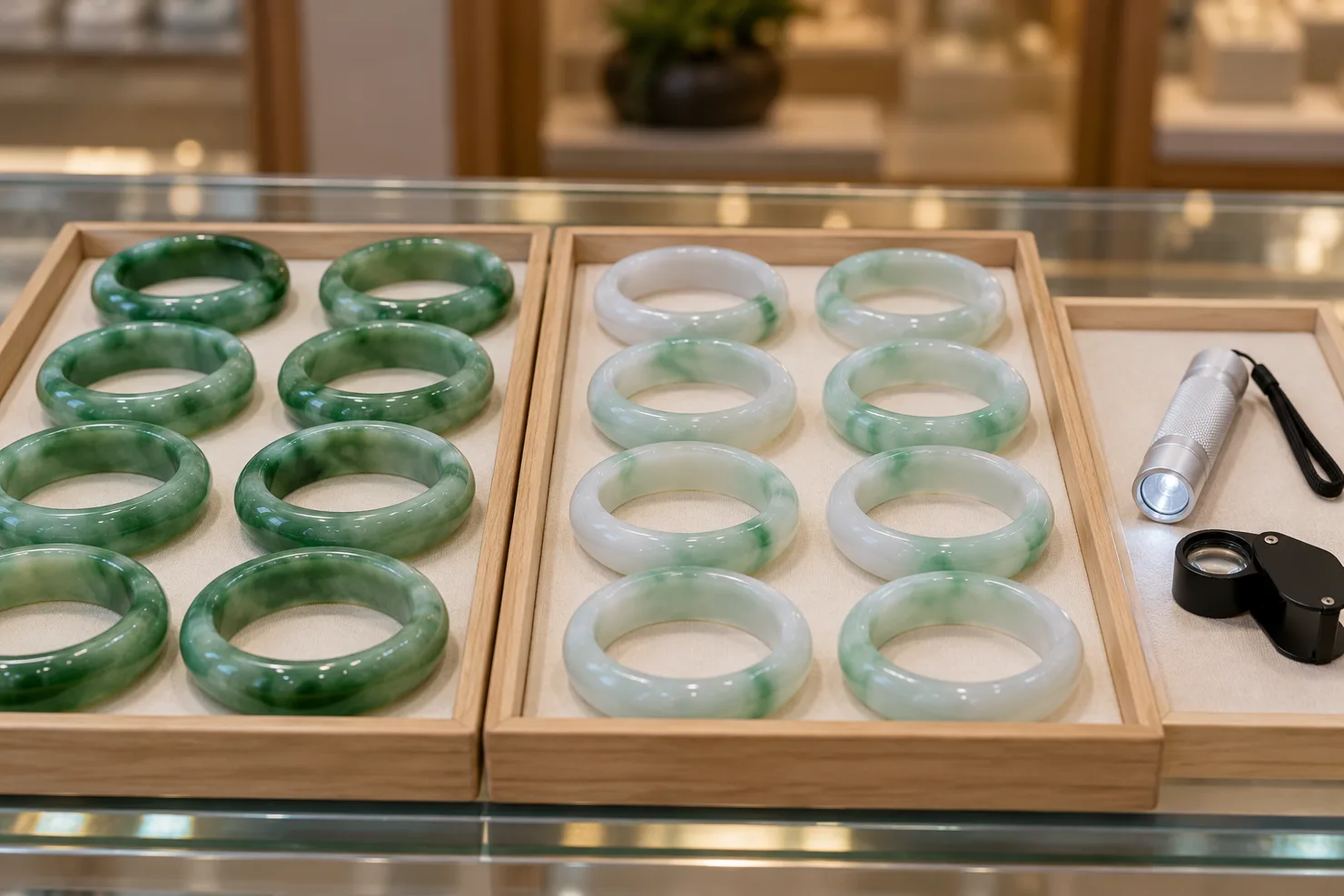
How dealers sort a tray like this: first in daylight, for colour and evenness; then with a small white flashlight pressed against the side, to see how deep the light travels and to look for cracks, which show as sharp lines that stop the light; then turning each bangle to check the inner rim and the thickness. Only after that do they talk price. Buyers who skip the flashlight step miss most of what separates two similar bangles.
What do "factory direct" and "source price" really mean?
Many sellers describe themselves as 源头 (the source), 厂家直销 (factory direct), "wholesale price", tận gốc in Vietnamese or ส่งตรงจากโรงงาน in Thai. These words do not guarantee anything.
| Claim | What it often means | What to check instead |
|---|---|---|
| "Source" or "from Ruili" | The seller is based in, or buys in, a trading hub | The certificate and the exact piece; living near the border does not make a stone natural |
| "Factory direct" | The seller owns a workshop, or buys from one | Return terms; a workshop can still sell treated or cracked pieces |
| "Wholesale price" | A price lower than the opening price | Compare like with like; a wholesale price for a lower grade is still not cheap |
| "Live from the market" | The stream is filmed in a market or a goods owner's shop | Ask for daylight video of the exact piece after the stream |
Being close to the source helps only if you can judge the stone. Traders at the source know what their goods are worth, and source markets are also where treated pieces and look-alikes are sold in the largest numbers.
How can buyers in Thailand and Vietnam buy closer to the source safely?
Much of the jadeite sold in Vietnam and Thailand is cut or carved in China, then sold on by importers, shops and livestream sellers. Buying closer to the source can cut out some hands, but it also removes the local shop you can walk back into. To keep the benefit without the risk:
- Buy one finished piece, with a certificate for that exact piece. Check that the photo, size and weight match, and look the report number up on the lab's own website. See how to verify a jadeite certificate.
- Get the return terms in writing before you pay. Who pays shipping back, and how long you have.
- Pay through a channel that protects you, such as a card or a platform that holds payment terms you can enforce. Avoid bank transfers to personal accounts.
- Do not buy rough or 赌石 (gambling stones) from a distance. Even experts misjudge rough. See jade gambling.
- Do not buy "wholesale lots" from strangers. Lots of mixed bangles offered on social media are usually ungraded, rarely certified piece by piece and impossible to return.
- Remember import duties. They depend on your country and are paid by the buyer.
For the full checklist, see how to buy jadeite from China safely. If you buy in person in Bangkok or a border town such as Mae Sai, see buying jade in Thailand.
Buying on JadeiteHub
JadeiteHub does not sell rough or gambling stones; we only sell finished jadeite. Sellers post real photos of each piece, some with video, every sold piece is checked against its certificate before it ships, and if it does not match the description you get a full refund. Payments go through licensed payment providers, shipping is insured, and import duties are paid by the buyer.
FAQ
Where is jade traded?
Rough jadeite is mostly mined around Hpakant in Myanmar and sold through official gem sales and private channels. It then crosses into China, mainly through Ruili in Yunnan, and is cut, carved and traded in hubs such as Ruili, Tengchong, Pingzhou, Sihui, Jieyang and Guangzhou. Mandalay and Hong Kong are also important markets.
Where is the main jade market in China?
There is no single one. Ruili and Tengchong in Yunnan are the border trading towns; Pingzhou, Sihui and Jieyang in Guangdong are the main cutting and carving centres; and Hualin in Guangzhou is a wholesale street for finished pieces.
Why is jade so expensive?
Fine jadeite is rare, much rough turns out cracked or poor when cut, skilled cutting and carving take time, and each trader, shop or livestream along the way adds a margin. Prices for the finest translucent green rise very steeply.
Is jade cheaper in Ruili or Myanmar?
Not automatically. Traders there know what their goods are worth, and those markets also sell many treated pieces and look-alikes. Being near the source only helps if you can judge the stone and verify its certificate.
Can I buy jadeite wholesale?
Trade buyers do, but mixed lots from strangers are a common trap: they are usually ungraded and uncertified. For personal buying, choose individual finished pieces with their own certificate and clear return terms.