Jade Turtle Meaning: Tortoise and Dragon Turtle Pendants
Updated
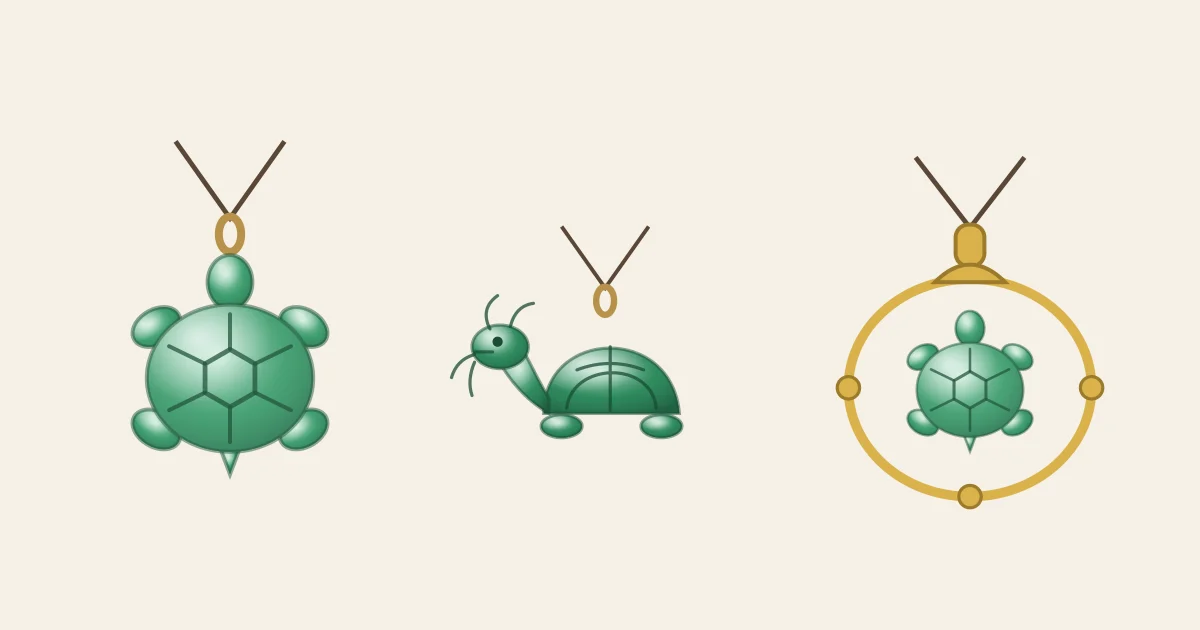
A jade turtle or tortoise stands for long life, stability and steady protection; 龟龄鹤寿 (the age of a tortoise and a crane) is a classic birthday wish. Behind it are Shang-dynasty oracle shells, the Black Tortoise of the North and the stele-carrying bixi. The dragon turtle (龙龟) adds wealth and is a favorite feng shui piece. The turtle is not a zodiac animal, so anyone can wear it. It is one of the sturdiest carving shapes; check the shell pattern, head and color, and buy with a certificate naming natural Type A jadeite. These are traditional meanings, not promises.
What does a jade turtle mean?
The jade turtle, or tortoise, is the classic symbol of long life, stability and steady protection. A tortoise lives a very long time, moves slowly and carries its own shelter, so in Chinese culture it came to stand for a long, safe and unhurried life. The phrase 龟龄鹤寿 (gui ling he shou), "the age of a tortoise and the years of a crane", is a standard birthday wish for an older person.
Unlike the tiger or the rabbit, the turtle is not one of the twelve zodiac animals, so anyone can wear it without worrying about their sign. It is chosen for its meaning: a birthday gift for parents and grandparents, a "steady and safe" charm for someone who travels, or a wealth charm when it is carved with coins or a dragon head.
These are traditional meanings, not promises: a jade turtle does not lengthen your life or protect you from harm. For other motifs, see jadeite pendant meanings.
Why is the tortoise a symbol of long life and protection?
The idea is very old. In the Shang dynasty, more than 3,000 years ago, diviners carved questions onto tortoise shells and read the cracks after heating them: the earliest Chinese writing survives on these oracle bones (甲骨). The tortoise was seen as a link between heaven and earth: its domed shell like the sky, its flat underside like the ground.
Later traditions built on that:
| Tradition | Chinese | What it means |
|---|---|---|
| The Black Tortoise of the North | 玄武 | One of the Four Symbols (四象), drawn as a tortoise entwined with a snake; a guardian of the north and of the home's back |
| Long-life pairing with the crane | 龟鹤齐龄 / 龟龄鹤寿 | The two longest-lived animals together; a birthday wish |
| The stele-carrying turtle | 赑屃 (bixi) | A turtle-like creature, said to be one of the dragon's sons, that carries stone tablets on its back in temples and tombs; strength and endurance |
| The dragon turtle | 龙龟 | A dragon's head on a tortoise body; long life plus wealth and protection, widely used in feng shui |
The turtle is loved across Asia, not only in China. In Thailand, releasing turtles (ปล่อยเต่า) at temples is a familiar way of making merit and wishing for long life, and the dragon turtle (เต่ามังกร) is a common sight in shops. In Vietnam, the Golden Turtle God (Kim Quy) and the turtle of Hoan Kiem Lake in Hanoi, which in legend took back King Lê Lợi's sword, are national stories, and stone turtles carry the doctoral stelae at the Temple of Literature (Văn Miếu).
What is a jade dragon turtle?
The dragon turtle (龙龟) joins two lucky animals: the dragon's head for power and wealth, and the tortoise body for long life and stability. It is usually carved sitting on a pile of coins or gold ingots, sometimes with a small turtle on its back, and is one of the most common feng shui pieces for desks, shops and pendants. Some people say it should face the door or the wearer's front; these are modern feng shui habits rather than fixed rules. For more on dragons, see jade dragon pendant.
What styles of jade turtle are there?
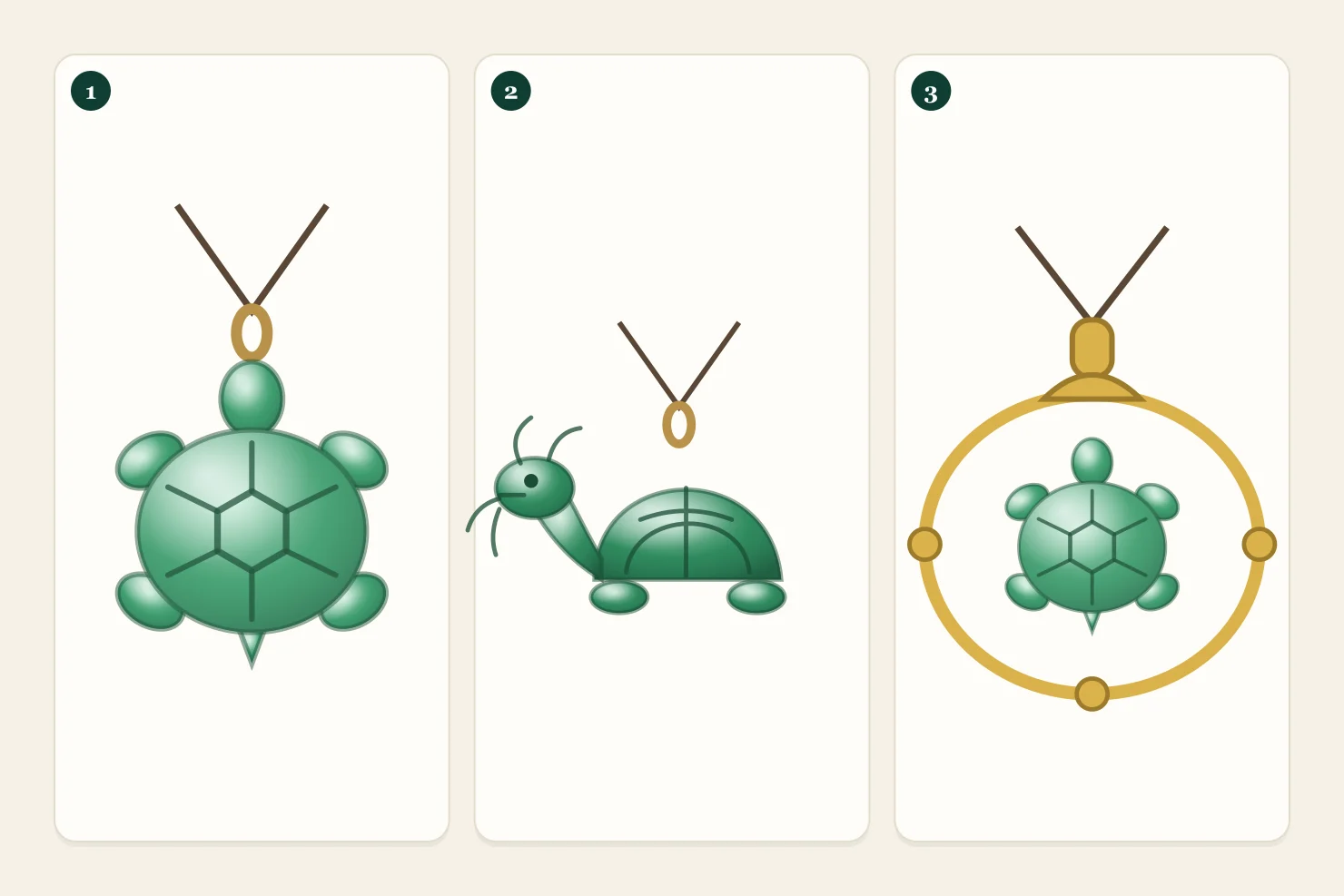
| Style | What to expect |
|---|---|
| Plain turtle, seen from above | A flat, rounded shape with the hexagon shell pattern (龟背纹); smooth and very wearable |
| Turtle with coins (金钱龟) | Coins on the shell or under the feet; a wealth version |
| Dragon turtle (龙龟) | Dragon head, scaled shell; bolder, more detail, more popular with men |
| Turtle on a lotus leaf | Calm and decorative; the lotus adds purity. See jade lotus pendant |
| Small turtle in gold | A little carving set in 18K gold with a gold bail; light and modern. See gold-set jadeite |
| Turtle charm on a bracelet | A small carved turtle between beads; see jadeite bead bracelet |
A turtle is one of the sturdiest shapes in jade carving: compact, with short legs and a tucked-in head. That makes it a good everyday pendant for people who are hard on their jewelry.
Is a jade turtle a good gift?
Usually yes, especially for a parent's or grandparent's birthday, a retirement, or someone setting off on a long journey. Two cautions:
- Wording matters in Chinese. In everyday Chinese, calling a man 乌龟 ("tortoise") can be an insult. Chinese buyers therefore say 寿龟 (longevity turtle), 金钱龟 or 龙龟 when they give one, and some avoid giving a plain turtle to a man. The carving itself is not unlucky.
- Don't give it to a baby to wear. Babies should not wear pendants; see jade for babies.
How do you choose a good jade turtle?
- Look at the shell pattern. On a good turtle the hexagons are cut evenly and the lines are clean. Wobbly, uneven plates suggest rushed work.
- Check the head and feet with a small flashlight from behind; the legs are short, but the head and tail tip can hide cracks.
- See how the color is used. A green shell and white body, or a brown skin used for the shell (俏色), are well-placed color. Color that sits only in cracks is a warning.
- On a dragon turtle, check the dragon's face, whiskers and the coins underneath: these are the finest details and show the carver's skill.
- Get the size in millimeters and a photo next to a coin or ruler.
- Ask for a lab certificate that names natural Type A jadeite. Cheap bright-green turtles are often dyed or are not jadeite at all; see jadeite look-alikes and how to verify a jadeite certificate.
What drives the price of a jade turtle pendant?
As with any carving, the stone first, then the carving. Translucency and texture matter most, then color and where it sits, then how clean the stone is. A detailed dragon turtle takes more carving time than a plain turtle, and a thick turtle uses more rough than a flat one. A gold setting and a certificate add the rest. See what determines jadeite price.
How do you wear and care for a jade turtle?
- A flat turtle lies well on the chest on a short cord or chain; a dragon turtle is heavier and suits a sturdier chain. See jade pendant cord and chain.
- Take it off for sport and sleep, even though turtles are tough.
- Clean with lukewarm water, mild soap and a soft brush, especially in the shell grooves, then dry.
Does JadeiteHub sell jade turtle pendants?
Not at the moment. JadeiteHub has no turtle pendants for sale right now. You can browse the pendants we do have in JadeiteHub pendants.
Every piece on JadeiteHub is certified natural Type A jadeite and ships with its own certificate. If a piece does not match its description, you get a full refund.
FAQ
What does a jade turtle mean?
Long life, stability and steady protection. The tortoise lives long and carries its shelter, so it is a classic birthday wish for elders. These are traditional meanings, not promises.
What is the difference between a jade turtle and a dragon turtle?
A plain turtle is about long life and safety. A dragon turtle (龙龟) has a dragon's head on a tortoise body, often on coins, adding wealth and protection; it is a common feng shui piece.
Is the turtle a Chinese zodiac animal?
No. It is not one of the twelve signs, so anyone can wear a jade turtle regardless of birth year.
Is a jade turtle a good gift?
Yes, especially for a parent's or grandparent's birthday or a retirement. In Chinese, call it a longevity turtle (寿龟) or dragon turtle, since 乌龟 can be an insult for a man.
Is a jade turtle pendant strong?
It is one of the sturdiest jade shapes: compact, with short legs and a tucked-in head. Still take it off for sport and sleep.