Jade Lotus Pendant Meaning: Seed Pod, Root and Choosing
Updated
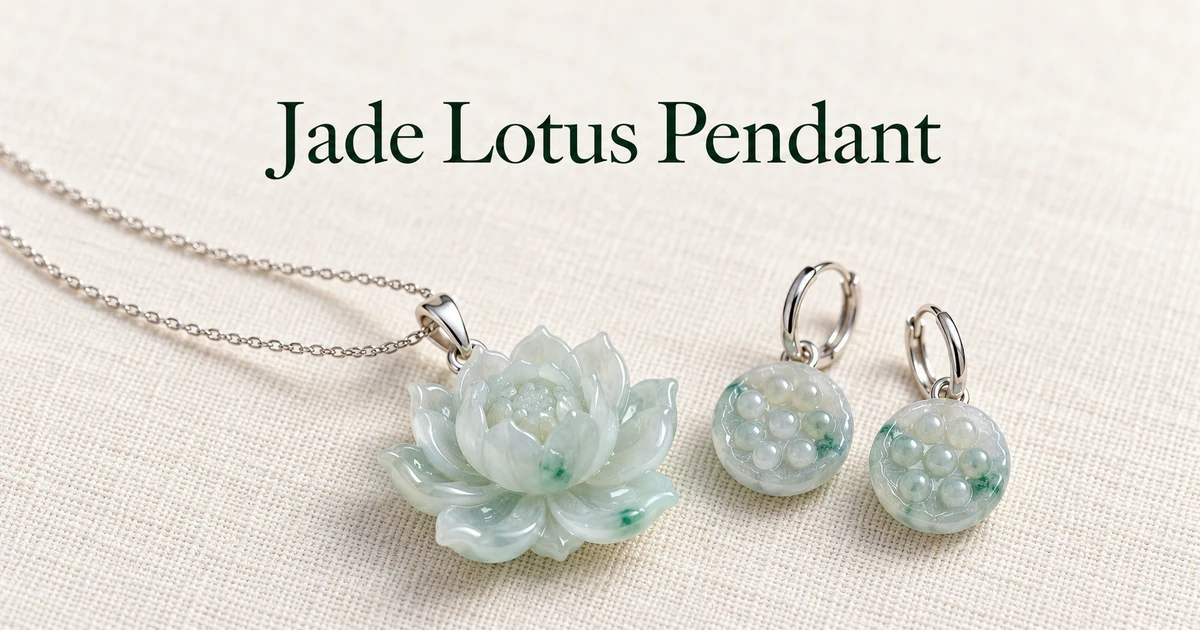
A jade lotus traditionally stands for purity and for blessings that keep coming. 莲 (lián, lotus) sounds like 连 (lián, continuing), and 荷 (hé) sounds like 和 / 合 (harmony, union). Each part has its own reading: the flower for purity and harmony, the seed pod (莲蓬) for many children, the leaf for harmony, and the root (藕, ǒu) for a happy couple, since it sounds like 偶 (pair). Lotus with fish reads 连年有余, abundance year after year. In Buddhism the lotus stands for purity, rising clean from mud; a lotus pendant is a flower, not a Buddha image, and anyone can wear it. These are traditional wishes, not promises. Choose full, evenly spaced seeds, layered petals, glassy polish in the hollows, no cracks at thin edges, and natural Type A jadeite with a certificate.
What does a jade lotus pendant mean?
A jade lotus pendant traditionally stands for purity and for good things that keep coming. The lotus has two everyday Chinese names, and both carry a pun. 莲 (lián) sounds like 连 (lián), "one after another, without a break", so a lotus is read as blessings that continue. 荷 (hé) sounds like 和 (hé, harmony) and 合 (hé, coming together), so the same flower is also a wish for a peaceful home and a happy couple.
Beyond the wordplay, the lotus is one of the oldest symbols of purity in Asia. It roots in mud and opens a clean flower above the water. Chinese readers know the line from the Song-dynasty scholar Zhou Dunyi (周敦颐) in his short essay On Loving the Lotus (《爱莲说》): 出淤泥而不染, "it rises from the mud unstained". That is why a lotus is also given as a wish for an honest, clear-minded life.
Each part of the plant, the flower, the seed pod, the leaf and the root, has its own reading, and carvers combine the lotus with fish, birds and other motifs to make whole sentences. These are traditional wishes, not promises: a lotus does not bring luck, children or success. For a side-by-side overview of all the common motifs, see jadeite pendant meanings. This guide covers the lotus alone: what each part means, the Buddhist association, the styles, how to judge carving and material, and the one lotus piece on sale at JadeiteHub.
What do the lotus flower, seed pod, leaf and root mean?
Each part of the plant has its own traditional reading. The puns below are standard in Chinese decorative art; the gift suggestions are common trade usage, not rules.
| Part | Chinese | Main reading | Where it comes from | Often given to |
|---|---|---|---|---|
| Lotus flower | 莲花, 荷花 | Purity; blessings that continue; harmony | 莲 sounds like 连 (continuing); 荷 sounds like 和 / 合 (harmony, union); the "unstained by mud" image | Anyone; a common gift for parents and teachers |
| Lotus seed pod | 莲蓬 | Many children, a growing family | A pod full of seeds; 莲子 (lotus seeds) sounds like 连子, "sons one after another", hence 连生贵子 | Newlyweds, new parents |
| Lotus leaf | 荷叶 | Harmony | 荷 sounds like 和 | Couples, families, business partners |
| Lotus root | 莲藕 | A good match, a happy couple | 藕 (ǒu) sounds like 偶 (ǒu, pair, spouse), as in 佳偶天成, "a match made in heaven" | Couples, newlyweds |
A note on the seed pod. In Chinese art, plants full of seeds (the pomegranate, the gourd, the lotus pod) have long stood for 多子多福, "many children, many blessings". For the gourd and the pea pod, which carry the same idea, see jade gourd pendant and jade pea pod pendant. The lotus pod is also simply a pleasant shape: a flat top dotted with round seeds, which carvers love because each seed works like a tiny polished dome.
A note on the root. You will also hear sellers say that the holes running through a lotus root mean 路路通, "every road open", and that its joints mean 节节高升, "rising step by step". Those are sales readings from the look of the root rather than old puns; the 藕 / 偶 pair is the classic one.
What do lotus combinations mean, like lotus with fish?
Chinese carving likes to build a sentence from two or three motifs, each standing for one word. The lotus appears in several well-known combinations:
| Combination | Saying | How it works | Meaning |
|---|---|---|---|
| Lotus with fish | 连年有余 (lián nián yǒu yú) | Lotus 莲 = 连 (continuous), fish 鱼 (yú) = 余 (yú, surplus) | "Abundance year after year" |
| Lotus with an egret | 一路连科 (yí lù lián kē) | Egret 鹭 (lù) = 路 (lù, road), lotus 莲 = 连 | "Passing exam after exam", a wish for study and career |
| Twin lotus on one stem | 并蒂莲 | Two flowers sharing one stem | A devoted couple |
| Lotus with seed pod and leaf | 莲蓬荷叶 | Flower, pod and leaf on one piece | Purity, harmony and family together |
| Guanyin seated on a lotus | 坐莲观音 | The lotus as a throne | A religious image; see below |
Lotus with fish is the most common. 连年有余 is a classic New Year picture subject in China, usually a plump child holding a carp beside lotus flowers, and jade carvers often reduce it to a small fish curling around a lotus leaf or pod. The fish is read as surplus, the lotus as "year after year".
Lotus with an egret is a student's gift. 一路连科 goes back to the old imperial examinations, where 科 meant an exam level. Today it is a wish for good results.
You will meet other combinations too (a frog on a lotus leaf, a dragonfly on a lotus bud, a lotus with a cicada). Most are simply nature scenes; if a seller attaches a saying you cannot find elsewhere, treat it as sales talk.
Why is the lotus linked with Buddhism?
Because in Buddhism the lotus is a symbol of purity. A lotus grows from mud but its flower stands clean above the water, an image used for a mind that stays clear in a troubled world. Buddhas and bodhisattvas are often shown seated or standing on a lotus throne (莲台), and the lotus is a common temple offering in Thailand, Vietnam and across Buddhist Asia.
A few things worth knowing:
- A lotus pendant is a flower, not a Buddha image. Anyone can wear it, Buddhist or not. Many buyers choose it simply because it is beautiful and its meaning, purity and harmony, is easy to share.
- For Buddhist buyers, the lotus carries more weight. In Thailand in particular, the lotus is closely tied to making merit and to the temple. If you buy it with that meaning in mind, treat it as you would any religious piece: keep it clean, store it in a proper place, and follow your own family or temple custom.
- Guanyin on a lotus is a religious image. If the piece shows a figure seated or standing on the lotus, the customs for Buddha and Guanyin pendants apply. See jade Guanyin pendant and jade Buddha pendant.
The pendant itself has no power of its own. It reminds the wearer of an idea; that is its value.
What styles of jade lotus are there?
Lotus pieces vary in which part of the plant is shown and in how they are worn.
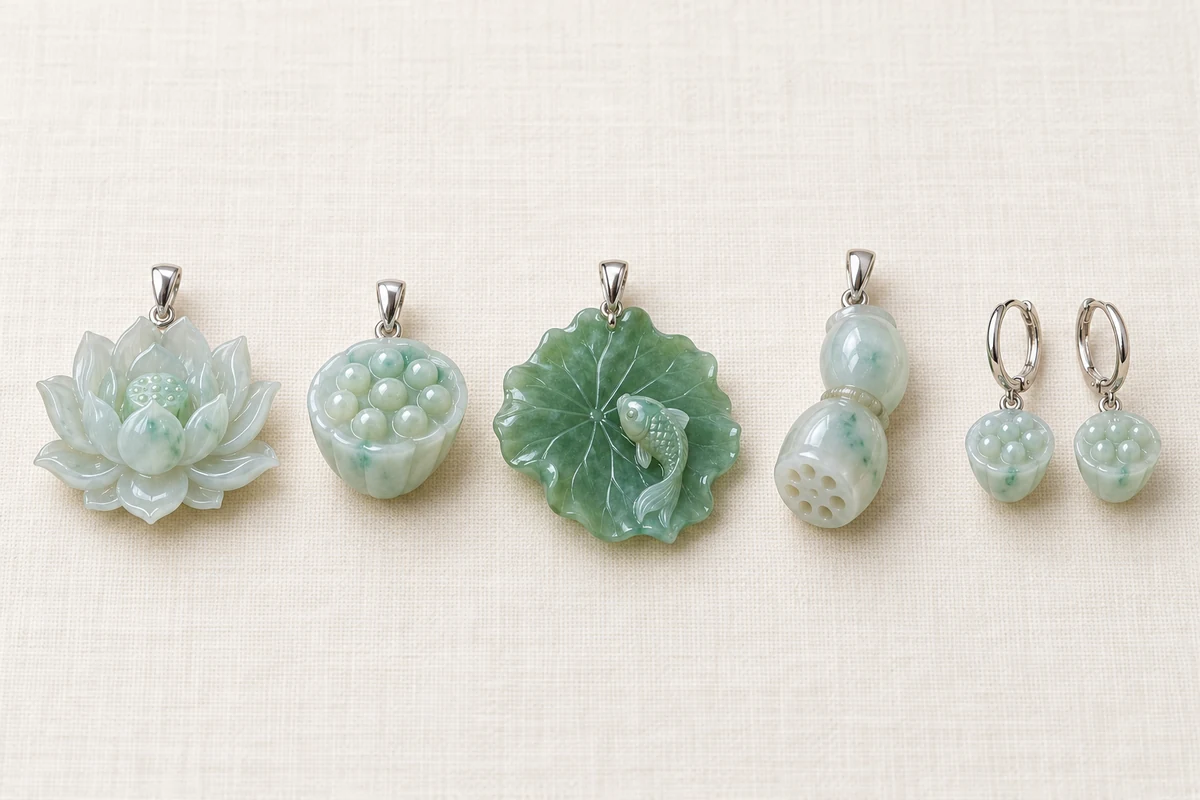
| Style | Chinese name | What it looks like | Notes |
|---|---|---|---|
| Lotus flower pendant | 莲花吊坠 | An open flower with layered petals, flat or carved in the round | Petal tips are thin; check them for chips |
| Lotus seed pod pendant | 莲蓬吊坠 | A rounded pod with seeds showing on its flat top, often with a short stem | Smooth, compact, good for daily wear |
| Lotus leaf pendant | 荷叶吊坠 | A curled leaf with veins, often with a fish, frog or dewdrop | Green material is often placed on the leaf |
| Lotus root pendant | 莲藕吊坠 | A short root with one or two joints and holes on the cut end | Simple shape, often plain or with a small leaf |
| Lotus seed pod earrings | 莲蓬耳饰 | Two small pods on hooks, studs or hoops | The pair has to match in base and color |
| Carved lotus bangle | 雕花手镯 | A bangle with a lotus carved in relief on one side | Much less common than plain bangles |
| Guanyin on a lotus | 坐莲观音 | A seated figure on a lotus base | A religious pendant; different buying rules |
Color placement (俏色). Good carvers place each color where it makes sense: green on the leaf, white or icy stone for the flower, a lavender or yellow patch for a petal or a fish. A piece where the colors follow the design is called 俏色 and is valued more than the same shape in one color. On an icy base with floating flowers (飘花), the flowers can read as water around the lotus; see floating flower jadeite.
Carved bangles. Most jadeite bangles are left plain, because a clean bangle shows its material best. When a bangle is carved, it is often to work around a crack: the carver cuts away the cracked area, and the finished bangle can be completely clean. A carved lotus bangle can be lovely and good value; before you buy, backlight the carved area to confirm no line is left.
"White jade lotus". In English, "white jade" often means nephrite (和田玉) or even other white stones, not jadeite. A white or colorless jadeite lotus is usually sold as icy (冰种) or white jadeite. If the material matters to you, check that the certificate says jadeite (翡翠). For what icy means, see icy jadeite.
How do you judge the carving on a jade lotus?
Check the material first, then the carving, then the setting. The lotus is a good test of a carver, because petals, seeds and leaf veins all show whether time was spent.
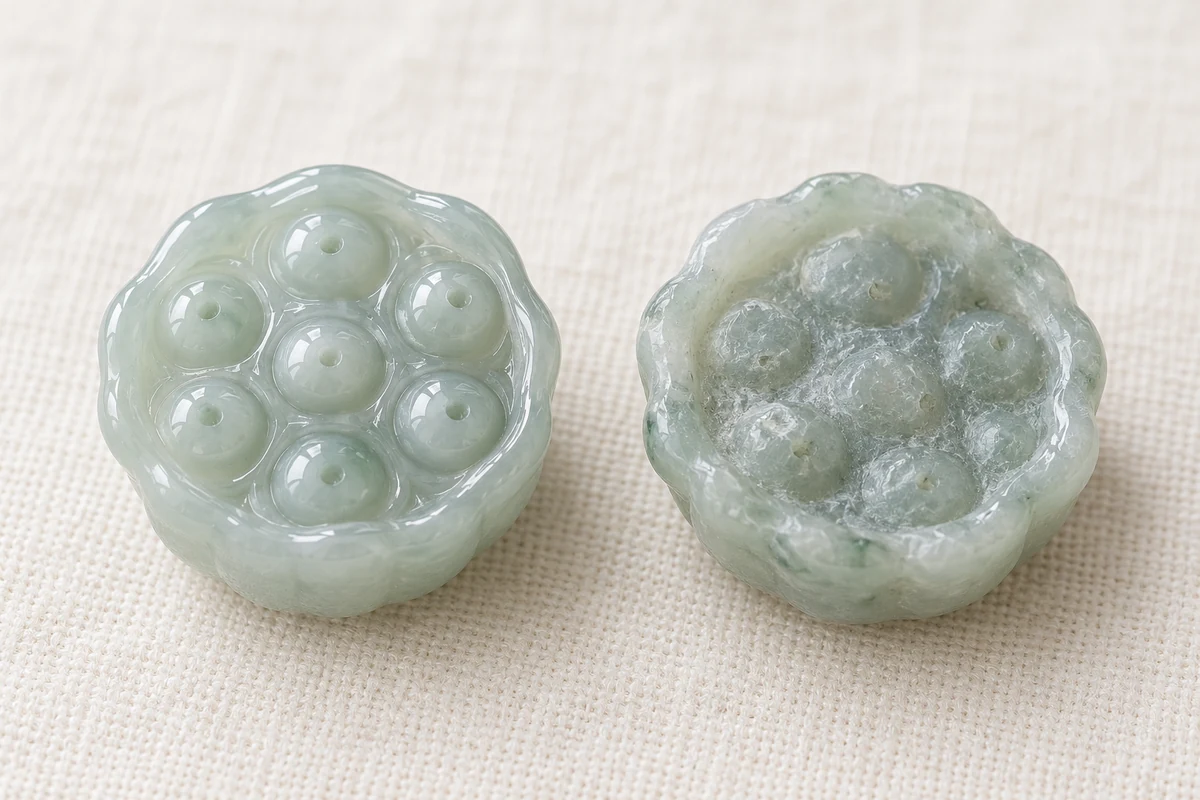
- Seed pod: look at the seeds. Good seeds are round and full (饱满), evenly spaced and cleanly set into the top of the pod. The rim should be a smooth curve. Flat seeds, seeds of very different sizes or seeds that blur into the surface point to thin rough or hurried work, as in the right-hand pod above.
- Flower: look at the petals. Petals should be layered, with depth between them, and each petal should curve naturally to its tip. Look from the side: a good flower has body. Petals cut as shallow lines on a flat slice look fine from the front and flat from the side.
- Leaf: follow the veins and the edge. Veins should radiate from the center and taper. The edge of the leaf may curl, but the curl should be smooth, with no wobbles.
- Check the polish in the hollows. The high points of any carving are easy to polish; the gaps between petals and seeds are not. Dull, rough hollows show where finishing time was saved.
- Machine or hand work. Many low- and mid-grade lotus pieces are cut on CNC carving machines and finished by hand. Machine-cut pieces tend to look identical, with shallow, even cuts. Careful hand finishing gives deeper, cleaner petals and fuller seeds. For more on this, see jadeite carving craftsmanship.
- Backlight the thin parts. Petal tips, leaf edges, the stem and the bail hole are the thinnest parts and the most likely to chip or crack. Shine a small flashlight through them and turn the piece slowly. A line that cuts the light sharply is a crack; a fine line that does not break the light may be a healed stone line.
- Check the material. In daylight, an icy or better base lets light pass easily through the seeds and petals. With green or floating flowers, look at where the color falls and whether it suits the design.
- Ask for the certificate. Bright green lotus leaves and small, very clear lotus pieces are common shapes for bleached and resin-filled (Type B) and dyed (Type C) jadeite. Buy natural Type A with a lab certificate. See how to spot treated jadeite.
When buying online or from a livestream, ask for a video of the piece turned under a flashlight, a side view and both faces.
Gold or silver: how are jade lotus pieces set?
Many lotus pieces are worn on a plain cord, but most finished pendants and all earrings are set in metal.
- 18K gold. Gold-set jadeite is mostly made in China in 18K (75%) gold, usually white or rose gold. White gold suits icy, colorless and blue-green pieces because it keeps the stone looking clean. A gold setting can add a metal stem, a leaf or a small cap over the bail hole, which also protects a thin stem.
- 925 silver. Every silver setting sold on JadeiteHub is 925 sterling silver. Silver costs much less than gold, so more of the price goes into the stone. It tarnishes and needs more cleaning.
For earrings, check the hooks or hoops close properly and that both pods hang at the same height. For a fuller comparison of metals, see silver vs gold settings for jadeite; for how to hang a lotus pendant, see jade pendant cord and chain; and for earring styles, see how to choose jadeite earrings.
What lotus pieces are on sale at JadeiteHub?
Right now there is one: JH-000078, a pair of lotus seed pod earrings. It is certified natural Type A jadeite. The price is as of 24 October 2026 and may change.
| Listing | Piece | Material | Setting | Size of each pod | Price |
|---|---|---|---|---|---|
| JH-000078 | Lotus seed pod earrings (pair) | Icy, soft blue-green floating flowers | 18K white gold hoops | About 18.9 × 14.2 × 5.6 mm and 17.5 × 14.2 × 5 mm | US$979 |
Why this pair is a good example of the motif:
- The seed pod suits icy material. The rounded seeds gather light, so an icy base glows through them, and the soft blue-green flowers sit in the stone like water under the pod.
- The two pods are matched. Both are 14.2 mm wide, with only a small difference in length; matching base, color and shape is the hard part of any pair of earrings.
- White gold keeps the look cool and clean. It matches the colorless base and the blue-green flowers.
For every pendant currently listed, including other motifs, browse the JadeiteHub pendants.
How do you care for a jade lotus?
- Take it off for sport, heavy work and sleep. Petal tips, leaf edges and the stem are the parts most likely to chip.
- Wash it in lukewarm water with mild soap and dry it; a soft toothbrush cleans the gaps between petals and seeds.
- Store it on its own, away from harder stones and other jewelry, and keep perfume and strong cleaners off it.
- Check prongs, hoops and bails now and then, and replace a cord as soon as it frays at the drill hole.
Every piece on JadeiteHub is certified natural Type A jadeite and ships with its own certificate from an accredited Chinese national gem lab (国检). If it does not match its description, you get a full refund.
FAQ
What does a jade lotus pendant mean?
Traditionally it means purity and blessings that continue: 莲 (lotus) sounds like 连 (continuing), and 荷 (lotus) sounds like 和 (harmony). It also recalls the lotus rising clean from mud. These are traditional wishes, not promises.
What does a jade lotus seed pod (莲蓬) mean?
A pod full of seeds stands for many children and a growing family (多子多福). Lotus seeds (莲子) sound like 连子, sons one after another, so the pod is also read as 连生贵子. It is a popular gift for newlyweds and new parents.
What does a jade lotus root pendant mean?
The lotus root, 藕 (ǒu), sounds like 偶 (ǒu), a pair or spouse, so it is read as a good match and a happy couple. Sellers also say its holes mean every road open, but that is a later sales reading.
What does a jade lotus with a fish mean?
It reads 连年有余 (lián nián yǒu yú): lotus 莲 sounds like 连 (continuing) and fish 鱼 sounds like 余 (surplus), so together they wish abundance year after year. It is one of the most common lotus combinations.
Is a jade lotus pendant only for Buddhists?
No. In Buddhism the lotus stands for purity, but a lotus pendant is a flower, not a Buddha image, and people of any faith or none wear it. Buddhist buyers may treat it with the same respect as other religious pieces.
Is a white jade lotus pendant jadeite?
Not always. In English, white jade often means nephrite or other white stones. A colorless or white jadeite lotus is usually sold as icy or white jadeite. Check that the certificate names the material as jadeite (翡翠).