Jade Gourd Pendant Meaning: Styles and How to Choose
Updated
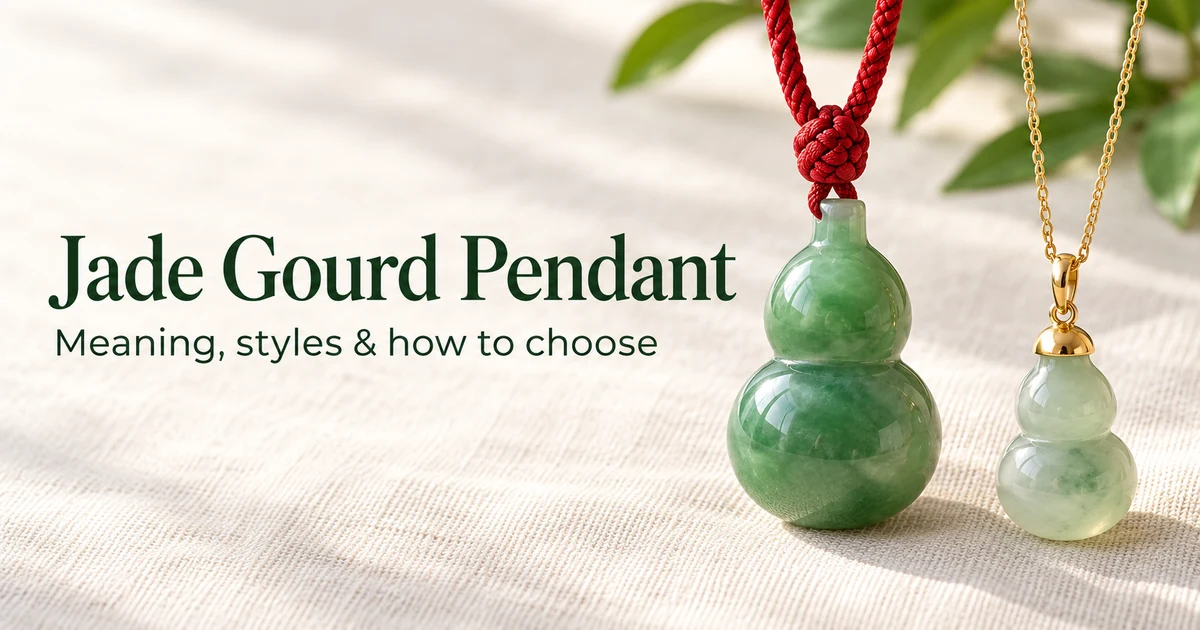
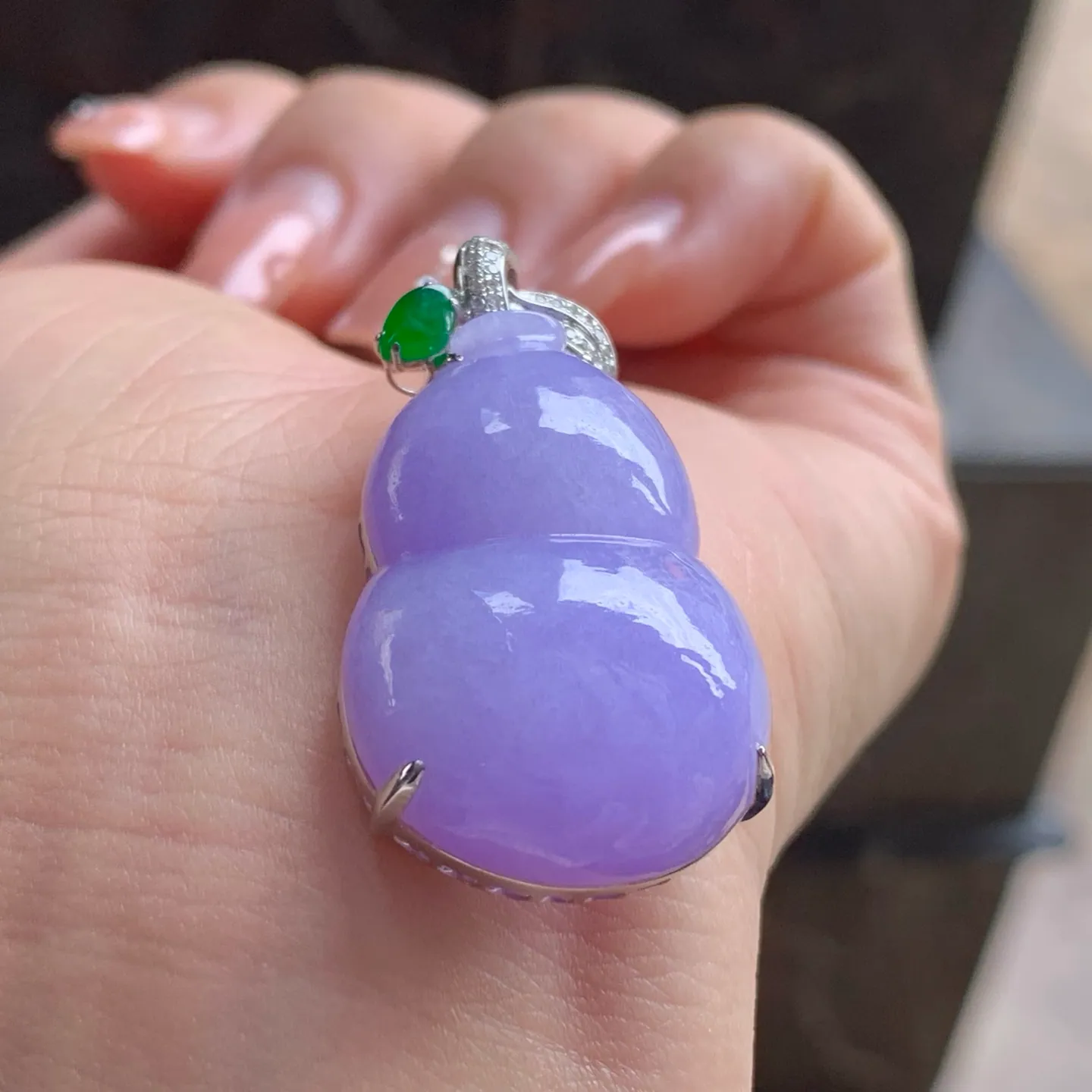
The gourd (葫芦, hulu) is one of the most popular jadeite pendants because its name sounds like fu lu (福禄), fortune and prosperity. By tradition it is also said to hold in wealth, guard health and, with its many seeds, stand for many descendants. These are cultural meanings, not physical effects: jade does not attract money. Choose a gourd by its material first: look for cracks at the thin waist and the neck with a flashlight, check that the two bulbs are full and balanced, check the polish and drill hole, and buy natural Type A jadeite with a lab certificate.
What does a jade gourd pendant mean?
A jade gourd pendant traditionally stands for fortune and prosperity, because the Chinese word for gourd, hulu (葫芦), sounds like fu lu (福禄), "blessings and prosperity". Around that pun the gourd has collected several more meanings over the centuries: it is said to hold in wealth, to protect health, and, because it is full of seeds, to wish a family many descendants.
That mix of meanings, plus a simple, rounded shape that suits almost any material, is why the gourd is one of the best-selling jadeite pendants in China and Southeast Asia, alongside the Buddha, Guanyin and the safety buckle. For a side-by-side overview of all the common pendant designs, see jadeite pendant meanings. This guide goes deeper on the gourd alone: what each style means, how dealers grade it, and what to check before you buy.
Why does the gourd stand for fortune and prosperity?
Mainly because of the sound. In Mandarin, hulu (葫芦) and fu lu (福禄) are close, and Chinese decorative art is built on this kind of wordplay: a bat (蝠, fu) means blessings (福, fu), a fish (鱼, yu) means abundance (余, yu). The gourd simply carries the pun in its name.
The other meanings come from how the gourd was used and how it looks:
| Traditional meaning | Where it comes from | How sellers often say it |
|---|---|---|
| Fortune and prosperity (福禄) | The sound of hulu | "A gourd brings fu lu" |
| Keeping wealth in | A wide belly and a narrow mouth: things go in and do not spill out | "Gathers wealth" (聚财), "keeps wealth" (守财) |
| Health and protection | Gourds were carried as medicine flasks; the idiom 悬壶济世 ("hanging up the gourd to help the world") describes a doctor's work. Taoist immortals such as Li Tieguai carry one, and folk feng shui says a gourd "absorbs" bad energy | "A gourd guards the body" |
| Many descendants | A gourd is full of seeds | 多子多福, "many children, much happiness" |
| Ten thousand generations | Vine (蔓, man) sounds like ten thousand (万, wan); with the gourd it reads 福禄万代 | "Fortune for ten thousand generations" |
These are the traditional readings. Families and regions tell them differently, and none of them is a rule. For how beliefs about jade work in general, see jadeite meaning and beliefs.
Does a jade gourd really attract wealth or have health effects?
No. A jadeite gourd has no proven physical effect on money, health or luck. When people search for the "effects" (功效) of a jade gourd, or ask in Thai whether a jade gourd calls in wealth (เรียกทรัพย์), what they are really asking about is the meaning the gourd carries in Chinese and Southeast Asian tradition.
That meaning is real in a cultural sense. A gourd given to a parent, to a friend opening a shop or to a newly married couple says "I wish you prosperity", and people value that message. Wearing one as a reminder of a wish, or because your family always has, is a good reason. Buying one because a seller says it will make you rich is not.
Be careful with sellers who attach promises to the pendant ("absorbs bad luck", "guaranteed to bring wealth", "blessed and activated"). A blessing or consecration may matter to you personally, but it does not change the stone, and you should not pay a jadeite premium for a promise. Judge the jade itself.
What styles of jade gourd are there?
Five styles cover most of what you will see in shops and livestreams.
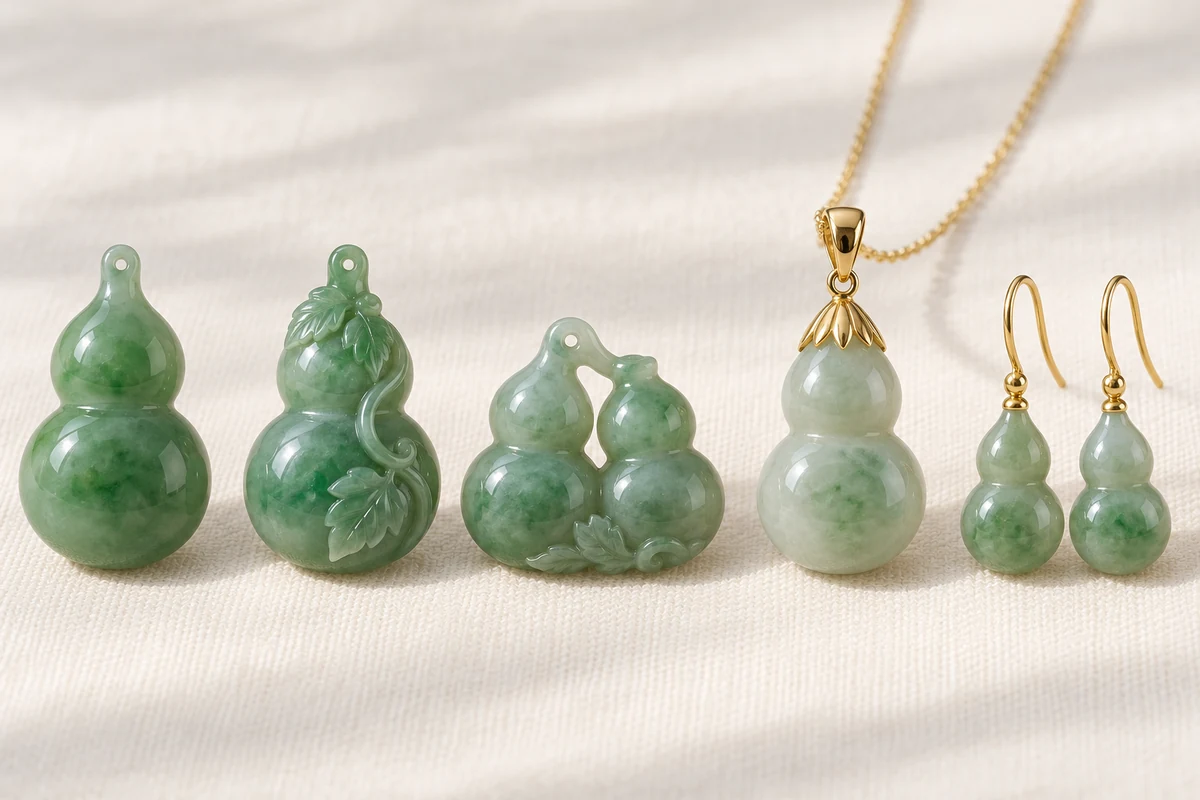
| Style | Chinese name | What it looks like | Extra meaning |
|---|---|---|---|
| Plain gourd | 素葫芦 (su hulu) | Smooth two-bulb shape, no carving except a small stem | The pure fu lu pun; a "clean" look |
| Gourd with leaves and vines | 藤蔓葫芦, 福禄万代 | Leaves, tendrils and sometimes a smaller gourd carved around the body | 福禄万代: fortune for ten thousand generations |
| Double gourd | 双葫芦 | Two gourds carved side by side in one piece | Double fortune; sometimes given to couples |
| Gold-set gourd | 金镶葫芦 | A gold cap over the neck with a bail; sometimes gold leaves or a small diamond | Same meaning; the setting adds protection and style |
| Small gourds on earrings and bead chains | 葫芦耳环, 葫芦手链 | Small gourds as drops, studs, or charms between beads | Same meaning in a lighter, everyday form |
A note on the name: in English a gourd with two bulbs is sometimes called a "double gourd", because the shape itself has two parts. Chinese sellers use 双葫芦 for two gourds together in one pendant, as in the third item above.
There are also gourds carved with a bat (福), a coin (钱) or a small Buddha, and gourds made as car hangings or small ornaments for the home. The meaning is built the same way: each motif adds its own pun.
Why are plain gourds usually cut from cleaner material?
Because a plain surface hides nothing. Carvers have a saying, 无绺不作花: "without a crack, you don't carve flowers". Carving is often used to cut away or cover cracks, cotton and dark spots, so a piece of rough with flaws tends to become a gourd with leaves and vines, while the cleanest pieces are kept smooth to show off their translucency and color.
This has two consequences for a buyer:
- A plain gourd of good material is priced on its material. Translucency (水头), texture (种) and color decide almost everything, and a crack has nowhere to hide. That makes a plain gourd easier to judge honestly.
- A heavily carved gourd deserves a closer look under light. Leaves and tendrils are not a bad sign in themselves; many are carved because the design is wanted, and good carving adds value. But check whether a leaf sits exactly where a crack would run.
In the workshops of Guangdong, low- and mid-grade carved pendants, gourds with vines included, are commonly cut on CNC carving machines and then finished by hand. Sihui is known for mid- and low-grade carvings and Jieyang for high-end small pendants. Machine-cut gourds are often symmetrical and neat, but the leaves can look flat and identical from piece to piece. For how to judge carving quality, see jadeite carving craftsmanship.
How do you check a jade gourd before buying?
Check for cracks at the waist and neck first, then the shape, then the finish and the material.
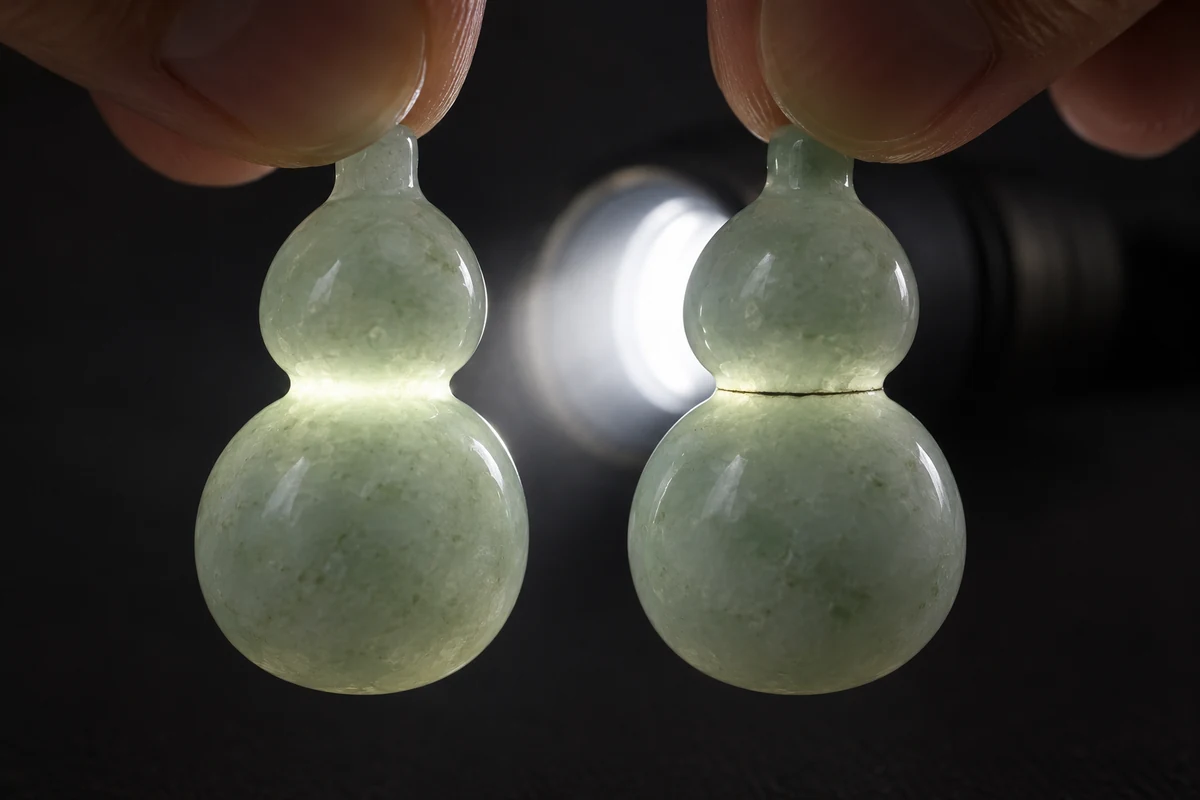
- Backlight the waist and neck. The waist (the narrow part between the two bulbs) and the neck (under the stem) are the thinnest parts of a gourd, and the places most likely to crack if it is knocked or dropped. Shine a small white flashlight through them from behind and turn the piece slowly. The waist naturally glows brighter than the thick bulbs; that is normal. What you are looking for is a sharp line that cuts the light across the waist. See cotton and cracks in jadeite.
- Look at the symmetry. Hold the gourd upright and look straight at it. The upper bulb is normally smaller than the lower one, and both should sit on one straight axis, round and full (饱满) rather than flat. A lopsided bulb or a waist cut deeper on one side often means the cutter was working around a flaw.
- Look from the side. Many cheaper gourds are cut from a flat slice and are rounded only at the edges, so the gourd looks fat from the front and thin from the side. A fuller, more three-dimensional gourd needs a thicker piece of rough and costs more.
- Check the polish. The bulbs should be glassy and even, with no dull patches, ripples or scratches. Polish inside the waist and around the leaves is the hard part; dealers check it closely because it shows how much hand work went in.
- Check the drill hole. On a cord-worn gourd the hole usually runs through the stem. It should be clean and smooth, with no chips at the rim and no crack running out from it.
- On gold-set gourds, ask about what the cap covers. A gold cap sits exactly on the neck, the weakest spot. Ask for a backlit photo of the neck before setting, or a certificate photo of the stone without the cap.
- Confirm it is Type A. The gourd is a popular shape for bleached and resin-filled (Type B) and dyed (Type C) jadeite, as well as for serpentine, dyed quartzite and glass. A bright, even green gourd at a low price is the classic warning sign. See how to spot treated jadeite, and buy with a certificate from a recognized gem lab that names the mineral as jadeite and states it is natural.
When buying online or from a livestream, ask for a video of the gourd turned against a flashlight, a side view and both faces.
What size jade gourd should I choose?
Choose by how it will be worn and your own taste. Gourds are usually described by their height in millimetres.
Size buying reference. The figures below are the height of the jade itself, without any setting or cord. They are reference ranges only; weight, thickness and design matter as much as height.
| Style or use | Reference height | Notes |
|---|---|---|
| Earrings | about 8–15 mm | Matching color and translucency in a pair matters most |
| Charms on bead chains and cord bracelets | about 10–20 mm | Small enough not to catch on things |
| Small, delicate pendant | about 18–28 mm | Light enough for a fine chain and daily wear |
| Standard pendant | about 28–40 mm | The most common size on cord |
| Large or statement pendant | above 40 mm | Heavy; better on a thicker cord or a strong chain |
Fuller gourds look bigger than their height suggests. Holding a coin or a ruler at your collarbone in a mirror helps.
Should you wear a jade gourd on a cord or a chain?
Both work; the choice depends on the setting and how you live.
- Cord. The traditional way for a plain gourd with a drilled stem. A braided cord with a diamond knot (金刚结) above the gourd and a sliding knot to adjust length is the usual style. Red cord is popular for gifts; black or dark cord is common for men. Cord is soft on the stone but needs replacing when it frays at the hole.
- Chain. Needs a bail: a gold or silver cap over the neck, or a jump ring through the stem. A chain is easier to keep clean and suits office wear. Check that the bail is closed and that the chain is strong enough for the gourd's weight.
For knots, cord sizes and chain lengths, see how to hang a jade pendant on a cord or chain. For what a gold setting adds and costs, see gold-set jadeite. Gold-set jadeite is mostly made in China in 18K (75%) gold, and every silver setting sold on JadeiteHub is 925 sterling silver.
Who can wear a jade gourd, and are there taboos?
Anyone. There is no tradition that limits the gourd to men or women, or to any zodiac sign or birth year. It is often given to parents and grandparents as a fortune-and-health wish, to friends starting a business, and to couples hoping for children. For babies, think about safety first: small pendants and cords are a choking and strangling risk, and many families keep a baby's gourd as a keepsake until the child is older.
The so-called taboos you may read online (do not let others touch it, do not wear it with other charms, it must be blessed before wearing) are folk customs or sales talk, not rules. Follow the ones that matter to your family; none of them changes the jade.
How do I care for a jade gourd?
- Take it off for sport, heavy work and sleep. The waist is the most likely place to crack if it hits a hard floor.
- Wash it in lukewarm water with mild soap when it gets dull, and dry it, especially in the folds of carved leaves where dirt collects. A soft toothbrush helps.
- Keep it away from harder stones and from other jewelry in the box, and keep perfume and strong cleaners off it.
- Replace the cord as soon as it frays at the drill hole.
On JadeiteHub we list only jadeite with a lab certificate. Every sold piece is checked against its certificate at our inspection center before it ships, and if it does not match its description you get a full refund.
FAQ
What does a jade gourd pendant mean?
Traditionally it stands for fortune and prosperity, because hulu (葫芦, gourd) sounds like fu lu (福禄). It is also said to hold in wealth, protect health and, with its many seeds, wish for many descendants. These are traditional meanings, not promises.
Does a jade gourd attract wealth?
No. Jade has no proven physical effect on money or luck. The gourd's link with wealth is a cultural meaning and a wish, which is why it is a popular gift. Judge the jade itself, not a seller's promise.
What is the difference between a plain gourd and a gourd with leaves?
A plain gourd shows the material with nothing hidden, so it is usually cut from cleaner rough and priced on translucency, texture and color. Leaves and vines add the meaning 'fortune for ten thousand generations', and carving can also cover cracks, so check carved gourds under a flashlight.
Where does a jade gourd usually crack?
At the waist between the two bulbs and at the neck under the stem, because they are the thinnest parts. Backlight them with a flashlight: a bright, even glow at the waist is normal, a sharp line across it is a crack.
Can men wear a jade gourd pendant?
Yes. The gourd has no gender rule. Men often choose a larger, fuller gourd on a black or dark cord or a strong chain.
Should a jade gourd be worn on a cord or a chain?
A plain gourd with a drilled stem is traditionally worn on a braided cord. A gourd with a gold or silver cap and bail suits a chain. Either is fine; check that the cord fits the hole and the bail is closed.