What Is Red Jadeite? Red and Yellow Jade, Real or Heated
Updated
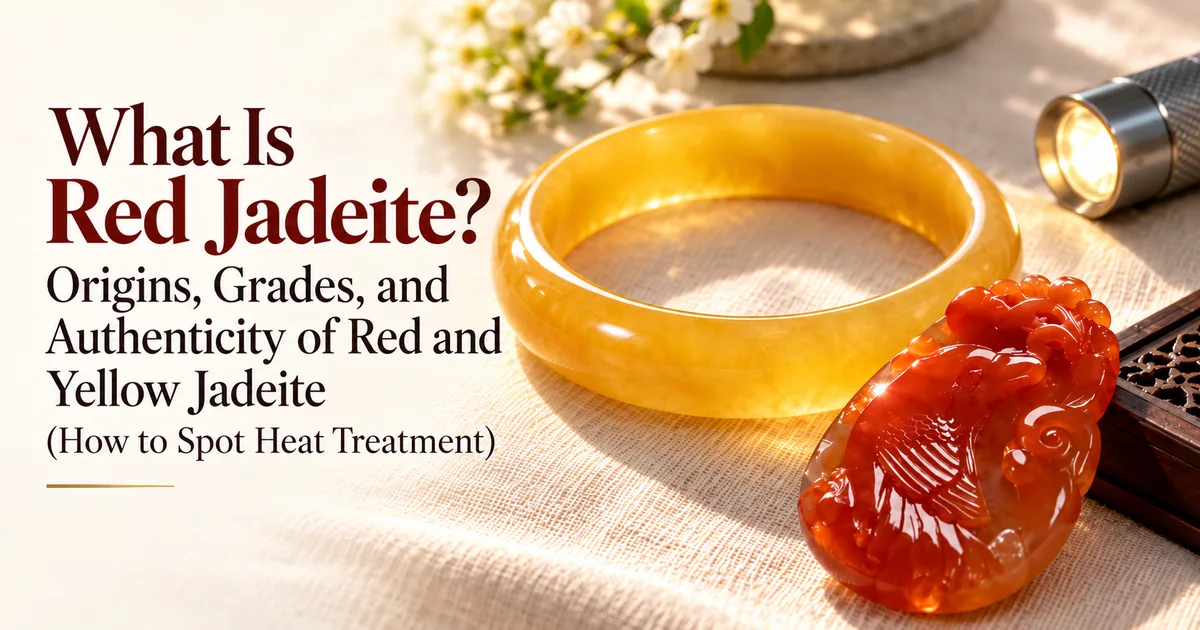
Red jadeite (红翡, hong fei) is jadeite colored red to orange-red by iron oxides that seeped in near the boulder's skin; yellow jadeite (黄翡) is the same process in yellow to honey tones. Bright, translucent red or yellow on fine texture is rare; most is opaque and brownish. Some red is made by heating yellow-brown material, which most of the trade does not accept as natural red, and some is dyed.
What is red jadeite?
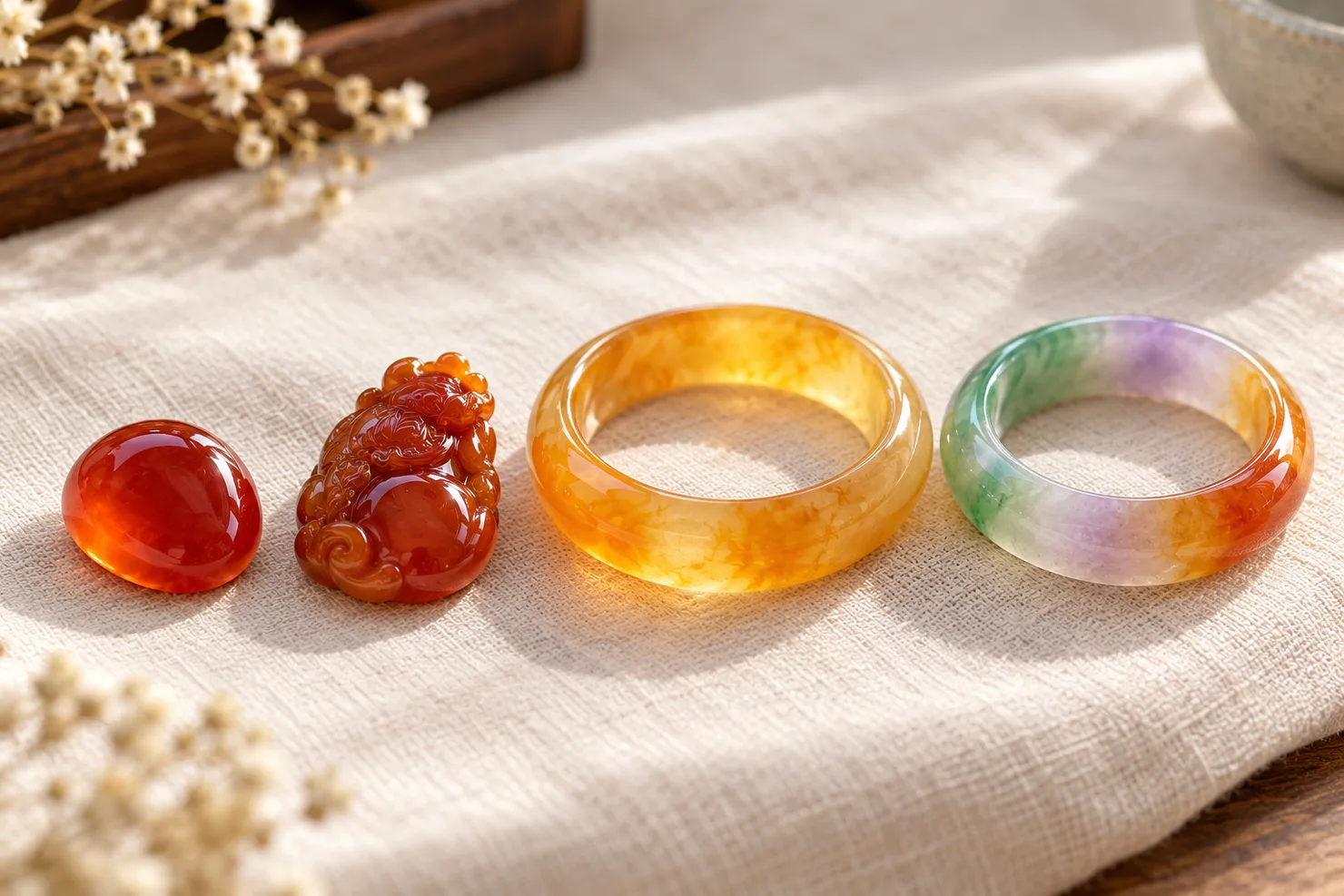
Red jadeite (红翡, hong fei) is jadeite whose color, from orange-red to deep red, comes from iron oxides that seeped between the grains near the outer skin of the boulder. Yellow jadeite (黄翡, huang fei) is the same thing in yellow, honey and brownish-yellow tones. Both are real jadeite, the same mineral as green jadeite. Only the coloring agent is different.
The name 翡翠 (feicui, jadeite) itself comes from these colors. It first named the kingfisher bird: an old Chinese dictionary describes 翡 (fei) as a bird with red feathers and 翠 (cui) as one with green feathers. When the stone arrived from Burma, the trade borrowed the name. That is why, in the trade, "fei" still means the red and yellow tones and "cui" the green.
In practice the trade uses a few more color words:
| Trade name | Chinese | What it looks like |
|---|---|---|
| Red jadeite | 红翡 | Orange-red to true red |
| Yellow jadeite | 黄翡 | Lemon to golden yellow |
| Honey yellow | 蜜黄 | Warm, translucent yellow-orange, like honey |
| Brown or brownish red | 棕红 / 褐色 / 褐红 | Red or yellow muddied with brown; the most common kind |
| Yellow with green | 黄加绿 | Yellow and green in one piece |
| Fu lu shou | 福禄寿 | Three colors in one piece: usually green, lavender and red or yellow |
Lavender with green in one piece is called 春带彩 (chun dai cai, "spring with color"). When red or yellow joins them, it becomes 福禄寿 (fu lu shou), named after the three gods of fortune, prosperity and longevity. For the other colors, see the jadeite colors guide.
Where does the red and yellow color come from?
Green jadeite gets its color mainly from chromium built into the crystals as the rock formed. Red and yellow are different: they are secondary colors, added much later.
Jadeite boulders lie for a very long time in riverbeds and weathered gravel. Water carrying iron seeps along the boundaries between the grains of the outer layer and leaves iron oxides behind. Yellow-brown iron hydroxides give yellow and brown; red iron oxide (hematite) gives red. In general, the drier and more thoroughly oxidized the iron, the redder the color.
This has three practical consequences:
- The color sits near the skin. Under the rough skin (皮, pi) there is often a thin weathered band the trade calls the "fog" (雾, wu). Red and yellow are usually found in the skin and this band, not deep inside. Red fog (红雾) and yellow fog (黄雾) are what carvers look for.
- The layer is thin, so big clean red is rare. A thick bangle in even, bright red needs a lot of colored material. Many red pieces are small: cabochons, beads, small pendants.
- Many pieces are carved with the skin. Carvers plan the design around a red or yellow skin, for example a red bat, fish or persimmon on a white or green body. This is called 俏色 (qiao se), using the color cleverly. A carving that follows a natural skin color is a good sign that the color is where nature put it.
Because the color fills the spaces between grains, it also follows the texture. Fine, tight texture holds clear, bright color; coarse texture usually gives duller, more opaque color.
What makes good red and yellow jadeite?
Dealers judge red and yellow jadeite the same way as green: color first, then texture and translucency, then cracks and size. For how texture and translucency work, see zhong, shui and se.
| Grade | Trade name | What it looks like | How often you see it |
|---|---|---|---|
| Top red | 鸡冠红 ("cockscomb red") | Bright, pure red, translucent, on fine texture | Rare |
| Good red | 正红 / 橙红 | True red to orange-red, fairly bright, semi-translucent | Uncommon |
| Common red | 棕红 / 褐红 | Red with brown, dull, mostly opaque | Common |
| Top yellow | 鸡油黄 ("chicken-fat yellow") | Bright, rich, warm yellow, translucent, on fine texture | Rare |
| Good yellow | 蜜黄 (honey yellow) | Clear honey to amber tone, translucent | Uncommon |
| Common yellow | 黄褐 / 栗黄 | Yellow with brown or grey, opaque | Common |
What dealers check, in order:
- Hue. The less brown and grey, the better. A red that leans toward pure red is valued over one that leans toward brown.
- Brightness. Lively color beats dark, muddy color. In Chinese, bright is 阳 (yang) and the opposite is 闷 (men, "stuffy").
- Translucency. Translucent red or yellow on icy or fine texture is the rarest combination. Most red is opaque.
- Evenness and quantity. Color across the whole piece is rarer than a patch; on carvings, a well-placed patch can be the point.
- Cracks. Because the color sits in the weathered outer layer, red and yellow areas often carry more fine cracks. Look for them.
The trade names in the table are not used consistently. One seller's "chicken-fat yellow" is another's ordinary brownish yellow. Judge the stone, not the label.
Is heated red jadeite still "Type A"?
Most of the trade does not accept heated red. It is not treated as natural red jadeite, and it is worth far less than natural red.
Heating (烤色, kao se, "baked color"; also 加热处理) means warming yellow or brown jadeite so that the iron in it turns red, a change that happens only slowly in nature. It is an old and widespread practice, which is why the question comes up so often with red jadeite.
Some secondary facts are still worth knowing:
- The structure is not damaged and nothing is added. Heating uses no acid, resin or dye, so a heated piece is not Type B or Type C.
- A certificate may not mention it. China's national standard generally classes heating of jadeite as an "enhancement" (优化), which a certificate is not required to state. Some labs elsewhere note heating when they can detect it.
- Heating cannot always be detected, even in a lab.
So "Type A" on a certificate tells you the piece is not bleached, filled or dyed. It does not always tell you whether a red was heated. Ask the seller to state in writing that the color is natural, not heated. For what A, B and C mean, see Type A vs Type B vs Type C jadeite.
Dyed red is a different matter. Dye is a treatment everywhere: it makes the piece Type C (often B+C if it was also bleached and filled), and a proper lab certificate will say so.
How can you tell natural, heated and dyed red apart?
No home check can prove anything here. These are the signs dealers use to decide whether to ask questions:
| Natural red | Heated red (look) | Dyed red (Type C) | |
|---|---|---|---|
| Color tone | Varied: red with orange or yellow areas | Often orange-red to brick red, one tone | Often too bright or too even |
| Translucency | Can be translucent where texture is fine | Tends to look dry and dull, less translucent | Varies; often glassy surface with flat color |
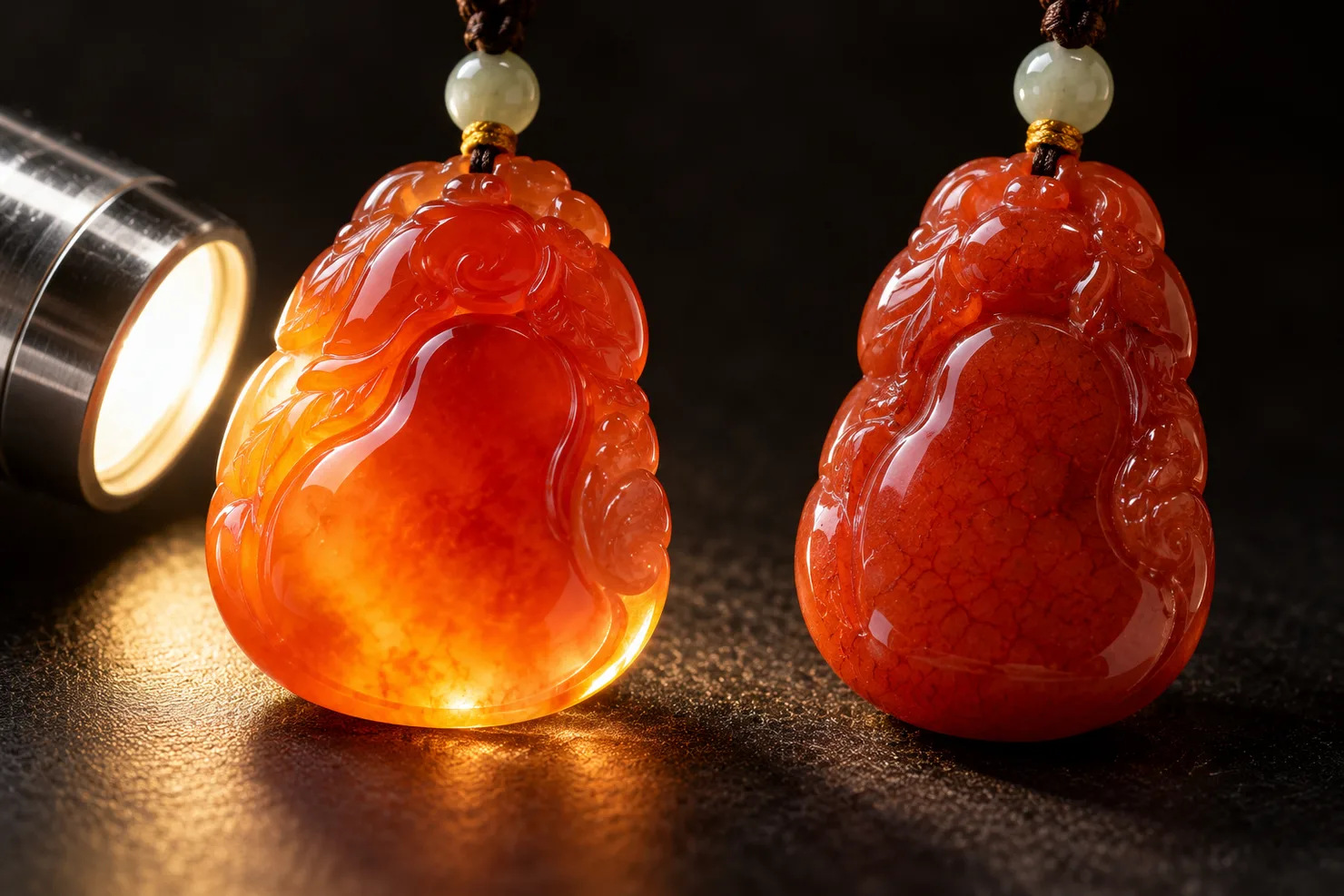
| Where the color sits | Fades gradually, usually from the skin side inward | Even across the surface, regardless of skin | Collects in cracks, grain boundaries and drill holes |
| Under a loupe | Color between grains, no network | Fine dry cracks may show | A fine web of color along cracks, paler gaps between |
| Lab result | Jadeite; Type A | Often still "Type A"; heating sometimes noted. The trade values it far below natural red | Treated (dyed); Type C or B+C |
How to look:
- Daylight first. Look at the color in daylight near a window, not under warm shop lamps. Warm light makes brownish red and yellow look richer than they are.
- Reflected light, then a flashlight. In reflected light, judge the hue. Then shine a small white flashlight through the piece from behind or the side. Natural red often glows a softer orange-red as light passes through; dyed color tends to show as threads and nets.
- Follow the color to the skin. On a carving or bangle, ask where the original skin was. Natural red usually sits on one side, the outer side. Red spread evenly all through a thick piece deserves a question.
- Check cracks, edges and holes with a 10× loupe. Color that is darker inside cracks or around drill holes is the classic sign of dye.
- Judge the surface. Heated pieces often look dry, a little chalky, with less shine than you would expect from their texture.
Which stones are sold as red or yellow jade?
Not every "red jade" is jadeite. These are the usual stand-ins:
| Material | Often sold as | Clue |
|---|---|---|
| Carnelian and red agate (incl. southern red agate, 南红) | "Red jade" | Very even, waxy-glassy, no grain; lighter |
| Dyed quartzite | "Red jade", "Malaysia jade" | Bright color in a net along grains |
| Red jasper | "Red jade" | Fully opaque brick red, often patterned |
| Yellow nephrite | Called 黄玉 in Chinese | Oily shine, finer and more even than yellow jadeite |
| Honey calcite, glass, resin | "Honey jade", "yellow jade" | Soft (calcite) or light (resin); bubbles in glass |
A note for Chinese readers: 黄玉 in mineral names is topaz, but in the jade trade it often means yellow nephrite. Neither is yellow jadeite. For more on telling stones apart, see jade look-alikes.
Common mistakes and seller wording to watch
- "Natural color" with no lab wording. Ask for a certificate and read what it says about treatment.
- "Blood red", "imperial red" or "chicken-fat yellow" on brownish stone. These are sales words, not grades.
- "Type A red jadeite" on a cheap, perfectly even bright red bead string. Even, bright, translucent red is rare; a whole string of it at a low price is unlikely.
- Judging by photos taken under warm light. Ask for daylight photos and a flashlight shot, and a video if the seller has one.
- Ignoring cracks in the red area. Red and yellow zones often carry more fine cracks.
When you buy, ask for a certificate from a recognized lab and check it online; see how to verify a jadeite certificate.
What do red and yellow jadeite mean?
These are traditions and sayings, not promises of any effect.
- China. Red is the color of luck and celebration, used at weddings and the New Year. A red jadeite carving is often described with the phrase 鸿运当头 (hong yun dang tou, "great luck ahead"), where 鸿 sounds like 红, red. Yellow was the emperor's color and is linked with gold and wealth. In the five elements, red belongs to Fire and yellow to Earth.
- Thailand. In the Thai day colors, red is Sunday's color and yellow is Monday's, so some people choose red or yellow jadeite to match their birth day.
- Vietnam. Red stands for luck, as at Tết. By element, red jadeite is commonly said to suit Fire (Hỏa) and Earth (Thổ), and yellow to suit Earth (Thổ) and Metal (Kim).
- Three colors. A fu lu shou piece, with green, lavender and red or yellow, is said to bring together fortune, prosperity and longevity, and is a popular gift.
For more on these traditions, see jadeite meaning and beliefs.
On JadeiteHub, listings use real photos from the seller, and some include video. Every sold piece is checked against its certificate before it ships, travels with insured shipping, and is fully refunded if it does not match the description.
FAQ
Is red jade real jade?
Red jadeite (hong fei) is real jadeite, colored by iron oxides near the skin of the boulder. But many stones sold as "red jade" are carnelian, red agate, jasper or dyed quartzite, so check the certificate.
Is heated red jadeite Type A?
Most of the trade does not accept heated red: it is not treated as natural red and is worth far less. Heating adds nothing, and China's national standard classes it as an enhancement a certificate need not state, so ask the seller to confirm in writing that the color is natural, not heated.
Why is most red jadeite brownish and opaque?
The color forms in the weathered outer layer of the boulder, where texture is often coarser and the iron is mixed with brown. Bright, translucent red on fine texture is rare.
How do I spot dyed red jadeite?
Look with a loupe at cracks, edges and drill holes. Dye collects there in a fine web of color, with paler gaps in between. A lab certificate will name dye as a treatment (Type C).
What does red jadeite mean?
In Chinese tradition red stands for luck and celebration, and yellow for wealth. These are sayings only. In the five elements, red is Fire and yellow is Earth.