Is Jade Cheaper in China Than in Myanmar? Here's Why
Updated
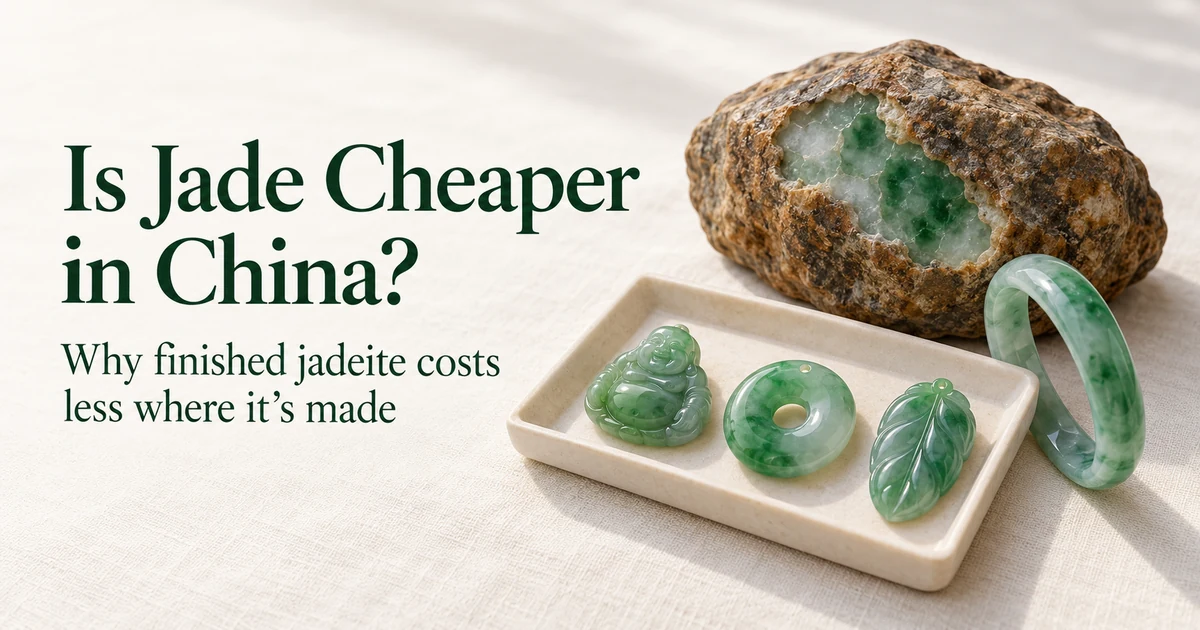
Yes for everyday jadeite. Myanmar supplies almost all gem jadeite as rough, but China has the full processing chain and the largest buyer market. A dense cluster of workshops in Guangdong turns one block into bangles, donut pendants, cabochons and beads and sells every offcut; machines, batch work and wholesale competition keep margins thin. Low-end pendants are so cheap in China that jade livestreams from Myanmar, run mostly by Chinese sellers, stock up in Sihui and then sell the same goods from Mandalay at far higher prices. Top-grade jadeite is expensive everywhere, and cheap does not mean fake: buy by certificate, not by country.
Is jade cheaper in China than in Myanmar?
For everyday low- and mid-grade jadeite, usually yes. The price of a finished bangle or pendant is set mostly by how it was processed and how many hands it passed through, not by how close you are to the mine. Myanmar supplies almost all gem jadeite as rough stone. China has the full processing chain, from cutting to carving, polishing, setting and selling, and the largest jade-buying public in the world. That combination makes finished pieces in China plentiful and competitively priced, so much so that the jade livestreams broadcast from Myanmar are stocked largely with pendants bought in China.
There are two big exceptions. Top-quality jadeite, such as fine icy or vivid green material, is expensive everywhere, because the stone itself sets the price. And shops built for tourists are expensive in every country, China included.
| What sets the price of a finished piece | Myanmar | China (Guangdong and Yunnan hubs) |
|---|---|---|
| Rough supply | The source of almost all gem jadeite | Buys rough from Myanmar through sales, tenders and private trade |
| Workshops and skilled hands | Relatively few | Dense clusters of specialised workshops |
| Using every offcut | Harder: fewer buyers for leftovers | Every offcut has a buyer |
| Machines and batch work | Limited | Common for low- and mid-grade goods |
| Buyers | Mainly traders; almost no local retail, and almost no tourists at present | A huge home market, wholesale halls and livestream rooms |
| Result for everyday pieces | Fewer choices, not cheaper | Plentiful, with thin margins |
How does rough jadeite leave Myanmar?
Rough jadeite leaves Myanmar mostly as uncut boulders and blocks, and most of it is bought by Chinese traders. The government's official channel is the Myanma Gems Emporium, a sale organised by the state-owned Myanma Gems Enterprise (MGE), where licensed traders bid on numbered lots of rough. GIA, reporting from the 56th emporium in 2019, described nearly 3,000 Chinese buyers attending, alongside about 1,500 local merchants. A great deal of rough also changes hands privately, between miners, brokers and traders, in Myanmar and across the border.
From there, rough crosses into Yunnan, most famously from Muse to Ruili, or reaches China through tender sales and other channels, and much of it travels on to Guangdong to be cut. We trace that route step by step in the jadeite supply chain.
The size of the trade is hard to pin down. In a 2015 report, the campaign group Global Witness estimated that Myanmar's jade production in 2014 could have been worth up to US$31 billion, far more than official figures showed. Whatever the true number, what leaves Myanmar is mainly raw material. The value of a finished piece is added later, and mostly in China.
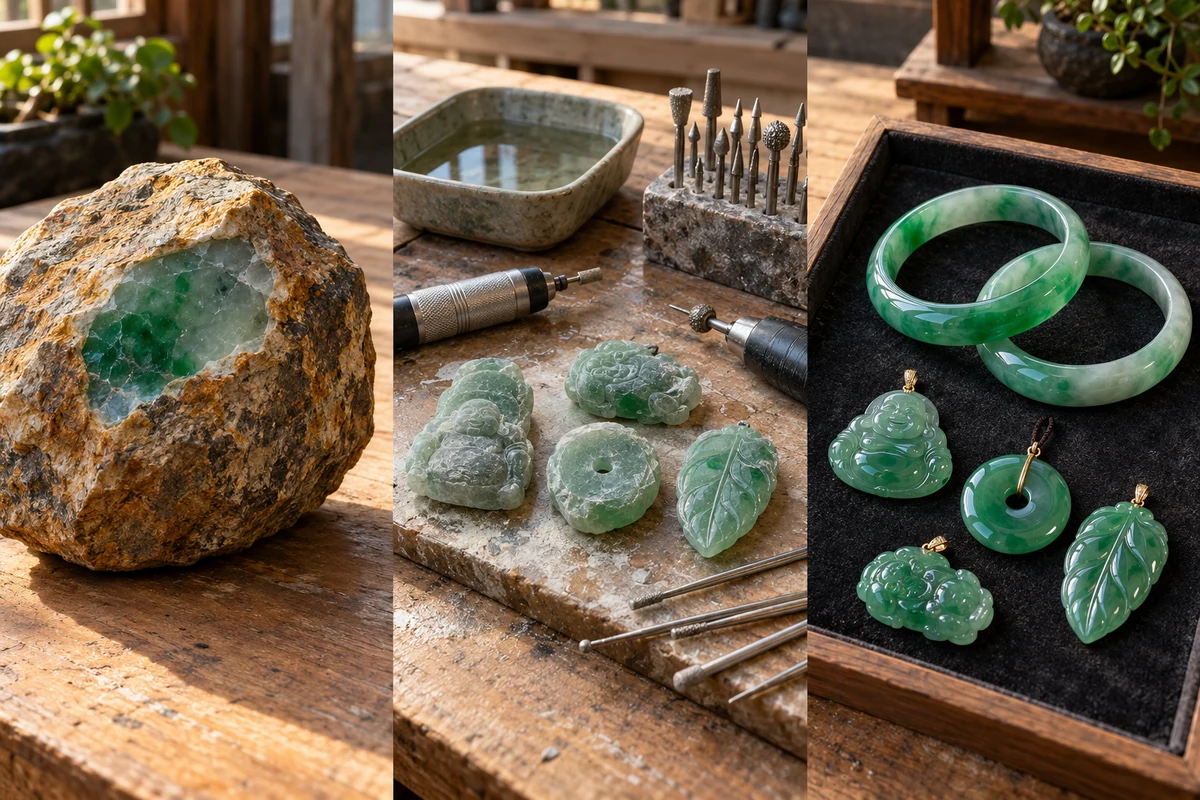
Why is jadeite processing concentrated in China?
Because only a dense industry cluster can turn one block of jadeite into many products and find a buyer for every one of them. That is the heart of the price difference.
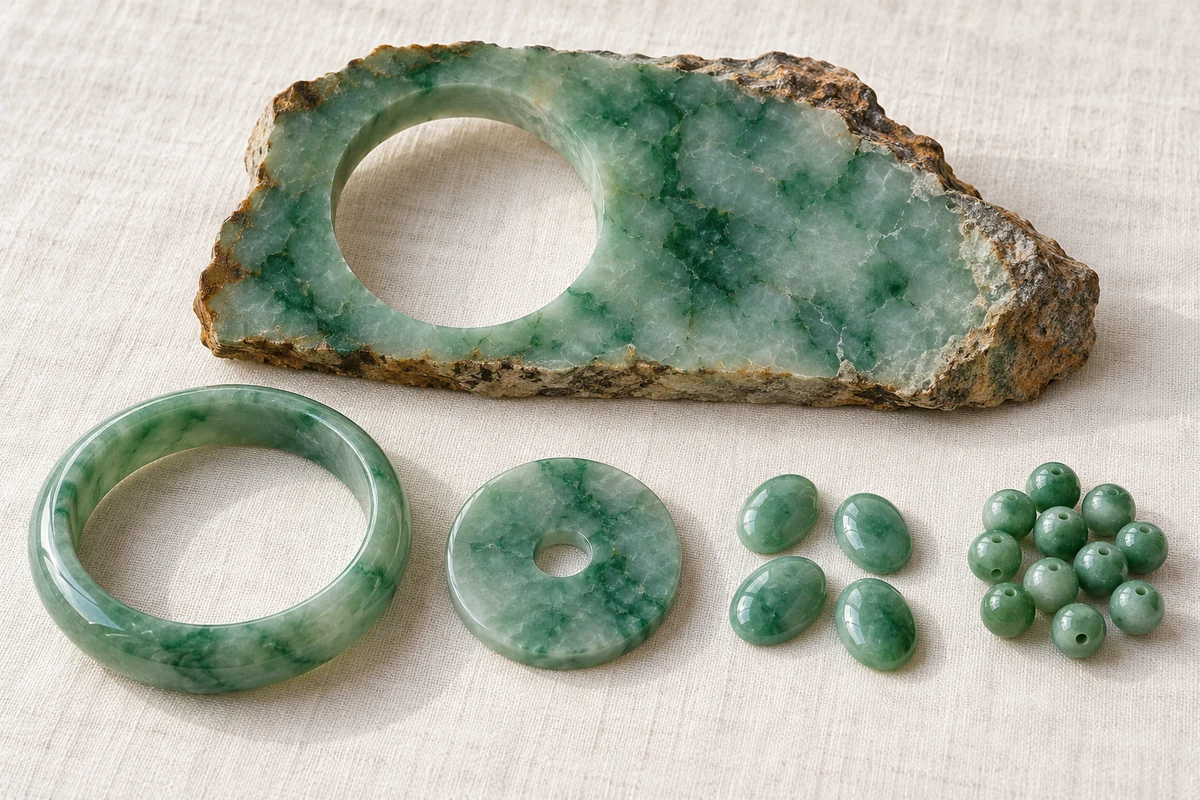
Think about how a cutter plans a slab. The best, cleanest part is cored into bangles first, because bangles earn the most from a given piece of stone. The round disc left inside each bangle, the bangle core (镯心), is not waste: it becomes a donut pendant (平安扣), a small carving or a cabochon (see the jade donut pendant). Offcuts from the edges become oval cabochons for rings and pendants. Smaller pieces become beads, and the smallest chips become tiny inlays. Every one of these products needs a different workshop and a different buyer. In a cluster where thousands of workshops and traders sit within a short drive of each other, the cutter can sell all of it the same week. Where that market does not exist, leftovers sit in a drawer, and the cost of the whole block has to be recovered from the bangles alone.
The cluster also splits the work between specialists. One workshop does nothing but open material (开料) and core bangles; another designs; carvers specialise in Buddha pendants, leaves or animals; polishers, setters, stringers and photographers each do one job. The trade even splits by town:
| Hub | What it is known for in the trade |
|---|---|
| Pingzhou (平洲), Foshan, Guangdong | The bangle hub: rough tenders, cutting and bangle wholesale |
| Sihui (四会), Guangdong | Mostly mid- and low-grade carvings and pendants, in volume |
| Jieyang (揭阳), Guangdong | Small, finely worked pendants, much of it high-end |
| Ruili and Tengchong, Yunnan | Border trade with Burmese dealers, and many livestream sellers |
Several other forces push the cost per piece down:
- Machines for the everyday goods. Low- and mid-grade Buddha and Guanyin pendants are commonly carved by CNC machines (电脑雕刻机), and beads and small pieces are polished in batches. That brings the labour cost per piece down to a fraction of hand work. Fine material still gets a skilled hand.
- Transparent prices, thin margins. In wholesale halls hundreds of stalls sell similar goods side by side, and livestream rooms show prices to thousands of viewers at once. Dealers talk about 走量 (zou liang, "moving volume"): a small profit on each piece, made up by selling many.
- Everything else nearby. Certificate labs, gold and silver setting workshops, packaging, couriers and mobile payment are all within reach, so nothing has to be sent abroad and back.
- A huge home market. China is the largest market for jadeite, so even ordinary pieces sell quickly, and stock does not tie up money for long.
Why can't Myanmar make finished jade as cheaply at home?
Myanmar has the stone, but not the industry around it on the same scale. There are workshops and carvers in Mandalay and elsewhere, and Mandalay's jade market is busy, but there are far fewer workshops, skilled hands and machines than in Guangdong, and far fewer local buyers for every grade and every offcut.
Running a workshop is also harder. Power cuts, slow and costly logistics, and an unstable currency with limits on foreign exchange have all been widely reported in Myanmar, and each adds cost to cutting and polishing. Supply itself has been disrupted: in 2016 the government said it would stop renewing expiring jade and gem mining permits until a new gemstone law was in place. Since the military took power in 2021, conflict has affected Kachin State, where the Hpakant mines are, and the United States (April 2021) and the United Kingdom (May 2021) sanctioned Myanma Gems Enterprise; the European Union has also listed it. All of this makes the official trade harder for foreign buyers and pushes more business through private channels and across the border.
Finally, there is almost no local retail market for finished jade inside Myanmar, and at present the country has almost no tourists either. With so few buyers at home, there is little to support a large finishing industry there.
Why are jade livestreams from Myanmar stocked with goods bought in China?
Because the sellers need the scene, not the stock. This is something we see from inside the trade: most of the sellers on jade livestreams from Myanmar are Chinese, along with some Burmese traders. They buy their goods in China, with the lowest-end pendants coming largely from Sihui, then travel to Myanmar, to Mandalay for example, and broadcast from there, because they need the "at the source in Myanmar" scene.
Why go to that trouble? Many foreign viewers believe that since Myanmar is where jadeite comes from, it must be cheapest there, and they trust a stream filmed in a Mandalay market, with rough boulders on the table and "direct from the mine" in the title. The phrases to recognise are "source price", "mine-direct", "Burmese factory price" and, in Chinese, 缅甸源头 ("Myanmar source").
The result is the opposite of a bargain. The same low-end pendant costs far more on one of these livestreams than it does in China, because the trip, the staged setting and the trust it buys are all added to the price.
The lesson for buyers: a Myanmar backdrop does not mean a lower price, and it does not even mean the piece was cut or carved in Myanmar. A pendant may have travelled from Hpakant to Guangdong as rough and back to Mandalay as a finished piece. Judge the piece and the paperwork, not the scenery.
Is jade always cheaper in China?
No. It depends on what you buy and where you buy it.
| What you buy, and where | Is China cheaper? | Why |
|---|---|---|
| Low- and mid-grade bangles, pendants, beads at wholesale hubs or from source workshops | Usually yes | Processing cost, volume and competition |
| Top-grade pieces (fine icy, vivid green, large clean bangles) | Not really | Rare material sets the price; top dealers everywhere know what it sells for, including at Hong Kong auctions |
| Mall counters and brand shops | Not necessarily | Rent, staff and brand margins are in the price |
| Tourist shops and tour-group shopping stops | No | Built for one-time buyers in every country, China included |
| Low-end pendants sold on livestreams filmed in Myanmar | Yes, much cheaper | The same China-made goods are resold with a "source" backdrop at a far higher price |
So "China is cheaper" is true for ordinary goods bought close to where they are made. A fine bangle is priced by its texture, translucency, colour and cracks, wherever it is sold; see what determines jadeite price. And a tourist shop in Yunnan can charge as much as a tourist shop in Bangkok; see buying jade in Thailand.
Does cheap jade from China mean it is fake?
No. Price and authenticity are two separate questions. A cheap pendant from Sihui can be genuine, untreated Type A jadeite of a low grade: coarse texture, little translucency, pale or patchy colour. That is real jade, just ordinary jade.
The risk is different. China's processing industry also produces treated jadeite in volume: Type B (acid-bleached and filled with resin) and Type C (dyed), along with look-alikes. A bright, even green at a low price is far more likely to be treated than lucky. See Type A vs Type B vs Type C jadeite.
When people search "is jade from China real", the honest answer is: jadeite sold from China is usually real jadeite, mined in Myanmar, and the question that matters is whether it was treated. ("Chinese jade" can also mean nephrite, or serpentine sold under a jade name, which are different materials.) Buy by certificate, not by country. A recognised independent lab can tell Type A from B and C; how to verify a jadeite certificate shows how to check one, and where to test jade covers getting a piece tested.
What does this mean for buyers in Thailand and Vietnam?
It means being close to the source does not make jade cheap, and a jade shop near Myanmar is not automatically selling Burmese work. Much of the jade sold at the Thai–Myanmar border, in Mae Sai, and in Vietnam has flowed back from China (the trade calls this 回流, "flowing back"): mined in Myanmar, cut and carved in China, then carried south again by traders.
That is not a problem in itself; it is simply how the trade works. What matters is the number of hands. Each trader who buys a piece and sells it on adds a margin, and a piece bought in Sihui, carried to Mandalay or Mae Sai and sold again has been through several. A few questions help:
- Where was this piece cut and carved, and who did you buy it from?
- Is there a certificate from an independent lab, and can I check the number myself?
- What is the return policy if the certificate does not match?
At JadeiteHub we are based in Ruili, on the Myanmar border, but our main sourcing ground is the large processing factories across Guangdong, where much of the world's finished jadeite is made. We list only jadeite that comes with a lab certificate, every sold piece is checked against its certificate at our inspection centre before it ships, and if a piece is not as described, you get a full refund.
FAQ
Is jade cheaper in China than in Myanmar?
For everyday low- and mid-grade jadeite, usually yes. Myanmar supplies the rough, but China does most of the cutting, carving and selling and has the largest buyer market, so finished pieces there are plentiful and cheap. Top-grade jadeite is expensive everywhere, and tourist shops are expensive in every country.
Is it cheaper to buy jade in Myanmar?
No, not for everyday pieces. Being near the mines does not lower the price of a finished piece, because the price comes mostly from processing and from how many traders handled it. Many low-end pendants sold on livestreams from Mandalay were bought in China, and the same pendant costs far more there than in China.
Why are jade livestreams from Myanmar stocked with goods bought in China?
Most of these livestream sellers are Chinese, along with some Burmese traders. They buy low-end pendants in China, largely in Sihui, Guangdong, then broadcast from Myanmar, for example Mandalay, because many foreign viewers trust the "at the source" scene. As a result, the same pendant costs far more on these streams than in China.
What is the difference between Burmese jade and Chinese jade?
Jadeite, often called Burmese jade, is mined almost entirely in Myanmar, and much of it is cut and carved in China, so a piece can be both. "Chinese jade" can also mean nephrite (such as Hetian jade) or serpentine, which are different materials.
Is jade from China real?
Jadeite sold from China is usually real jadeite mined in Myanmar, but China also produces treated Type B and Type C jadeite and look-alikes in volume. Price and country prove nothing; a certificate from an independent lab tells you whether the piece is untreated Type A.
Is the jade sold in Mae Sai or Vietnam made in Myanmar?
Often not. Much of the jade sold at the Thai–Myanmar border and in Vietnam has flowed back from China: mined in Myanmar, processed in China, then traded south again. Ask where it was made and check the certificate.