What Is a Jade Pixiu? Meaning, How to Wear It, Fakes
Updated
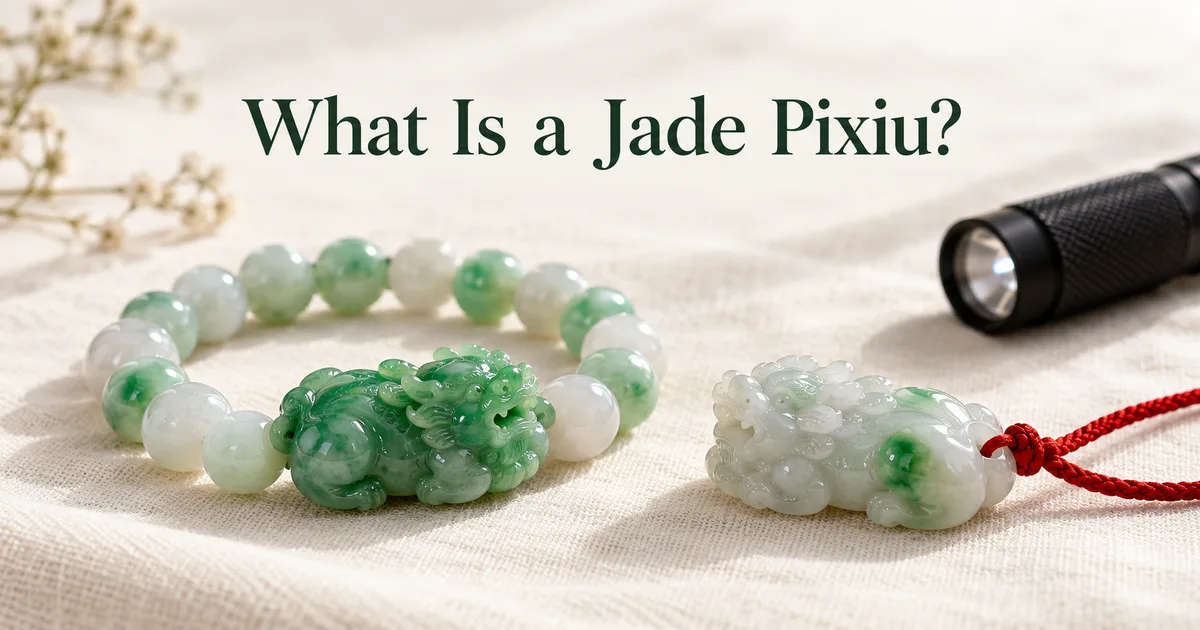
A jade pixiu (貔貅) is a carved mythical beast, worn as a pendant or on a bead bracelet, that Chinese tradition says takes in wealth and keeps it. Custom says wear it head facing out, usually on the left wrist, and don't let others touch it; these are beliefs, not rules. Judge it by the stone first, then the face, mouth, tail and the hidden belly, and insist on a certificate saying natural jadeite (Type A), because pixiu are often Type B, glass or dyed stone.
What is a jade pixiu?
A jade pixiu (貔貅) is a carving of a mythical Chinese beast, usually a crouching lion-like creature with a big open mouth, worn as a pendant or as the centrepiece of a bead bracelet. In Chinese tradition it is the animal that "takes in wealth and never lets it out", which is why it is one of the most popular designs for business owners and for gifts at the opening of a shop.
The legend most people repeat goes like this: the pixiu loves to eat gold, silver and jewels, but it has no anus, so everything it swallows stays inside. Some versions call it a son of the dragon. Older accounts describe two related beasts, one-horned and two-horned, carved as tomb guardians; today the names have blurred and most pieces you see are a single-horned or hornless pixiu with a curled tail.
On jadeite, the pixiu is everywhere. Its compact body suits a small block of stone, it can be carved from modest material and still look good, and it sells steadily in China, Vietnam and Thailand. That also makes it one of the designs most often made from treated jadeite or look-alike stones.
| Language | What people call it and search for |
|---|---|
| Chinese | 貔貅, 翡翠貔貅, 貔貅手链 (pixiu bracelet), 貔貅吊坠 (pixiu pendant) |
| Vietnamese | tỳ hưu, tỳ hưu cẩm thạch, tỳ hưu phỉ thúy, vòng tay tỳ hưu |
| Thai | ปี่เซียะ, ปี่เซียะหยก, ปี่เซียะหยกพม่า, กำไลปี่เซียะ |
| English | pixiu, pi xiu, pi yao, jade pixiu bracelet |
What does a pixiu mean?
The meanings are traditional sayings, not promises. Chinese dealers often explain a pixiu part by part:
| Part | What people say it stands for |
|---|---|
| Big open mouth | Takes in wealth "from all four directions" (嘴大吃四方) |
| Round, full belly | Holds what it has taken in |
| No anus, raised rump | Wealth goes in and does not go out, so it is said to keep money as well as bring it |
| Fierce face, horn | Guards the owner and wards off bad influences; one old name for the beast is 辟邪, "repel evil" |
| Curled tail | Said to "sweep in" good fortune |
Because of this, the pixiu is linked above all with money: business, sales, trading and gambling luck in popular belief. It is a common gift for a new business or a new job. It is less often chosen for a newborn or an elder's birthday, where a peace buckle, a gourd or a peach is the usual choice; see jadeite pendant meanings.
Local customs add their own layer. In Thailand, the pixiu (ปี่เซียะ) is one of the best-known Chinese lucky animals, popular in Thai-Chinese families and among people who follow lucky charms, and many shrines and temples hold blessing ceremonies for them. In Vietnam, many buyers first ask which element a pixiu "suits": by folk five-element thinking, the colour decides it, so green jadeite is said to suit Wood and Fire. Those beliefs are explained in jadeite meaning and beliefs. Wearing a pixiu is a custom and a personal choice; it does not change what the stone is worth.
Pixiu pendant or pixiu bracelet: what are the options?
Jadeite pixiu come in a few forms, and they are bought and checked differently.
| Form | How it is made | Who it suits | What to check |
|---|---|---|---|
| Pixiu pendant (貔貅吊坠) | A carved pixiu, usually a few centimetres long, drilled across the back or fitted with a gold bail; hangs level on a cord or chain | People who prefer a necklace; larger, better-carved pieces | Carving all round, cracks at the bail or drill hole, size in mm |
| Bracelet with one pixiu (单貔貅手链) | One pixiu bead drilled lengthwise from mouth to tail, strung among round beads | The most common form; easy to wear daily | Whether the round beads are jadeite too, chips around the drill holes, wrist size |
| Bracelet with a pair (双貔貅手链) | Two pixiu beads on one strand, often facing each other or both facing out | Couples, or people who want the "bring and keep" pair | Matching colour and texture between the two |
| All-jadeite pixiu bead bracelet | Pixiu and every round bead cut from jadeite, ideally from the same rough | Buyers who want a matched strand | One certificate covering the whole strand |
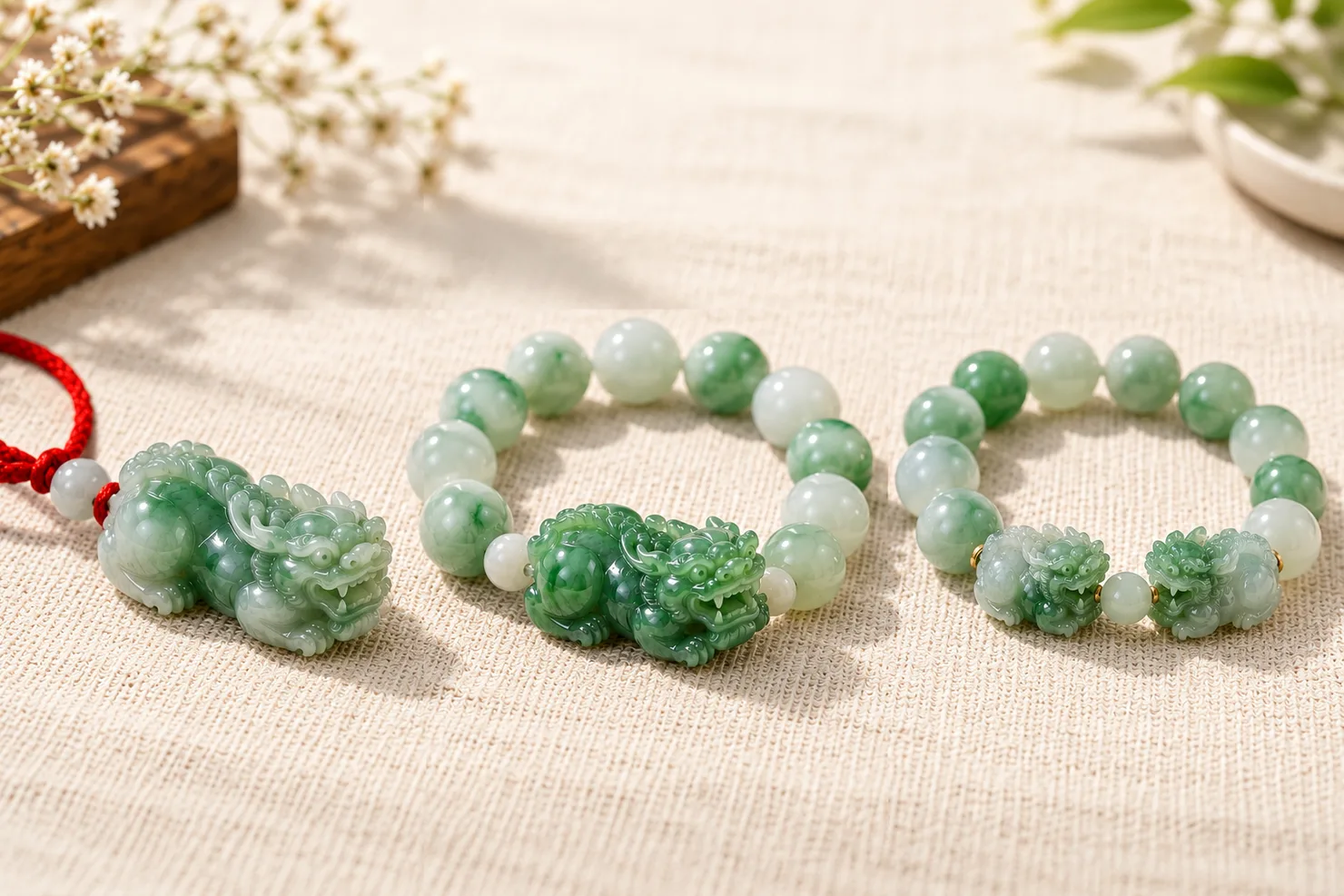
The most common trap is the mixed bracelet. A jadeite pixiu is strung with beads of glass, dyed quartzite, obsidian or another stone, and the listing just says "jade pixiu bracelet". Ask what every part is made of, and check what the certificate actually covers: a certificate for the pixiu bead says nothing about the round beads. Bead sizes, wrist fit and restringing are covered in the jade bead bracelet guide.
How do people traditionally wear a pixiu?
Customs vary by family, region and teacher, and they contradict each other in places. These are the ones you will hear most often.
| Custom | What people say | Practical note |
|---|---|---|
| Head facing out | The head points away from the body: on a bracelet, toward the hand, so it can "catch" wealth; it should not face back toward you | On a pendant, most people just let it hang level, never head down |
| Which hand | Mostly the left wrist, from the saying "left in, right out" (左进右出); some say women wear it on the right, or that either is fine | The non-dominant hand knocks into things less, which protects the stone |
| No touching by others | The pixiu "recognises its owner" (认主); others, especially, should not touch its head or mouth | Also sensible: fewer drops when passed around |
| Rubbing it | Owners often rub the head and back; some say never cover or touch the mouth or eyes | Skin oil and rubbing slowly add shine to polished jadeite |
| "Opening" (开光) | A blessing at a temple or shrine before first wearing | It does not change the material; do not pay a large premium for "already opened" |
| Taking it off | Some say remove it when bathing, sleeping, during intimacy, or at funerals and hospitals | Taking it off for sleep, sport and heavy work protects stone and cord |
A sensible way to read this table: follow the customs that matter to you or your family, and do not let a seller turn any of them into a reason to pay more. A blessing can be arranged after purchase at a temple you trust.
Cleaning. Wipe with a soft damp cloth after wearing. Now and then, wash in lukewarm water with a little mild soap and use a soft toothbrush inside the mouth, between the legs and under the tail, where grime collects. Dry well, especially the cord. Do not use ultrasonic cleaners or steam: they can loosen gold settings and stress any existing cracks, and they can damage treated stones. Some people "cleanse" a pixiu in clean water, sunlight or moonlight; plain water is harmless, but keep salt water away from cords and gold fittings.
Should you wear one pixiu or a pair?
A traditional explanation splits the name: 貔 (pí) is the male and 貅 (xiū) the female. The male is said to bring wealth in and the female to keep it, so a pair is said to be complete. Shops tell them apart in different ways: some make the male larger and fiercer, some use one horn versus two, some simply label them. There is no single standard, and the trade does not agree.
- One pixiu is the most common choice, especially on a bracelet. Many dealers say a single pixiu is perfectly normal.
- A pair is often chosen by couples, given as a wedding or opening gift, or placed on a desk. On a bracelet, a pair is usually strung facing each other or both facing out.
What matters more to a dealer: if you buy a pair, the two should match. Two pixiu from the same piece of rough (同料) share colour and texture, look right together and are harder to find. Two pixiu that do not match look like what they are, two pieces from a tray.
How do dealers judge a pixiu carving?
Dealers look at the material first, then the carving. Material means texture, translucency and colour (种水色); these set most of the price. Many pixiu are carved from mid- or lower-grade stone, and a busy carving is also a good place to hide cracks, so the carving check doubles as a crack check.
Use three kinds of light:
- Reflected light (one lamp above, tilt the piece): shows polish, surface pits and whether the recesses shine.
- Raking light (lamp low to one side): shows carving depth, crisp or soft edges, and the face's expression.
- Transmitted light (flashlight pressed against the back or belly): shows cracks, cotton and how the colour sits inside.
Then go through the piece in this order:
| Area | Good work | Warning signs |
|---|---|---|
| Proportion | Crouching, head raised, chest forward, round belly, rump high; the saying is "big mouth, round belly, full rump" | Flat, sausage-shaped body; head too small; looks like a dog or a cartoon |
| Face | Eyes level and the same size, brow and nose clearly cut, alert and fierce but not ugly | Lopsided eyes, a vague face, eyes as two simple dots |
| Mouth | Open wide, cut deep, teeth and tongue clean, polished inside | Shallow slot; dull grey inside; a crack running from the corner of the mouth |
| Horn, mane, whiskers | Lines crisp and tapering, flowing in one direction | Blurred or rounded lines, all the same depth |
| Tail | Curled up over the rump, joined to the body, edges smooth | Thin, sticking out (chips easily), or already chipped and re-polished |
| Legs and belly | Four legs with paws cut, belly carved and polished even though it is hidden | Flat, rough or unpolished underside; black spots or cracks "parked" underneath |
| Recesses | Mouth, gaps between legs and under the tail polished to a shine | Matte, gritty or grey hollows: the sign of rushed or machine work |
| Drill hole (bracelet pixiu) | Straight, centred, clean edges | Chipped rim, cracks radiating from the hole |
The belly deserves the most attention. It is the side buyers rarely turn over, so it is where a cutter leaves a crack, a black spot or a rough patch. A carver who finishes the paws and polishes the underside properly is usually careful everywhere else.
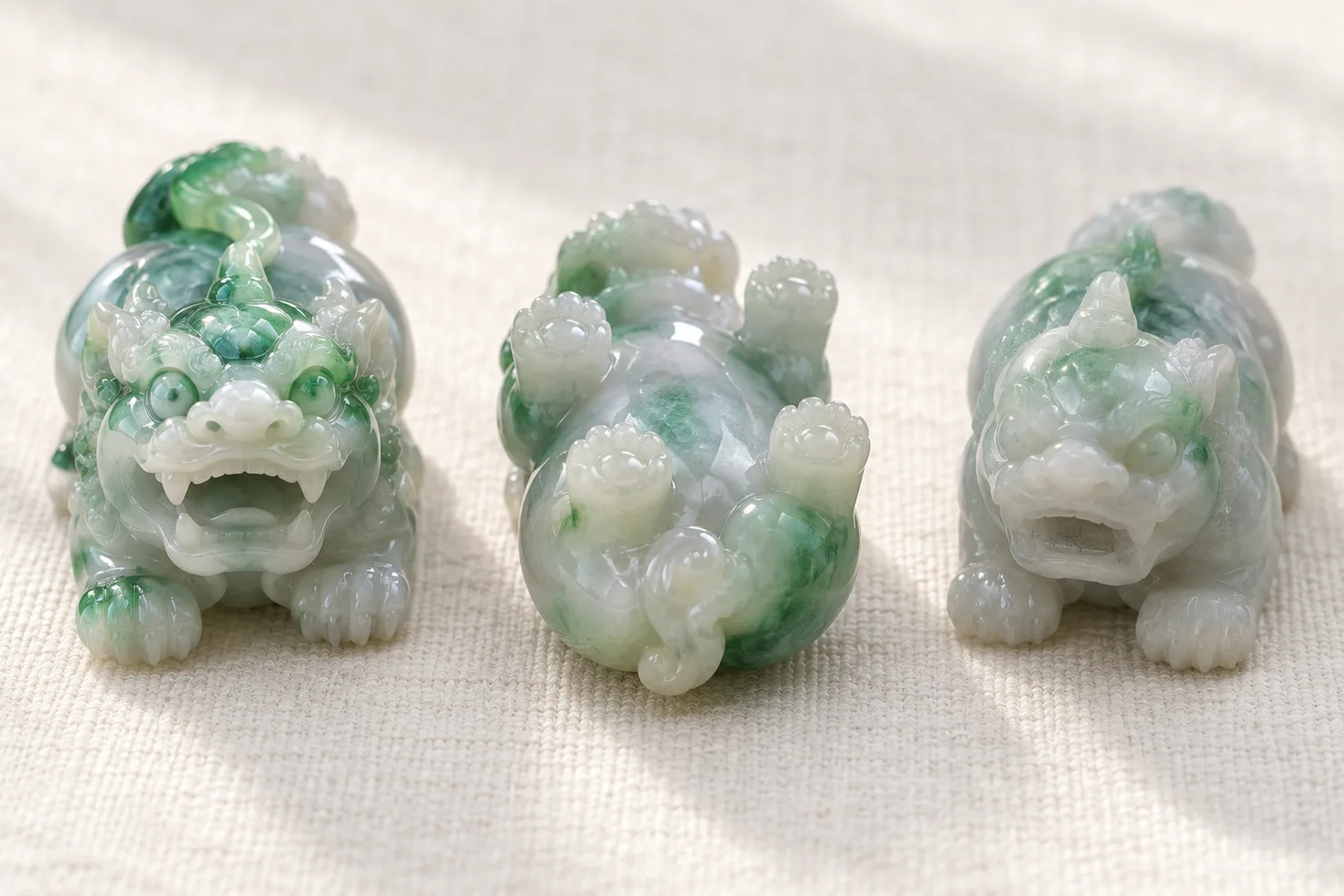
Many mid-priced pixiu are machine carved, with the face and polish finished by hand. That is honest work if it is described honestly. The signs that separate hand work, CNC carving and ultrasonic stamping are covered in jadeite carving craftsmanship. A tray of identical pixiu is machine work, whatever the label says.
Where the pieces come from also tells you something. In the Chinese trade, Sihui (四会) in Guangdong handles mostly mid- and lower-grade carved pieces, while Jieyang (揭阳) is known for small, fine, high-end pendants. A finely carved pixiu from top material is a different product from a market-stall one, even if the photo looks similar.
What fakes are sold as jadeite pixiu?
| What it really is | How it is often described | Clues |
|---|---|---|
| Bleached and resin-filled jadeite (Type B) | "Natural jade", "A-grade", "AAA" | Very clean, glassy-bright green on a cheap piece; cracks look filled; dull, plastic-like shine. Only a lab can confirm |
| Dyed jadeite (Type C) | "Green pixiu", "lucky green" | Colour sits in a net along grain and cracks; too even; sometimes fades |
| Moulded glass | "Jade glass", "imitation jade", sometimes just "jade" | Mould seams, round bubbles, very soft details, identical copies |
| Resin or plastic | Often no material named | Very light, warms fast in the hand |
| Dyed quartzite | "Malaysia jade" | Bright even green, dye collected along cracks, lighter than jadeite |
| Nephrite | "Hetian jade", "jade" | Genuine jade but a different mineral; oily lustre, different price |
| Serpentine | "Xiuyan jade", "new jade" | Yellow-green, softer, scratches easily |
| Obsidian | Usually sold honestly as obsidian | Black, glassy; fine under its own name |
Watch the wording. "Natural stone", "real jade", "Burmese jade" and "A-grade" are not the same as "natural jadeite, Type A" on a lab certificate. "A-grade" on a market label often means "good quality" in the seller's opinion, not untreated. The difference between Type A, B and C is explained in Type A vs Type B vs Type C jadeite, and the stones most often passed off as jadeite in jadeite look-alikes. Nephrite is real jade, but it is not jadeite, so a "Hetian pixiu" should not be priced or sold as one.
How do I buy a jadeite pixiu safely?
- Decide the form: pendant, single-pixiu bracelet, pair or all-jadeite strand.
- Ask what every part is made of, in writing: the pixiu, the round beads, the fittings.
- Ask for a lab certificate that says natural jadeite (Type A) and check that the photo, weight and size match the piece. For a bracelet, check whether it covers the whole strand.
- Ask for photos in daylight from all sides, including the belly, plus a short video.
- Ask for a flashlight shot through the mouth area, the tail and the drill hole.
- Get the size in millimetres and, for bracelets, the bead size and wrist size.
- Pay for the stone and the carving, not for "already opened" or for a story about luck.
Typical buyer mistakes: buying from photos that never show the underside, assuming the round beads are jadeite because the pixiu is, and taking "A-grade" as a treatment statement.
Buying a jadeite pixiu on JadeiteHub
JadeiteHub works from Ruili, on the China–Myanmar border jade route. Sellers post real photos of each piece, some with video, and you can ask the seller to show the belly, the mouth and a flashlight shot before you buy, so the listing says exactly what you are getting. Every sold piece is checked against its certificate before it ships, shipping is insured, and if the piece does not match the description you get a full refund. If a blessing matters to you, you can have the pixiu opened at a temple you trust once it arrives.
FAQ
Which hand should I wear a pixiu bracelet on?
Most people wear it on the left wrist, from the Chinese saying "left in, right out". Some say women should wear it on the right, and others say either hand is fine. It is a custom, not a rule; the non-dominant hand is simply safer for the stone.
Which way should the pixiu head face?
Custom says the head should face away from your body: on a bracelet, toward your hand. On a pendant, people let it hang level and avoid hanging it head down.
Can other people touch my pixiu?
Tradition says the pixiu recognises its owner, so others should not touch it, especially the head and mouth. Whether you follow this is up to you. It does no harm to the stone either way, but it does mean fewer drops.
Does a pixiu have to be opened (blessed) before wearing?
Many people have it blessed at a temple or shrine, but it is a personal choice. A blessing does not change the jadeite's quality or value, so do not pay a large premium for a piece sold as "already opened".
How can I tell if a jade pixiu is real jadeite?
Clues help: glass shows mould seams and bubbles, dyed stone shows colour along cracks, resin feels light and warm. But Type B jadeite can only be confirmed by a lab, so ask for a certificate that says natural jadeite (Type A) and matches the piece.