Most Expensive Jade in the World: Record Sales Explained
Updated
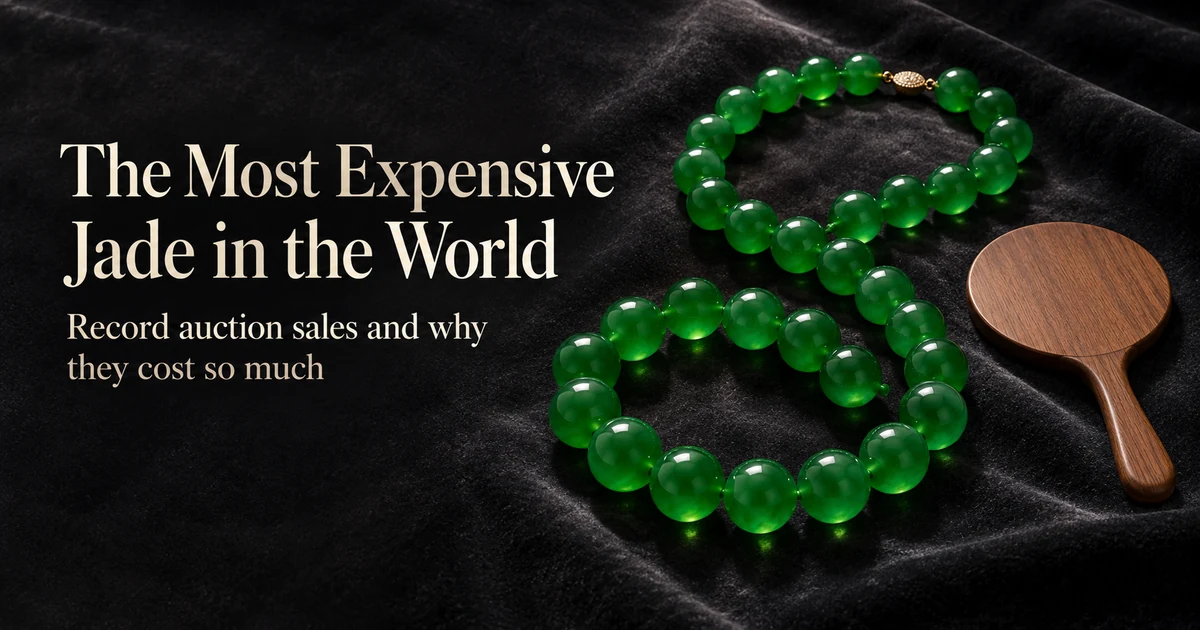
The most expensive jade ever sold at auction is the Hutton-Mdivani jadeite bead necklace: 27 imperial green beads, sold at Sotheby's Hong Kong in April 2014 for HK$214 million (US$27.44 million), the figure Guinness World Records lists. In May 2026 Christie's Hong Kong sold a 61-bead necklace for HK$200.2 million, just short of it. Almost every record is green jadeite with intense, even imperial green color in glassy, highly translucent, untreated material, in large matched pieces, often with famous provenance. These pieces are a tiny top tier; they say little about the price of ordinary jadeite jewelry.
What is the most expensive jade in the world?
The most expensive jade ever sold at auction is the Hutton-Mdivani necklace, a single strand of 27 imperial green jadeite beads that Sotheby's Hong Kong sold in April 2014 for HK$214 million (US$27.44 million). Guinness World Records lists it as the most expensive jade jewellery sold at auction. The beads are graduated from about 19.2 mm to 15.4 mm, and the ruby and diamond clasp was added by Cartier in 1933 for the American heiress Barbara Hutton. Sotheby's confirmed the buyer was the Cartier Collection.
Twelve years later it is still the record. In May 2026 Christie's Hong Kong sold the "Ethereal" jadeite necklace, 61 matched beads, for HK$200.2 million (about US$25.6 million); the trade outlet IDEX reported that it narrowly missed the world record.
When people search "most expensive jade", they nearly always mean jadeite (翡翠), the jade mineral mined mainly in Myanmar. Nephrite (Hetian jade) has its own market, mostly in carved objects and antiques, and is a separate story.
Which jadeite pieces have sold for the highest prices at auction?
The table lists results we could confirm in auction house releases, lot pages, Guinness World Records or major trade press. Prices are as reported, in the original currency with the US dollar figure given at the time. Results reported by Sotheby's and Christie's include the buyer's premium. It is not a complete list of every high price ever paid; private sales are not public, and we left out results we could not confirm.
| Piece | Auction house, city | Date | Price as reported | Notes |
|---|---|---|---|---|
| Hutton-Mdivani necklace: 27 imperial green beads, about 19.2–15.4 mm, Cartier ruby and diamond clasp | Sotheby's, Hong Kong | April 2014 | HK$214 million (US$27.44 million) | Guinness World Records: most expensive jade jewellery sold at auction. Once owned by Barbara Hutton |
| "Ethereal" necklace: 61 matched beads, about 13.7–8.8 mm | Christie's, Hong Kong | 26 May 2026 | HK$200.2 million (about US$25.6 million) | Estimate HK$110–200 million (IDEX) |
| "Heavenly Harmony" long necklace (sautoir): 68 beads, spinel clasp | Christie's, Hong Kong | November 2019 | HK$73.58 million (about US$9.44 million) | Christie's: beads matched from two different rough stones; estimate HK$55–85 million |
| "Imperial Green" jadeite bead and diamond necklace | Sotheby's, Hong Kong | October 2020 | HK$62,963,000 (US$8,124,300) | Top lot of the sale (Sotheby's) |
| "The Emperor's Treasure": 43 beads, about 13.05–11.55 mm, ruby and diamond clasp | Sotheby's, Hong Kong | April 2023 | HK$61.5 million (about US$7.8 million) | Price reported by Rapaport. Gübelin report: no signs of treatment ("Type A") |
| Jadeite bangle, 277.673 carats, green to vivid green | Sotheby's, Hong Kong | April 2021 | HK$30,425,000 (US$3,917,830) | SSEF lab called it "a true treasure of nature" |
| Pair of imperial green cabochon earrings | Sotheby's, Hong Kong | April 2021 | HK$6,951,000 (US$895,080) | US$35,101 per carat; Sotheby's called it a record for a cabochon imperial green jadeite |
Sources by row: Guinness World Records and Sotheby's; IDEX and the Gem and Jewelry Institute of Thailand (GIT); Christie's sale page, Rapaport and GIT; Sotheby's press release of 7 October 2020; Sotheby's lot page and Rapaport; Sotheby's press release of 20 April 2021 (last two rows).
What is the most expensive jade bangle and jade ring?
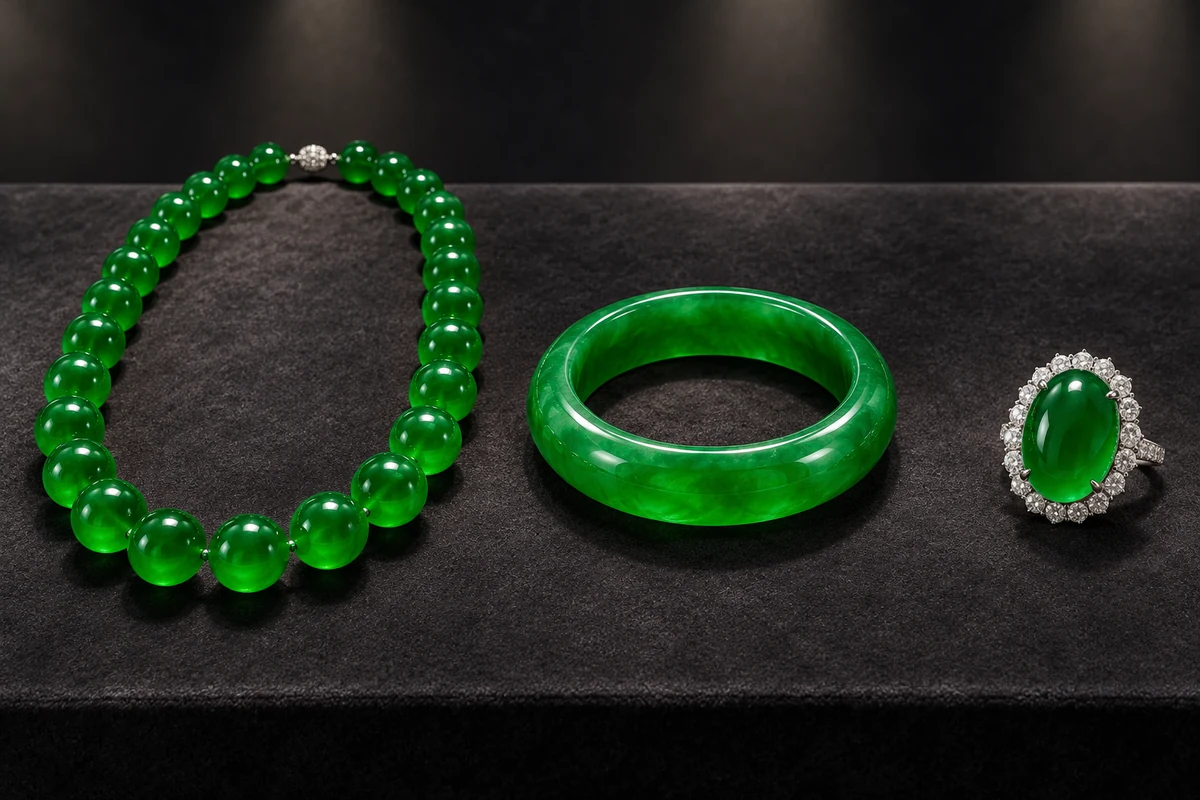
The highest bangle result in the table is the 277.673-carat bangle Sotheby's sold in 2021 for HK$30,425,000. Other bangle figures circulate online, including claims of new bangle records, but we could not match them to an auction house release, so we leave them out. The same goes for rings: we did not find an auction-house-confirmed record for a jadeite ring. Rings and earrings are priced mainly on the single cabochon they hold, which is why the record above is quoted per carat.
Why are the top results almost all necklaces?
A bead necklace is the hardest jadeite jewel to make. Every bead is cut as a sphere from solid rough, which wastes a lot of material, and dozens of beads must match in color, texture and translucency. The Hutton-Mdivani beads are each more than 15 mm across. Christie's described the Heavenly Harmony beads as matched from two different rough stones, which was rare enough to give the necklace its name. Finding one boulder with enough top material for a full strand happens very seldom.
Why is the most expensive jadeite so expensive?
Because it is top on every price factor at once, and pieces like that almost never come to market. A single top factor raises price; all of them together in one large, matched piece is what produces eight-figure results. In the trade the factors are summed up as 种水色 (texture, translucency, color) plus size, workmanship and condition. Our guide on what determines jadeite price covers them in detail. At record level they look like this:
| Factor | Record-level jadeite | Typical commercial jadeite |
|---|---|---|
| Color | Imperial green: intense, pure, bright and even (浓阳正匀) | Lighter, grayish, yellowish or patchy green, or no green |
| Texture (种) | Glassy (玻璃种) or high icy: grains too fine to see | Medium to coarse grain, visible structure |
| Translucency (水) | Light passes deep into the stone, the color seems to glow | Semi-translucent to cloudy |
| Evenness | Same color and texture across every bead | Color in patches, roots or flecks |
| Size | Beads of 13–19 mm, or a bangle of 277 carats | Small beads, thin bangles, small cabochons |
| Treatment | Untreated (Type A), backed by SSEF or Gübelin reports | Untreated or treated; check every piece |
| Provenance | Famous owners, historic makers (Hutton, Cartier) | None |
Color: imperial green
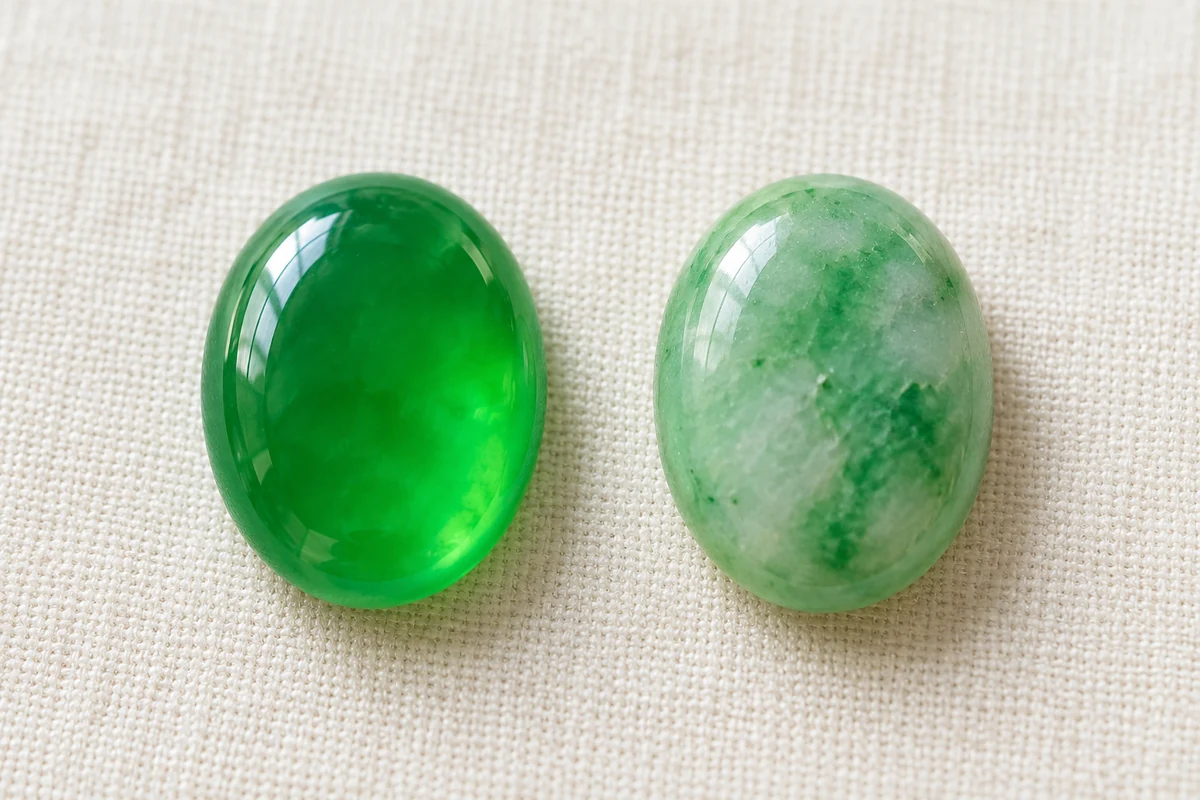
Every result in the table is green. Imperial green (帝王绿) is the top of the green scale: no yellow, gray or blue cast, not so dark it looks black, and even throughout. It is trade language, not a lab grade, so dealers can disagree about a given stone. See what imperial green jade is.
Texture and translucency: glassy
Color on its own is not enough. The same green in coarse, cloudy material is worth a fraction as much. Record pieces have glassy texture: grains too fine to see, high translucency, and a soft glow called 起光 when light moves over the surface. For how traders judge this, see zhong, shui and se explained.
Size, matching and workmanship
Price does not rise in a straight line with size. A 19 mm bead of top material is far rarer than two 9 mm beads, and a matched strand of dozens of such beads rarer still. A cutter working a piece of top rough has to decide between fewer large beads and more small ones, and large, flawless beads of even color are what the top of the market pays for.
Untreated, with lab reports
Treated jadeite (Type B, bleached and polymer-filled, or Type C, dyed) does not reach these prices. Auction catalogues cite reports from labs such as SSEF and Gübelin; Sotheby's catalogue for The Emperor's Treasure quotes a Gübelin report stating no signs of treatment. Only natural, untreated Type A jadeite competes at this level.
Provenance and the auction room
Part of the Hutton-Mdivani price is history: a necklace owned by Barbara Hutton with a Cartier clasp, bought by the Cartier Collection. Auction prices also depend on who is in the room. Two determined bidders can push a result well above estimate; Guinness noted the Hutton-Mdivani estimate was HK$99 million, less than half the final price.
Which color and type of jade is the most expensive?
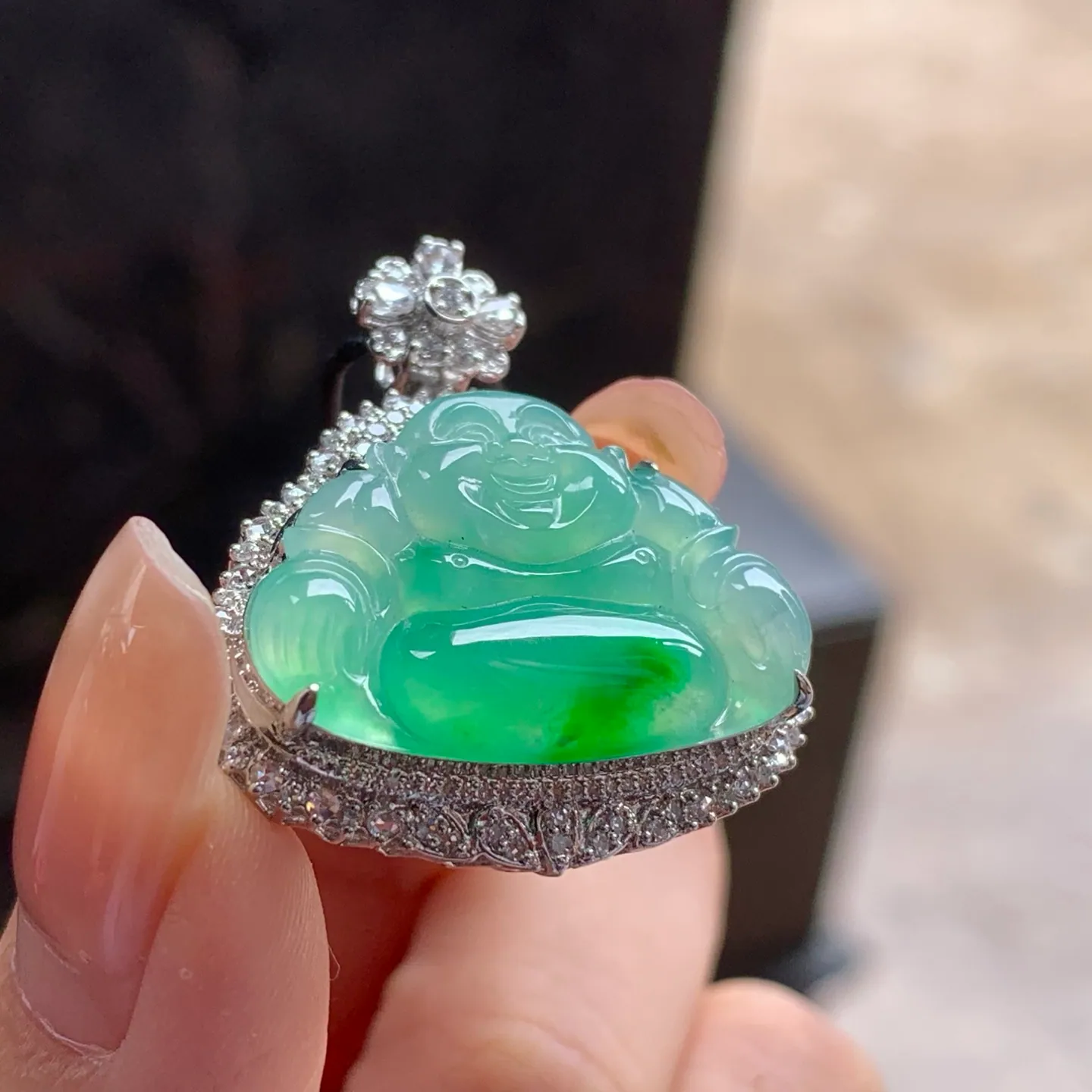
Imperial green in glassy texture (玻璃种帝王绿) is the most expensive type of jadeite. All the auction records above are green, and the trade ranks a glassy, even imperial green at the top of the price scale.
Other colors and types also reach high prices when the quality is top:
- Lavender (紫罗兰): strong, pure purple in fine, translucent material is rare and highly valued, though top lavender generally sits below top green. See lavender jadeite.
- Icy and glassy colorless (冰种, 玻璃种): near-colorless jadeite with very high translucency and a strong glow is valued for texture alone. See icy jadeite.
- Red and yellow (红翡, 黄翡), black (墨翠): fine examples are prized, but they rarely compete with top green at auction.
"Type" can also mean treatment. Here the answer is simple: only untreated Type A jadeite reaches high prices. A treated piece in the same color is worth a small fraction.
Why are auction prices so different from shop prices?
Auction records and shop prices measure different things, and neither tells you the value of an ordinary piece.
- Auction results include the buyer's premium and reflect what one bidder would pay on one evening. A different evening could give a different number.
- The pieces are one-offs. There is no second Hutton-Mdivani necklace to compare with, so there is no "market price" in the normal sense.
- Retail prices include costs such as cutting, setting, rent, staff and the dealer's margin, and are often set to leave room for bargaining. Asking prices on livestreams and shop tags are not sale prices.
- Resale is different again. When you sell, you usually get less than you paid retail, unless the piece is truly exceptional. See selling jadeite and resale value.
What does this mean for an ordinary jade buyer?
Record pieces are a tiny top tier. The jadeite most people buy, including fine pieces, is in a different category, and that is normal. A few practical points:
- "Same as the record necklace" is sales talk. Sellers on livestreams and in markets sometimes say a piece is "the same material as the Hutton necklace", "from the same boulder" or "imperial green" to justify a price. Imperial green is not a lab grade, and no certificate states that two pieces come from the same rough. Judge the piece in front of you.
- A certificate proves material and treatment, not grade or value. A good lab report names jadeite and states whether it is treated. It does not say "imperial", does not price the stone and does not compare it with famous pieces. See how to verify a jadeite certificate.
- Bright, even green at a low price is a warning sign. Dyed (Type C) and bleached-and-filled (Type B) jadeite can look strong in photos. The cheaper an "imperial green" piece, the more carefully you should check it.
- Do not buy jadeite as an investment because of auction headlines. Records are rare events. Most jadeite does not resell near its retail price.
- Buy what you like at a quality you can verify. A clean, untreated piece with honest color is a better buy than a "near-imperial" story.
On JadeiteHub we list only jadeite that comes with a lab certificate. Each sold piece is checked against its certificate at our inspection center before it ships, and if it is not as described you get a full refund.
FAQ
What is the most expensive jade ever sold?
The Hutton-Mdivani necklace of 27 imperial green jadeite beads, sold at Sotheby's Hong Kong in April 2014 for HK$214 million (US$27.44 million). Guinness World Records lists it as the most expensive jade jewellery sold at auction.
Has the Hutton-Mdivani record been broken?
Not as of October 2026. In May 2026 Christie's Hong Kong sold the 61-bead Ethereal jadeite necklace for HK$200.2 million (about US$25.6 million), which trade press reported as narrowly missing the record.
Which color of jade is the most expensive?
Imperial green: an intense, pure, even green in glassy, highly translucent jadeite. All the auction records listed here are green. Top lavender and glassy colorless jadeite are also highly valued but generally sit below top green.
What is the most expensive jade bangle?
The highest bangle result we could confirm from an auction house is a 277.673-carat jadeite bangle sold by Sotheby's Hong Kong in 2021 for HK$30,425,000 (US$3,917,830). Other bangle figures circulate online but we could not confirm them.
Why is jadeite so expensive?
Top jadeite combines intense even color, glassy texture, high translucency, large size and no treatment, and material like that is extremely rare. Matched bead necklaces need many such beads from very little rough, and famous provenance adds more.
Is my green jade worth millions?
Almost certainly not. Records are a tiny top tier of exceptional, untreated, large and matched pieces. Most jadeite, including good pieces, is priced far lower. A lab certificate tells you whether it is natural and untreated, not what it is worth.