Jade Bead Necklace: Size, Length, Value and Real Type A
Updated
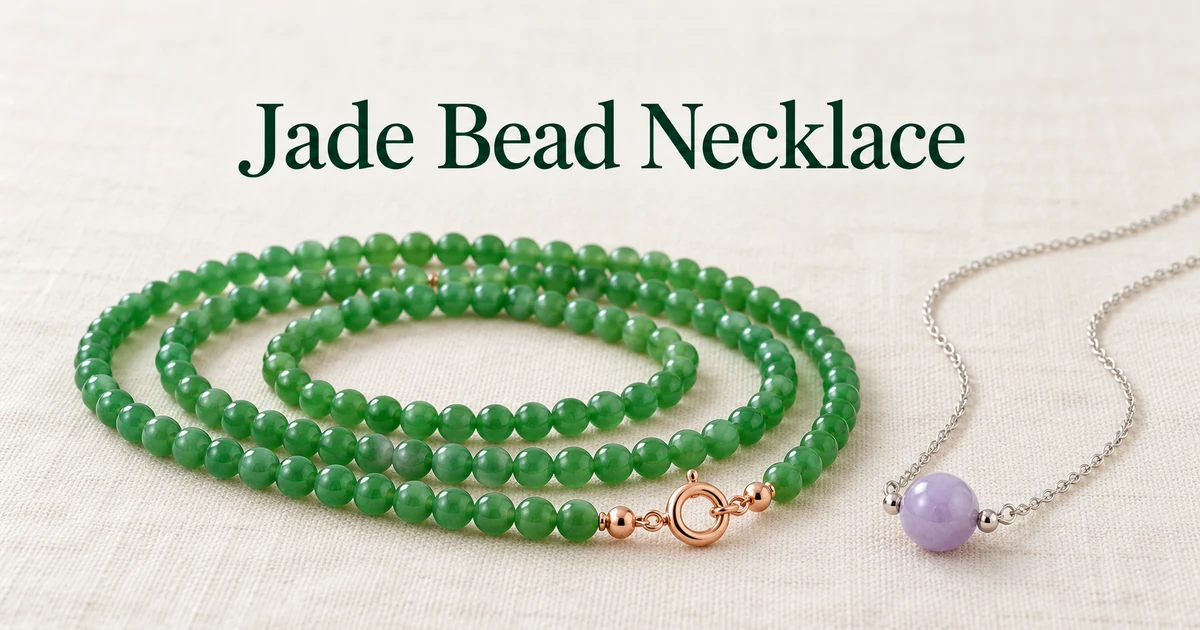
A jade bead necklace (珠链) is a strand of round jadeite beads worn around the neck; long strands of small beads can also be wound several times around the wrist, and a 108-bead strand is a Buddhist mala. Its value depends less on the bead count than on how well dozens of beads match in color and texture, which is why a full-color strand costs far more than its bead count suggests. Dyed small green beads are a common fake, so ask for a certificate that covers the whole strand, check the clasp and stringing, and restring before the thread fails.
What is a jade bead necklace?
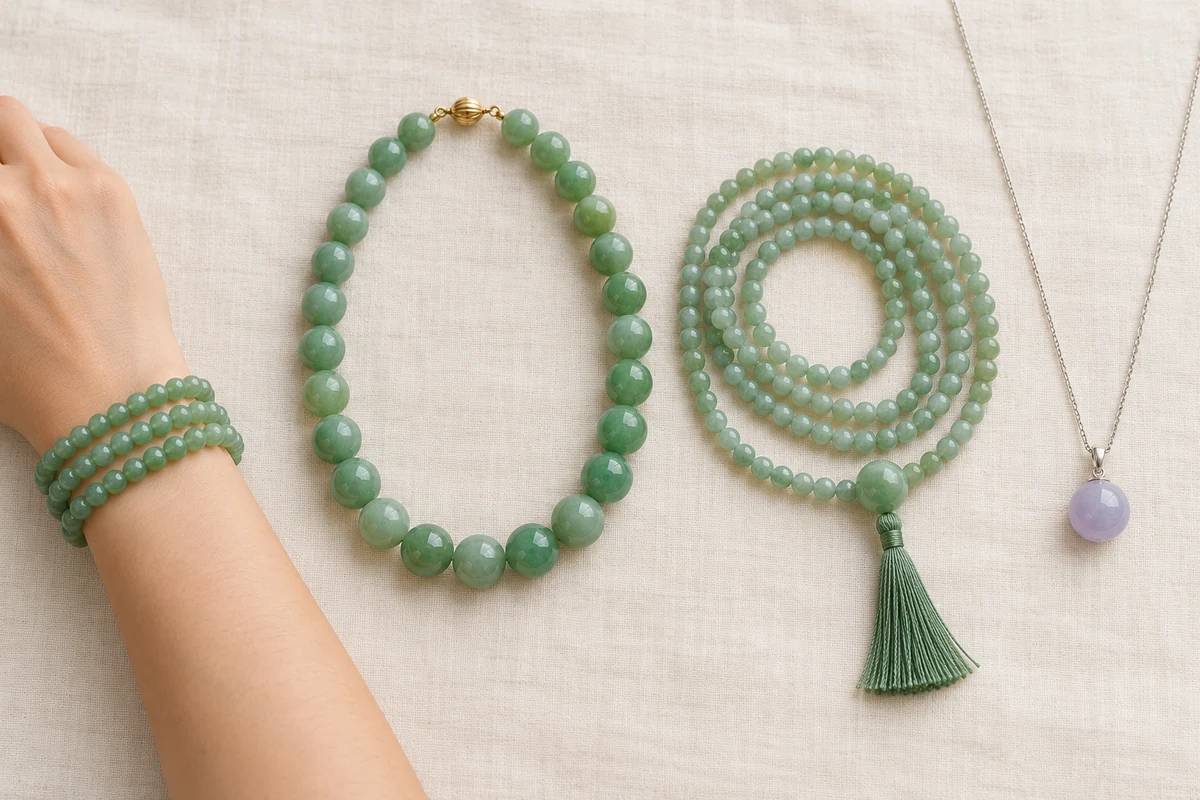
A jade bead necklace is a strand of round, drilled jadeite beads strung on thread or wire and worn around the neck. In Chinese it is called 珠链 (zhūliàn, "bead chain"). The name covers several styles, and some strands can be worn more than one way: a long strand of small beads can be worn once around the neck or wound several times around the wrist.
A single loop sized for the wrist is a bead bracelet (手串). Wrist sizing, which wrist to wear it on and elastic cords are covered in jade bead bracelets, so this guide sticks to necklaces, long strands, malas and mixed strands.
| Style | Chinese | Beads | How it is worn |
|---|---|---|---|
| Small-bead strand | 小珠链 | Many small beads, about 3 to 6 mm | Around the neck, or wound several times around the wrist; usually closed with a clasp |
| Classic bead necklace | 珠链 | One size of bead, often larger | Once around the neck, on knotted thread with a clasp |
| Graduated necklace | 塔链 | Largest bead at the center, smaller toward the clasp | Around the neck |
| 108-bead mala | 佛珠, 念珠 | 108 beads plus a larger guru bead | Around the neck, or wound around the wrist |
| Mixed strand | 多宝串 | Jadeite beads with carvings, other stones or metal parts | On the wrist or around the neck |
| Bead with a pendant | 吊坠 | A strand or chain with one larger bead or carving hanging from it | Around the neck |
This guide is about natural jadeite. Strands of glass, dyed quartzite and other stones are also sold as "jade", and they are a different material.
Which bead size should I choose?
Bead size is the diameter of each bead in millimeters. It changes the look, the weight and how many beads the strand needs.
| Bead size | Look | What it means for the strand |
|---|---|---|
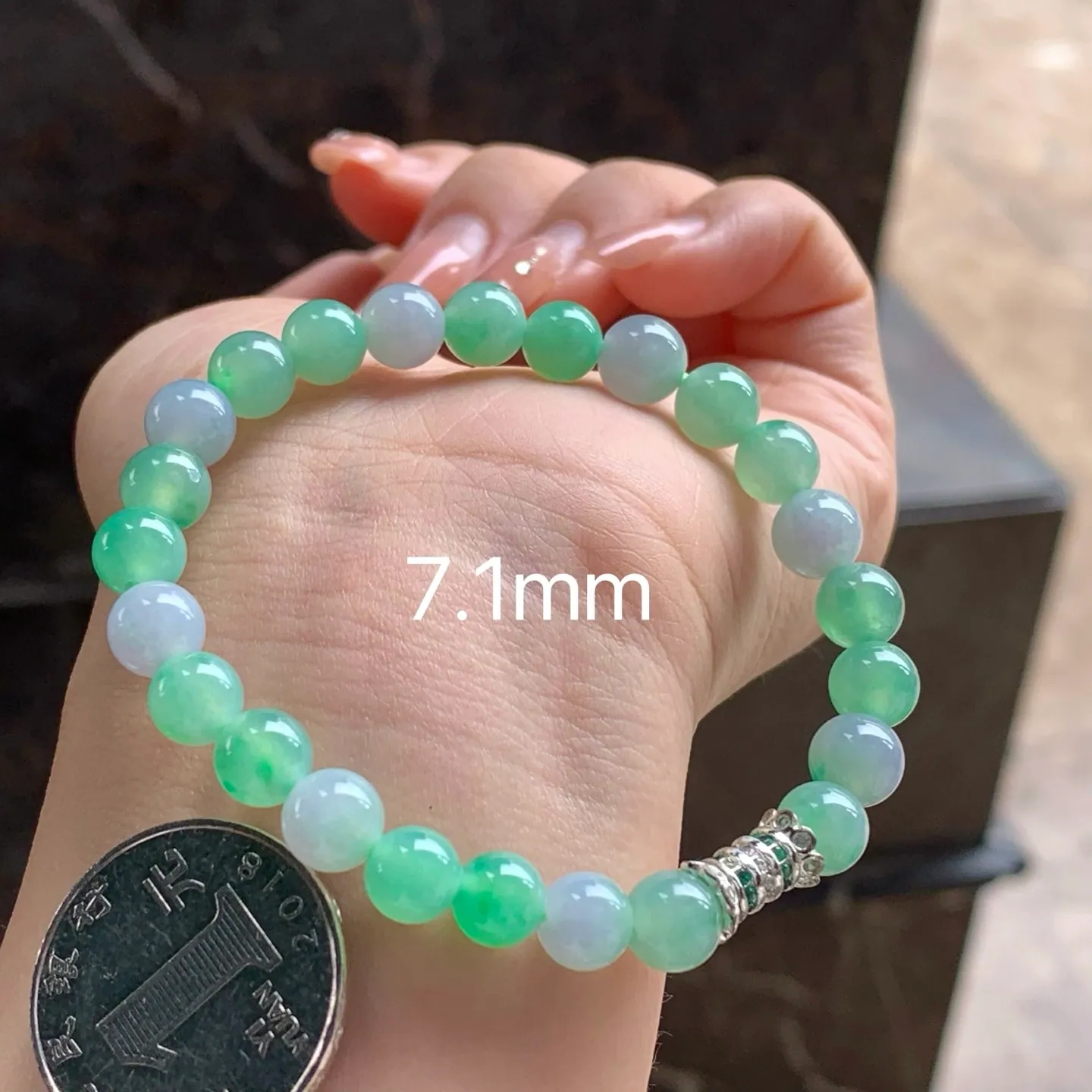
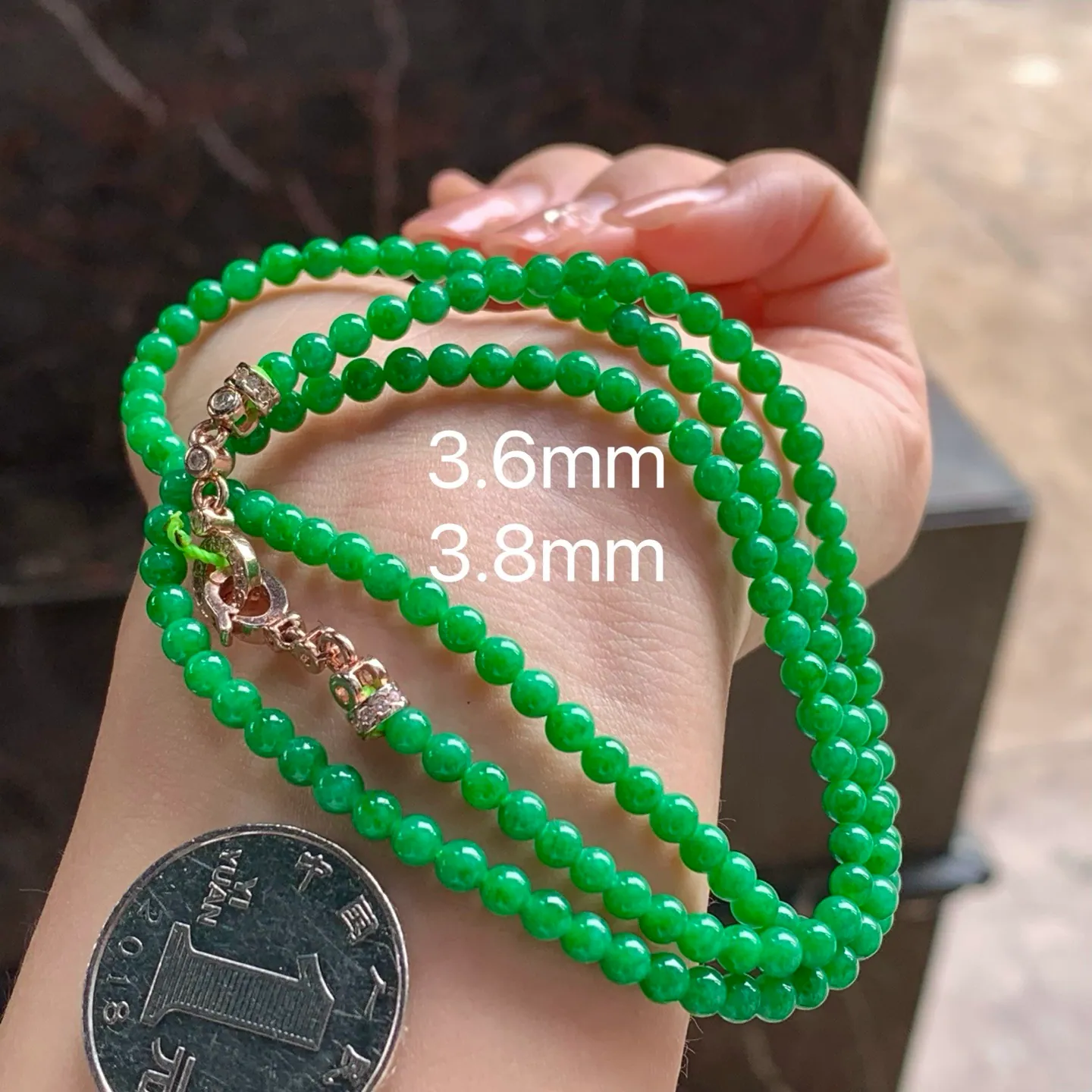
| About 3 to 4 mm | Fine and delicate; good for layering and multi-wrap wear | Very many beads, and every one of them has to match |
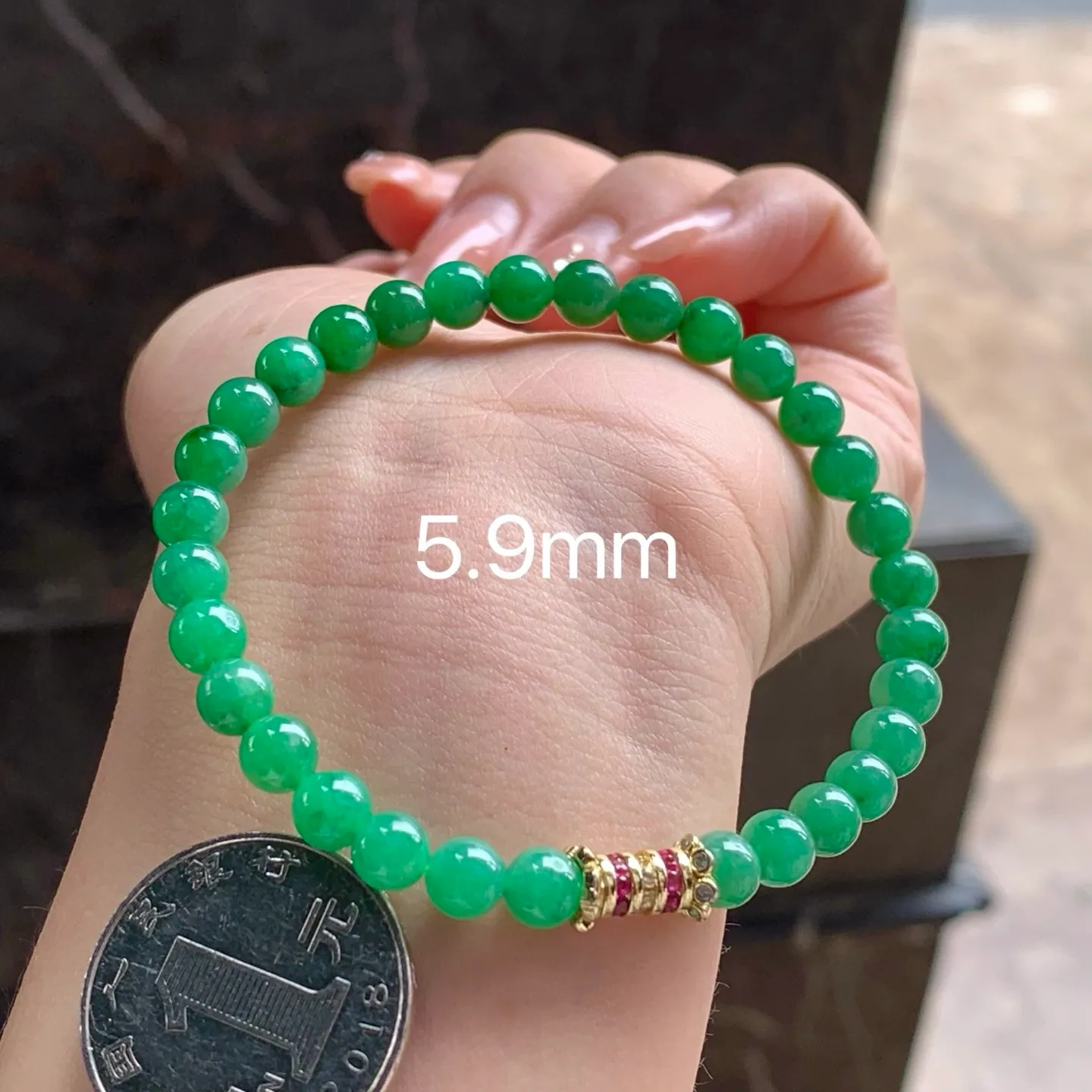
| About 5 to 6 mm | Light, still easy to wear every day | Color shows more clearly in each bead |
| About 7 to 9 mm | A classic necklace; the color reads from across a room | Each bead needs a larger clean piece of stone |
| About 10 mm and more | Bold and heavier; common for malas and men's strands | Large, clean, matched beads are hard to find |
As a rough guide, a strand holds about its length divided by the bead diameter. A 45 cm strand of 6 mm beads is around 75 beads, and the same length of 3 mm beads is around 150, fewer if there are knots or spacers. That is why small beads are not automatically cheap: a small-bead strand in one even color needs a great many matched beads.
How long should a bead necklace be?
Necklace lengths follow the usual jewelry sizes. These are approximate and depend on your build and on bead size, since large beads sit a little higher and looser than small ones.
| Length | Where it sits on most adults | Suits |
|---|---|---|
| About 40 to 45 cm | At or just below the collarbone | Small beads, open necklines |
| About 45 to 50 cm | A little below the collarbone | Most everyday bead necklaces |
| About 50 to 60 cm | Upper chest | Larger beads, wearing over a collar, a bead with a pendant |
| About 60 cm and more | Mid chest or lower | Long strands, malas, wearing doubled |
Multi-wrap strands. A long strand of small beads with a clasp can be wound around the wrist several times. Each turn uses roughly your wrist measurement plus a little room, so the number of turns depends on the strand's total length and on your wrist. Whether the same strand also works as a necklace depends on that length too. Ask the seller for the total length before you buy, then lay a piece of string around your wrist and neck to see how it would sit.
Clasp or no clasp. A strand without a clasp has to be long enough to pass over your head. Shorter necklaces, and most multi-wrap strands, close with a clasp.
What is a 108-bead mala?
A mala (佛珠 or 念珠 in Chinese) is a Buddhist prayer strand. Its 108 beads are used to count recitations of prayers or mantras. A larger bead, the guru bead (佛头), marks where the strand begins and ends, and it often carries a tassel. Some malas add three or four marker beads that divide the count. Shorter strands of 54, 27 or 18 beads are also made. Traditions differ between Chinese, Tibetan, Thai and other Buddhist communities, and the meaning of 108 is explained in our bead bracelet guide.
A jadeite mala is worn around the neck, wound around the wrist, or kept in the hand for practice. Many people also wear one simply as jewelry. If you use it for practice, follow the customs of your own tradition or teacher. Some practitioners, for example, avoid putting a mala on the floor or wearing it into the bathroom.
Buying points specific to a mala:
- Count the beads, and check that the certificate's bead count or weight matches the strand, guru bead included.
- Ask what the guru bead and marker beads are made of. They are sometimes a different color or a different material from the main beads.
- Think about weight. 108 large beads make a long, heavy strand. Smaller beads keep a mala comfortable for daily wear.
What is a 多宝 (mixed) strand?
A 多宝 strand (duōbǎo, "many treasures"; Vietnamese sellers say chuỗi đa bảo) mixes jadeite beads with other pieces: small jadeite carvings such as a gourd or a safety buckle, beads of other stones, and gold or silver spacers and caps. Some are mostly jadeite in several colors and shapes. Others mix many materials.
A mixed strand is judged differently from a matched one. Matching is not the point; you judge the quality of each piece and how well the design hangs together. Before you buy:
- Ask in writing which parts are jadeite and what every other material is.
- Read what the certificate covers. Check that its conclusion names the jadeite parts and does not leave the rest to guesswork.
- Check the metal stamp, such as 750 for 18K gold or 925 for sterling silver.
Why does a full-color matched strand cost so much more?
The bead bracelet guide explains the basic reasons a strand is not priced as one bead times the number of beads: matching, wastage and bead size. A necklace multiplies all of them.
- More beads to match. A necklace or long strand can need many dozens to well over a hundred beads, and every one must look like its neighbors in color, texture and translucency.
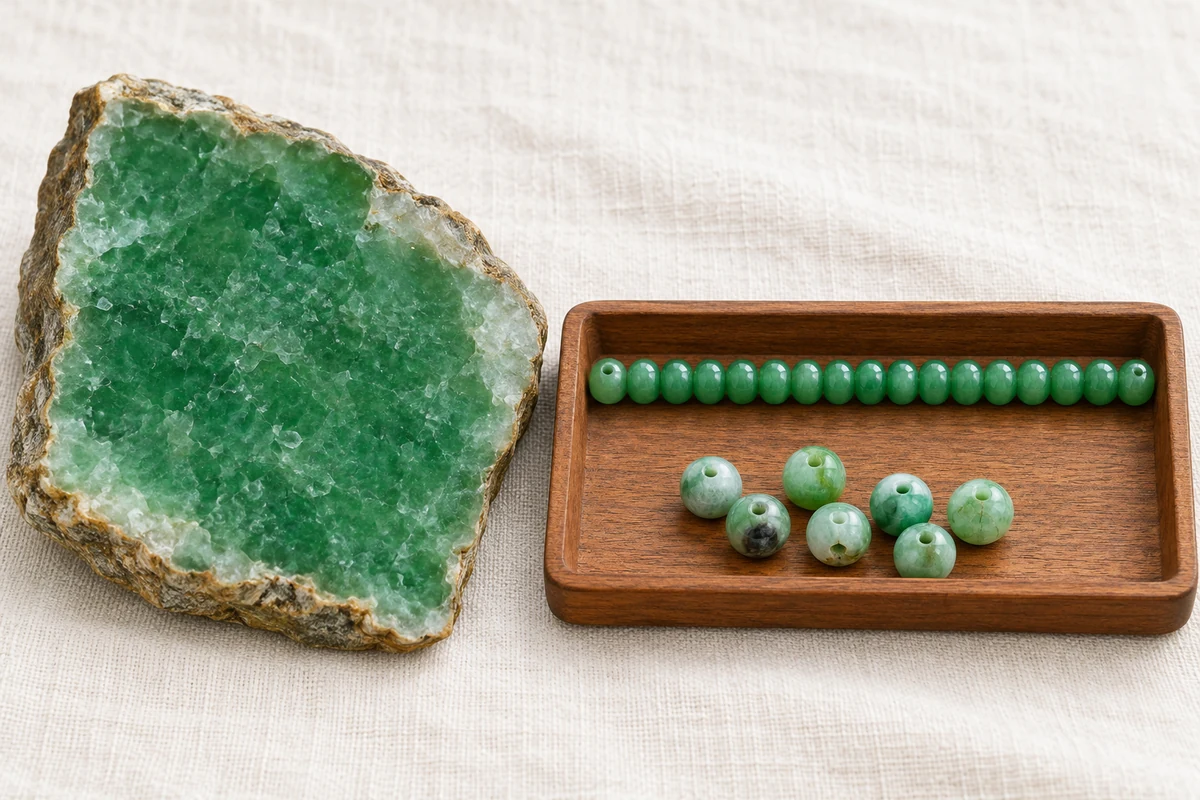
- Full color means every bead. In a full-color strand (满色) each bead is green all over, without white patches. Green often runs in veins or patches through a block of rough, so only the colored parts can be used, and they have to be large enough to cut whole beads from.
- One rough, one look. Beads from different rough rarely match. A long matched strand is usually cut from one piece, and the beads that do not match are set aside.
You can see this in the strands on sale at JadeiteHub, prices as of 24 October 2026. Two are full-green multi-wrap strands of glutinous-icy (糯冰种) Type A jadeite with 18K rose gold clasps. One has small bright green (阳绿) beads of about 3.1 to 3.5 mm (JH-000074, US$4,049). The other has vivid green (辣绿) beads of about 6 mm (JH-000077, US$11,939). A 6 mm bead holds roughly five to seven times as much stone as a 3.3 mm bead, and all of it has to be the same deep green, which is why the larger strand costs nearly three times as much. These are the prices of two pieces, not a market guide.
Vivid green (辣绿) is a strong, deep green, and it is not the same as imperial green; see imperial green jadeite and the jadeite colors guide. For everything else that moves a price, see what determines jadeite price. The whole range of strands and beads is in the beads section of the shop.
How do I check that every bead is natural Type A?
Every bead is a separate stone, so the certificate has to cover the whole strand. How to read it, and how to look at drill holes under a flashlight, is explained step by step in the bead bracelet guide. Necklaces and long strands add a few traps of their own.
- Dyed small green beads are one of the most common fakes. Small beads soak up dye easily, and a long strand of evenly bright green beads is exactly what dye can make cheaply. Dyed (Type C) green tends to look the same in every bead, runs along fine cracks like a net of threads and gathers at the drill holes. Natural green, even in a well-matched strand, usually shows small differences inside each bead under a flashlight.
- Watch the price. If a long, evenly bright green strand costs about as much as a single plain pendant, treat it as dyed or not jadeite until a lab says otherwise.
- Check the certificate details. The photo should show the whole strand. For a necklace with a clasp, the weight on the report often includes the metal. For a mala, the bead count should match.
- Resin filling (Type B) usually cannot be seen by eye. See how to spot treated jadeite and Type A vs Type B vs Type C jadeite.
Knotted silk, elastic or wire: how should a strand be strung?
The thread decides how the strand hangs, how it fails and how often it needs work.
| Stringing | Good points | Drawbacks | Common use |
|---|---|---|---|
| Knotted silk or nylon thread | Drapes softly; knots keep beads from rubbing; if it breaks, at most one bead comes loose | Silk stretches and weakens when wet; needs restringing | Classic necklaces, graduated necklaces |
| Elastic cord | No clasp needed; easy to put on | Stretches and wears; tension on a long strand | Wrist strands, many malas |
| Coated steel beading wire | Strong; does not stretch | Stiffer drape; kinks stay; held by small crimps at the clasp, which are the weak point | Some multi-wrap and fashion strands |
Clasps. On good jadeite strands the clasp is usually 18K gold, often white or rose gold, stamped 750 or 18K. A clasp may be set with small stones as decoration. Ask what those stones are, and do not assume they are diamonds or rubies unless the seller says so in writing. Check that the clasp closes firmly with a safety catch, and that the thread or wire is tied off neatly where it meets the clasp, because that is where most strands fail. More on gold and settings is in gold-set jadeite and silver vs gold settings.
With a pendant or without?
A plain strand lets the beads themselves be the piece. A pendant adds a center point. There are two common ways to combine them:
- A pendant on a bead strand. A carving or a larger bead hangs from the middle of the strand on a metal bail or connector. The strand should be strong enough for the pendant's weight, so a heavy carving suits larger beads on knotted thread, not a fine 3 mm strand.
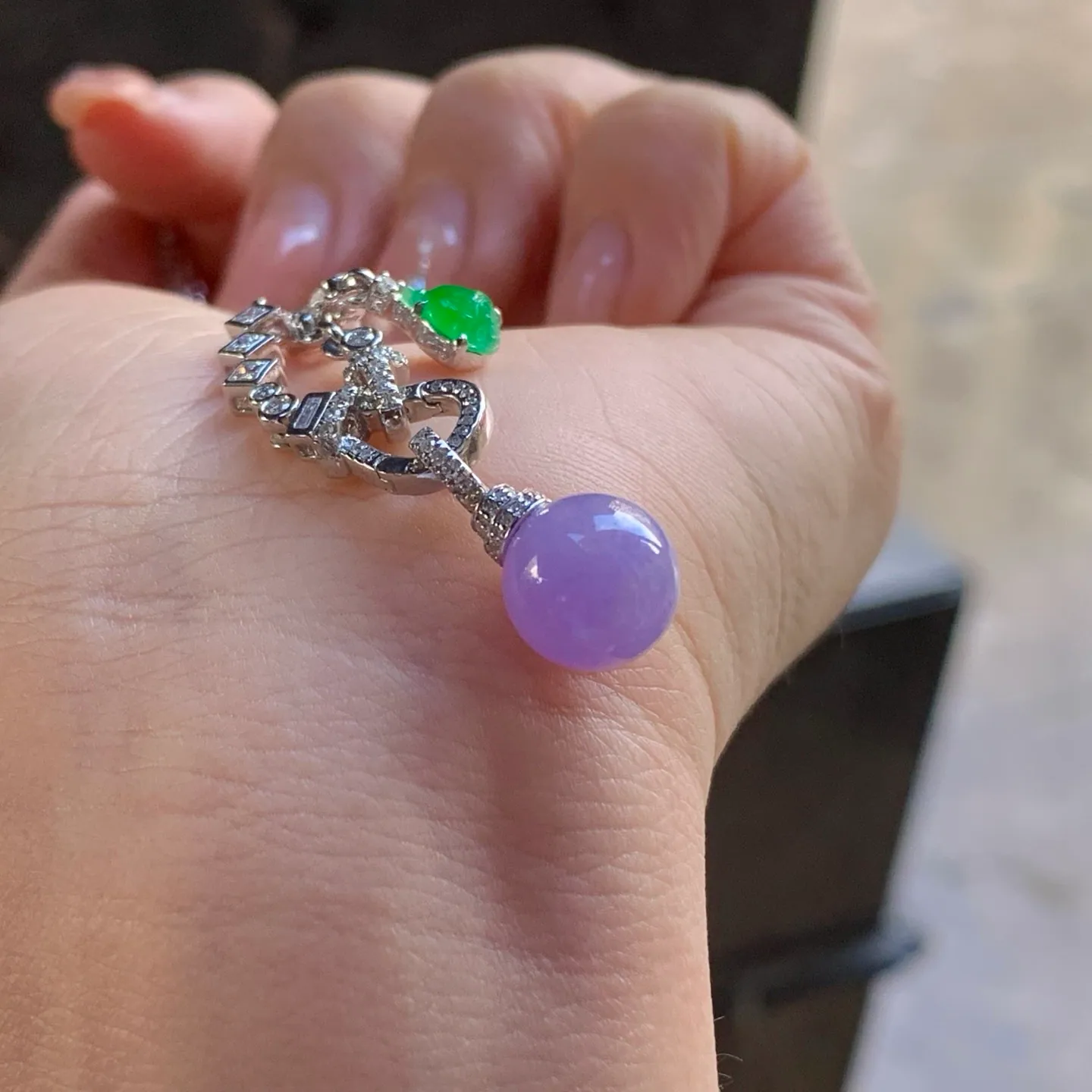
- One bead as the pendant. A single larger bead hangs from a chain or cord, often under a small gold cap or drop.
At JadeiteHub, as of 24 October 2026, JH-000082 is a necklace of this second kind: one lavender (春色) Type A jadeite bead of about 9.7 mm, a "good luck" bead (转运珠), hangs under an 18K white gold drop (US$8,389). The name "good luck bead" is a wish, not a property of the stone. For lavender color, see lavender jadeite. For cords, chains and bails, see how to hang a jade pendant.
How do I care for and restring a bead necklace?
- Put it on last and take it off first. Perfume, hair spray, lotion and sweat age silk thread.
- Keep it dry. Take it off for showers and swimming. Wipe the beads with a soft cloth after wearing. No ultrasonic cleaners and no chemicals. See how to care for jadeite.
- Store it flat, in a soft pouch or a lined box, away from harder stones. A silk-strung necklace hung on a hook slowly stretches.
- Restring when you see the signs: gaps between beads and knots, fuzzy or darkened thread, a loose knot or wear near the clasp. Restring before it breaks. Strands that are worn often or get wet need it sooner.
- Keep the order. On a matched or graduated strand the bead order was chosen. Photograph and count the beads before restringing, and check the count against the certificate when you get it back.
- Ask for the same clasp back. A gold clasp is worth keeping; ask the jeweler to reuse it.
Is a jade bead necklace for men or women?
Both. Common patterns, not rules: many men choose larger beads, dark or solid green, or a mala; many women choose small-bead strands, lavender, icy beads or a bead with a pendant. In Chinese custom, a round bead strand is often read as completeness (圆满), and a strand is often given as a wish for safety. These are traditions; a necklace does not change health or luck. For other ideas, see the jadeite gift guide.
How do I buy a jade bead necklace?
- Decide on the style: necklace, multi-wrap strand, mala, mixed strand or a bead with a pendant.
- Choose bead size and ask for the total length, and check it with a piece of string around your neck or wrist.
- Ask what the material is, in writing: natural jadeite with no treatment, and for a mixed strand, what every part is.
- Ask for a certificate that covers the whole strand, and check the photo, bead count and weight.
- Ask for photos and video in daylight and under a flashlight, with close-ups of the drill holes.
- Judge the matching across all beads, not the bead count.
- Check the stringing and clasp: knotted, elastic or wire, the metal stamp, and the safety catch.
On JadeiteHub, listings use the seller's own photos, and some include video. Every piece ships with a certificate from an accredited national testing lab, every sold piece is checked against its certificate before it ships, and if it does not match the description you get a full refund.
FAQ
How much is a jade bead necklace worth?
There is no single price. It depends on whether every bead is natural Type A jadeite, how well the beads match, the color, translucency, bead size, bead count and cracks. A long strand of matched full-green beads costs far more than a mixed strand of the same length.
Can a long jade bead strand be worn as both a necklace and a bracelet?
Often, if it has a clasp and is long enough. Small-bead strands are commonly wound several times around the wrist; whether one also sits well around the neck depends on its total length. Ask the seller for the length before you buy.
Is it respectful to wear a jade mala as a necklace?
Many people wear a 108-bead mala around the neck, both for practice and as jewelry. Handle it with care. If you use it for practice, follow the customs of your own tradition, such as keeping it off the floor.
How can I tell if a green jade bead necklace is dyed?
Look at each bead under a flashlight. Dyed green tends to look identical in every bead, runs in fine cracks and gathers at the drill holes; a very low price for an even bright green strand is a warning. Only a lab certificate covering the whole strand is proof.
Is knotted silk or elastic better for a jade bead necklace?
For a classic necklace, knotted silk or nylon thread with a clasp: it drapes well, and a break loses at most one bead. Elastic suits wrist strands and many malas. Both need restringing when they stretch or fray.
What is a 多宝 jade strand?
A strand that mixes jadeite beads with other pieces, such as small jadeite carvings, beads of other stones and gold or silver spacers. Judge each piece on its own, and ask which parts are jadeite and what the certificate covers.