Can Jade Be Repaired? Scratches, Polishing and Cracks
Updated
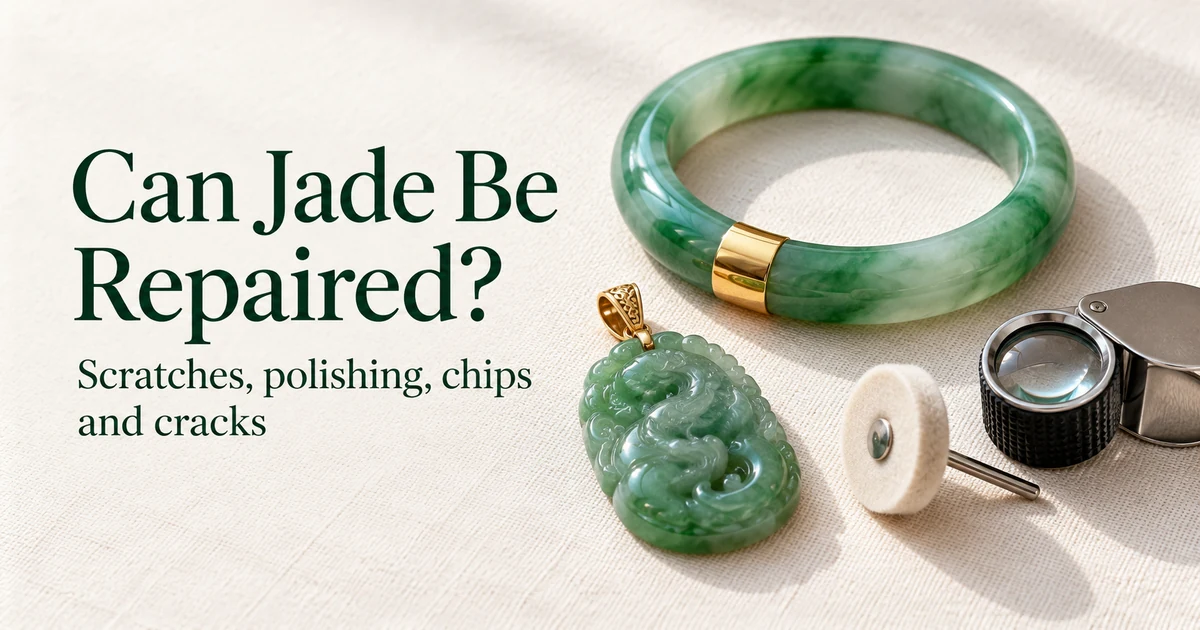
Scratches, a hazy surface and small chips can usually be removed by a jade polishing workshop, at the cost of a very thin layer of stone, so the weight on the certificate may no longer match exactly. A "dry" or dull look is usually dirt, skin oil or worn wax; clean it first. Cracks cannot be undone: you can leave and protect a cracked piece, bind it with gold or silver, or re-carve it. Glue or resin filling only hides a crack and must be disclosed if sold. A broken bangle can be joined with metal or cut into pendants, rings or beads. Avoid toothpaste, polishing powder and sandpaper at home.
Can jade be repaired?
Some damage can be repaired and some cannot. Scratches, a hazy surface and small chips can usually be removed by a jade polishing workshop, because polishing takes off a very thin layer of stone. Cracks cannot be undone: no process welds jadeite back together. A cracked or broken piece can be protected, bound with metal or re-cut into something smaller, but it stays a cracked or broken piece.
Every repair also costs the piece something, even when it costs you nothing more than a visit. Polishing removes material; re-cutting makes the piece smaller; metal covers part of the stone. The table sums it up.
| Problem | What can be done | What it costs the piece |
|---|---|---|
| Fine scratches, hazy or matte surface | Professional re-polish (重新抛光) and a fresh wax finish | A very thin layer of stone; weight and size may change slightly, so the certificate weight may no longer match |
| "Dry", dull look | Clean it first; often that is all it needs. Then re-wax or re-polish if worn | Nothing for cleaning; a little material for re-polishing |
| Dull, yellowish or crazed Type B (resin-filled) | Little; polishing may help the surface for a while but cannot fix aged resin | The problem is inside the stone |
| Chip on an edge, a cabochon or a bead | Grind and re-polish the chipped area, or re-cut the stone smaller | Size, weight, sometimes the shape; a ring stone may need a new setting |
| Crack | Leave it and protect it, bind it with gold or silver, or re-carve around it | The crack stays; value drops a lot |
| Broken bangle | Join it with metal bands, or cut the pieces into pendants, rings, cabochons or beads | It is no longer an intact bangle |
| Loose stone, bent prongs, worn bail | A jeweler repairs the metal | Usually nothing to the stone, if done with care |
| Worn or broken bead cord | Restring | Nothing |
Why does my jade look dull or "dry"?
Usually because something is sitting on the surface, not because the stone has changed. Natural Type A jadeite is dense and does not dry out the way wood or leather does. When buyers say a piece looks "dry" (发干), the cause is almost always one of these:
- A film of skin oil, soap, lotion or dust. It builds up on the back of pendants and in carved recesses and makes the stone look cloudy or flat. Wash it, and the shine usually comes back. See how to care for jadeite.
- The wax finish has worn off. Most workshops finish jadeite with a thin coat of wax (过蜡) after polishing. It fills microscopic pits and adds gloss. With wear and washing it slowly goes, and the piece looks a little less glossy than on the day you bought it. That is normal.
- Fine scratches. Household dust contains quartz, which is about as hard as jadeite. Years of contact with dust, desks, keys and other stones leave a fine web of scratches that scatters light. This is the haze a re-polish removes.
- Aged resin in treated jadeite. Type B jadeite has been bleached with acid and filled with resin. As the resin ages, the stone can turn dull or yellowish and the surface can show crazing, a fine net of cracks. Polishing cannot truly fix this, because the problem is in the filled structure, not on the surface. See Type A vs Type B vs Type C jadeite.
A clean Type A piece can also look a little glossier after months of wear, from skin oils and gentle rubbing. That is a surface effect too; the stone inside does not change.
How do I get scratches out of jade?
Take it to a workshop that polishes jade and ask for a re-polish. Scratches in jadeite are removed by grinding the surface down to the bottom of the scratch and polishing it again, which needs the right equipment and some skill.
In the trade, polishing (抛光) is done on small rotating wheels with abrasives of decreasing grit, usually diamond powder or paste, finishing with fine polishing powder on soft wheels. Carvings are polished partly by hand with small tips so that the details survive. After polishing the piece is cleaned, warmed and given a thin wax coat. Dealers call bringing an older piece back to shop condition 翻新, "making it new again".
What to expect:
- Fine scratches and haze usually polish out completely.
- Deeper scratches need more material removed. On a thin pendant or a delicate carving, the polisher may choose to leave a faint trace rather than flatten the carving.
- Coarse material (bean texture, 豆种) can polish unevenly and show a faint ripple called orange peel (橘皮). Good polishers work around it; it is a property of the stone, not always bad work.
- Pieces set in metal are usually taken out of the setting first, or polished with care around it, because metal and stone need different compounds.
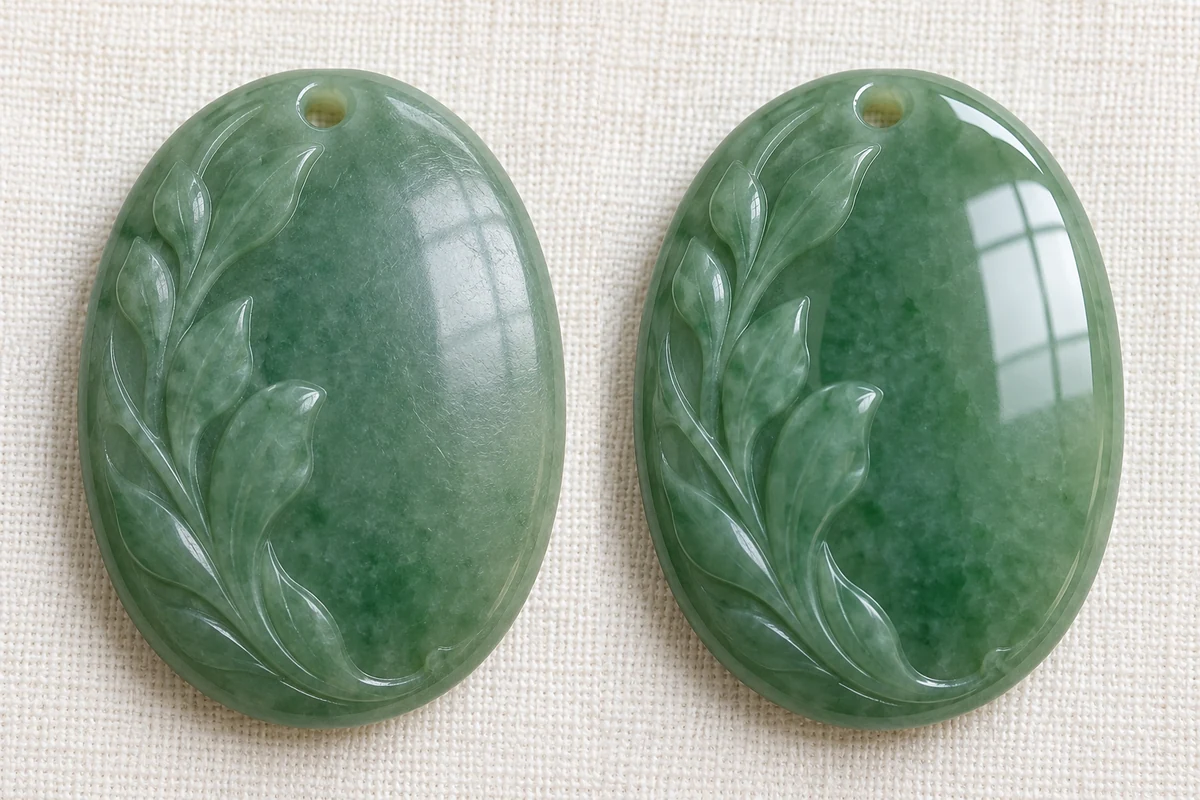
Re-polishing removes material, so do it when the piece needs it, not every year. Some owners of old family pieces prefer to keep the soft sheen of wear rather than make them look new.
Can I polish jade at home?
Cleaning, yes. Polishing, it is better not to. Home methods either do nothing or make the surface worse:
| Home method | What happens |
|---|---|
| Toothpaste | Contains mild abrasives that are too weak to remove scratches but can dull the polish and leave white residue in carvings |
| Polishing powder or polishing paste (抛光粉, 抛光膏) by hand | Without a wheel and graded grits you cannot level the surface, so you get uneven, wavy patches; powder packs into recesses |
| Sandpaper or a rotary tool | Leaves flat spots and new scratches, can round off carved details, and the heat can stress the stone along existing lines |
| "Jade scratch remover" products | Many are fillers, oils or waxes that hide fine scratches for a while rather than remove them |
| Oil or wax rubbed on | Gives temporary gloss, attracts dust, and can hide cracks rather than protect against them |
Jade polishing wax (玉石蜡) is not a repair. It is a cosmetic finish that adds gloss for a while. If your piece looks dull after a wash, the wax may have worn off; a workshop can re-wax it properly when it is in for other work. Do not boil jade in wax at home.
What you can safely do: wash in lukewarm water with a drop of mild soap, brush gently with a soft brush, rinse, dry with a soft cloth. Wipe dust with a damp cloth, not a dry one.
What is the white powder stuck in my jade carving?
Usually polishing powder or old wax left in the recesses, or dried soap. It is common on new carvings and on pieces polished in a hurry. It is not a sign of a fake.
To remove it, soak the piece in lukewarm soapy water for a few minutes, then work the recesses with a soft toothbrush or a wooden toothpick. Rinse and let it air-dry. Do not dig with metal needles, which can scratch the polish, and do not use an ultrasonic cleaner, which can enlarge hidden cracks. If white material keeps coming back from inside a line, or the line looks shiny or glassy, show it to a lab or a dealer: it may be a crack, or filling.
Can a chipped jade be fixed?
Usually yes, by making the piece a little smaller. A chip is a small piece broken off an edge, a corner, a bead hole or the top of a cabochon. The workshop grinds the chipped area smooth and re-polishes it.
- Bangles: a small chip on the outer edge can be rounded off; a deep chip leaves a slightly flatter spot.
- Cabochons (蛋面): a chip on the dome or girdle often means re-cutting the whole stone slightly smaller and lower, so the ring or earring setting may need to be adjusted or remade.
- Carvings: a carver can sometimes re-shape a chipped leaf, tail or edge into the design. How much is possible depends on where the chip is.
- Beads: a chipped bead is often simply replaced, if you can find a matching one, or re-polished smaller.
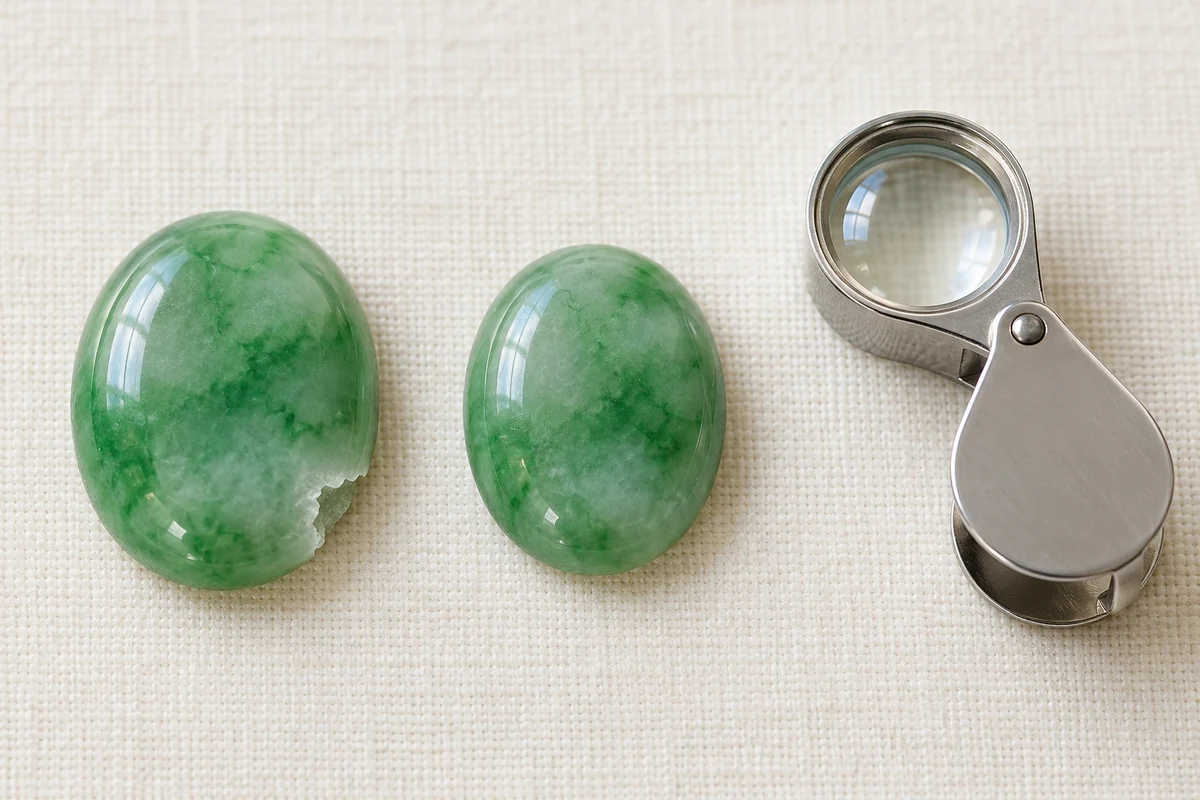
Before any re-cut, look at the chip under a loupe or a flashlight. A chip with a line running inward from it is a crack, and grinding the edge will not remove it.
Can a cracked jade be repaired?
No, a crack cannot be repaired in the sense of making the stone whole again. Jadeite does not heal, and nothing a workshop or a jeweler does joins the two sides of a crack. What you can choose is how to live with it:
- Leave it and protect it. A small crack that does not reach an edge is often left alone. Wear the piece less, avoid knocks and sudden heat, and check the crack now and then.
- Bind it with metal. A gold or silver band, a cap or a bezel over the cracked section holds it together. Done well, it looks like a design. This is the traditional repair for bangles; see gold-set jadeite.
- Re-carve or re-cut. A carver removes the cracked part and makes a smaller piece from the rest, or carves a design that follows the crack.
Filling a crack with glue or resin is concealment, not repair. It makes the line harder to see but does not make the stone strong again. It is a treatment, and if you ever sell the piece you must say so.
Can you still wear a cracked piece? A cracked pendant or ring in a protective setting often can be worn with care. A bangle cracked across the band is at real risk of breaking, sometimes into sharp pieces, so it is better to stop wearing it until it is bound or re-made. A cracked ring stone is at risk mainly where the prongs press on it; ask a jeweler to check the setting.
Not every line is a crack. Natural stone lines (石纹) are healed and do not catch a fingernail; open cracks (裂) do. Learn the difference before you worry: see jade crack or natural line.
Can a broken jade bangle be repaired?
It can be joined with metal, but not made into an unbroken bangle again. Some broken bangles can be joined at the break with a metal wrap, or, depending on the damage, redesigned as an opening bangle with a hinge and clasp; both are a kind of 金镶玉-style ("gold inlaid with jade") repair. The result is wearable and can be beautiful, but it is a repaired bangle and is valued as one.
The other common choice is to have a carver cut the pieces into pendants, saddle rings, cabochons or beads. Keep every piece and the certificate until you decide. The options, and what a broken bangle traditionally means, are in jade bangle cracked or broken.
What about rings, pendants and bead bracelets?
Most damage on these is in the metal or the cord, and a jeweler fixes it:
- Loose stone or bent prongs: stop wearing the ring and take it to a jeweler before the stone falls out. Tell them the stone is jadeite, so they avoid steam and strong heat near it.
- Worn bail or jump ring on a pendant: replace it; it is the most common reason pendants are lost.
- Bead bracelets: elastic cord stretches and silk cord frays. Restring before it breaks, and count the beads. See the jadeite bead bracelet guide.
Who should repair jade, and what should I ask?
For polishing, re-cutting and carving, go to a jade carving or polishing workshop, or a jade shop that works with one. For settings, prongs, gold bands and chains, a jeweler or goldsmith. Many general jewelers do not polish jade themselves and send it out, so ask who will actually do the work.
When you search "jade repair near me" or "jade polishing near me", ask before you hand the piece over:
- Will you polish it yourself, or send it to a workshop?
- How much material will come off, and will the shape or carving change?
- Do you need to take the stone out of its setting?
- Will you add a wax finish?
- Will you use any filler, glue or resin? (The answer for a polish should be no.)
- Can I have a written note of what was done?
- How long will it take, and how will you protect the piece while you have it?
Take clear photos and note the weight and measurements before you hand the piece over. Ask for a quote first; costs vary by piece and workshop, so we do not quote figures here.
Does a repair affect the certificate and resale value?
It can. A certificate records the piece as it was tested: weight, measurements, photo, mineral and treatment. After a re-polish or re-cut, the weight and size may no longer match exactly. That does not make the stone less natural, but it can complicate verification or a later sale. Ask the lab that issued the certificate whether they can re-check the piece and update it.
For resale, a clean re-polish costs little. Cracks, glued repairs and joined bangles cost a lot: most buyers mark them down sharply or refuse them, and any filling must be disclosed. See selling jadeite and resale value.
How can I avoid damaging my jade?
Most damage comes from knocks and hard floors, not from wear. Jadeite is tough but can chip or break on stone or tile.
- Take bangles off for sports, heavy cleaning and work with tools.
- Store each piece in its own soft pouch, away from harder or equal-hardness stones.
- Avoid sudden temperature changes: boiling water, saunas, a hot car after air-conditioning.
- No ultrasonic or steam cleaning.
- Check settings and cords every few months.
More detail is in is jadeite fragile and wearing jade every day.
Every piece JadeiteHub lists has a lab certificate, every sold piece is checked against its certificate at our inspection center before it ships, and if a piece does not match its description you get a full refund.
FAQ
Can jade be repaired?
Partly. Scratches, a dull surface and small chips can usually be re-polished or re-cut by a jade workshop. Cracks cannot be undone; a cracked or broken piece can be bound with gold or silver or re-carved into smaller pieces.
Can cracked jade be fixed?
Not truly. No process joins the two sides of a crack. You can leave it and protect it, bind it with a metal band or cap, or re-carve around it. Filling a crack with resin or glue only hides it and must be disclosed if the piece is sold.
Can I polish jade at home with toothpaste or polishing powder?
It is better not to. Toothpaste is too weak to remove scratches and can dull the polish, and hand-polishing with powder, paste or sandpaper leaves uneven patches and residue in carvings. Wash it with mild soap and water and leave polishing to a workshop.
Where can I get jade polished?
At a jade carving or polishing workshop, or a jade shop that works with one. Many general jewelers send jade out, so ask who does the work, how much material will come off and whether any filler will be used.
Does jade polish wax help?
Wax is a cosmetic finish. Workshops apply a thin coat after polishing to add gloss, and it wears off over time. It does not remove scratches or repair anything, and wax rubbed on at home attracts dust.
Will re-polishing affect my jade certificate?
Re-polishing removes a little material, so the weight and size may no longer match the certificate exactly. The stone is still natural. Ask the issuing lab whether they can re-check and update the record.