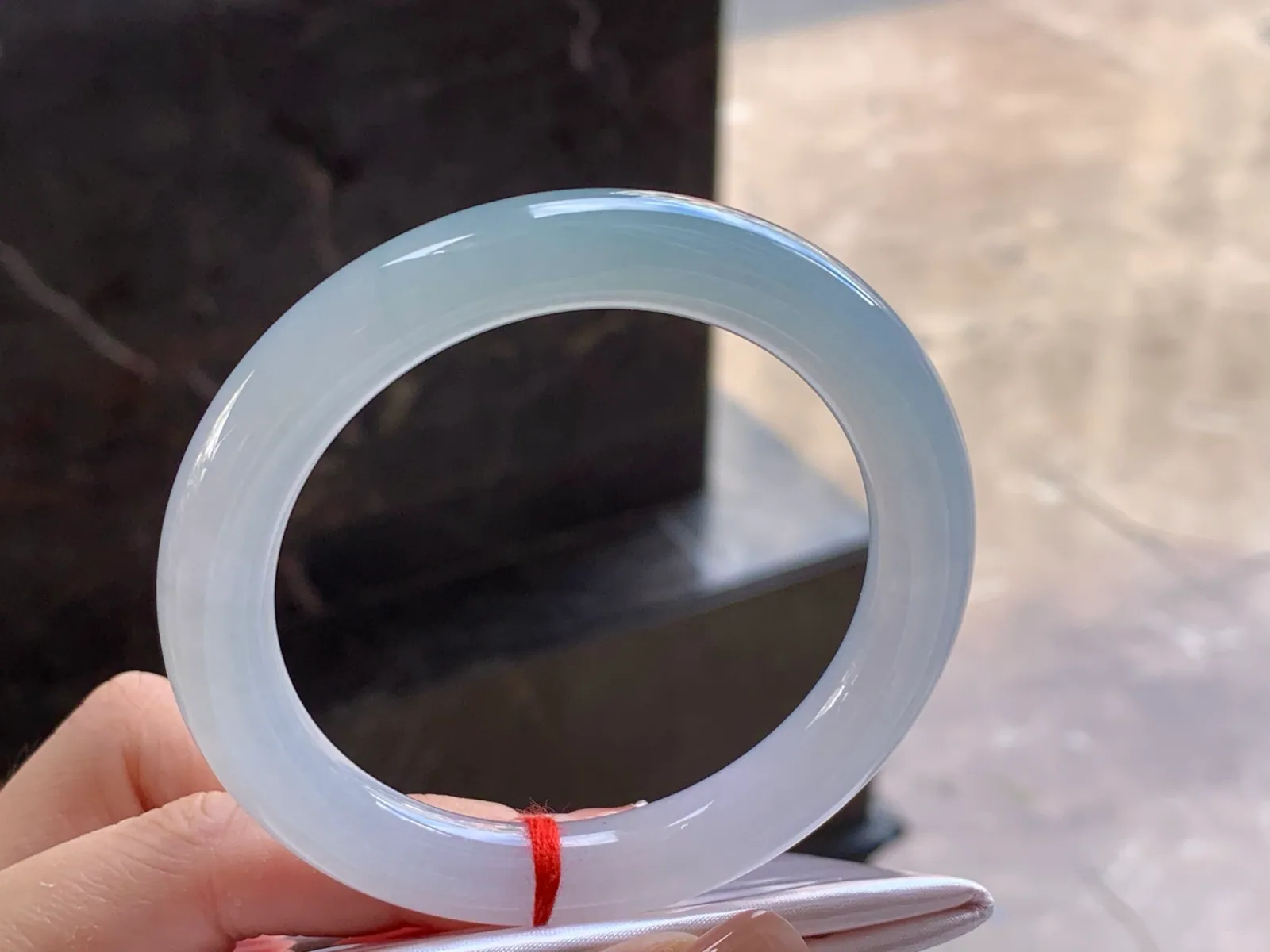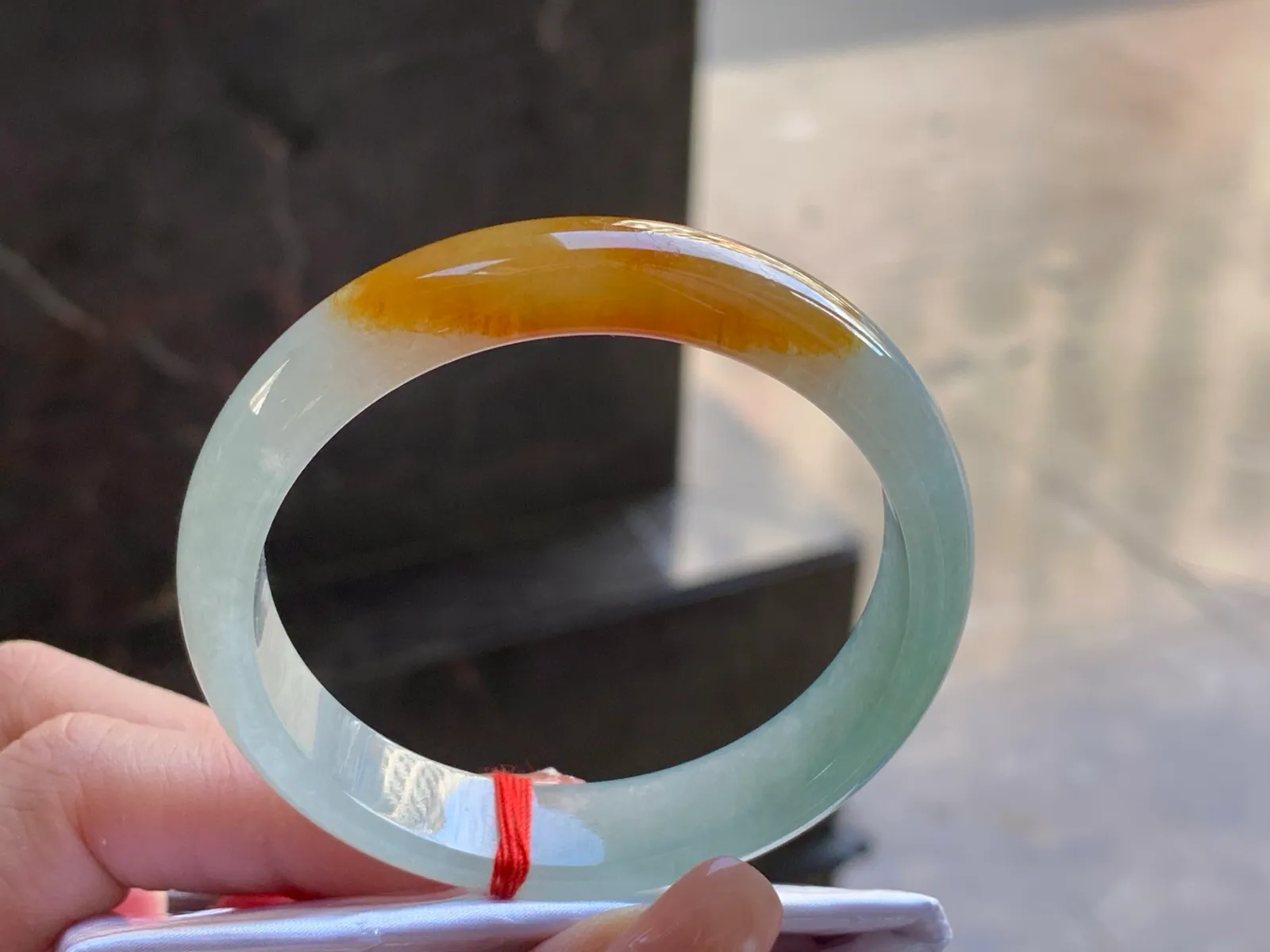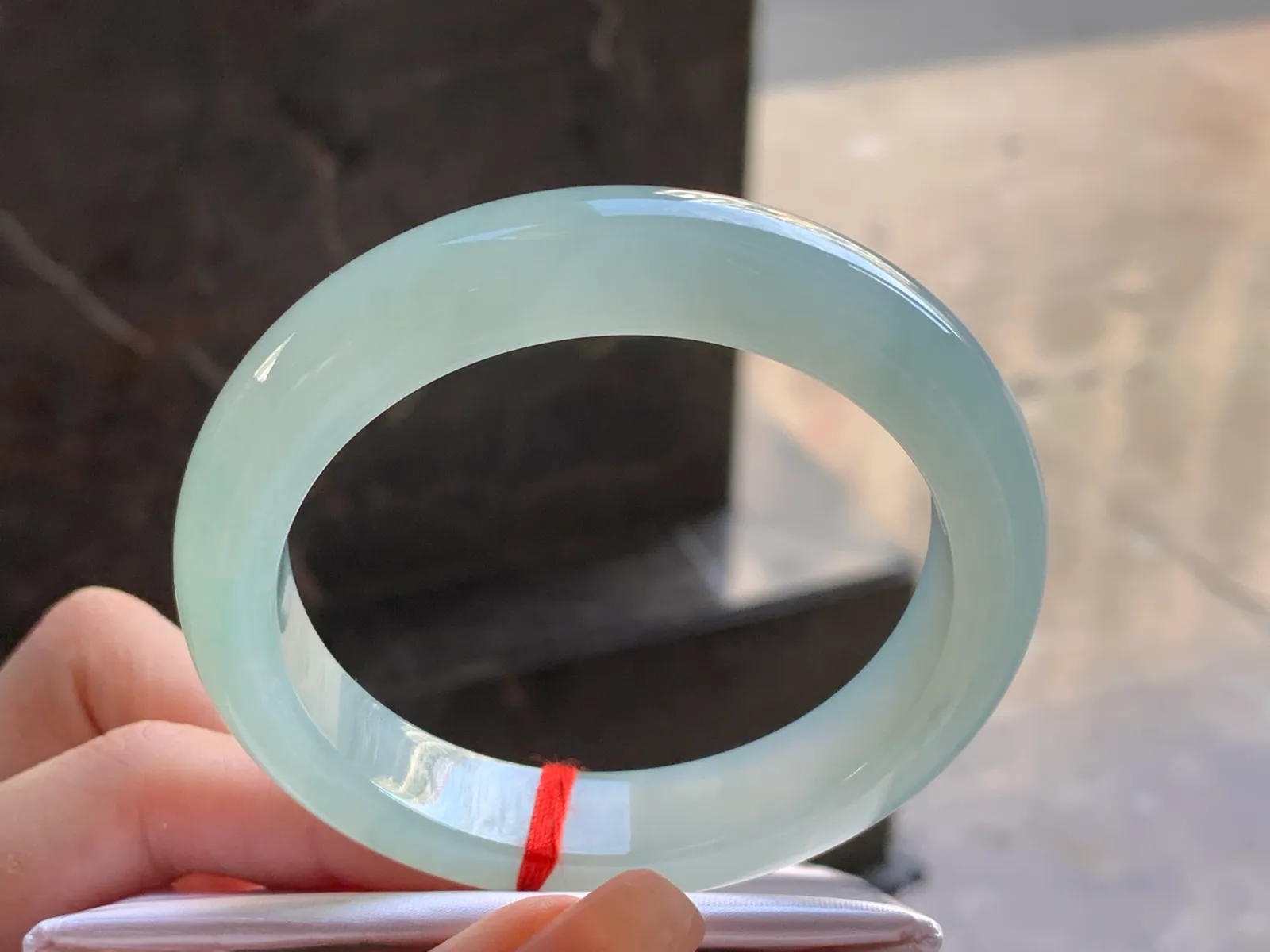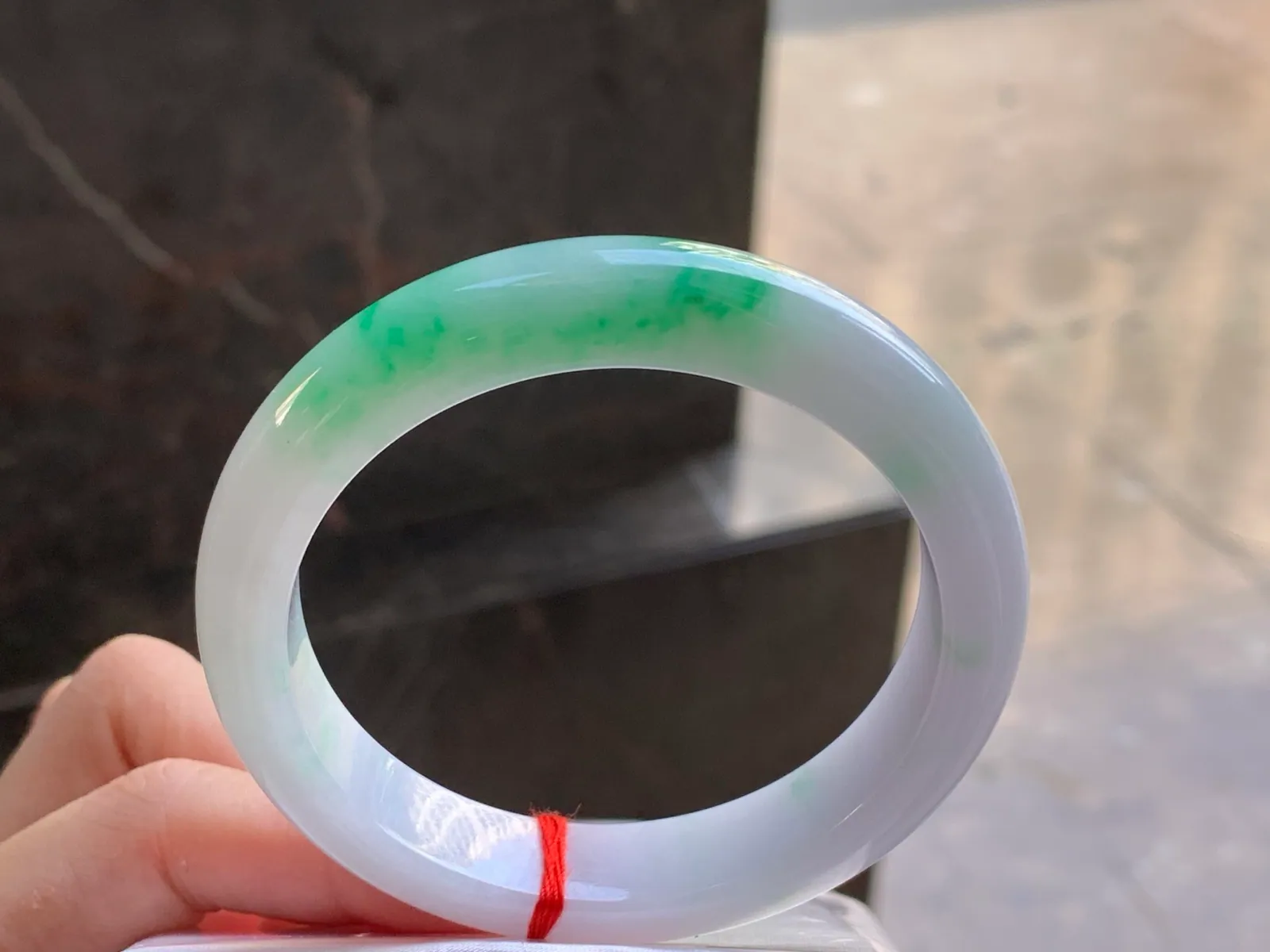
How to Choose a Jade Bangle: 10-Step Buying Checklist
Updated
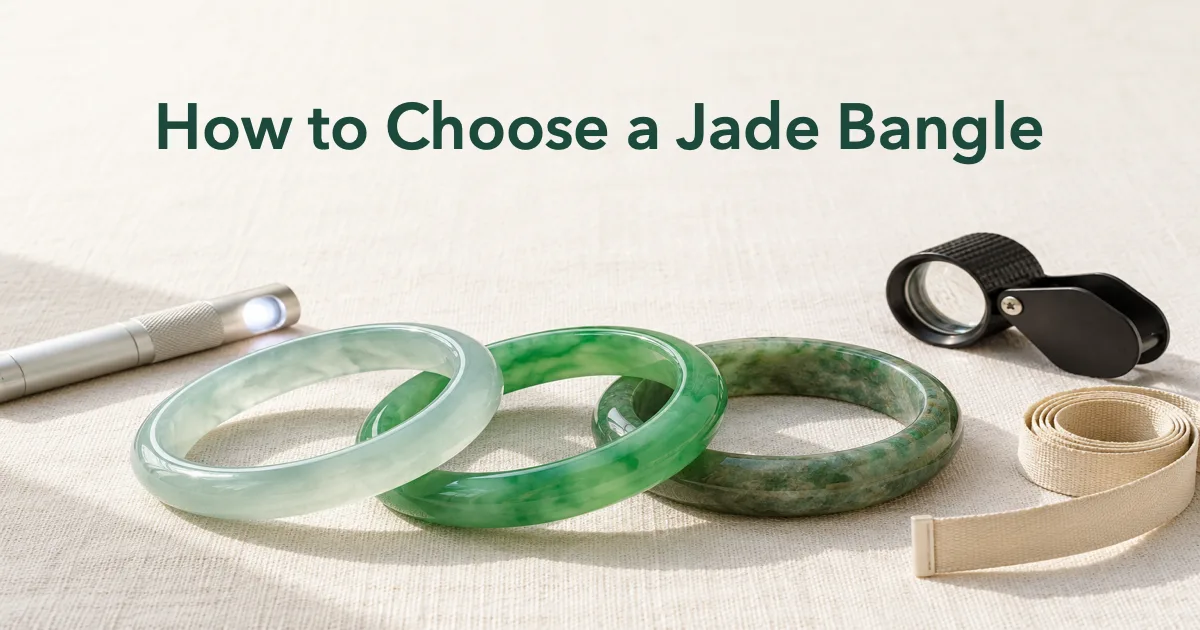
To choose a good jade bangle, check it in this order: make sure it is natural Type A jadeite with a certificate for that piece, then judge texture and translucency, color, and cracks under a flashlight, then size, band shape and any gold wrap. Fit and a clean, crack-free band matter more for a bangle than for any other jade piece, because a bangle is worn every day, cannot be resized and takes knocks. Decide in advance whether you value texture or color more, ask for video in daylight and a flashlight test, and buy where you can return it.
How do you choose a good jade bangle?
Choose a jade bangle by checking, in order: that it is natural Type A jadeite with a certificate for that exact piece, its texture and translucency, its color, whether the band has cracks, and then size, band shape and any gold. The first and the fourth are pass-or-fail. The rest are about taste and budget.
A bangle is the hardest jadeite piece to buy well. It is one continuous ring of stone, so a crack anywhere runs through the whole piece. It is worn every day and knocks against tables and door frames. It cannot be resized. And it is large enough that a bangle with even color and fine texture all the way round is rare, which is why good bangles cost more than a pendant of similar quality.
The checklist below follows the order a dealer uses when a tray of bangles is put in front of them. Each step links to a full guide if you want to go deeper.
1. What matters most to you: texture or color?
Before you look at a single bangle, decide what you are paying for. In jadeite, price rises steeply with three things: texture and translucency (种水), color, and size without flaws. Very few bangles have all three, and the ones that do are priced accordingly.
| If you care most about | Look for | Accept |
|---|---|---|
| A glowing, translucent look | Icy or glutinous-icy texture, even if colorless or with light floating green | Little or no color |
| Strong green | Even, saturated green over as much of the band as possible | A more opaque, coarser texture at the same budget |
| Daily wear and value for money | Fine, even texture, a clean band, a comfortable shape | Pale or patchy color |
| A gift or heirloom | A clean band, a certificate, a classic round or flat-inner shape | Less color or translucency |
Dealers often say that a bangle with good texture and no color is a safer buy than one with color on poor texture, because texture shows across the whole band while color is often only in one section. See jadeite texture, translucency and color for how each is graded.
2. Is it natural Type A jadeite with its own certificate?
This is the one step you cannot skip. Bangles are the piece most often bleached and filled with resin (Type B) or dyed (Type C), because the treatment can turn a large, cheap, cloudy bangle into one that looks clean and green. A treated bangle can lose its look within a few years and has little resale value.
- Ask for a certificate from a recognized gem lab that names the material as jadeite with no treatment.
- Check that the certificate matches this bangle: inner diameter, band width and thickness, weight and photo. See how to verify a jadeite certificate.
- Be wary of a bangle that is very clean, very green and very cheap. That combination is what treatment is designed to produce. See how to spot treated jadeite.
- Glass, dyed quartzite and aventurine are also sold as "jade" bangles. See how to tell real jade from glass and other fakes.
A certificate tells you what the material is. It does not tell you whether the bangle is cracked, whether the color is good or whether the price is fair. The rest of this checklist covers that.
3. How fine is the texture, and how translucent is it?
Texture (种) is how fine and tightly packed the grains are; translucency (水) is how far light goes into the stone. On a bangle, look at the whole ring, not one spot:
- Hold the bangle up to a window and turn it slowly. A fine-textured bangle looks smooth and even all the way round; a coarse one shows visible grains or a sugary look.
- Check that the texture is consistent. Many bangles have a fine, translucent section and a coarser, cloudier one. Sellers photograph the good side.
- White cloudy patches (cotton, 棉) are natural. Fine snowflake cotton matters little; a dense white patch on the top of the band matters more.
Glow under light, often described with words like 起光 or 起胶, comes from fine texture and good polish. See what is icy jadeite for the higher texture grades and the words sellers use for them.
4. Is the color even, and is it real color or lighting?
Color is what most people notice first, and it is where photos mislead most.
- Even beats bright. A bangle with soft, even green all the way round usually wears better than one with a bright green patch on one side and grey on the other. Price, however, follows the best color, so a single bright section can still make a bangle expensive.
- Look at where the color sits. Color on the top of the band, where it shows when worn, is worth more than color on the inside or underneath.
- Check it in daylight. Warm or yellow light makes green look richer and hides grey and blue tones; strong white LED light can make icy texture look clearer than it is. Ask for the same bangle under daylight, indoor light and a white flashlight.
- Watch for color that follows cracks. Green that runs along fine lines like a web is a sign of dye.
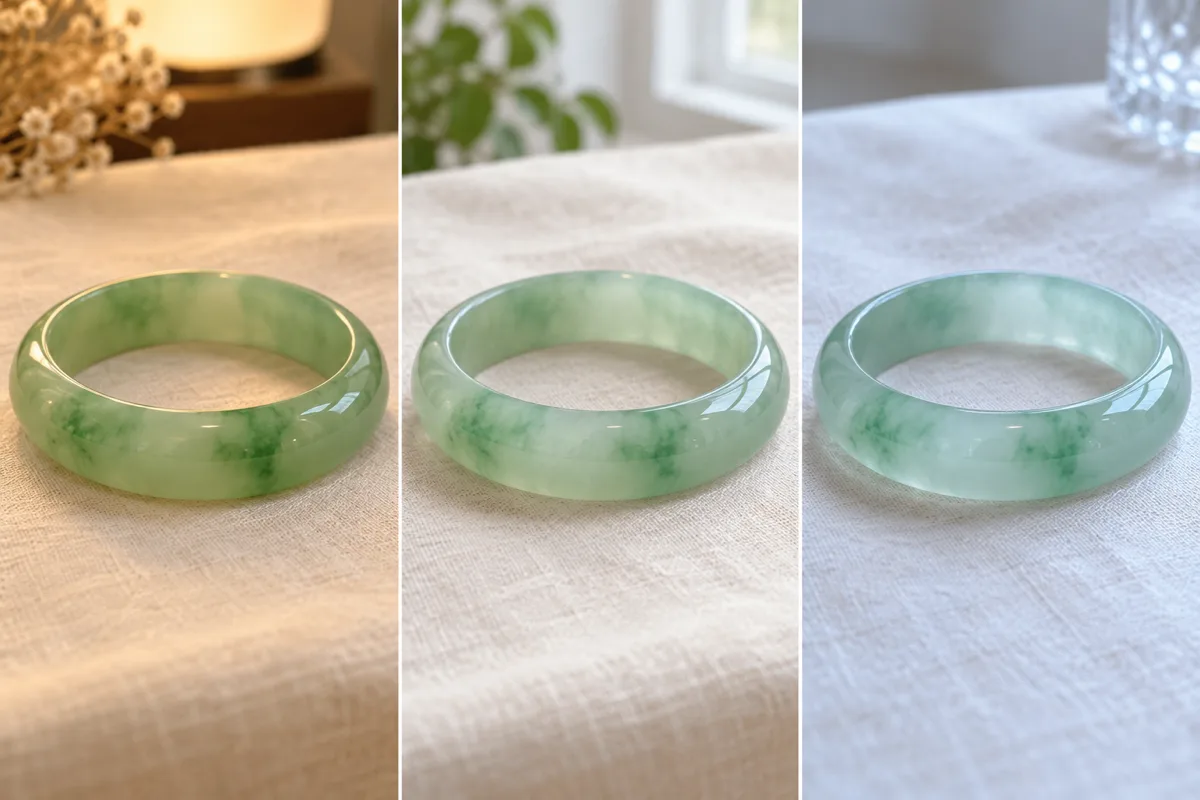
See the jadeite colors guide for the main colors and how each is valued.
5. Does the band have cracks, or only natural lines?
For a bangle, a crack is the most serious flaw. It weakens the ring, it can open further with a knock or a change in temperature, and it sharply lowers the value. Natural healed lines (石纹) are common and acceptable; open cracks (裂) are not.
How to check, in person or on video:
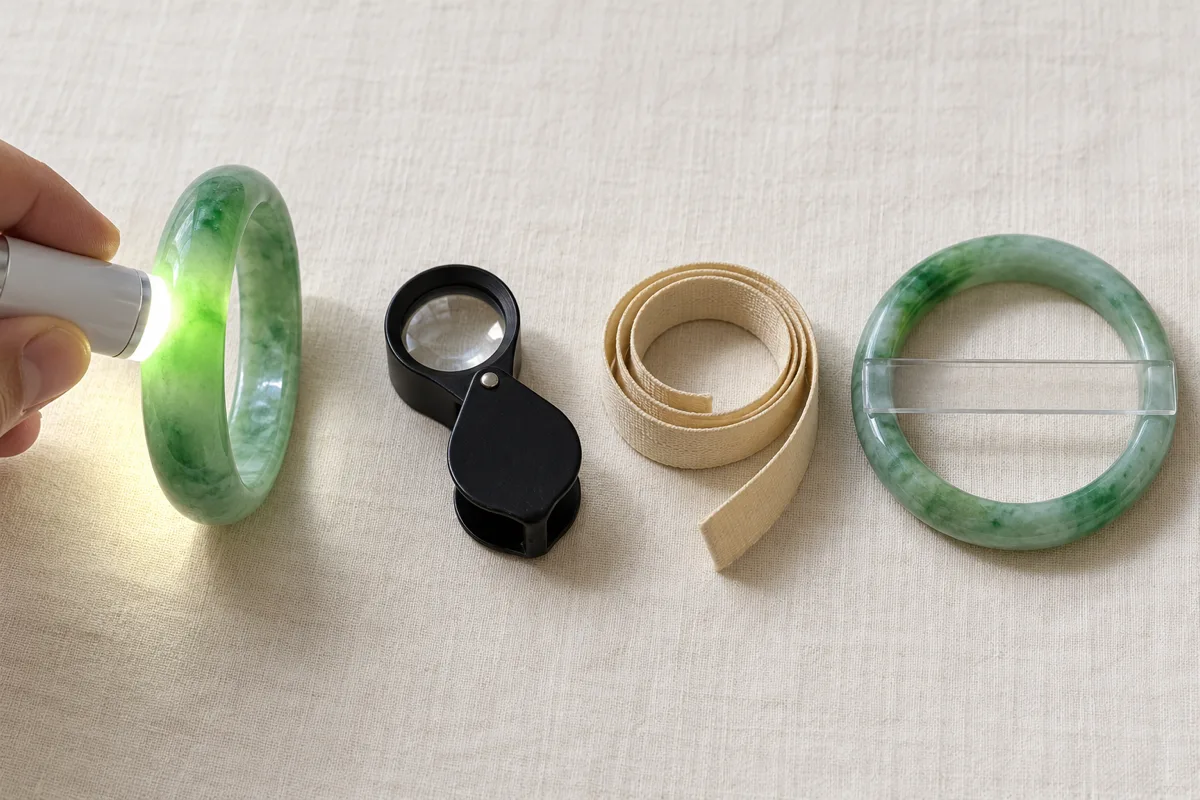
- Shine a small white flashlight against the band and move it slowly all the way round, outside and inside.
- A crack stops the light: the band looks dark on the far side of the line, and at one angle a flat, mirror-like flash appears. A natural line lets the light pass.
- Run a fingernail across any line on the surface. A surface crack catches the nail.
- Look closely at the inside of the band and anywhere covered by gold, a hand or a sticker.
Most certificates do not say whether a bangle is cracked, so you have to check yourself or ask the seller to show you on video. See jade crack or natural line for the full method, and cracked or broken jade bangle if yours is already damaged.
6. Will it fit? Size, band width and thickness
A jadeite bangle cannot be resized, so measure before you buy. Bangles are sized by inner diameter in millimetres. The short version:
- Tuck your thumb toward your little finger, measure around the widest part of your hand, and divide by 3.14 for an estimate.
- Better: measure the inside of a bangle that already fits you.
- A wide or thick band feels tighter than a slim one of the same inner diameter, and an oval bangle sits closer to the wrist than a round one.
The full method and a size chart are in how to choose a jadeite bangle size. Also look at the band's width and thickness in the listing: a thin band is lighter and cheaper but more fragile; a thicker band is sturdier and shows more color, and usually costs more. If a bangle is hard to get on or off, see jade bangle stuck before you force it.
7. Which band shape suits you?
| Style | Shape | Good for |
|---|---|---|
| Round band (圆条) | Round cross-section, the classic shape | Traditional look, shows color and translucency well |
| Flat-inner (正装, 平安镯) | Flat inside, rounded outside | Most comfortable for daily wear; sits flat on the skin |
| Oval (贵妃镯) | Oval opening | Slim wrists; stays put and turns less |
| Slim (美人镯) | Narrow band | Light, elegant, wearing with other bracelets |
| Wide band | Broad, often flat | A bold look; uses more stone, so costs more |
Style changes how a size feels and how much material the bangle needs. See jadeite bangle styles for photos and how to choose.
8. Is there gold on it, and what is under the gold?
Gold wraps and caps can be pure decoration, a way to join a broken bangle, or a way to cover a crack, a chip or a dark spot. All three look the same from outside.
- Ask why the gold is there, and ask for photos or video of the jade before it was wrapped if the seller has them.
- Check that the certificate was issued for the jade and describes the wrap; the certificate covers the jade, not the gold.
- Most gold wraps on jadeite are made in China in 18K gold, which is hard enough to hold its shape. 24K is softer and bends.
See gold-wrapped jade bangles for the setting types and what each can hide.
9. Buying online: what should you ask the seller for?
A bangle is a three-dimensional ring of stone, and a single photo shows less than half of it. Before you pay, ask for:
- A video turning the bangle slowly through a full circle in daylight, with no filter.
- A flashlight video moving round the whole band, outside and inside.
- The bangle on a wrist, to see the color against skin and how big it looks.
- The inner diameter, band width, band thickness and weight, measured with a ruler or caliper in the video if possible.
- The certificate details, and confirmation that they match this bangle.
- The return policy in writing: how many days, who pays return shipping, and whether you get a full refund.
A seller who will not show the inside of the band, or who only sends edited photos, is telling you something. See jade photos vs real life for how lighting, water and filters change what you see.
10. Is the price reasonable?
There is no price list for jadeite, and two bangles that look alike in photos can differ in price many times over. To judge a price:
- Compare like with like: same texture grade, similar color coverage, similar size and band thickness, both Type A, both crack-free.
- Expect a jump for each step up in texture and for even color all the way round; expect a drop for cracks, heavy cotton, dark spots on top or a thin band.
- Be careful with "factory price", "direct from the source" and "auction price" claims. Pingzhou in Guangdong is China's main bangle-trading hub, but a bangle bought there still passes through several hands. See where jade is traded.
- A price far below others of the same grade usually means something is missing from the description.
See what determines jadeite price for the eight factors behind the number.
What are the red flags when buying a jade bangle?
| Red flag | Why it matters |
|---|---|
| No certificate, or a certificate that does not match the measurements | You cannot tell whether it is Type A, or whether the certificate belongs to another piece |
| Very green, very clean, very cheap | The usual result of resin filling or dye |
| Only one side shown, or no video | The other side may be cracked, cloudy or colorless |
| The inside of the band never shown | Cracks and dark spots are often on the inside |
| Strong warm light or filters in every photo | Color and translucency will look different in daylight |
| Gold covering part of the band with no explanation | The gold may hide a crack or a repair |
| "No lines, no cracks" without a flashlight video | Natural jadeite almost always has some lines; a seller who has not checked cannot promise this |
| No returns | You have no recourse if it does not match |
A short checklist to keep
- Decide: texture, color or daily-wear value?
- Type A, with a certificate that matches this bangle.
- Texture even all the way round; cotton not on the top of the band.
- Color checked in daylight; even, or at least on top; no color in webs along lines.
- Flashlight round the whole band: no line that stops the light.
- Inner diameter measured against a bangle that fits you; band width and thickness noted.
- Band shape chosen for comfort and your wrist.
- Any gold explained, with photos of what is under it if possible.
- Full-circle video in daylight, flashlight video, written return policy.
- Price compared with bangles of the same grade.
Buying a bangle on JadeiteHub
On JadeiteHub, listings use real photos from the seller, and some include video; for questions about a piece, use the chat on the page. Every piece is natural Type A jadeite and ships with its own certificate from an accredited national gem lab. Every sold piece is checked against its listing and certificate before it ships, travels with free insured shipping, and can be returned within 7 days of delivery for any reason.
FAQ
What is the most important thing to check on a jade bangle?
First, that it is natural Type A jadeite with a certificate that matches the bangle. Second, that the band has no cracks: shine a flashlight all the way round and make sure no line stops the light. Everything else, color, texture and style, is a question of taste and budget.
Is a jade bangle with more green always better?
Not always. Price follows the best color, but a bangle with fine, translucent texture and little color often looks better and wears better than one with a bright green patch on a coarse, cloudy band. Even color all the way round is rarer and worth more than one bright spot.
How can I tell if a jade bangle is real?
Ask for a certificate from a recognized gem lab that names it as jadeite with no treatment, and check that the measurements and photo match the bangle. Glass, dyed quartzite and aventurine are common fakes, and bleached, resin-filled jadeite (Type B) is the most common treated bangle.
Should I choose a round or a flat-inner jade bangle?
A flat-inner bangle (正装) is the most comfortable for daily wear because the flat side sits on the skin. A round band is the classic shape and shows color and translucency well. An oval bangle suits slim wrists. Each feels different at the same inner diameter, so check the size guide for the style you choose.
Can I buy a jade bangle online safely?
Yes, if you see a full-circle video in daylight and a flashlight video of the whole band, get the measurements and a matching certificate, and have a written return policy. Avoid sellers who show only one side or only edited photos.