Jade Elephant Meaning: Trunk Up or Down, Pendants, Fakes
Updated
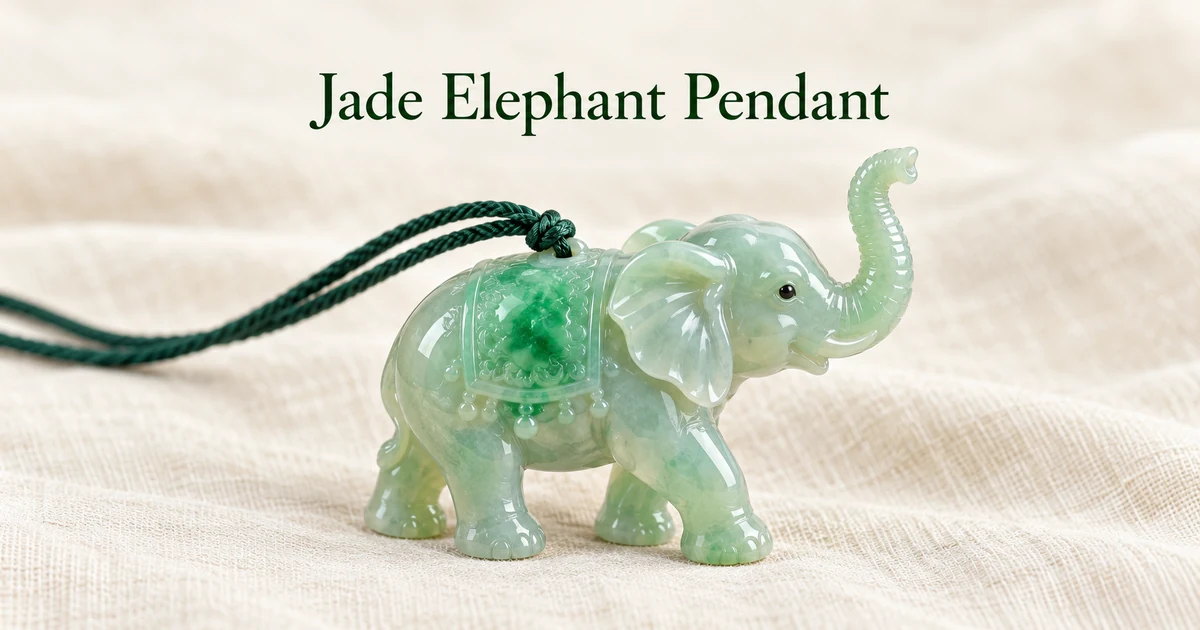
In Chinese tradition a jade elephant stands for peace and good fortune. Elephant, 象 (xiàng), sounds close to 祥 (xiáng, auspicious), and an elephant carrying a vase reads as 太平有象, "peace shows its signs". It is also read as strength, stability and long life, and in Buddhism the white elephant is a noble animal. Trunk up or down has no fixed meaning in Chinese carving; "trunk up is lucky" is a popular modern belief. In Thailand the elephant is the national animal. These are traditional wishes, not promises. Choose a natural trunk curve, clean polish in the hollows, no cracks in the trunk or tusks, and certified natural Type A jadeite, never ivory.
What does a jade elephant mean?
In Chinese tradition, a jade elephant stands for peace and good fortune. The meaning rests on two puns. Elephant is 象 (xiàng), which sounds close to 祥 (xiáng), "auspicious", so an elephant reads as 吉祥, good fortune. And 象 also means "sign" or "scene", which gives the best-known elephant saying, 太平有象 (tài píng yǒu xiàng): "peace shows its signs", a picture of a calm, prosperous time.
The elephant also carries meanings from its own nature. It is strong but gentle, steady on its feet and long-lived, so it is read as stability, reliability and long life. In Buddhism it is a noble animal: the bodhisattva Samantabhadra (普贤) rides a white elephant, and the Buddha's mother is said to have dreamed of a white elephant before his birth.
These are traditional meanings and wishes, not promises: a jade elephant does not bring luck or money. Its value is the stone, the carving and what it means to you. For other pendant motifs, see jadeite pendant meanings. This guide covers the elephant: the common sayings, trunk up or down, what elephants mean in Thailand and Vietnam, the styles, how to judge carving and material, and why jade rather than ivory.
What do the elephant sayings mean, like 太平有象?
Chinese carving builds phrases from objects that sound like words. The elephant appears in several:
| Design | Saying | How it works | Meaning |
|---|---|---|---|
| Elephant carrying a vase | 太平有象 | Vase 瓶 (píng) = 平 (píng, peace); 象 = sign | "Peace shows its signs", a peaceful, prosperous time |
| Person or child riding an elephant | 吉祥 | Ride 骑 (qí) sounds close to 吉 (jí); 象 (xiàng) close to 祥 (xiáng) | Good fortune |
| Elephant alone | 吉祥 / 有象 | 象 close to 祥 | Good fortune, stability |
| Elephant at New Year | 万象更新 | 万象 means "everything", here written with the elephant | "Everything made new", a New Year greeting |
| Mother and calf | (no fixed phrase) | Elephants live in close family herds | Family, care between generations |
The elephant and vase is the classic. 太平有象 was a favorite motif in Qing dynasty decorative art: bronze and porcelain elephants with a vase on their backs stood in palaces and homes. In jade pendants it is reduced to a small elephant with a vase or a saddle cloth on its back.
If a seller gives an elephant design a saying you cannot find anywhere else, treat it as sales talk.
Should a jade elephant's trunk be up or down?
There is no rule in Chinese jade carving. Carvers shape the trunk to fit the stone and the design: raised, curled to the side or hanging down.
The idea that "trunk up is lucky" is a popular modern belief, repeated widely in feng shui shops and in Western home decor, where an elephant with its trunk raised is said to welcome good fortune. Some people say a lowered trunk stands for steadiness or for storing up good things. Both are beliefs, not tradition with a fixed meaning, and neither changes the value of the piece.
In practice, a raised trunk is also the thinnest, most exposed part of a pendant. If you like the look, check it carefully for cracks (see below).
What does the elephant mean in Thailand and Vietnam?
Thailand. The elephant is Thailand's national animal, and 13 March is Thai Elephant Day (วันช้างไทย). White elephants (ช้างเผือก) have long been linked to the king, and one of the kingdom's royal orders is the Order of the White Elephant. Bangkok's seal shows the god Indra riding Erawan, his three-headed elephant (พระอินทร์ทรงช้างเอราวัณ), and Ganesha (พระพิฆเนศ), the elephant-headed god of the arts and of overcoming obstacles, is widely respected; he is the emblem of the Fine Arts Department (กรมศิลปากร). An elephant pendant in Thailand is a natural, well-loved choice. If you are buying there, see buying jade in Thailand.
Vietnam. Elephants are part of national history: Lady Triệu (Bà Triệu) is remembered riding an elephant into battle, and the Central Highlands still hold elephant festivals, such as the elephant race at Buôn Đôn in Đắk Lắk. In Vietnam you can also find elephant statues sold in pairs (cặp voi) as feng shui decor.
A Ganesha carving is a religious image, so the respect usually shown to Buddha pendants applies: see jade Buddha pendants. An ordinary elephant is not a religious image and has no special rules.
What styles of jade elephant are there?
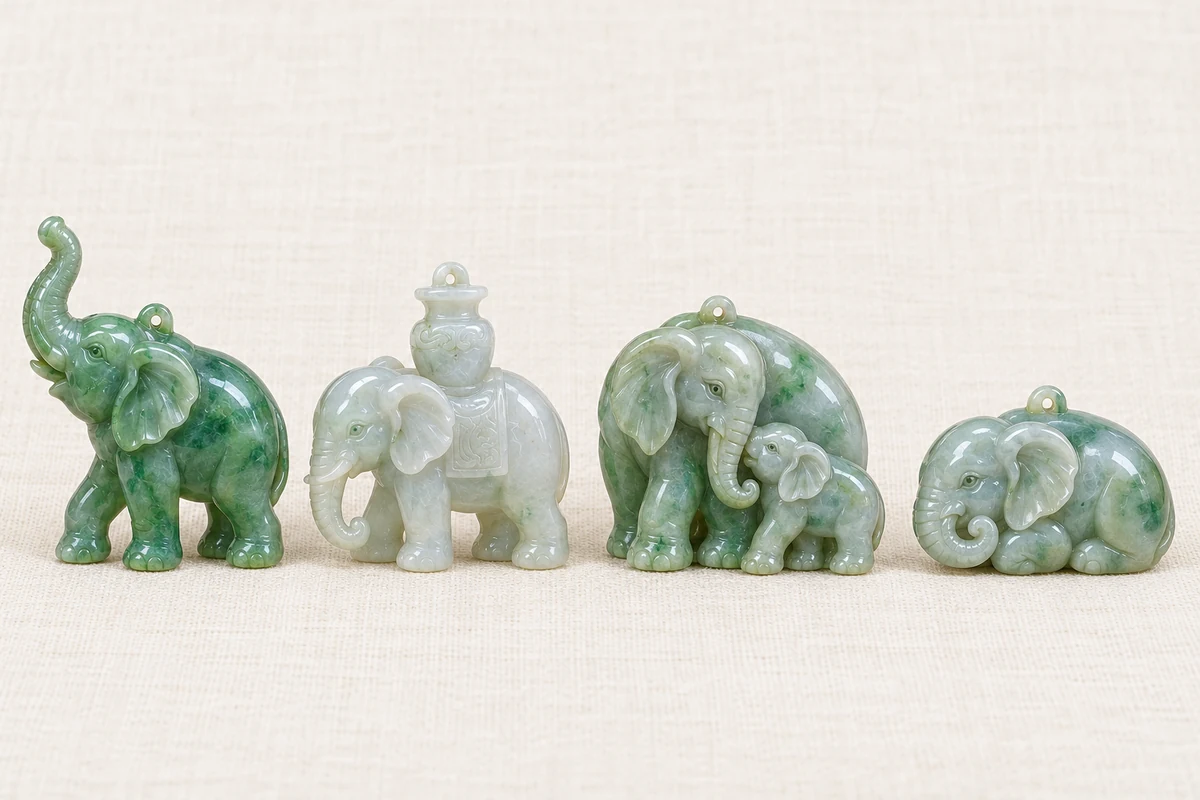
| Style | What it looks like | Notes |
|---|---|---|
| Standing, trunk raised | An elephant on four legs, trunk lifted | The most popular pendant; check the trunk and tusks |
| Elephant with a vase | A vase or saddle cloth on its back | The 太平有象 design |
| Mother and calf | A large and a small elephant together | Often a family or parent gift |
| Lying or rounded elephant | A compact elephant with folded legs and curled trunk | Few thin parts, so it is the most durable |
| Child riding an elephant | A small figure on the elephant's back | The 吉祥 pun; more detail to inspect |
| Elephant charms | A tiny elephant on a bead bracelet or earrings | Usually simple, machine-cut shapes |
| Figurines | Larger carvings for a desk or shelf | Often not jadeite; see below |
Color placement (俏色). A good carver uses each color on purpose: green for a saddle cloth or a vase, red or yellow jadeite for a decoration, a clear icy area for the body. For those colors, see red and yellow jadeite.
Jade elephant figurines. Many "jade elephant" statues sold online and in markets are not jadeite at all. They are often serpentine, green aventurine quartz, dyed quartz, glass, or nephrite. If the word on the label is just "jade", ask what mineral it is. See how to tell if jade is real and jadeite vs nephrite.
How do you judge the carving on a jade elephant?
Check the material first, then the carving, then the setting.
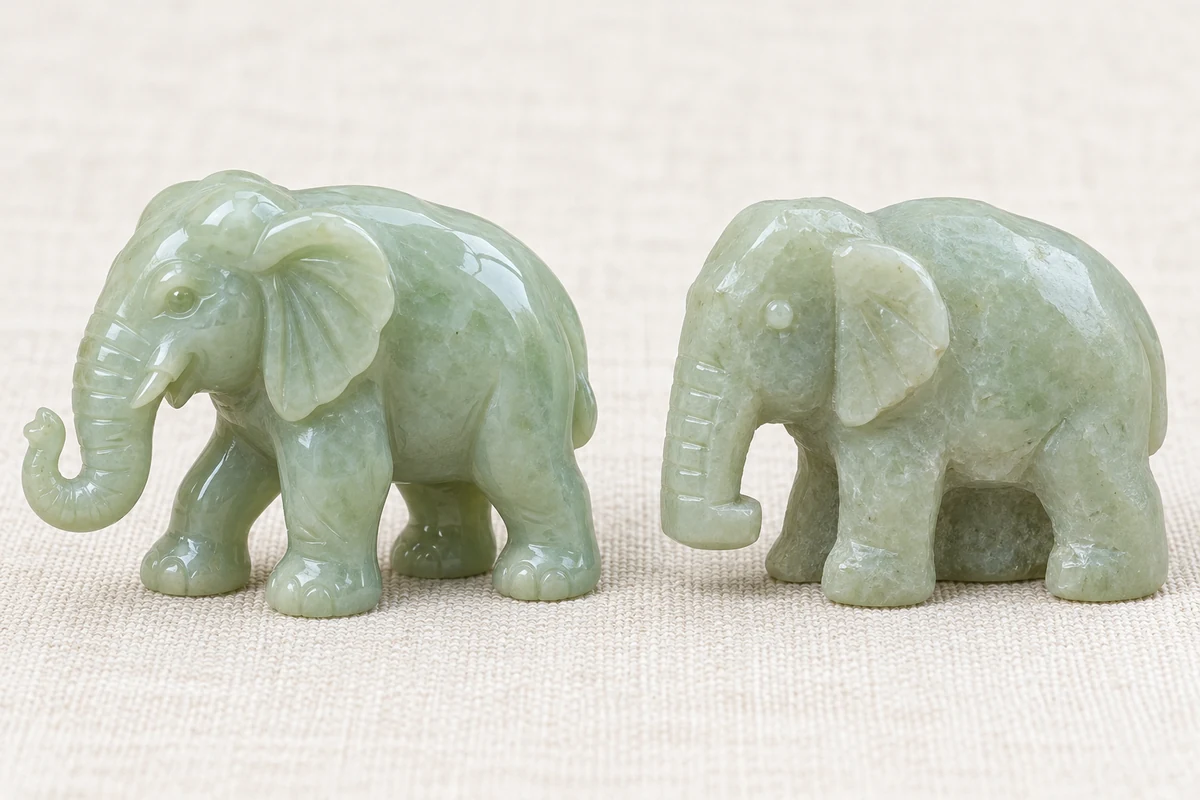
- Look at the shape. A good elephant has weight and movement: a rounded body, legs that look as if they carry it, and a trunk that curves naturally. A stiff, blocky outline looks lifeless.
- Look at the trunk and tusks. The trunk should taper smoothly; fine rings along it are a sign of care. Tusks should be even and cleanly finished.
- Look at the ears and eyes. Ears with a clear edge and a small, clean eye give the elephant its expression.
- Check the polish in the hollows. The gaps between legs, under the trunk and around the ears are hard to polish. Dull, rough hollows show where finishing time was saved, as in the right-hand elephant above.
- Machine or hand work. Many low- and mid-grade elephant pendants are cut on CNC carving machines, so identical pieces with shallow, even cuts are common. See jadeite carving craftsmanship.
- Backlight the thin parts. The raised trunk, tusks, tail and the bail hole are the most likely to chip or crack. Shine a small flashlight through them and turn the piece slowly; a line that cuts the light sharply is a crack.
- Ask for the certificate. Bright green and very clear small carvings are common shapes for bleached and resin-filled (Type B) and dyed (Type C) jadeite. Buy natural Type A with a lab certificate. See how to spot treated jadeite.
When buying online or from a livestream, ask for a video of the piece turned under a flashlight, a side view and both faces.
Why choose a jade elephant instead of ivory?
Elephant ivory comes from elephants, many of them killed by poachers. International commercial trade in ivory has been banned under CITES since 1990, and China closed its domestic ivory market at the end of 2017; many other countries restrict it too. Old ivory pendants and "ivory" sold in markets are often either illegal to trade or not ivory at all.
A jadeite elephant carries the same traditional meanings with none of that harm, and natural Type A jadeite can be checked by a lab. If you are offered an "ivory" or "bone" elephant, the safest choice is to say no.
How do you wear a jade elephant pendant?
- Which way it faces. There is no rule. Hang it so the carving looks natural, usually with the elephant upright and the trunk at the front.
- Cord or chain. A plain cord suits a carved elephant; a gold or silver bail makes it easy to hang on a chain. See jade pendant cord and chain.
- Anyone can wear it. An ordinary elephant suits women, men and children. Ganesha pendants are religious images and are usually treated with more care.
- As a gift. An elephant is an easy gift for parents and elders (long life, steadiness), a family (mother and calf) or a new home (太平有象). For more ideas, see jadeite gift guide.
Are jade elephants on sale at JadeiteHub?
Not at the moment. Our current pendants include safety coins, Buddha and Guanyin pendants, pea pods and leaves; browse all JadeiteHub pendants. If you are looking for an elephant, the checks above apply to any seller.
How do you care for a jade elephant?
- Take it off for sport, heavy work and sleep. The trunk, tusks and bail are the parts most likely to chip.
- Wash it in lukewarm water with mild soap and dry it; a soft toothbrush cleans the gaps around the legs and ears.
- Store it on its own, away from harder stones and other jewelry, and keep perfume and strong cleaners off it.
- Replace a cord as soon as it frays at the drill hole.
Every piece on JadeiteHub is certified natural Type A jadeite and ships with its own certificate from an accredited Chinese national gem lab (国检). If it does not match its description, you get a full refund.
FAQ
What does a jade elephant mean?
In Chinese tradition it means peace and good fortune. 象 (xiàng, elephant) sounds close to 祥 (xiáng, auspicious), and an elephant with a vase reads as 太平有象, "peace shows its signs". It is also read as strength, stability and long life. These are traditional wishes, not promises.
Should a jade elephant's trunk be up or down?
Chinese jade carving has no rule. "Trunk up brings luck" is a popular modern belief from feng shui shops and Western decor; some say trunk down means steadiness. Choose the one you like, and check a raised trunk for cracks, since it is the thinnest part.
What does 太平有象 mean?
It means "peace shows its signs": a calm, prosperous time. The design is an elephant carrying a vase, because vase, 瓶 (píng), sounds like 平 (píng, peace), and 象 means both elephant and sign. It was a favorite Qing dynasty motif.
Why are elephants important in Thailand?
The elephant is Thailand's national animal, with Thai Elephant Day on 13 March. White elephants are linked to the king, Bangkok's seal shows Indra riding the three-headed elephant Erawan, and the elephant-headed Ganesha is widely respected.
Is a jade elephant figurine real jadeite?
Often not. Many "jade" elephant statues are serpentine, aventurine quartz, dyed quartz, glass or nephrite. Ask what mineral it is and ask for a lab certificate if it is sold as jadeite.
Who can wear a jade elephant pendant?
Anyone. An ordinary elephant is not a religious image, so there are no special rules. Ganesha pendants are religious and are usually treated with the same respect as Buddha pendants.