Jade Fish Pendant Meaning: Koi, Carp, Goldfish, Two Fish
Updated
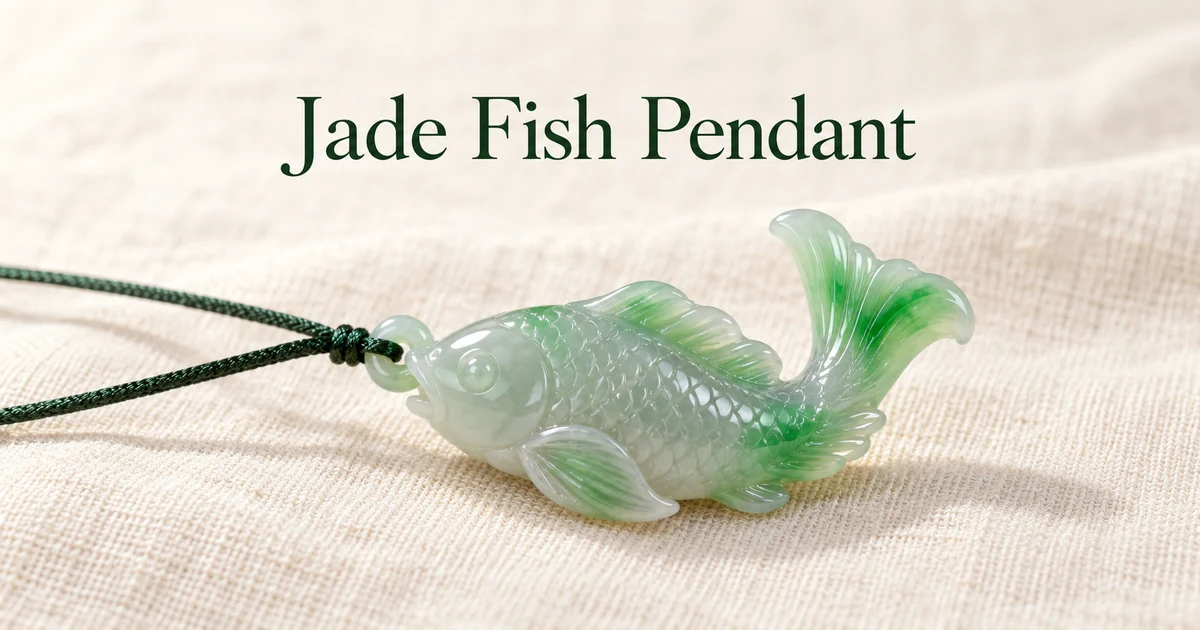
A jade fish pendant traditionally stands for abundance. In Chinese, fish (鱼, yú) sounds like 余 (yú, surplus), so a fish reads as 年年有余, "more than enough, year after year". Each fish has its own reading: a carp leaping the Dragon Gate stands for success through effort, a goldfish (金鱼) sounds like 金玉, gold and jade, two fish stand for a happy couple and are one of the eight Buddhist auspicious symbols, and koi has become modern slang for a lucky person. These are traditional wishes, not promises. Choose even scales, clean fins and tail, a glassy polish, no cracks at thin edges, and natural Type A jadeite with a certificate.
What does a jade fish pendant mean?
A jade fish pendant traditionally stands for abundance: having more than enough. The meaning comes from a pun. In Chinese, fish is 鱼 (yú), and it sounds exactly like 余 (yú), "surplus, something left over". So a fish is read as 年年有余 (nián nián yǒu yú), "more than enough, year after year". That is why fish appear on Lunar New Year pictures, and why a whole fish is served at the New Year's Eve dinner and is often not finished, so that some is left over.
On top of that general meaning, each kind of fish and each combination carries its own reading. A carp leaping upstream, a pair of fish, a goldfish and a fish beside a lotus all say slightly different things, and carvers choose among them on purpose.
These are traditional wishes, not promises: a jade fish does not bring money or luck. Its value is the stone, the carving and the meaning you give it. For an overview of all the common pendant motifs, see jadeite pendant meanings. This guide covers the fish alone: what each type means, the common combinations, the styles, how to judge carving and material, and how to wear it.
What do carp, koi, goldfish and two fish mean?
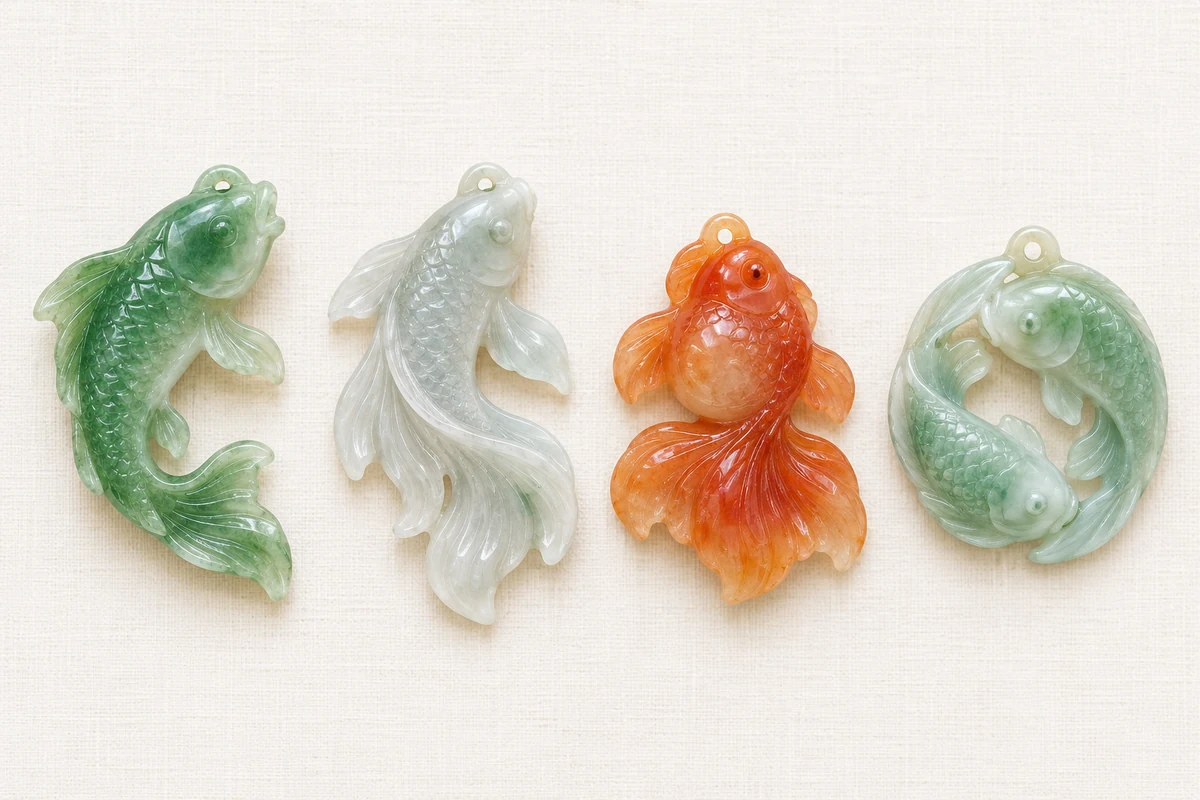
| Fish | Chinese | Main reading | Where it comes from | Often given to |
|---|---|---|---|---|
| Any fish | 鱼 | Abundance, 年年有余 | 鱼 (yú) sounds like 余 (yú, surplus) | Anyone; business owners; at New Year |
| Carp | 鲤鱼 | Success through effort | The carp that leaps the Dragon Gate becomes a dragon (鲤鱼跃龙门) | Students, people starting a job or business |
| Koi | 锦鲤 | Success; in modern slang, great luck | Koi are ornamental carp; since about 2018, 锦鲤 is Chinese internet slang for a lucky person | Young people, friends |
| Goldfish | 金鱼 | Wealth, a house full of treasure | 金鱼 (jīnyú) sounds like 金玉 (jīnyù, gold and jade), as in 金玉满堂 | Families, new homes |
| Two fish | 双鱼 | A happy couple; a Buddhist auspicious sign | Fish swimming in pairs; the pair of golden fish is one of the eight auspicious symbols (八吉祥) | Newlyweds, couples |
The carp and the Dragon Gate. The old legend says that carp swim up the Yellow River to a waterfall called the Dragon Gate (龙门), and the one that leaps over it turns into a dragon. The story became a picture of hard work rewarded, especially passing the imperial exams. A pendant showing a fish with a dragon's head, or a fish turning into a dragon, is called 鱼化龙. For more on dragon pieces, see jade dragon pendant.
Koi as modern slang. In 2018 a Chinese online campaign picked one lucky winner as the "Koi of China", and since then 锦鲤 has been used for a person who seems unusually lucky. People forward a picture of a koi "for luck" the way others share a four-leaf clover. A koi pendant today carries both the old carp meaning and this light-hearted new one.
Two fish. Fish swim in pairs and in schools, and a pair has long stood for a close couple; the phrase 如鱼得水, "like a fish in water", describes two people who suit each other. In Buddhism, the pair of golden fish is one of the eight auspicious symbols, standing for freedom and happiness. A double fish pendant is a common wedding or anniversary gift.
What do fish combinations mean, like fish with lotus?
Chinese carving often builds a whole phrase from two or three motifs. The fish appears in several well-known ones:
| Combination | Saying | How it works | Meaning |
|---|---|---|---|
| Fish with lotus | 连年有余 | Lotus 莲 (lián) = 连 (lián, continuing), fish 鱼 = 余 (surplus) | "Abundance year after year, without a break" |
| Fish with a chime stone | 吉庆有余 | Chime 磬 (qìng) = 庆 (qìng, celebration), fish = 余 | "Joy and celebration, with plenty to spare" |
| Fish with peony | 富贵有余 | Peony stands for 富贵 (wealth and rank), fish = 余 | "Wealth and honor, with plenty to spare" |
| Carp turning into a dragon | 鱼化龙 | The Dragon Gate legend | Success, a big step up |
Fish with lotus is the most common. 连年有余 is a classic New Year picture, usually a plump child holding a carp among lotus flowers. Jade carvers reduce it to a fish curled on a lotus leaf or beside a lotus pod. See jade lotus pendant.
If a seller attaches a saying to a fish combination that you cannot find anywhere else, treat it as sales talk.
What styles of jade fish pendant are there?
| Style | What it looks like | Notes |
|---|---|---|
| Single curled fish | A fish bent into a C or S shape, tail flicked up | The most common shape; compact and easy to wear |
| Leaping carp | A carp with its body arched, sometimes over waves | Often larger; the fins and tail are thin |
| Fish turning into a dragon | A fish body with a dragon's head or a dragon emerging | Detailed carving; check the horns and whiskers for chips |
| Goldfish | A round body with a fan or double tail | Often carved in red or yellow jadeite |
| Pair of fish | Two fish curled head to tail, sometimes forming a circle | Popular as a wedding gift |
| Fish with lotus or leaf | A small fish on a leaf or beside a lotus pod | Green is often placed on the leaf |
| Small fish charms | A tiny fish on earrings or a bead bracelet | Usually simple, machine-cut shapes |
Color placement (俏色). Good carvers place each color where it makes sense: a patch of red or yellow jadeite becomes a goldfish or the fins of a koi, green becomes a leaf or water weed, and an icy base reads as water. A fish where the color follows the design is valued more than the same fish in one color. For red and yellow jadeite, see red and yellow jadeite; for blue-green flowers that read as water, see floating flower jadeite.
A note on the fish hook. If you search for a jade fish hook, you will find the Māori hei matau from New Zealand. It is traditionally carved from pounamu, New Zealand greenstone, which is mostly nephrite, not jadeite, and its meaning comes from Māori culture, not from the Chinese pun. For the difference between the two jades, see jadeite vs nephrite.
How do you judge the carving on a jade fish?
Check the material first, then the carving, then the setting. A fish is a good test of a carver, because scales, fins and tail all show whether time was spent.
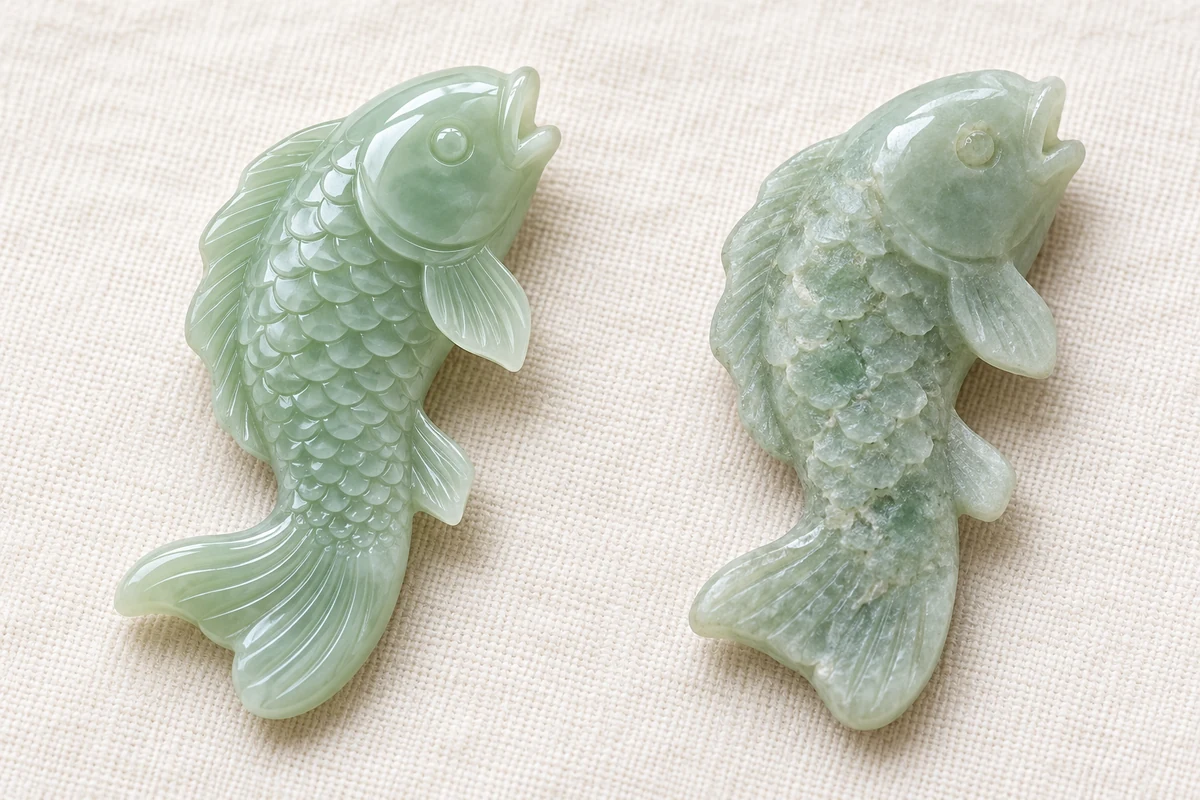
- Look at the body line. A good fish has movement: the body curves naturally and the tail looks as if it has just flicked. A stiff, flat outline looks lifeless.
- Look at the scales. Scales should be even in size and spacing, getting smaller toward the tail, and cleanly cut. Blurred, uneven scales point to hurried work, as in the right-hand fish above.
- Look at the fins and tail. Fine lines on the fins and tail should be crisp and taper to the edge. These are the thinnest parts of the piece.
- Look at the eye and mouth. A small, clean eye and a defined mouth give the fish its expression.
- Check the polish in the hollows. The high points are easy to polish; the gaps between scales and fins are not. Dull, rough hollows show where finishing time was saved.
- Machine or hand work. Many low- and mid-grade fish pendants are cut on CNC carving machines and then finished by hand. Machine-cut pieces tend to look identical, with shallow, even cuts. See jadeite carving craftsmanship.
- Backlight the thin parts. Fins, tail tips, dragon horns and the bail hole are the most likely to chip or crack. Shine a small flashlight through them and turn the piece slowly. A line that cuts the light sharply is a crack.
- Ask for the certificate. Bright green and very clear small carvings are common shapes for bleached and resin-filled (Type B) and dyed (Type C) jadeite, and red "goldfish" color can be heated or dyed. Buy natural Type A with a lab certificate. See how to spot treated jadeite.
When buying online or from a livestream, ask for a video of the piece turned under a flashlight, a side view and both faces.
How do you wear a jade fish pendant?
- Which way up. Most fish pendants hang with the head up or the body curled around the bail. A leaping carp usually hangs head up, as if leaping. There is no rule that a fish must face a certain way; hang it so the carving looks natural.
- Cord or chain. A plain cord suits a carved fish and keeps the look traditional; a gold or silver bail makes it easy to hang on a chain. See jade pendant cord and chain and silver vs gold settings for jadeite.
- Anyone can wear it. A fish is not a religious image, so the customs for Buddha and Guanyin pendants do not apply. It suits women, men and children.
- As a gift. A fish is an easy gift: for a new business, a student, a couple (two fish) or at Lunar New Year. For more ideas, see jadeite gift guide.
Are jade fish pendants on sale at JadeiteHub?
Not at the moment. Our current pendants include safety coins, Buddha and Guanyin pendants, pea pods and leaves; browse all JadeiteHub pendants. If you are looking for a fish, the checks above apply to any seller.
How do you care for a jade fish?
- Take it off for sport, heavy work and sleep. Fins, tail tips and the bail are the parts most likely to chip.
- Wash it in lukewarm water with mild soap and dry it; a soft toothbrush cleans the gaps between scales.
- Store it on its own, away from harder stones and other jewelry, and keep perfume and strong cleaners off it.
- Replace a cord as soon as it frays at the drill hole.
Every piece on JadeiteHub is certified natural Type A jadeite and ships with its own certificate from an accredited Chinese national gem lab (国检). If it does not match its description, you get a full refund.
FAQ
What does a jade fish pendant mean?
Traditionally it means abundance. Fish (鱼, yú) sounds like 余 (yú, surplus), so a fish is read as 年年有余, more than enough year after year. It is a traditional wish, not a promise of wealth.
What does a jade koi fish pendant mean?
Koi are ornamental carp. A carp pendant recalls the legend of the carp that leaps the Dragon Gate and becomes a dragon, success through effort. Since about 2018, 锦鲤 (koi) has also been Chinese internet slang for a very lucky person.
What does a pair of jade fish mean?
Two fish swimming together stand for a happy, well-matched couple, and the pair of golden fish is one of the eight auspicious symbols of Buddhism. Double fish pendants are popular wedding and anniversary gifts.
What does a jade goldfish mean?
Goldfish, 金鱼 (jīnyú), sounds like 金玉 (jīnyù), gold and jade, so it is read as 金玉满堂, a house full of treasure. Carvers often use red or yellow jadeite for the goldfish.
What is a jade fish hook pendant?
The fish hook (hei matau) is a Māori design from New Zealand, traditionally carved from pounamu, New Zealand greenstone, which is mostly nephrite, not jadeite. It has its own meaning in Māori culture, separate from the Chinese fish.
Who can wear a jade fish pendant?
Anyone. It is not a religious image, so there are no special rules. It is a common gift for business owners, students, newlyweds and at Lunar New Year.