Jade Horse Pendant Meaning: Styles, Choosing and Price
Updated
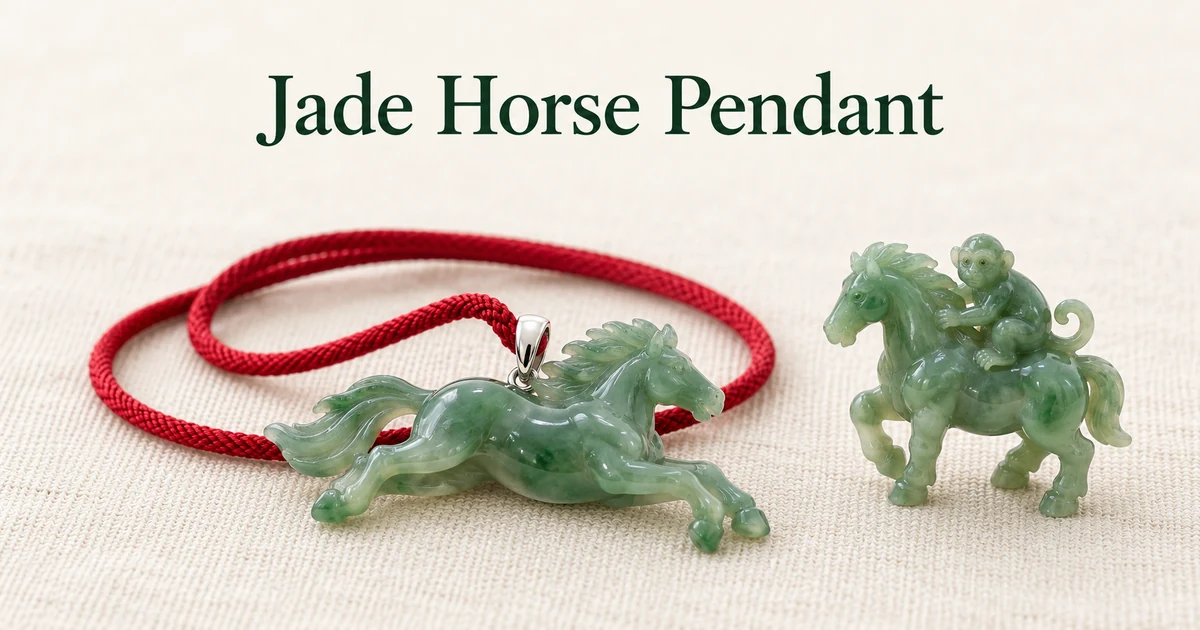
A jade horse pendant traditionally stands for quick success and drive. The main sayings are 马到成功 (success as soon as the horse arrives) and 马上封侯, a monkey on a horse's back, because 猴 (monkey) sounds like 侯 (marquis): a fast promotion. 一马当先 means taking the lead and 龙马精神 means vigor; eight horses (八骏) are a display theme. 2026 is the Year of the Fire Horse (17 February 2026 to 5 February 2027). These are traditional wishes, not promises. A horse has thin legs and a tail, so check proportion, mane detail and polish in the gaps, backlight the legs for cracks, and buy natural Type A jadeite with a certificate; many cheap jade horse figurines are dyed quartzite, serpentine or glass.
What does a jade horse pendant mean?
A jade horse pendant traditionally stands for success that arrives quickly, along with energy, drive and steady progress. In Chinese the horse is 马 (ma), and it sits at the center of some of the best known good-luck sayings in the language: 马到成功 (ma dao cheng gong), "success as soon as the horse arrives", and 马上封侯 (ma shang feng hou), "made a marquis on horseback", read today as a quick promotion. A horse carved in jadeite puts those wishes into a stone that is itself valued for lasting a lifetime.
For centuries the horse was the fastest way to travel and win a battle, so Chinese art uses it for speed, loyalty and stamina. The meanings below are traditional sayings, not promises: a jade horse does not bring a promotion, a deal or good health. People give it because the message is clear and positive.
For an overview of every common motif side by side, see jadeite pendant meanings. This guide covers the horse alone: the sayings, the Year of the Horse, the styles, why a horse is hard to carve, how to check one and what moves the price.
What do 马到成功, 马上封侯 and the other horse sayings mean?
Most horse carvings are built around one of a handful of sayings.
| Saying | Pinyin | Literal sense | What it wishes | What the carving shows |
|---|---|---|---|---|
| 马到成功 | ma dao cheng gong | Success the moment the horse arrives | Quick success in a new venture, an exam, a deal | A single galloping or standing horse |
| 马上封侯 | ma shang feng hou | Made a marquis on horseback | A fast promotion, rising in your career | A monkey sitting on a horse's back |
| 一马当先 | yi ma dang xian | One horse rides out in front | Taking the lead, being first | One horse ahead, often galloping |
| 龙马精神 | long ma jing shen | The spirit of a dragon-horse | Vigor and energy; a New Year greeting, often to older people | A horse, sometimes with cloud or dragon details |
| 马上有钱 | ma shang you qian | Money right away | Wealth arriving soon | A horse with coins or a gold ingot (元宝) |
| 八骏 | ba jun | Eight fine steeds | Success and momentum; a display theme | Eight horses together, on larger carvings |
Three notes:
- 马上封侯 is a pun. 马上 means "on horseback" and also "right away". 猴 (hou, monkey) sounds the same as 侯 (hou, marquis), a high noble rank in old China. So a monkey on a horse reads as "made a marquis right away". Monkeys riding horses already appear in Han-dynasty stone reliefs; some versions add a bee, because 蜂 (feng, bee) sounds like 封 (feng, to grant a title).
- 马到成功 began as a military phrase: a battle won as soon as the cavalry arrived. It is now a standard wish for a new business, job or exam.
- 八骏, the eight steeds, go back to the legend of King Mu of Zhou, who rode a chariot drawn by eight famous horses. Eight horses became a classic painting subject, made famous in the 20th century by Xu Beihong. In jade it is a display theme, because eight horses need a large stone.
Is 2026 the Year of the Horse, and who wears a jade horse?
Yes. 2026 is the Year of the Fire Horse (丙午, bing wu). By the Chinese calendar it began at Chinese New Year on 17 February 2026 and ends on 5 February 2027, when the Year of the Goat begins. The same dates apply to Vietnamese Tết, where the year is Bính Ngọ. The last Fire Horse year was 1966.
People born in a Horse year (1954, 1966, 1978, 1990, 2002, 2014 and 2026, counting from Chinese New Year, not 1 January) often choose their own sign as a pendant. In their own zodiac year (本命年), many Chinese families add red, such as a red cord. That is a custom, not a rule.
Looking ahead, 2027 is the Year of the Goat, and in the zodiac the Horse and the Goat are a "six harmony" (六合) pair. That is why a horse is one of the pendants people suggest for Goat-year wearers in 2027; see the 2027 Year of the Goat guide for every sign.
Beyond the zodiac, anyone can wear a horse; there is no rule for men or women, age or birth year. Common choices:
- A new business or job: 马到成功; for a promotion, the monkey on a horse.
- Students before an exam: a small galloping horse, 一马当先.
- Parents and grandparents at New Year: 龙马精神.
- Men: a horse plaque or a solid round-carved horse on a dark cord; see jadeite for men.
How is the horse seen in Vietnam and Thailand?
In Vietnam, the Sino-Vietnamese form of 马到成功, mã đáo thành công, is an everyday wish. Paintings of galloping horses, often eight of them (tranh bát mã), are a popular gift for a shop or company opening (khai trương), for a housewarming and for business partners. Vietnamese feng shui writers usually say the horses should face into the room, not out of the door. One naming trap for Vietnamese searches: "ngựa đá cẩm thạch" usually means a horse carved from marble, because "đá cẩm thạch" is marble, while jadeite is "ngọc cẩm thạch" or "phỉ thúy".
In Thailand, the horse belongs to the Chinese zodiac as ปีมะเมีย, and Chinese good-luck art is widely used in Thai homes and shops. The picture of eight horses (ภาพม้า 8 ตัว) is a familiar decoration, described in Thai feng shui articles as a symbol of speed and success in business. A jade horse (ม้าหยก) carries the same meaning of progress and success; details such as which way the horses face differ from one adviser to another.
What styles of jade horse are there?
Jade horses come in three basic forms for wearing and one for display.
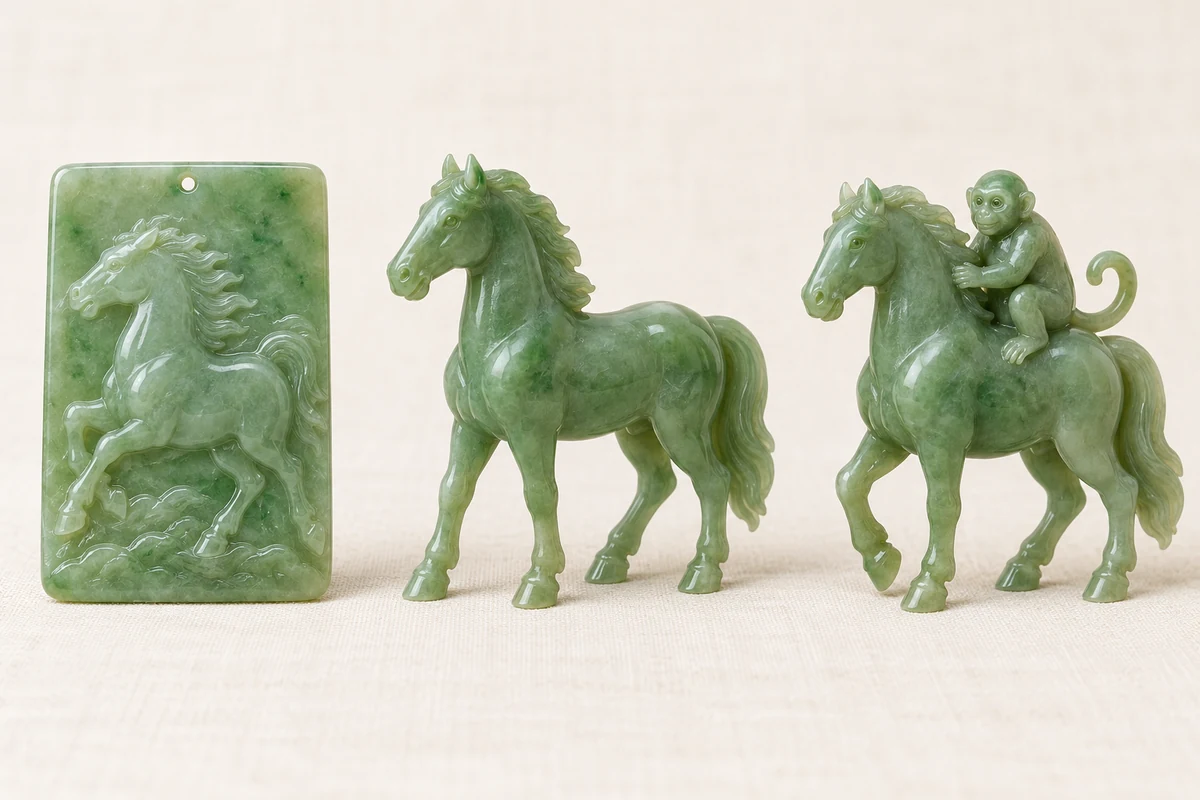
| Style | Chinese name | What it looks like | Notes |
|---|---|---|---|
| Horse plaque | 马牌 | A flat plaque with a horse in low relief | Legs are carved into the plaque, so it is sturdy; needs a clean, flat slab |
| Round-carved horse | 圆雕马 | A small three-dimensional horse | Shows the carver's skill; the legs and tail are the weak points |
| Lying horse | 卧马 | Resting, legs folded under | Compact and strong for daily wear |
| Galloping horse | 奔马 | Legs stretched, mane flying | The most dynamic; thin legs need checking |
| Monkey on a horse | 马上封侯 | A small monkey on the horse's back | The promotion pun; check the monkey's arms and face |
| Horse with coins or ingot | 马上有钱 | A horse with a coin or 元宝 under its hooves or beside it | The wealth version |
| Display carving | 摆件 | A larger figurine or group of horses on a stand | Usually lower-grade or mixed-color material; eight horses (八骏) is a classic |
A galloping horse looks the most alive but is the most fragile; a lying horse or a plaque is easier to wear every day.
Why is a jade horse harder to carve than most pendants?
Because a horse has thin parts that stick out: four legs, a tail, ears and a mane. A Buddha or a safety buckle is compact; a horse is not. That has three effects:
- Thin parts break and crack. Jadeite is very tough, but a slender leg or tail can still chip if it hits a hard floor, and any crack in the rough tends to show up exactly where the stone is thinnest. A horse needs clean material at the legs.
- Proportion is easy to get wrong. A horse's body, neck and legs have to balance, or it looks like a donkey or a toy.
- Deep cuts are hard to polish. The gaps between the legs and under the belly are narrow. They are the first place a hurried workshop saves polishing time.
In the Guangdong trade, Sihui (四会) makes much of the mid- and low-grade carving, and many cheap jade horses there are cut on CNC carving machines and then finished by hand. Machine-cut horses tend to be identical, with stiff legs, shallow mane lines and dull gaps. Jieyang (揭阳) and Pingzhou (平洲) work more at the high end, and Jieyang in particular makes many small, fine pendants; where a good horse is shaped by hand to suit the stone. A machine-cut, hand-finished horse at a fair price is a fine buy; it is only a problem when it is sold as hand carved at a hand-carved price. For how to tell the two apart, see jadeite carving craftsmanship.
How do you choose a good jade horse pendant?
Check the material first, then the carving, then the setting.
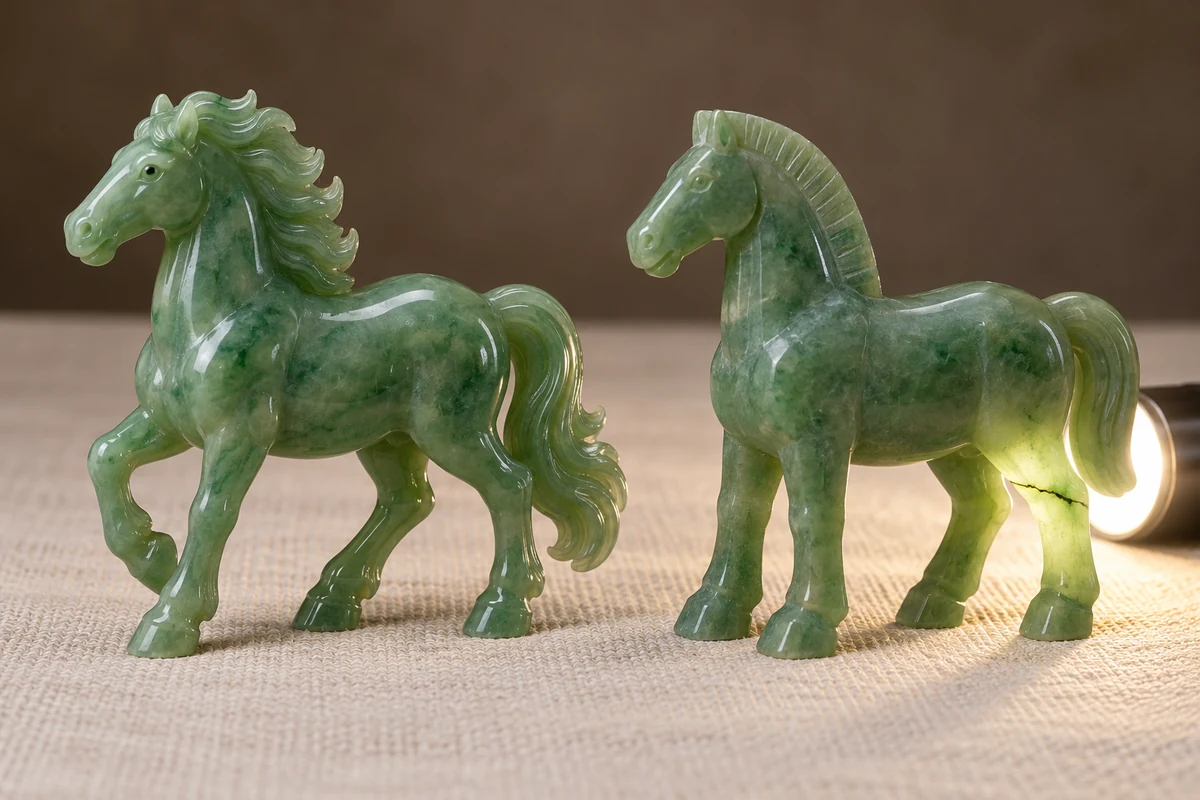
- Look at the whole horse first. Does it look like a horse or a toy? The head should be in proportion, the neck should curve naturally, and the legs should look able to carry the weight.
- Check the legs and joints. Good legs have visible knees and hocks and taper to the hooves. Stiff, straight, identical legs are a sign of a machine cut with little hand finishing.
- Look at the mane and tail. The mane should flow in clean, separated lines; the tail should have shape and direction. Blurred or shallow lines mean hurried work.
- Check the polish in the deep cuts. Look between the legs, under the belly and around the monkey on a 马上封侯 piece. The polish there should be as bright as on the body; dull, rough gaps show saved finishing time.
- Backlight the thin parts. Shine a small flashlight through each leg, the tail, the ears and the neck, and turn the piece slowly. A line that cuts the light sharply is a crack; a fine line that does not break the light may be a healed stone line. A crack across a leg is the most common hidden flaw on a horse, as in the right-hand piece above.
- Judge the color and translucency in daylight. Many horses are carved with 俏色, using a band of green or a patch of brown skin for the mane or the saddle. Well-placed color adds value; color that looks too even, or sits only in the cracks, should make you suspicious.
- Check the size and thickness. Ask for the length, width and thickness in millimeters and a photo next to a coin or ruler. A round-carved horse can be thick and heavy for a pendant.
- Ask for a lab certificate that names natural (Type A) jadeite, and check that the photo, size and weight match the piece.
Buying online or from a livestream, ask for a flashlight video with close-ups of the legs and tail.
Is a cheap "jade horse" figurine real jadeite?
Often not. Many low-priced "jade horse" pendants, figurines and statues sold online are made from other green or white materials:
- Dyed quartzite, sometimes sold as "Malaysia jade", which shows color concentrated in the grain.
- Serpentine, a softer stone that scratches easily and is sometimes sold as "new jade".
- Glass and resin, often with bubbles, mold lines and an even, flat color.
- Marble, especially in large white or green horse statues.
- Treated jadeite: bleached and resin-filled (Type B) or dyed (Type C), common in small bright green carvings.
A white jade horse may also be nephrite, which is real jade but a different mineral from jadeite; see jadeite vs nephrite. For how to tell the look-alikes apart, read jadeite look-alikes, and for treatments, how to spot treated jadeite. The simplest protection is a certificate from a recognized lab; how to verify a jadeite certificate shows what to check on it.
What drives the price of a jade horse pendant?
The material first, then the carving, then size and paperwork. Two horses of the same design can differ in price many times over because of the stone.
| Factor | What dealers look at | Why it matters |
|---|---|---|
| Texture and translucency (种水) | How fine and glassy the stone is | The biggest single driver; icy and glassy horses cost far more |
| Color (色) | How green, how even, and where the color sits | Green on the horse's head or body is worth more than green on the base |
| Cleanliness | Cracks, especially across the legs, neck and tail | A crack in a leg cuts the value sharply and can break later |
| Carving | Hand or machine, proportion, mane detail, polish in the gaps | Matters most on mid-grade stone, where good work lifts the price |
| Size and thickness | Length, width, thickness in mm, weight | A round-carved horse needs a thick, clean piece of rough |
| Certificate | A lab report naming natural (Type A) jadeite | Without it, the price rests on trust alone |
| Setting | 18K gold or 925 silver, how much metal | Adds metal and labor cost on top of the jade |
A simple horse plaque in fine, even material can cost more than an elaborate galloping horse in coarse stone, because clean material that size is rare. For how dealers grade stone, see what determines jadeite price.
Gold or silver: how are jade horse pendants set?
Most horse pendants hang from a cord or a simple metal bail; some add a gold cap, a gold saddle detail or a gold coin.
- 18K gold. Gold-set jadeite is mostly made in China in 18K (75%) gold, usually white or rose gold. Gold is strong enough for a heavier round-carved horse and does not tarnish.
- 925 silver. Every silver setting JadeiteHub sells is 925 sterling silver. Silver costs much less than gold, so more of the price goes into the stone, but it tarnishes and needs more cleaning.
- Cord. A red cord is the traditional choice for a Horse-year wearer; a black or dark green cord suits a man's plaque. See jade pendant cord and chain for lengths and knots.
A metal setting can protect a fragile tail or leg but can also hide a crack, so ask for photos before setting. For a fuller comparison, see silver vs gold settings for jadeite.
How do you care for a jade horse?
- Take a horse pendant off for sport, heavy work and sleep. The legs, tail and ears are the parts most likely to chip.
- Wash it in lukewarm water with mild soap and dry it; a soft toothbrush cleans the gaps between the legs and the mane lines.
- Store it on its own, away from harder stones, perfume and strong cleaners.
- Keep a display carving on its stand, away from the edge of a shelf, and dust it with a soft brush.
- Replace a cord as soon as it frays at the drill hole.
Does JadeiteHub sell jade horse pendants?
Not at the moment. JadeiteHub has no horse pendants or horse carvings for sale right now. You can browse the pendants we do have, in other motifs, in JadeiteHub pendants.
On JadeiteHub we list only jadeite with a lab certificate. Every sold piece is checked against its certificate at our inspection center before it ships, and if it does not match its description you get a full refund.
FAQ
What does a jade horse pendant mean?
Traditionally it stands for quick success, energy and steady progress, from the Chinese saying 马到成功, success as soon as the horse arrives. A monkey on a horse adds a wish for promotion (马上封侯). These are traditional wishes, not promises.
What does a monkey on a horse mean in jade?
It is the saying 马上封侯, "made a marquis on horseback". 马上 also means "right away", and 猴 (monkey) sounds like 侯 (marquis), so the carving reads as a quick promotion. It is a popular gift for someone starting a new job or hoping to rise in their career.
Is 2026 the Year of the Horse?
Yes. 2026 is the Year of the Fire Horse (丙午), from Chinese New Year on 17 February 2026 to 5 February 2027. People born in Horse years, such as 1990, 2002 and 2014, often choose a horse pendant, and in 2027, the Year of the Goat, the horse is the goat's six-harmony partner.
Who can wear a jade horse pendant?
Anyone. There is no rule for men or women or for birth year. People often give one to someone opening a business, starting a job or sitting an exam, and Horse-year people often wear their own sign.
Is a white jade horse real jadeite?
It can be, but many white jade horses are nephrite (real jade, a different mineral), marble, dyed quartzite or glass. Only a lab certificate that names jadeite, Type A, tells you for sure.
How can I tell if a jade horse figurine is real?
Ask for a lab certificate naming natural jadeite. Without one, warning signs are a very low price, perfectly even bright color, color sitting in cracks, bubbles or mold lines, and a stone that scratches easily. Backlight the legs and tail for cracks before you buy.