Jade Money Toad Meaning: Legend, Placement, How to Choose
Updated
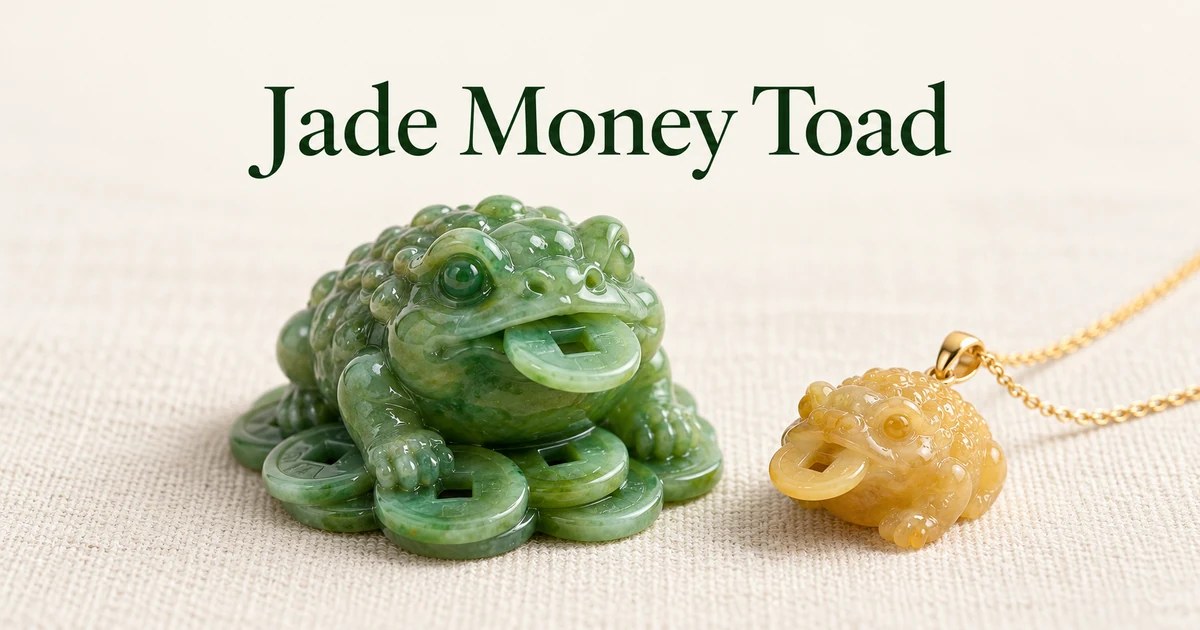
A jade money toad (金蟾, jin chan) is a three-legged toad, usually with a coin in its mouth and sitting on coins or gold ingots. It comes from the legend of the Daoist immortal Liu Hai, who caught the golden toad with a string of coins; tamed, it spat out gold coins. Traditionally it stands for money coming in and staying, a wish, not a promise. The common folk saying is to place it facing inward, into the home or toward the cash register; other placement rules vary by teacher. Unlike the pixiu, which is usually worn on a bracelet, the toad is mostly a counter or desk carving, though small pendants are common. Choose a compact shape, crisp eyes and bumps, polished grooves and certified Type A jadeite: many cheap toads are dyed quartzite, serpentine or glass. JadeiteHub has no money toads listed at the moment.
What is a jade money toad?
A jade money toad (金蟾, jin chan, also called 招财蟾蜍, the "wealth-beckoning toad") is a carving of a toad with three legs, usually holding a coin in its mouth and sitting on a heap of coins or gold ingots. It is one of the best-known Chinese wealth symbols, next to the pixiu. In jadeite it is made as small pendants, bead-bracelet charms, ring tops and small carvings for a desk or shop counter.
Four things mark it as a money toad rather than an ordinary toad:
- Three legs: two at the front and a single one at the back, often tucked under the body like a tail.
- A coin in the mouth: an old Chinese cash coin, round with a square hole, or a short string of coins.
- Coins or ingots underneath: the toad sits on a pile of coins, a gold ingot (元宝) or sometimes a lotus leaf.
- Bumps on the back: carvers often set seven of them in the shape of the Big Dipper (北斗七星).
| Language | What people call it and search for |
|---|---|
| Chinese | 金蟾, 三足金蟾, 招财蟾蜍, 翡翠金蟾, 金蟾吊坠 (pendant), 金蟾摆件 (display carving) |
| Vietnamese | thiềm thừ, cóc ngậm tiền, cóc ba chân, cóc thần tài, cóc cẩm thạch |
| Thai | คางคกสามขา, คางคกคาบเหรียญ, คางคกหยก |
| English | money toad, money frog, three-legged toad, jin chan, chan chu |
The animal is a toad (蟾蜍), not a frog, but "money frog" is just as common in English listings. Both names mean the same design.
Where does the money toad come from?
The money toad joins two old stories: the toad on the moon, and the Daoist immortal Liu Hai.
The moon toad. In early Chinese myth a toad lives on the moon. A well-known version says that Chang'e (嫦娥), who swallowed the elixir of immortality and fled to the moon, became that toad. That is why the moon is poetically called 蟾宫, the "toad palace", and why 蟾宫折桂, "breaking a cassia branch in the toad palace", meant passing the imperial exams. In this older layer the toad stood for the moon and long life, not money.
Liu Hai and the golden toad. Liu Hai (刘海), also called Liu Haichan (刘海蟾), is a Daoist immortal. Popular accounts make him a chancellor of the tenth-century state of Yan who gave up office to study the Dao; historians place the real figure a little later, in the Northern Song. The Quanzhen school of Daoism counts him among its Five Northern Patriarchs, and folk religion made him a minor god of wealth, usually shown as a cheerful, barefoot boy with a fringe of hair. (The Chinese word for a fringe of hair, 刘海, is said to come from him.)
The toad story is told in several versions. In one, a three-legged toad caused trouble in a pond or well until Liu Hai caught it with a string of gold coins as bait; tamed, it spat out gold coins to help the poor. In another, the toad was his companion and kept escaping down wells, and he lured it back each time with coins. The picture that came out of these stories, very popular from the Ming and Qing dynasties on, is always the same: Liu Hai swinging a string of coins and the toad leaping for it. It is called 刘海戏金蟾, "Liu Hai plays with the golden toad", and a folk rhyme adds 步步钓金钱, "step by step he fishes up gold coins".
Why three legs? No source gives an agreed reason. The missing leg simply marks the toad as a magical creature rather than a real one.
What does a jade money toad mean?
The meanings are traditional sayings, not promises. Sellers explain the toad part by part:
| Part | What people say it stands for |
|---|---|
| Coin in the mouth | Money coming in; the toad "spits out coins" (金蟾吐钱) for its owner |
| Coins or ingots underneath | Wealth piled up and kept |
| Wide mouth, round belly | Takes money in and holds it |
| Three legs | A magical toad, the one from the Liu Hai story |
| Seven bumps on the back | The Big Dipper, a star group linked with fate in Chinese astrology |
The phrases you will hear at the counter are 招财进宝 (bringing in wealth and treasure) and 财源广进 (money flowing in from many sources). That is why a money toad is a classic gift for a shop opening, a new business, a cashier's desk or anyone in sales. Because of the moon story, a few families also give one to students as a nod to 蟾宫折桂, but that reading is far less common.
None of this means a carving changes anyone's income. People choose a money toad because the story is lively and the wish is easy to explain. For how these beliefs sit in wider jade culture, see jadeite meaning and beliefs, and for every common motif side by side, see jadeite pendant meanings.
How is a money toad traditionally placed and worn?
These are folk feng shui sayings. They vary by teacher and by region, and some contradict each other. One feng shui writer notes that pre-modern texts do not mention the day-and-night turning rule at all and dates it to the shop market of late-twentieth-century Hong Kong, Taiwan and Singapore. Read the table as custom, not as rules.
| Saying | What people say | Practical note |
|---|---|---|
| Face inward | At home or on a shop counter, the head faces into the room or toward the cash register, so money "comes in"; facing the door or the street is said to send it out | The most common version |
| Out by day, in by night | Some say turn it toward the door in the day to fetch money and back inward at night to bring it home | Many teachers call this unnecessary |
| One or two | Some place two toads, one facing out to fetch and one facing in to keep | One is the usual choice |
| Where to put it | A counter, cash register, desk or low living-room cabinet; not in a bathroom, kitchen or bedroom; some say keep it low, since toads live on the ground | Low, stable spots are also safer for a jade carving |
| Keep the coin | If the coin is loose, keep it in the mouth | A loose coin is easy to lose; check it when cleaning |
| Wearing a pendant | No widely agreed rule; most people let it hang level, head up | Never hang any carving upside down; it strains the drill hole or bail |
| Blessing (开光) | Some have it blessed at a temple before first use | It does not change the stone; do not pay extra for "already blessed" |
Follow the customs that matter to you or your family, and do not let a seller turn any of them into a reason to pay more.
Money toad or pixiu: which should you choose?
Both are wealth symbols, and many people own both. The differences are in the story and in how they are used.
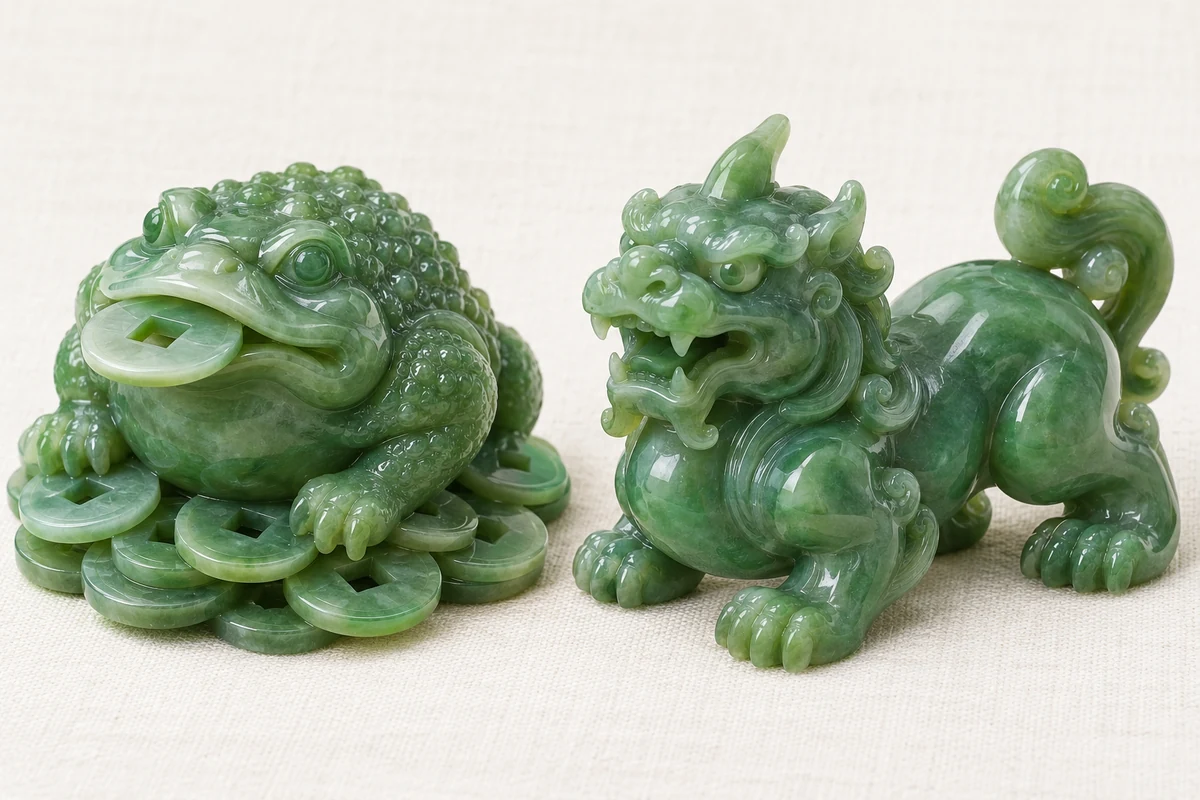
| Money toad (金蟾) | Pixiu (貔貅) | |
|---|---|---|
| What it is | A toad with three legs, from the Liu Hai story | A mythical lion-like beast, often horned |
| What it is said to do | Brings money in and "spits out coins" | Takes in wealth and never lets it out; also guards against bad influences |
| Most common form | Display carving on a counter or desk; small pendants | Bead-bracelet charm and pendant |
| Usual direction | Head facing inward, into the home or shop | On a bracelet, head facing out toward the hand |
| Typical owners | Shopkeepers, business owners, cashiers | Business people, traders, anyone wanting "bring and keep" |
If you want something to wear on the wrist every day, a pixiu is the more usual choice. If you want something to sit on a counter or desk, the money toad is the classic. For the pixiu in depth, read the jade pixiu guide.
Is a money toad the same as a jade frog or toad carving?
No. Count the legs. A frog or toad with four legs, or one sitting on a lotus leaf without coins, is a nature motif, not a money toad. Chinese carvers make many pond scenes with frogs and lotus, and in English some sellers call any of them a "money frog".
On small pendants the legs are tucked in, so turn the piece over: a money toad shows two front legs and one back leg. The coin in the mouth or the coins underneath are the other giveaway. A toad on a coin is a money toad even if the third leg is hard to see; a frog on a lily pad with no coins is not.
What styles of jade money toad are there?
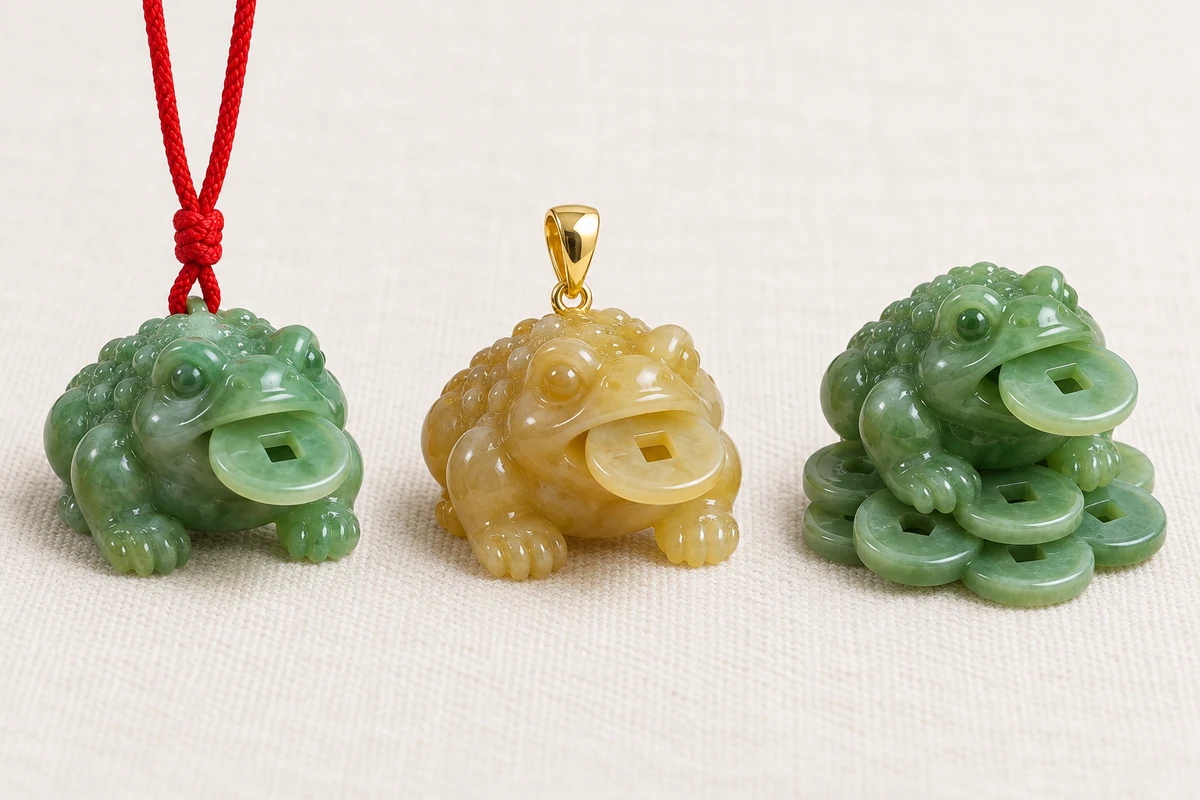
| Style | Chinese name | What it looks like | Notes |
|---|---|---|---|
| Small pendant | 金蟾吊坠, 金蟾挂件 | A compact toad, usually 2–4 cm, drilled or fitted with a bail | The most common worn form |
| Toad on coins or ingot | 金蟾踩元宝, 金蟾踏钱 | The toad sits on a coin or a gold ingot | The full "money" picture in one piece |
| Liu Hai with the toad | 刘海戏金蟾 | A boy with a string of coins and the toad below | Needs more carving; usually a larger pendant or carving |
| Bead-bracelet charm | 金蟾手串 | A small toad drilled lengthwise among round beads | Check what the other beads are made of |
| Ring top | 金蟾戒指 | A tiny toad set on a gold or silver ring | Small and exposed; knocks easily |
| Display carving | 金蟾摆件 | A larger toad on a stand, for a counter or desk | Often cut from mid-grade material because of the size |
A money toad is a compact, rounded shape, so it suits a small block of rough and can look good even in modest material. That is also why so many cheap ones exist.
What colors are jade money toads made in?
- Green is the most common, simply because green is the best-known jadeite color.
- Yellow and honey yellow (黄翡) are popular for a "golden" toad. Natural yellow jadeite gets its color from iron oxides near the weathered skin of the rough.
- Red (红翡) is less common. Heat is used in the trade to turn yellow-brown jadeite red (烤色). Most of the trade does not accept heated color as natural, and a heated piece is worth far less. It is seen mostly on single-color red pieces, so ask directly about a deep, even red toad. See red and yellow jadeite for how natural and heated color are told apart.
- Two colors (俏色): a skilled carver may use a yellow patch for the coins and green or colorless jade for the toad. Clever use of color raises the value of the work.
- Black (墨翠) and icy colorless toads are also made, often with gold-set coins for contrast.
How do you choose a good jade money toad?
Check the material first, then the carving, then the setting.
- Pick a compact shape. A rounded body with legs tucked in is sturdy. Thin parts that stick out, such as a raised string of coins, open legs or the edge of a ring top, are where chips happen.
- Look at the eyes. They should be symmetrical, rounded and clearly cut. Lopsided or shallow eyes make the whole face look dull.
- Look at the back. The bumps should be rounded and evenly spread, not flat dots. Mass-made toads, often cut on CNC carving machines, have identical shallow bumps and soft details. See jadeite carving craftsmanship.
- Check the coin. A good coin is round with a clean square hole, and it sits naturally in the mouth.
- Check the polish in the grooves. Look under the chin, around the legs and between the bumps. Dull, rough grooves show where finishing time was saved.
- Backlight it. Shine a small flashlight through the toad and turn it slowly. A busy, bumpy surface can hide cracks. A line that cuts the light sharply is a crack.
- Rule out fakes and treatment. Many cheap "jade money toads" are dyed quartzite, serpentine, green aventurine, glass or resin, and bright green toads at low prices are often bleached and filled (Type B) or dyed (Type C) jadeite. See jadeite look-alikes and how to spot treated jadeite.
- Ask for the certificate. Buy natural Type A jadeite with a lab certificate that matches the piece's weight, size and photo.
When buying online or from a livestream, ask for a video of the toad turned under a flashlight, including the underside, where the legs and the drill hole are.
Gold or silver: how are jade money toads set?
Many toad pendants are sold on a plain cord; others get a metal bail, a gold cap over the drill hole, or a gold coin set in the mouth.
- 18K gold. Gold-set jadeite is mostly made in China in 18K (75%) gold. Yellow gold suits honey-yellow toads and the "golden toad" idea; white gold suits icy and pale green ones.
- 925 silver. Every silver setting sold on JadeiteHub is 925 sterling silver. It costs much less, so more of the price goes into the stone, but it tarnishes and needs cleaning.
For a fuller comparison, see silver vs gold settings for jadeite. For cords, chains and lengths, see how to choose a cord or chain for a jade pendant.
Does JadeiteHub sell jade money toads?
Not at the moment. JadeiteHub has no money toad pieces listed right now, and we would rather say so than point you to something else. We add pieces as we find certified Type A material with good carving. In the meantime, you can browse every pendant currently listed in JadeiteHub pendants, and use the checklist above wherever you buy.
How do you care for a jade money toad?
- Take a pendant or ring off for sport, heavy work and sleep. The coin, the legs and the edges are the parts most likely to chip.
- Wash it in lukewarm water with mild soap and dry it. A soft toothbrush cleans the grooves between the bumps and under the chin.
- Keep a display toad on a stable, low surface, away from the edge of a counter.
- Store worn pieces on their own, away from harder stones, and keep perfume and strong cleaners off them.
- Check the bail, the cord and any loose coin now and then.
On JadeiteHub we list only jadeite with a lab certificate. Every sold piece is checked against its certificate at our inspection center before it ships, and if it does not match its description you get a full refund.
FAQ
What does a jade money toad mean?
Traditionally it stands for money coming in and staying: the three-legged toad (金蟾) holds a coin in its mouth and sits on coins or ingots, and in the Liu Hai legend it spits out gold coins. It is a traditional wish for business and wealth, not a promise.
Why does the money toad have three legs?
There is no agreed explanation. The missing leg marks it as the magical toad of the Liu Hai story rather than an ordinary toad. Most carvings show two front legs and one back leg, often tucked under like a tail.
Which way should a money toad face?
The most common folk saying is head facing inward, into the home or toward the cash register, so money comes in. Some say face out by day and in by night. These are folk feng shui customs that vary by teacher, not fixed rules.
What is the difference between a money toad and a pixiu?
The money toad is a three-legged toad with a coin, said to bring money in, and is usually placed on a counter facing inward. The pixiu is a horned mythical beast said to take in wealth and never let it out, usually worn on a bracelet facing out.
Can you wear a jade money toad?
Yes. Small money toads are worn as pendants, bracelet charms and ring tops. There is no widely agreed direction for a pendant; most people let it hang level, head up. Choose a compact shape, since thin parts chip easily.
How can I tell if a jade money toad is real jadeite?
Many cheap ones are dyed quartzite, serpentine, aventurine, glass or treated jadeite. Ask for a lab certificate showing natural Type A jadeite that matches the piece, and check it under a flashlight for cracks and even color.