What Is Son Thuy (Landscape) Jadeite? Hua Qing Jade
Updated
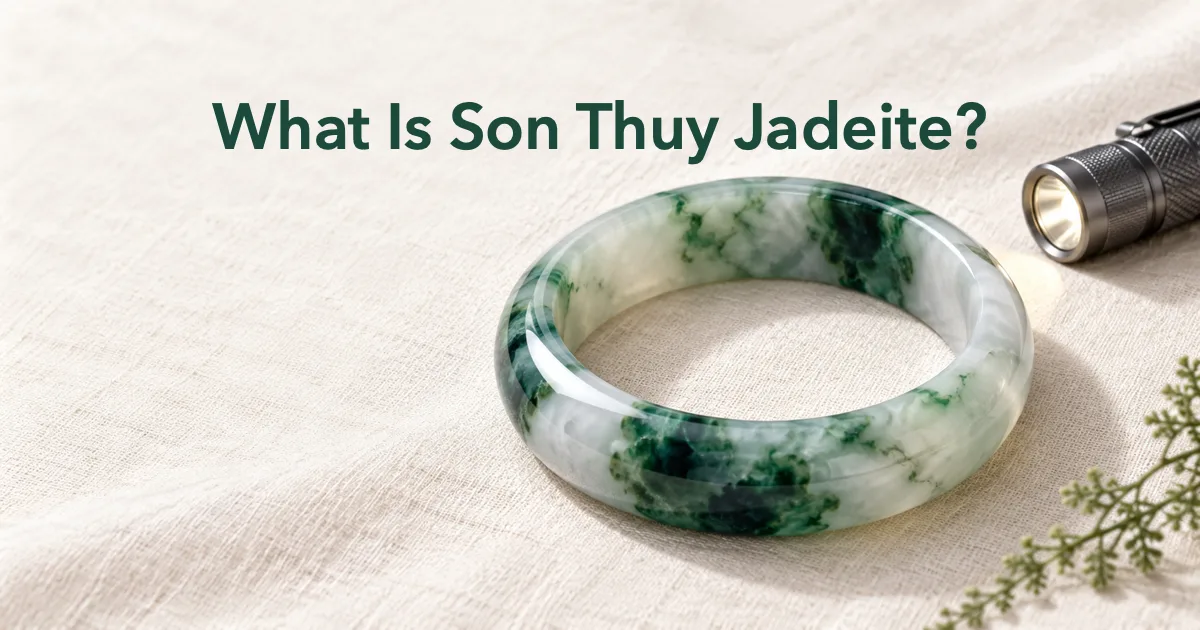
Son thuy (cẩm thạch sơn thủy, "mountain and water") is the Vietnamese market name for jadeite with dark green patches and veins on a pale ground, like an ink landscape painting. The closest Chinese term is 花青 (hua qing). It is a seller's name, not a lab grade, and sellers use it differently. Value depends first on whether the piece is natural Type A, then on the texture and translucency of the ground, the quality of the green, the pattern and cracks. Patchy green is often dyed, so check with a flashlight and get a certificate.
What is son thuy (landscape) jadeite?
Son thuy jadeite (Vietnamese cẩm thạch sơn thủy, "mountain and water") is the Vietnamese market name for jadeite with dark or deep green patches, veins and clouds on a lighter, often whitish ground, so that the piece looks like a Chinese ink-wash landscape painting. The green can be bright, deep or almost blackish, and it is spread unevenly: thick in one place, thin streaks in another, white or pale between.
Three points to know before anything else:
- It is a seller's name, not a grade. No gem lab writes "son thuy" on a certificate. A certificate names the material (jadeite) and whether it is natural (Type A) or treated. The word "son thuy" describes how the pattern looks.
- Usage varies between sellers. Most use it for the dark-patches-on-pale-ground look described here. Some use it for any bangle with uneven green, and a few use it for watery pieces with dark green wisps. Ask the seller what they mean and judge the piece, not the word.
- It says nothing about quality. Son thuy pieces range from cheap, coarse, cracked bangles to fine translucent pieces with striking patterns. Texture, translucency, cracks and treatment decide the value, as for any jadeite.
What is son thuy called in Chinese and in other markets?
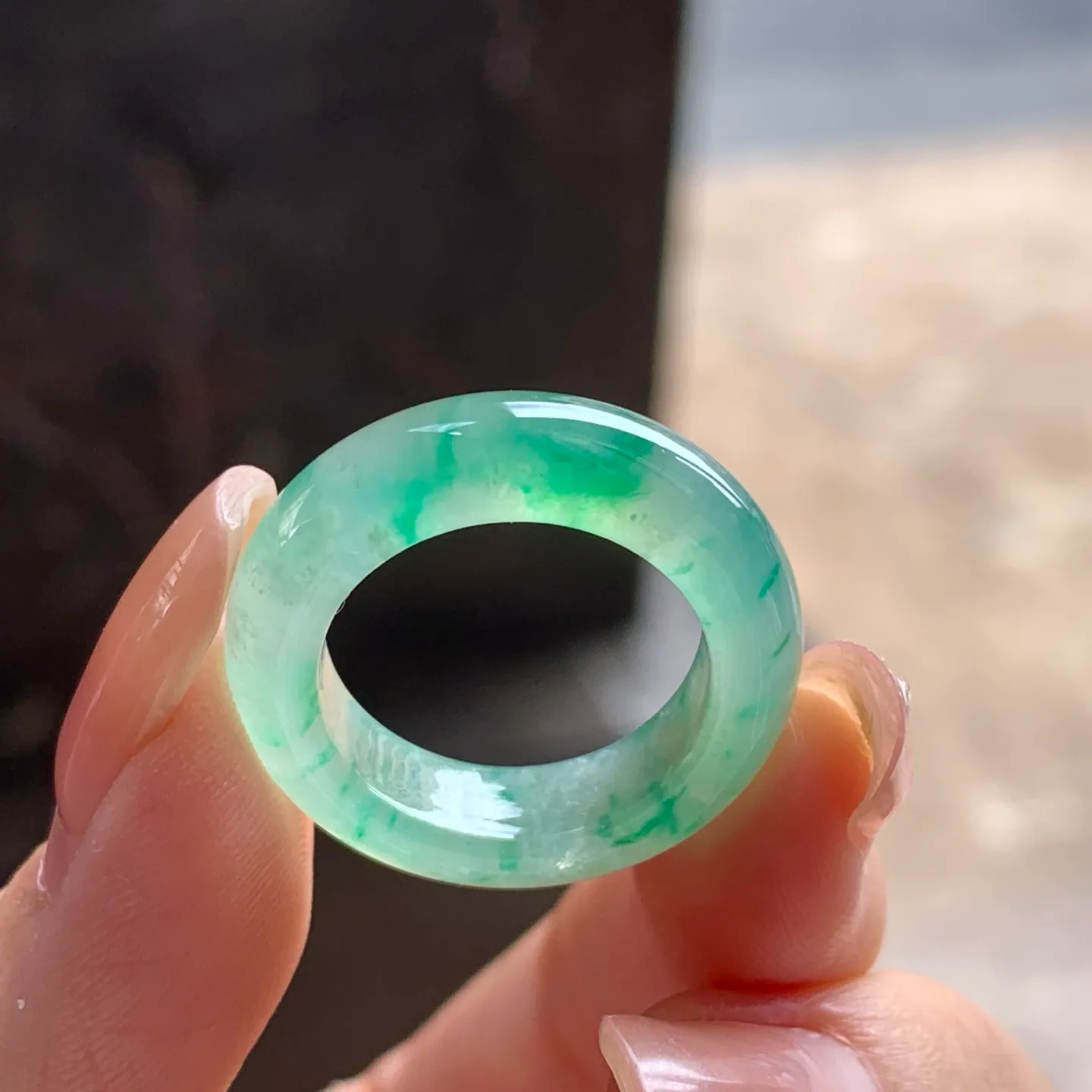
The closest Chinese trade term is 花青 (hua qing, "flowery green"): jadeite whose green is patchy, streaky or spotty rather than even. When the ground is clear or icy and the dark green floats inside it as wisps, the Chinese trade calls it 飘花 (floating flowers), or 墨绿飘花 when the wisps are very dark.
Do not confuse the material with a carving theme. 山水牌 or 山水挂件 ("landscape plaque", "landscape pendant") is a carved scene of mountains, water, trees and a boat. It can be carved from any jadeite, green or not.
| Name | Language | What it usually means |
|---|---|---|
| Cẩm thạch sơn thủy, ngọc sơn thủy | Vietnamese | Dark green patches and veins on a pale ground, like an ink landscape |
| 花青, 花青种 (hua qing) | Chinese | Uneven, patchy or streaky green; often on a coarser, less translucent ground |
| 飘花, 墨绿飘花 (floating flowers) | Chinese | Green or very dark green wisps inside a clear or icy ground |
| 山水牌, 山水挂件 (landscape plaque) | Chinese | A carved landscape scene; a design, not a material |
| Landscape jade, mountain-and-water jade | English listings | Usually a translation of sơn thủy or 山水; check which one |
| No standard term | Thai | Sellers describe it: หยกพม่าลายเขียวเข้ม, ลายภูเขา |
In Chinese grading, 花青 is often placed lower than even green because the ground of many hua qing pieces is coarse (豆种, "bean" texture). That is a rule of thumb, not a law: a hua qing or son thuy piece with a fine, translucent ground can be worth far more than a dull even green.
How is son thuy different from floating flowers, even green and black jadeite?
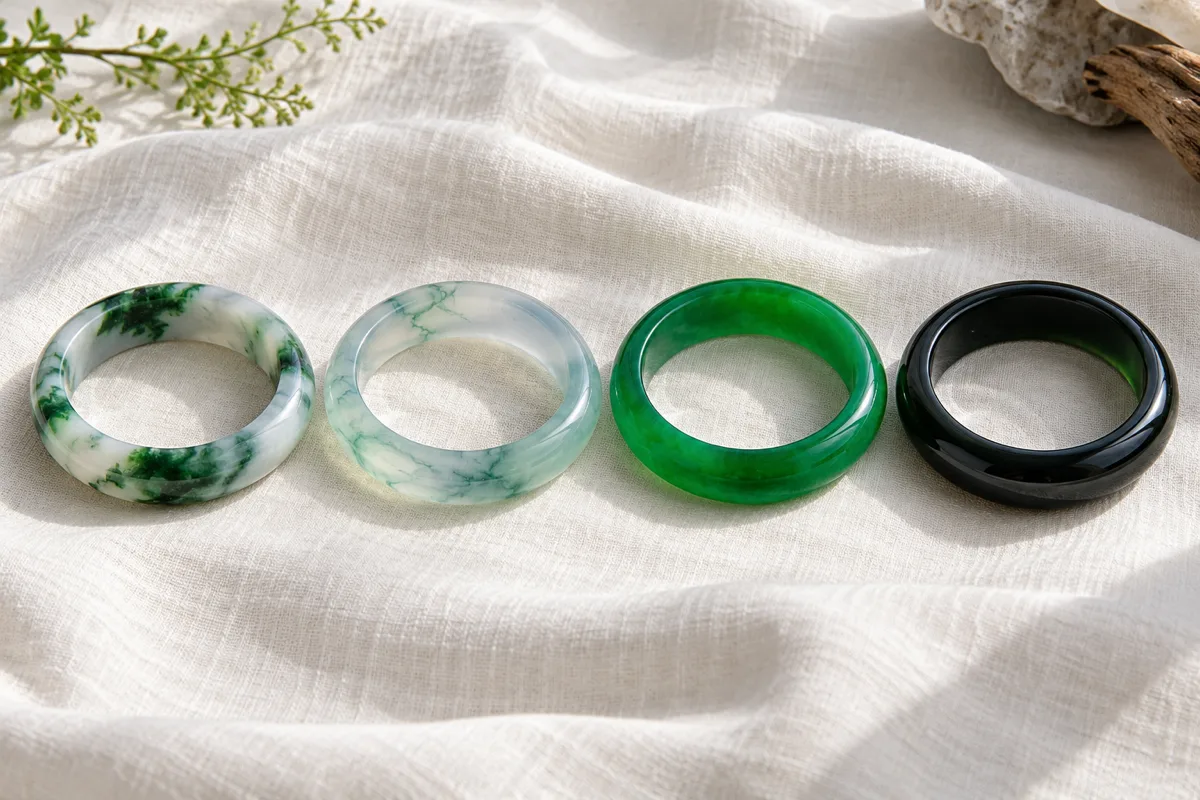
| Son thuy (花青) | Floating flowers (飘花) | Even green | Black jadeite (墨翠, gà đen) | |
|---|---|---|---|---|
| Ground | Pale, white or greyish; often semi-opaque | Clear or icy, translucent | Green throughout | Looks black in daylight |
| Green | Patches, veins and clouds, often dark | Thin wisps floating inside | Spread evenly | Very dark green, seen only when lit from behind |
| Contrast | Strong: dark on light | Soft: color in clear water | Little or none | None in daylight |
| Typical texture | From coarse to fine | Usually icy or better | From coarse to glassy | Usually fine |
- Floating flowers live inside a clear body, so the green seems to hang in water. In son thuy the pale ground is usually less translucent and the dark green sits more on and in the surface, like ink on paper. Pieces in between exist, and sellers may use either word. See icy jadeite and floating flowers.
- Even green covers the piece with one tone. Son thuy is the opposite: the beauty is in the contrast between green and white.
- Black jadeite (墨翠, Vietnamese mặc thúy or gà đen) looks black all over and glows green only under a flashlight. Some son thuy pieces have blackish-green patches, but the ground between them is light. See black jadeite.
- Dark patches (癣) are another thing again: grey, black or dull dark green mineral patches, often with a different texture. Many son thuy patterns contain some 癣. Bright, glowing dark green adds value; dull grey-black patches usually do not. See cotton, cracks and dark patches.
Can the son thuy pattern be dyed?
Yes, and patchy green is one of the most common looks for dyed jadeite. Many cheap "son thuy" bangles sold online and at markets are Type B+C: bleached with acid, filled with resin and dyed green. Dyed quartzite and glass are also sold with the same pattern.
Natural and dyed patches look different when you shine a small flashlight through the piece from behind:
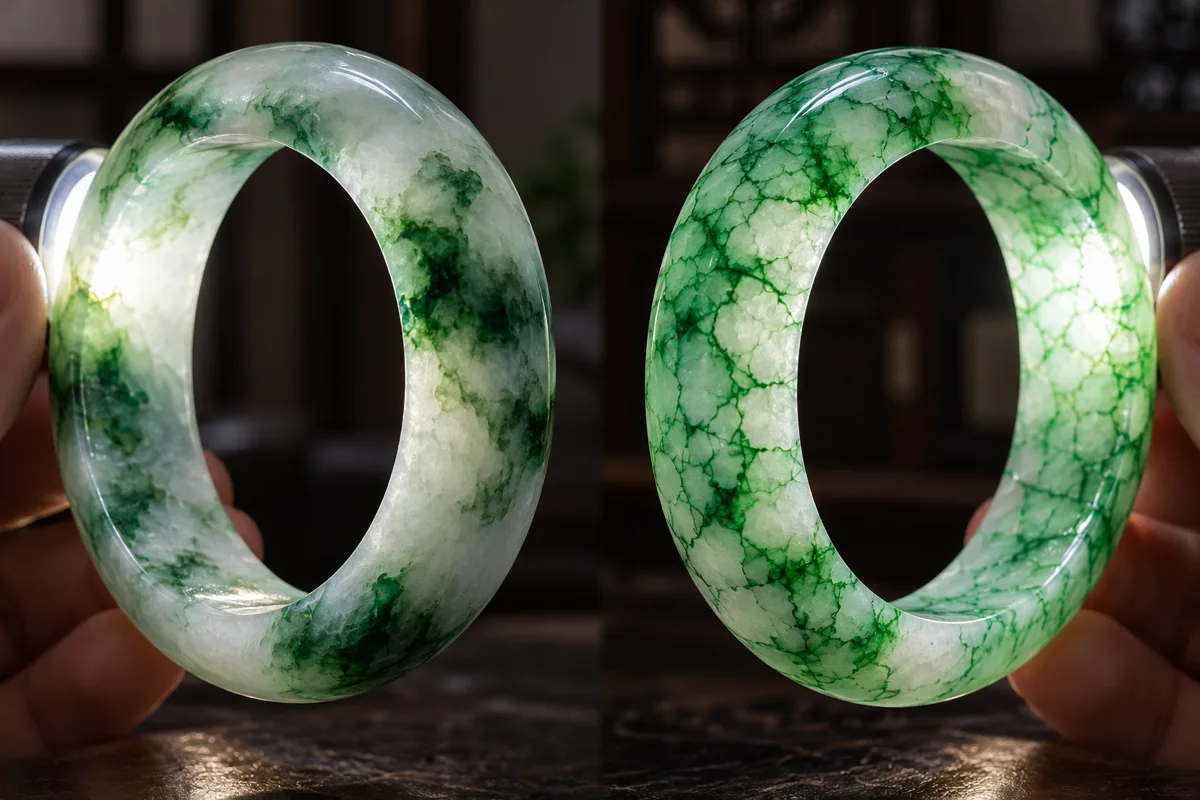
| Clue | Natural green | Dyed green |
|---|---|---|
| Shape under transmitted light | Patches, clouds and veins with soft edges that fade into white | Green gathered in a net of fine lines, with paler gaps in between |
| Color "roots" (色根) | Darker cores or threads where the color starts | None; color the same depth along each line |
| Where the color sits | Independent of cracks | Follows cracks, scratches and grain boundaries |
| Tone | Varies naturally inside one patch | Often a flat, slightly bluish or yellowish green |
| Surface | Smooth, glassy polish | Sometimes a web of fine pits or a waxy look (resin) |
None of these is proof on its own, and good dye work is hard to see by eye. A lab certificate stating natural jadeite, Type A, is the only reliable answer. See how to spot treated jadeite and jade look-alikes.
How is son thuy jadeite valued?
Look at the piece in this order:
- Natural or treated. A Type B or C piece is worth a small fraction of a natural one, however good the pattern looks.
- Texture and translucency of the ground. A fine, glowing, translucent ground lifts the whole piece. A dry, coarse, chalky ground keeps it cheap. Most of the price difference between son thuy pieces comes from here. See zhong, shui and se explained.
- Quality of the green. Lively, saturated green that glows when lit is worth more than dull grey-green or flat black-green.
- The pattern itself. Buyers pay for a pattern that reads like a painting: clear contrast, a natural flow, green that is well placed. On a bangle, a strong patch on the top face is valued more than one hidden on the inside.
- Cracks. Dark patches can hide cracks, and cracks often run through the green. Check every dark area with a flashlight. See cotton and cracks.
- Carving. In pendants and plaques, a good carver uses the dark green as part of the design, for example as mountains, pine trees or leaves. This is called 俏色, "clever color", and it raises value when the color stops exactly at the edge of the motif. See carving and craftsmanship.
For the wider picture, see what determines jadeite price.
What should I check in son thuy bangles, beads, rings and pendants?
| Piece | What works well | What to check |
|---|---|---|
| Bangle | A continuous pattern around the bangle, green on the outer face | Cracks inside dark patches; the inside of the bangle; whether the pattern repeats too regularly (a sign of dye) |
| Bead bracelet | Beads with similar ground and a mix of green and white | Each bead can be different; ask for a close-up of every bead. Dyed beads often have color concentrated around the drill hole. See jade bead bracelets |
| Ring (saddle or band) | A dark patch centred on the top | Thin rings crack easily along the green; check the band with a flashlight |
| Pendant or plaque | Green used as part of the carving | Whether gold or a closed setting covers part of the stone |
Which element (mệnh) does son thuy jadeite suit?
In Vietnamese tradition, buyers often ask "cẩm thạch sơn thủy hợp mệnh gì?". The folk answer follows the colors, not the name:
- Green is Wood (Mộc). A son thuy piece with mostly green is said to suit Wood people, and Fire people (Wood feeds Fire).
- Very dark, blackish green is placed by some advisers with Water (Thủy), which feeds Wood.
- The white ground is Metal (Kim). Since Metal cuts Wood, some advisers say Wood people should prefer pieces where the green dominates.
- Advisers usually go by the color that covers most of the piece.
These are folk beliefs and personal meaning, not properties of the stone, and advisers disagree. See jade and the five elements for the full tables.
How do I buy son thuy jadeite safely?
- Ask for photos and video in daylight, near a window over white paper, not under shop or live-stream lamps that make green look richer.
- Ask for a flashlight video moved slowly over each dark patch, front and back.
- Ask for dimensions, including the inner diameter of a bangle and the thickness. See how to choose a jadeite bangle size.
- Get a lab certificate stating jadeite, natural, Type A, and check it online. Expect it not to mention "son thuy". See how to verify a jadeite certificate.
- Be careful with very low prices. A large son thuy bangle with vivid green at a bargain price is most often dyed.
On JadeiteHub, listings use the seller's own photos, and some include video. Every sold piece is checked against its certificate before it ships, and if it does not match the description you get a full refund.
FAQ
What does son thuy mean in jade?
Son thuy (sơn thủy) is Vietnamese for "mountain and water", the Chinese term for landscape painting. In the jade trade it usually means jadeite with dark green patches and veins on a pale ground, so the piece looks like an ink landscape. It is a seller's name, not a grade.
Is son thuy jadeite Type A?
It can be either. Natural Type A son thuy exists, but patchy green is also one of the most common looks for dyed Type B+C jadeite. Only a lab certificate stating natural jadeite (Type A) settles it.
Is son thuy the same as floating flowers?
Not quite. Floating flowers (飘花) are green wisps inside a clear, icy body. Son thuy usually has a paler, less translucent ground with darker, stronger patches, like ink on paper. Pieces in between exist, and some sellers use both words.
Is son thuy jadeite valuable?
It depends on the piece. Most of the value comes from the ground: a fine, translucent ground with lively green and a beautiful pattern can be valuable, while a coarse, dry, cracked bangle is cheap whatever it is called.
Which element does son thuy jade suit?
In Vietnamese folk tradition, green is Wood (Mộc), so mostly green son thuy is said to suit Wood and Fire people; blackish green is sometimes counted as Water and the white ground as Metal. Advisers go by the color that covers most of the piece. These are beliefs, not properties of the stone.