Jade Cabbage in Taiwan: Museum Piece and Pendant Meaning
Updated
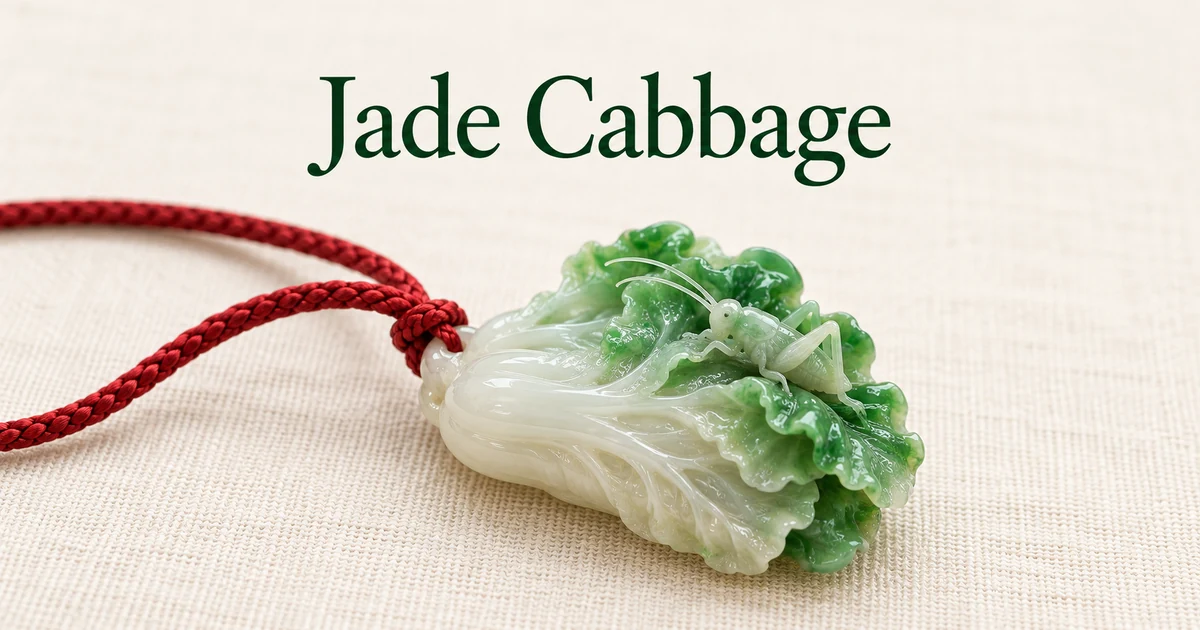
The Jadeite Cabbage (翠玉白菜) is a Qing dynasty carving in the National Palace Museum, Taipei, 18.7 × 9.1 × 5.07 cm, cut from one piece of white-and-green jadeite with a katydid and a locust on its leaves. It usually sits in Room 302 of the Northern Branch but sometimes travels (Prague, late 2025), so check npm.gov.tw before you go. It came from Consort Jin's Yonghe Palace in the Forbidden City; the dowry story is only surmised, and the Cixi tomb story is a legend. It has never been sold and has no price; legally it is a significant antiquity. As a pendant, the cabbage traditionally means wealth (白菜 sounds like 百财) and purity. Choose a white stalk with green at the leaf tips, deep polished folds, no cracks at the thin edges, and a Type A certificate.
What is the Jadeite Cabbage in Taipei?
The Jadeite Cabbage (翠玉白菜, cui yu bai cai) is a small Qing dynasty carving of a Chinese cabbage in the collection of the National Palace Museum in Taipei, Taiwan, and it is the museum's best-known object. According to the museum's own catalog text, published on Google Arts & Culture, it measures 18.7 cm long, 9.1 cm wide and 5.07 cm thick: about the size of an adult's hand. The carver is unknown.
It is carved from one piece of jadeite (翡翠), the jade mineral mined in Myanmar, that was partly white and partly green. The white part became the stalk and the green part became the leaves, so the colors of the finished cabbage are the stone's own, not added. Wikipedia's article, citing the museum, notes that the carver also used the stone's cracks and color patches as the veins of the stalk and leaves.
Two insects sit on the leaves. The museum identifies them as a katydid (螽斯, zhong si) and a locust (蝗虫, huang chong). They are carved so naturally that many visitors need a moment to spot them.
In everyday Chinese the piece is also called 翡翠白菜 (jadeite cabbage), and in English you will see "Jade Cabbage", "Jadeite Cabbage with Insects" and "Jade Cabbage of Taiwan". They all mean the same object.
Where is the Jadeite Cabbage now, and is it on display?
Its home is the Northern Branch of the National Palace Museum in Taipei (Shilin district), where it is usually shown in Room 302 of the main building. Taiwan's Central News Agency (CNA) reported in 2025 that this is the room where the museum displays it.
It does not stay there all the time:
| When | Where | Source |
|---|---|---|
| 2014 | Tokyo National Museum, Japan | CNA, CNN |
| From December 2015 | Southern Branch, Chiayi, for the branch's trial opening | Focus Taiwan |
| 11 September to 31 December 2025 | National Museum, Prague, Czech Republic: its first trip to Europe | CNA |
| Early 2026 | Back in Taipei after the Prague show | World Journal, February 2026 |
While it was away in 2025, CNA reported, the museum filled Room 302 with two other pieces from its "cabbage family": the museum owns three jadeite cabbages in all, including a smaller one with a mantis on the stem and a cabbage-shaped flower holder.
Before you go, check the National Palace Museum website (npm.gov.tw). The museum moves the cabbage between rooms and branches and lends it abroad from time to time, and it publishes these changes on its site. We could not confirm its location for any specific date in late 2026, so we do not give one here.
Where did the Jadeite Cabbage come from?
The museum's text says the carving was originally displayed in the Yonghe Palace (永和宫) in the Forbidden City in Beijing. That was the residence of Consort Jin (瑾妃), a consort of the Guangxu Emperor (reigned 1875 to 1908), who entered the palace in 1889.
That location is the root of the best-known story about it: that the cabbage was part of Consort Jin's dowry, a white stalk for purity and insects for many children. The museum itself only says that "some have surmised" this. Taiwan's World Journal reported in 2026 that the idea goes back to Na Zhiliang (那志良), a long-serving museum scholar, and that it has never been proven. So treat the dowry story as traditionally said, not documented.
The rest of the journey is better recorded. According to CNN's 2025 feature on the cabbage, it was found in the Forbidden City after the end of the Qing dynasty, set in a small enamel flowerpot as if it were growing; the palace collection was moved south in the 1930s to keep it out of Japanese hands, and after the Chinese Civil War crates of it were shipped to Taiwan. The museum opened at its present site in Taipei in 1965.
Was the jade cabbage found in Empress Dowager Cixi's tomb?
No evidence says so. This is a legend, though a widely retold one.
The story goes like this. A memoir called 爱月轩笔记 (Notes from the Aiyue Pavilion), attributed to Li Chengwu, a nephew of Cixi's chief eunuch Li Lianying, lists treasures said to have been placed in Cixi's coffin, and retellings say that list includes jadeite cabbages. Her tomb at the Eastern Qing Tombs was looted in 1928 by troops under the warlord Sun Dianying, and the loot was scattered. From there, the legend jumps to the claim that the Taipei cabbage is one of Cixi's lost tomb cabbages.
Why it does not hold up:
- The museum's own record places the Taipei cabbage in the Yonghe Palace, Consort Jin's residence, not in a tomb.
- Chinese press reports that quote the memoir do not even agree on whether it mentions a cabbage at all.
- The memoir is a later private account, not an official record, and the details of what was in the coffin cannot be checked.
It is a good story, and it is why Vietnamese search results often pair "ngọc cải thảo" with "Từ Hy thái hậu". But the Taipei cabbage and the Cixi tomb cabbage are best kept apart: one is a museum object with a known history, the other is a story.
Why is the Jadeite Cabbage so famous?
Three reasons come up again and again.
- It uses the stone's own colors. The carver put the white part of the stone where a cabbage is white (the stalk) and the green part where it is green (the leaf tips), and turned flaws into veins. The trade name for this skill is 因材施艺, "fit the design to the material", and the cabbage is the textbook example. For how carvers place color, see jadeite carving craftsmanship.
- It is a homely subject in a precious stone. Visitors expect dragons and emperors and find a vegetable, carved so it looks freshly picked. That surprise is easy to remember.
- The museum and the media made it a star. It is one of the museum's "three treasures", with the Meat-Shaped Stone and the Mao Gong Ding bronze. CNN reports that a 1968 stamp of it was printed 3.5 million times, and that one art historian, Wang Shao-chun, called its "popularity and its historical value" clearly "unproportional".
Some researchers also question the symbolism. CNN quotes the art historian Hsu Ya-hwei of National Taiwan University saying that historians have doubted both the dowry story and the idea that the insects stand for children. The meanings are still part of why people love it; they are simply not proven history.
How much is the Jadeite Cabbage worth?
It has no price. It has never been sold, it belongs to the state collection of the National Palace Museum, and it is protected under Taiwan's cultural heritage law, so there is no market value to quote. Any figure you see online is a guess.
One detail surprises many people: it is often called a "national treasure", but legally it is not one. Taiwan grades antiquities as national treasures (国宝), significant antiquities (重要古物) and general antiquities. Wikipedia, CNN and Taiwanese press reports on the Ministry of Culture's grading all say the Jadeite Cabbage is a significant antiquity; of the museum's "three treasures", only the Mao Gong Ding is a national treasure. Both grades are protected in the same way.
If you want to see what top jadeite actually sells for at auction, see the most expensive jade ever sold.
What does a jade cabbage pendant mean?
A jade cabbage pendant traditionally stands for wealth and a clean, honest life. These are traditional sayings, not promises; a pendant does not bring money or children.
| Meaning | Where it comes from | How sellers often say it |
|---|---|---|
| Wealth of every kind | 白菜 (bai cai, cabbage) sounds like 百财 (bai cai, "a hundred fortunes, meaning great wealth") | 百财聚来, "a hundred fortunes gather" |
| Purity and honesty | The white stalk and green leaves: 清清白白, "clean and clear" | Given to officials, students, brides |
| Many children | The katydid, after the Book of Songs poem 螽斯 that wishes a family many descendants | Given to newlyweds |
The wealth pun is the one you will hear most, which is why cabbages are a favorite gift for business owners and a common ornament on shop counters. The insect reading comes from the museum piece: a pendant with a small katydid or cricket on its leaves points straight back to it. For every common motif side by side, see jadeite pendant meanings; for the deeper background, see jade in Chinese culture.
Anyone can wear one. There is no rule for men or women, age or zodiac sign.
What styles of jade cabbage are there?
Cabbages are made as pendants for daily wear and as larger ornaments (摆件) for a desk or shop.
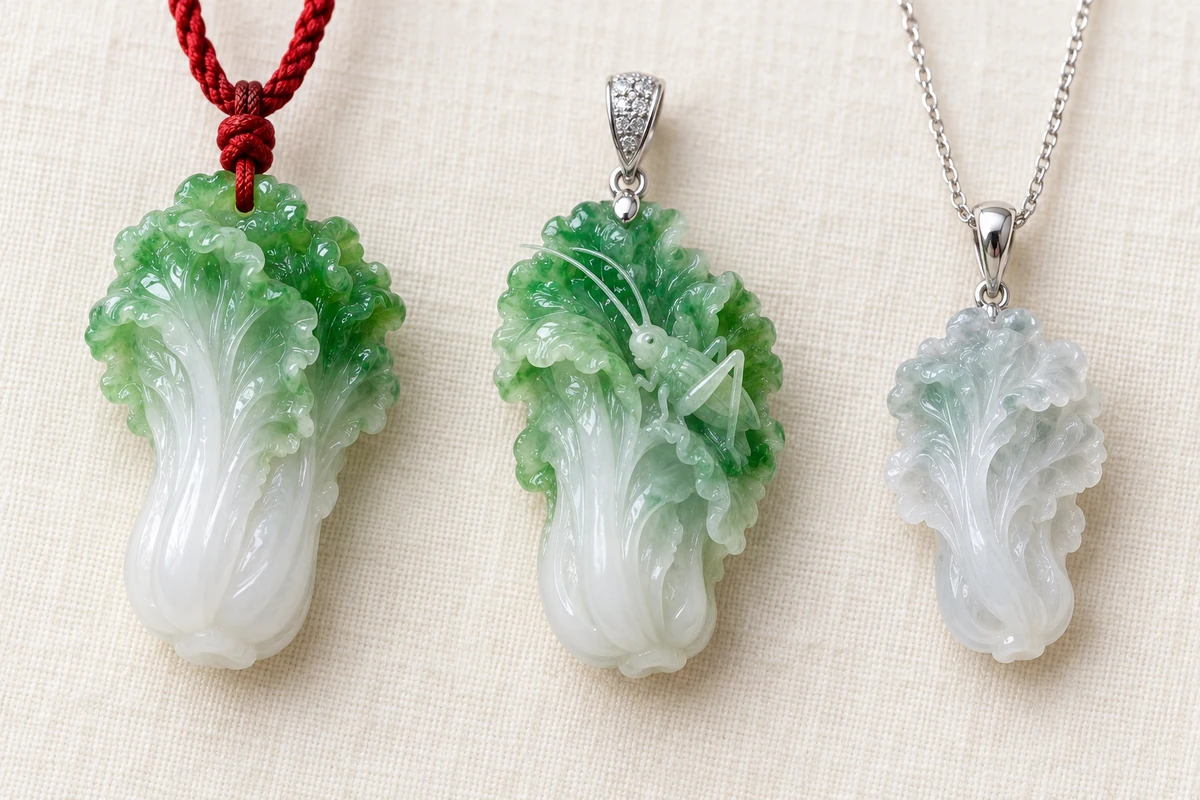
| Style | Chinese name | What it looks like | Notes |
|---|---|---|---|
| Plain cabbage pendant | 白菜挂件 | Stalk and leaves only, drilled at the stalk end | The classic; the stone does the work |
| Cabbage with insect | 螽斯白菜, 蝈蝈白菜 | A katydid or cricket on the leaves | The museum-style design; check the thin legs and feelers |
| Gold- or silver-set cabbage | 金镶白菜 | A metal cap and bail over the stalk end | Protects the stalk; suits a chain |
| Small cabbage charm | 小白菜 | A tiny cabbage on a bead bracelet or earring | Light, everyday |
| Cabbage ornament | 白菜摆件 | A larger cabbage on a wooden stand | For a desk, home or shop counter |
How do you choose a good jade cabbage pendant?
Start with how the color sits, then the carving, then cracks and treatment.
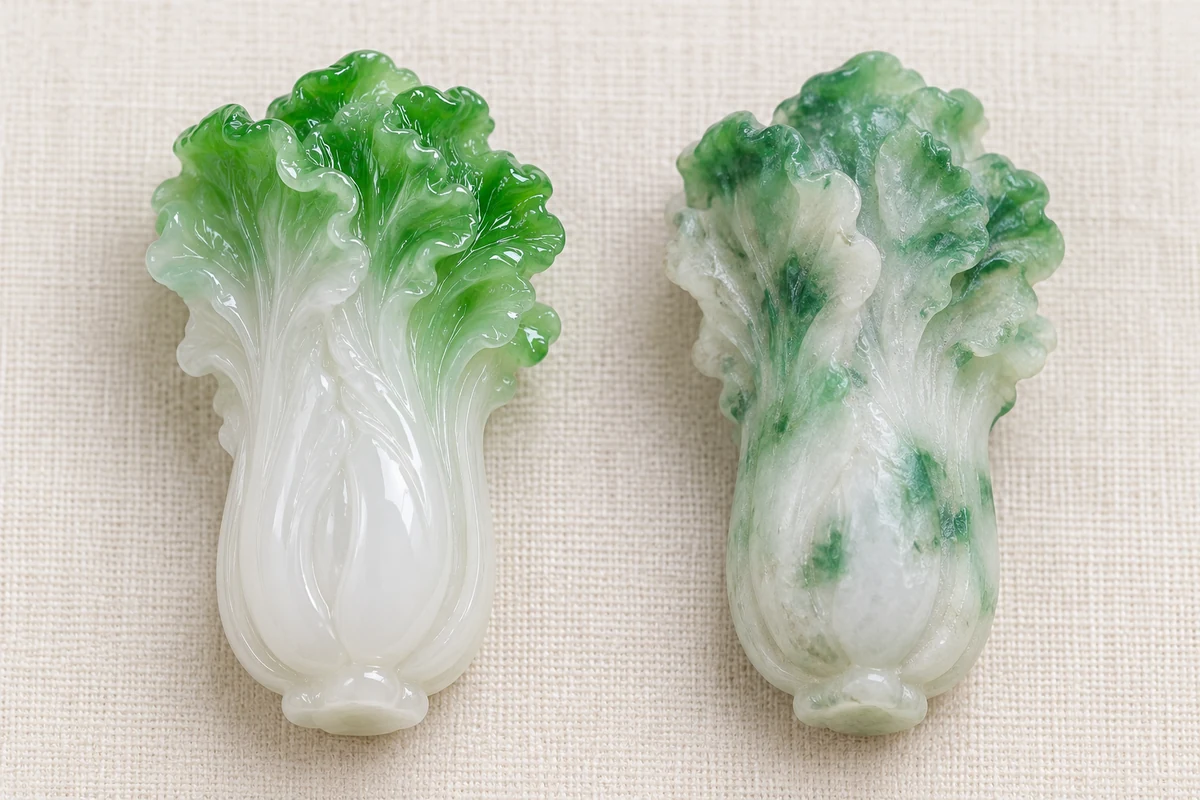
- Look at where the green is. Many buyers like a cabbage that echoes the museum piece, with a white or colorless stalk and green toward the leaves, but there is no fixed rule. What matters more is that the green looks fresh and the base is clean, without muddy grey patches. A clean white or icy base matters as much as the green; see white jadeite and jadeite colors.
- Check translucency. Hold it to daylight. On an icy base the thin leaves glow; on a coarse base they look chalky. For the grades, see jadeite texture, translucency and color.
- Judge the leaves. Good leaves are layered and curl naturally, the stalk is full and rounded, and the veins look like they grow from the stalk. Flat, stamped-looking leaves of one depth are usually quick machine work.
- Check the polish in the folds. The outer surfaces are easy to polish; the folds between leaves are not. Glassy folds mean time was spent; dull, rough folds show where it was saved, as in the right-hand cabbage above.
- Backlight the thin leaf edges. Leaf edges and an insect's legs are the thinnest parts. Shine a small flashlight through them and turn the piece slowly. Carvers sometimes turn a crack into a leaf vein, as the museum carver did, so look closely at every vein: a line that cuts the light sharply is a crack. See jadeite cotton and cracks.
- Be wary of very bright green at a low price. Buy natural Type A with a lab certificate, and check it: see how to spot treated jadeite and how to verify a jadeite certificate.
When buying online or from a livestream, ask for a video of the cabbage turned under a flashlight, both faces and a side view.
Gold or silver: how are jade cabbages set?
Many cabbages are simply drilled and hung on a cord; set ones usually have a cap and bail over the stalk end.
- 18K gold. Gold-set jadeite is mostly made in China in 18K (75%) gold. White gold keeps a white-and-green cabbage looking clean; yellow and rose gold suit warmer greens.
- 925 silver. Every silver setting sold on JadeiteHub is 925 sterling silver. It costs much less than gold, so more of the price goes into the stone, but it tarnishes and needs cleaning.
For a fuller comparison, see silver vs gold settings for jadeite.
How much does a jade cabbage pendant cost?
It depends first on the material (base, translucency and how much clean green there is), then on size, carving and setting, the same as any jadeite pendant; see what determines jadeite price.
JadeiteHub has no cabbage pieces for sale at the moment, so we cannot show you real listings and prices for this design, and we will not guess at a price range. For the pendants we do have, in other motifs, browse the JadeiteHub pendants. Two other motifs carry similar wishes: the jade gourd for fortune and the jade pea pod for blessings and children.
How do you care for a jade cabbage?
- Take it off for sport, heavy work and sleep. Thin leaf edges and carved insects are the parts most likely to chip.
- Wash it in lukewarm water with mild soap and dry it; a soft toothbrush clears the folds between the leaves, where dirt collects.
- Store it on its own, away from harder stones and other jewelry, and keep perfume and strong cleaners off it.
- Check the cap and bail now and then, and replace a cord as soon as it frays at the drill hole. For more, see how to care for jadeite.
On JadeiteHub we list only jadeite with a lab certificate. Every sold piece is checked against its certificate at our inspection center before it ships, and if it does not match its description you get a full refund.
FAQ
Where is the Jadeite Cabbage now?
Its home is the National Palace Museum's Northern Branch in Taipei, usually Room 302 of the main building. It sometimes moves to the Southern Branch in Chiayi or travels abroad (Prague, September to December 2025), so check npm.gov.tw before visiting.
What insects are on the Jadeite Cabbage?
A katydid (螽斯) and a locust (蝗虫), according to the National Palace Museum. Traditionally they are read as a wish for many children, though some researchers doubt that reading.
Was the Jadeite Cabbage Empress Dowager Cixi's?
No evidence says so. The museum places it in the Yonghe Palace, home of Consort Jin. The idea that it came from Cixi's looted tomb is a legend based on a later private memoir.
How much is the Jadeite Cabbage worth?
It has no price. It has never been sold and belongs to the National Palace Museum's state collection. Legally it is a significant antiquity, not a national treasure, but both are equally protected.
What does a jade cabbage pendant mean?
Traditionally wealth, because 白菜 (cabbage) sounds like 百财 (a hundred fortunes, meaning great wealth), and a clean, honest life, from the white stalk. A katydid on it adds a wish for many children. These are traditional sayings, not promises.
How do I choose a jade cabbage pendant?
Look for fresh green on a clean base, layered leaves, glassy polish in the folds, and no cracks at the thin edges under a flashlight. Buy natural Type A with a lab certificate.